The Sugar Bush

Here in Canada, early March is when we start to see the first signs of spring. Generally, the snow hasn’t melted back much, so nothing green is growing, and even if the days peek above freezing, the nights are cold and bitter. There will still be a few good snowstorms. So how is it different from the rest of winter? The maple sap starts running.

It’s less obvious in the cities, where less of the economy is based on maple syrup, but a lot of private land-owners still tap their trees — even if they only have one or two. If you’re not from around here, you may not recognize the silver buckets with lids attached to the maple trees. A single tree may not yield much (it takes 40L of sap to make 1L of syrup), but home-made maple syrup is enough of a lure even for city-dwellers. Restaurants and coffee shops suddenly start featuring maple-flavoured everything, in much the same way the pumpkin spice craze happens in October.


Left to right: my Nan, the host family’s child, me, and my little brother, at the sugar bush.

One of my fondest childhood memories is of visiting a sugar bush. I couldn’t tell you if we did it once or many times, or if I even seemed to appreciate it at the time — but it’s an event that stuck in my memory.

Now, a sugar bush is not the same thing as a sugar shack, which is a rough translation of the Québecois cabane à sucre. From page 10-11 of Anita Stewart’s Canada:

In the maple forests, les cabanes were the quarters for those harvesting the sap. There was a wood stove for cooking and keeping warm. With cast-iron frying pans, the traditional foods of les cabanes à sucre evolved to satisfy the enormous appetites. Fèves au lard (pork and beans), liberally sweetened with maple syrup, simmered on the stove-top. Potatoes were fire-roasted, and eggs were poached in syrup. There were thin crêpes made form sarrazin (buckwheat flour). Ham and bacon, both requiring little refrigeration, were fried, and omelettes were cooked to go with them. Syrup was poured over everything. And the workers didn’t just make syrup — they boiled down sugar, fermented partially boiled sap into maple vinegar and even made maple wine.

The tradition of visiting a cabane à sucre is still going strong to this day. Not surprising, as maple syrup is one of our biggest crops — according to Wikipedia, Canada produces about 80% of the world’s maple syrup, and the province of Québec accounts for 85% of that total. Here on the Ontario/Québec border, many of us cross the river to visit Quebécois cabanes, although there are a number of them on this side as well.


Left to right: my Nan, the host family’s child, me, my little brother, the host mother, my father, and my mother at the sugar bush.

However, there is a great deal of difference between a cabane à sucre and a sugar bush. I visited many cabanes as a child, mostly as school field trips, and they didn’t stick with me the same way my visit to the sugar bush did. A modern cabane (especially one open to serve the general public) is part of a commercial maple syrup enterprise. The building is large, snug, and well-appointed. Often you can pay a flat rate and eat as much maple syrup, pancakes, baked beans, breakfast sausages, and bacon as you can stuff into your face. They are used to having a huge number of people cycling through the place in the spring. If you are lucky, they will offer tours of the facilities.

A sugar bush, on the other hand, is just the actual forest with the tapped trees. There is no fancy building with extensive cooking facilities. If you’re invited to one of these, you have to know the owner. They are often on private land and are not part of a commercial enterprise. Any food cooked is over a campfire or on a camp stove. A sugar bush is rustic, outdoors, and, to a kid, much more interesting. I remember getting to wander the woods, peek into the sap collection buckets, build things out of sticks, and tromp through the mud and slush. Then it was time to eat fresh-cooked pancakes and bacon and sausages doused in fresh-made syrup. Then we explored some more. We came home that night filthy, stuffed to the gills, and absolutely exhausted. It was wonderful.


Thing 1, Thing 2 and I making tire in the quickly-melting snow.

Unfortunately, we no longer know anyone who owns a sugar bush, so bringing my kids to one is not an option. To my surprise, their schools have never arranged for a field trip to a cabane à sucre, so I think I will have to take them to one sometime soon. But with the snow on the weekend (hopefully the last one of the season) I was able to at least make tire with them this year.

Tire (from the French word le tire meaning taffy pull) is pronounced pronounced like “teer”, not like the rubber things you put on wheels. It is the absolute simplest way of making maple candy. Basically, you boil the syrup, then pour it over clean snow. (Full instructions at TheKitchn.com.) Now, I don’t actually own a candy thermometer, so I had to straddle the line between “not hot enough” and “burnt”. I think I came down a little bit too much on the “not hot enough” side, so the tire didn’t end up as solid as I’d like. Also, the day had warmed up a bit and the snow I’d set out plates for the night before was more slush than anything else. The kids didn’t care. It was still maple syrup deliciousness.


Thing 2 holding her tire.

It’s not necessary to use a wooden craft stick to eat the tire, but it’s much less messy that way. Just roll the candy around the stick when it’s still a little bit warm, and ta-daa! Instant lollipop. Oh, and you can totally used shaved or crushed ice if you don’t have clean snow. The fresh snow part is tradition, but it’s not 100% necessary.

Moncton Market

Spring has been exceptionally slow coming around these parts this year; we had a snowstorm last Friday, and the forecast is for more snow this coming Friday. Daytime temperatures have been just above freezing, while at night it has been dipping just below zero, so our snowbanks aren’t melting back very quickly. And it’s only a few days until the beginning of April!


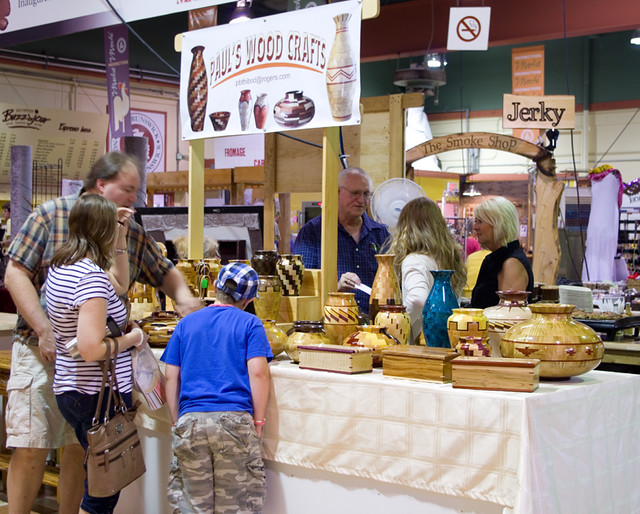
A handicraft booth set up outside the Moncton Market building; there are many tables outdoors when the weather is nice.

Despite the weather, it’s technically spring, and spring to me means the start of the farmers’ market season. Technically it’s a little early for that; we’re not getting fresh produce for a little while yet, unless it’s from greenhouses. And yet I find myself thinking about all the great markets I’ve been to, and yearning for a chance to visit them again.


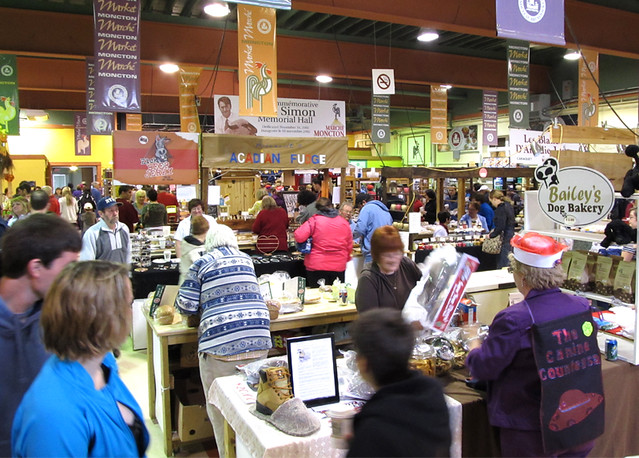
The main hall (Con Simon Memorial Hall) on an unseasonably-cool summer day.

One of my favourite markets to visit while on vacation is the Moncton Market in Moncton, New Brunswick. We seem to end up there on at least one weekend every time we visit the city. It’s not specifically a farmers’ market, although it does have a large selection of fresh local produce (when in season), as well as deli and butcher booths. There is also a food court and a huge number of handicrafts for sale.


Main hall.

The Moncton Market runs all year long, and actually is set up in its own proprietary building that was built in 1995 (although this market has existed, in one form or another, since the late 1800’s). Saturday is market day, but the food court is open all week long for lunch. Due to its downtown location and proximity to office buildings, particularly government offices, there is a brisk lunch business.


Main hall.

In addition to the main hall, there is a second, later-built hall (Festival Place) and a bay area, all of which are packed with vendors and customers on market day. Festival Place is sometimes rented out for other events on non-market days. There is also a culinary center on the premises, although I’ve never seen it in use. Every time I’ve been there, it has been used as a seating area for the food court.


Accordion player in the main hall.


Maple syrup and maple candy are pretty much prerequisites for any Canadian market.

There is often live entertainment throughout the market. There may be a single busker in the main hall, a duo in the secondary hall, and an entire ensemble on the stage outside — so there’s always entertainment. Thing 2 could happily spend her entire trip to the market sucking on a maple lollipop while she watches the performers. Thing 1, on the other hand, would rather hunt down a gourmet cupcake seller. Me, I’m on the lookout for fresh, local food to bring home for dinner.

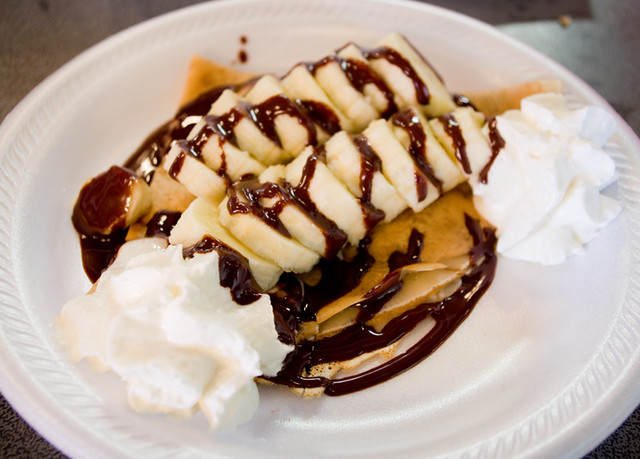
Of course, part of the fun is to pick up some breakfast or lunch at the market while you are there. I am partial to the fresh-cooked crepes and waffles; the lineup is always long, but the food is cooked fresh to order, and the delicious portions are substantial.


Fruit-covered crepe drizzled with chocolate hazelnut butter, raspberry syrup, and whipped cream. Photo by my mother.


Classic crepe with banana, chocolate hazelnut butter, and whipped cream.


Waffle with berries, apples with cinnamon-sugar, and whipped cream.

Around here, the winter (indoor) version of the Lansdowne Park Ottawa Farmers’ Market runs on Sundays from January 8th to April 30, from 10:00am to 3:00pm, in the Aberdeen Pavilion. There’s nothing specifically stated on their website, but the outdoor summer market usually starts sometime in May. The Cumberland Farmers’ Market has their Spring Market on Saturday April 8th from 9:00am to 3:00, but their main season doesn’t start until mid-June.

I can’t wait for summer market season to start again. Come on, Ottawa… Thaw!

Recycled Crayons Tutorial

Back in Girl Guides, we recycled our crayons by melting them in the microwave or in a double boiler, then pouring the different colours in layers into muffin tins (waiting for the wax to cool a bit between layers so they didn’t mix). I wanted to do something a little simpler than that with my kids yesterday — since they are younger than I was when first did this craft, I wanted a process that involved less handling of molten wax. However, this is still an activity that is done with kids, as opposed to setting them up and letting them go.

Recycled Crayons

Supplies Needed:
– old crayons
– molded cookie pans OR silicon molds rated for use in an oven OR muffin tins
– flat cookie pans
– utility knife
– large, heavy knife OR clear zipper bag and hammer
– cutting board

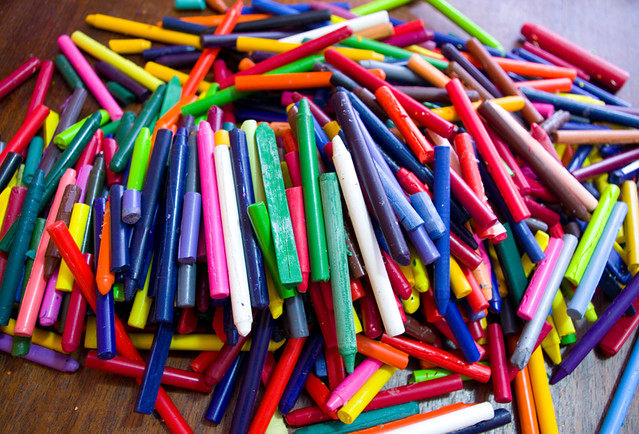
1. Sort through the kids’ crayons and separate out the old, broken ones, along with the ones that just don’t colour well.

2. Remove the paper wrappers from the crayons. The labels can be peeled off with your fingernails. However, the quickest way is to run the blade of a utility knife lightly down the paper to slit it, then peel it off. When I was doing it with my kids, I would cut the paper, and they would take it off.

3. Sort the crayons by colour.

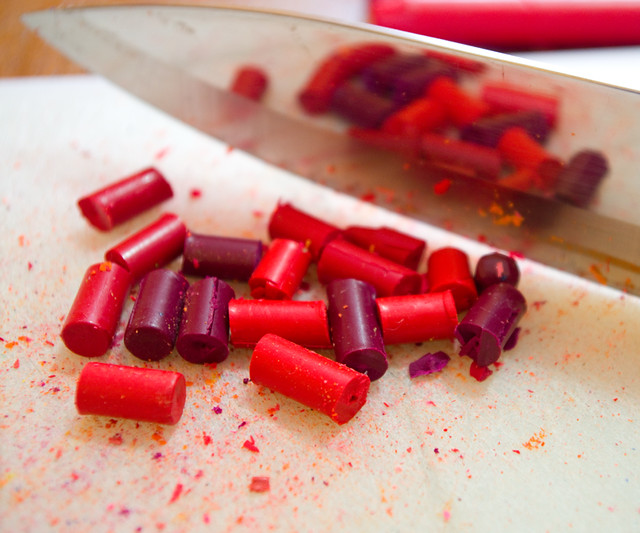
4. Protect the work surface with a cutting board, then use the large knife to chop up the crayons into chunks that are approximately 1cm (0.4″) long. Sharp knives should be handled by an adult. Alternately, put each colour of crayon into a clear zipper bag, seal the bag, and smash the crayons into large chunks with a hammer. This may damage the surface underneath and will be noisy, so I suggest working on a concrete surface with a cutting board over top, and using ear protection.

5. Fill the molded cookie pans or silicon molds or muffin tins with the chunks of crayon. The molds should be almost overflowing, as the air pockets between crayon chunks will be filled as they melt. To create colour-coordinated crayons, fill each compartment with different shades of the same colour. To create more contrast, add chunks of coordinating colours. Be careful not to mix too many colours, though, as the colours will mix and they may turn an unlovely brown.

6. Preheat the oven to 200°F (93°C) (the oven temperature needs to be low so that the wax doesn’t catch fire). Put the crayon-filled molds on top of the flat cookie pans for support; this is especially important if using silicone molds, which are flexible. Anything to do with the oven should be done by an adult.

7. Bake until crayon chunks are thoroughly melted, 15 to 30 minutes, checking every 5 minutes after first 15 minutes is up to see if there are still any lumps. Remove trays carefully from oven, being careful not to spill the wax.

8. Cool the recycled crayons thoroughly before removing them from the molds. To make removing them easier, place them in the freezer (or anywhere outside in winter in Canada, so long as it’s protected from precipitation) until thoroughly chilled. Wax shrinks when it gets cold, so it will pull away from the sides of the mold and slide out more easily.

When I made these candles, I used three different kinds of molds:

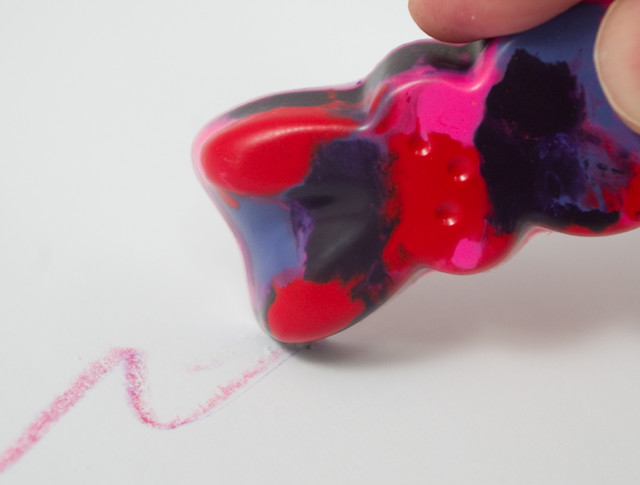
– metal, nonstick Wilton PEEPS Bunny Shaped Cookie Pans ($3.00 each at the dollar store), which released easily
– a silicone Wilton PEEPS Chicks and Bunnies Treat Mold ($4.00 each at the dollar store), which released with a little more difficulty, but cleanly
– a silicone flower-shaped IKEA PLASTIS Ice Cube Tray ($1.99 at IKEA), which stuck to the wax, obscured detail, and were very difficult to remove

All in all, I much preferred the metal pans to the silicone versions.

We packaged these crayons up into little spring-themed bags and put them aside until the week before Easter to give out at school. Of course, we had to leave a few out for the kids to colour with right away, too.

Booboo Bunnies and Chicks Tutorial

It’s day two of March Break, and it’s still much too cold for this time of year. That means more crafts with the kiddos! Today’s craft was booboo bunnies and chicks, for which I have created a brief tutorial. They’re really very simple.

You may be wondering why are they called “booboo” animals. Well, it’s because the hole in the back of the animals caused by a loop in the fabric makes a great place to tuck an ice cube. The ice cube can then be applied to a child’s booboo without it getting their hands cold, and without it dripping all over the place. As an added bonus, the cuteness of the animal distracts the child from their injury. But don’t think that this is their only use! The hole in the back makes for a great place to stash an Easter candy; I’ve seen them made with beach towels so that one of those jumbo Kinder Eggs can fit inside. I’ve also seen them used as a creative way to present washcloths at a baby shower.

Booboo Bunny

Supplies Needed:
– one facecloth or dish cloth (without a pattern is best)
– 12″ of thin ribbon
– one pink pompom
– one white pompom
– two small googly eyes (with button shanks if you plan to sew them on)
– glue gun and glue OR needle and coordinating thread
– sharp scissors

1. Trim tags off of the cloth, if there are any.

2. Starting at one corner, roll the cloth diagonally until you have a tube.

3. Keeping the tube rolled tightly, fold it in half.


Top view.


Side view.

4. Keeping the tube rolled tightly, fold the open ends of the tube backwards. Secure by tying the ribbon tightly around the cloth, about 2/3 of the way along.

5. Tie the ribbon into a bow. Trim the ends with the scissors.

6. Using the hot glue gun, stick the two halves of the face securely together (otherwise it will look like a bum). Glue the eyes, nose, and tail to the bunny. Alternatively, sew the face together, and sew on the eyes, nose and tail. Sewing is the preferred method if you plan on using the cloth for other purposes at a later date.


Bunnicula Booboo Bunny

Don’t forget, booboo bunnies can be any colour of the rainbow! I just made white ones because that is the easiest colour of face cloth to find (and the cheapest). Don’t be afraid to experiment with decorating the bunnies, either. Above I added some glued-on felt “fangs” and used red googly eyes to create a “Bunnicula”, after a creature from a favourite childhood book. Be creative!

Booboo Chick

Supplies Needed:
– one facecloth or dish cloth (without a pattern is best)
– 12″ of thin ribbon
– scraps of yellow felt
– two small googly eyes (with button shanks if you plan to sew them on)
– glue gun and glue OR needle and coordinating thread
– sharp scissors

1. to 3. Follow steps 1-3 of the Booboo Bunny tutorial.

4. Instead of folding the cloth roll back on itself, fold it to either side, creating an “M” shape. Secure by tying the ribbon tightly around the cloth, about 2/3 of the way up.

5. Cut out scraps of felt for the beak and feet, proportionate to the size of the cloth that you are using.

6. Glue both sides of the head together, then glue on the felt pieces and googly eyes. Alternatively, sew the face together, and sew on the eyes, beak, and feet.

Once again, be creative! A chick easily turns into a penguin if you use a black cloth.

Bunnies and chicks! Now you’re all set for spring.