Mr. Ubbink’s Crepes Recipe

Crepes are one of the first thing that I learned how to cook without the need for parental supervision. I used to go visit my elementary school best friend almost every second weekend (she’d be over at my house if I wasn’t over at hers), and her father taught us his technique. Crepes do take a bit of practice, and you do have to read the recipe properly — there was one memorable occasion when we read “1/4 teaspoon salt” as “1/4 cup salt”, creating an end product that was highly inedible.


Replica crepes in a Montreal shop window (2005)

By the time I hit high school, it became a tradition to make crepes in the morning whenever I hosted sleepovers. I would make crepes up in bulk when I had a birthday party in order to feed all of my guests breakfast. My friends came to expect it; it was now a tradition!

I still use Mr. Ubbink’s recipe whenever I make crepes, which isn’t as often as when I was a kid, although I do still break them out for special occasions. The recipe is both dependable and flexible, although as with most crepes, flipping them takes a bit of practice. Don’t be discouraged if you make “scrambled” crepes the first few times, since they taste just fine so long as you cook them thoroughly, and they can still be topped as you wish.


Savoury crepe filled with cheddar cheese, Monterrey Jack cheese, and summer sausage; topped with a sunny side up egg and chopped chives

Mr. Ubbink’s Crepes
Yields 4-5 large crepes

In a large bowl, mix together:
1 cup all-purpose flour
1/4 tsp salt
Add to bowl:
1 large egg
1 1/2 cups milk
1 tsp vanilla
Mix all ingredients together with a whisk or a hand mixer. Blend until batter is smooth.

Apply a small amount of cooking spray, butter, or margarine to a large non-stick frying pan. Preheat the pan to medium-high. Pour 1 large ladle-full of crepe mixture into the pan, tilting to spread the batter into a circle that covers the bottom of the pan. Fry until the crepe has darkened in colour and is just starting to show spots of golden brown. Carefully flip the crepe and fry the other side until spots of golden start to appear on that side as well. Repeat until all the batter is gone. This type of crepe is best rolled into a tube, sometimes with fillings such as fresh fruit inside the tube.

If you are making a crepe inside of which you wish to have a melted ingredient such as cheese or chocolate chips, the technique is slightly different (it’s actually a lot like cooking and omelet). Cook the first side, flip, and then add the filling to half of the cooked side. Fold the crepe in half over the filling. Cook until the bottom is slightly golden, flip carefully so that the filling doesn’t fall out, and cook the last side until it is starting to turn golden and the filling has melted. You may need to turn the burner down so that the filled crepe can cook more slowly, allowing the filling to melt without burning the batter.


Sweet crepe filled with fruit salad (Asian pears, strawberries, blueberries, bananas, and grapes) and maple syrup, topped with whipped cream.

Suggested toppings/fillings:

Sweet
berries, fresh cut fruit, drained canned fruit, jam, chocolate chips, syrup, whipped cream, ice cream, nut butter, fruit butter, icing/brown/granulated sugar, marshmallows and chocolate chips, caramel sauce, custard, chopped nuts, apples and cinnamon sugar

Savoury
deli meat, cooked chopped roast meat, fish, plain steamed vegetables, steamed vegetables with a cream sauce, asparagus and cream cheese, salmon and cream cheese and capers, shredded cheese, bacon and eggs, poached eggs and salsa, spinach and feta, avocado and fried mushrooms, canned tuna and mayonnaise and lettuce

Basically, just about anything you could bake into a cookie or put in a sandwich is good in/on a crepe! (They can also be a great vehicle for using up leftovers.)

Guinness Yeast Bread Recipe

March 17th is Saint Patrick’s Day, which to be honest isn’t observed very seriously in this neck of the woods. However, since I do have some Irish blood in me, I thought it might be nice to cook up a dinner that reflects (some of) my roots. Irish stew sounded great, since it’s more or less my default stew anyway. To go along with dinner, I wanted to make some Guinness bread. I searched my recipe books and online to find a recipe, and what I found was leavened with baking soda. Although I know that this is traditional, I’m not a big fan of the flavour of baking soda, so I turned my hand to creating my own, yeast-leavened recipe.

This is a very dark bread, more akin to what Maritimers call brown bread (coloured by molasses) than what is called brown bread on the Prairies (whole wheat bread). The Guinness adds a natural yeasty flavour and a rich colour. The recipe includes oatmeal, so these loaves are very dense and filling. This bread is delicious served with cheese, sausages, sliced lunch meats, and hearty stews.

Guinness Yeast Bread
Yields 2 loaves

In a large bowl, mix together:
1 cup (125g) large-flake oatmeal
1 1/2 cups 2% milk
Cover and leave to soak for 4 hours in the fridge.
Add to the bowl:
one 500mL can of Guinness beer, warmed to between 120ºF to 130ºF (49ºC to 54ºC)
2 Tbsp cooking molasses
In a second bowl, stir together:
4.5 cups (600g) all purpose whole wheat flour
10g quick-rise instant yeast
1 tsp salt
Add dry ingredients to wet ingredients. Stir together until well combined.
Gradually incorporate:
4 1/2 cups (500g) bread flour

Turn out dough onto a lightly floured surface and knead by hand for about 8 minutes. When kneaded, the dough should be smooth and elastic, but not sticky. If dough is sticky, add bread flour 1 Tbsp at a time until stickiness abates.

Oil a large mixing bowl. Form the dough into a ball and place it in the bowl. Cover the bowl with a clean, damp tea towel. Place the bowl in a warm, dry area with no drafts. Allow the dough to rise until double, about 1 hour.

Punch down the dough. Grease two 9.5″x5.5″ loaf tins. Divide the dough into two equal-sized portions. Cover the pans with a clean, damp tea towel and allow to rise again until double, about 1 hour.

Lightly spritz the loaves with:
water
Dust the loaves with:
1 Tbsp large-flake oatmeal

Preheat oven to 450ºF (232ºC). Bake loaves for 10 minutes. Turn heat down to 350ºF (177ºC) and bake for about 30 to 40 minutes more. Check to see if the bread is done by removing a loaf from the pan and tapping it on the bottom. When cooked through, it should make a hollow sound. Remove both loaves from the pans immediately and place them on a wire cooling rack.

Guinness yeast bread can be eaten immediately, but it keeps well for up to a week if wrapped in a clean plastic bag. Make sure they are wrapped up only after totally cool, or they will go soggy.

Nan’s Pan Rolls Recipe

I’ve mentioned before that I regret not asking my grandmother for copies of her recipes; honestly, I felt like that indomitable old lady was too tough to die, until the very day that she passed away. As I grew up, I did less and less cooking with her — she would cook for me or I for her, but rarely did we cook together anymore. It became all that much more difficult once my attention (and hers as well) was focused on my children. I didn’t realize that it would be something I missed so much.


White pan rolls straight out of the oven.

In Nan’s memory, I’ve been trying to recreate her famous pan roll recipe. Whenever we were in town, or she was visiting us, Nan was always the one to cook Sunday dinner (which was always understood to mean “roast beef dinner”). Her fresh rolls were an integral part of that meal, and came to be considered by all the family as the proper accompaniment. She would start the dough and leave it to rise before she left for church in the morning, then punch it down and form the rolls immediately upon returning home. It was a Sunday ritual.


White flour pan rolls after the second rise.

To me, pan rolls should be squished as tightly as possible into their pan so that, when they rise, they rise upward and become tall and skinny once they are pulled away from their fellows. They should be yeasty, but not too fluffy, and fairly filling. They should be golden on top, crispy around the edges, and soft (but not raw) in the middle. With this recipe, I think I’ve made them as close to what Nan made as I possibly can.


White pan rolls after the second rise.

Nan’s Pan Rolls
Yields 35 rolls

In a large bowl, mix together:
4 1/2 cups (500g) all-purpose flour*
2 packages (14g) quick-rise instant yeast
2 1/2 tsp salt
Add to the dry ingredients:
3 cups very warm water (120ºF to 130ºF)
2 large eggs
1/4 cup (4 Tbsp) lard, melted
Stir by hand until mixture is more-or-less smooth.
Gradually mix in:
4 1/2 cups (500g) all-purpose flour
If the dough starts to become tough to knead, do not add any more flour. When flour is fully incorporated, dough should be smooth and elastic, but not sticky. If dough is sticky, add all-purpose flour 1 Tbsp at a time until stickiness abates.


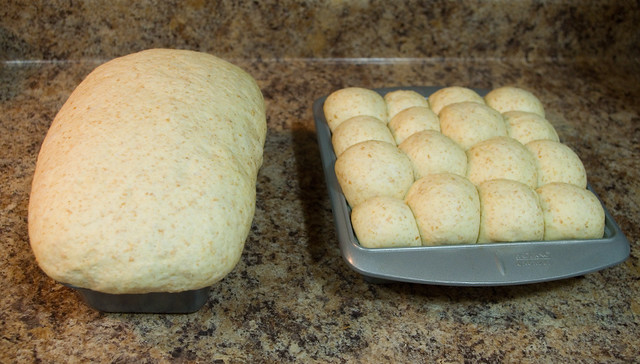
Whole wheat dough divided in half and made half into pan rolls, half into a loaf of bread, after the second rise.

Turn out dough onto a lightly floured surface and knead by hand for about 8 minutes. Oil a large mixing bowl. Form the dough into a ball and place it in the bowl. Cover the bowl with a clean, damp tea towel. Place the bowl in a warm, dry area with no drafts. Allow the dough to rise until double, about 1 hour.

Punch down the dough. Grease a 9″x13″ cake pan. Divide the dough into 35 approximately equal-sized portions. Form the portions into balls and place them in lines closely together to fill up the cake pan.** Cover the pan with a clean, damp tea towel and allow to rise again until double, about 1 hour.


Whole wheat loaf after baking.

Preheat your oven to 450ºF (232ºC). Bake rolls for 10 minutes. Turn heat down to 350ºF (177ºC) and bake for about 20 minutes more. Check to see if they are done by removing the rolls all in one piece from the pan and tapping them on the bottom. When cooked through, they should make a hollow sound. Remove the rolls from the pan immediately and place them on a wire cooling rack.

To create the glossy shine on top of the rolls, use waxed paper to pick up:
1/2 to 1 Tbsp cold butter
Rub the tops of the rolls with the butter, keeping the waxed paper between the butter and your hand.

Nan’s pan rolls taste best when served immediately; to keep them at their freshest, pull them apart only when they are about to be eaten. These rolls will keep for three or four days if wrapped in a clean plastic bag. Make sure they are wrapped up only after totally cool, or they will go soggy.


Whole wheat pan rolls being pulled apart by my temporarily-tattooed Thing 1.

*For whole wheat bread, replace the first 4 1/2 cups of all-purpose flour with all-purpose whole wheat flour.

**Alternately, this recipe makes two good-sized loaves of bread. I used a slightly too-small loaf pan to create a “mushroom-top” loaf; if you want your loaf to have smoother sides, use a pan that is at least 9.5″x5.5″. You could also make three smaller loaves in smaller loaf pans instead of two big ones. Allow the loaves to have a second rise as per pan roll instructions. Be careful of cooking times if you change the shape of the end product. Bread loaves will take 10min at 450ºF (232ºC), and then they must be turned down to 350ºF (177ºC). However, how long they stay in at 350ºF depends on the size of loaves you make. When in doubt, bake for less time and check often to see if they’re done.

Dad’s Biscuits (Baking Soda Biscuits) Recipe

One of the things I loved best as a child when coming in on a cold, blustery day was opening the door to the house and having the smell of fresh-baked biscuits wash over me. To me the smell goes along with the orange glow of incandescent lights shining through a window over a dark, snow-covered landscape. It is the scent of hanging up your sled or skates, taking off your snowsuit, and coming in for dinner.

Dad’s biscuits are one of the dishes for which he is best known; childhood friends of mine fondly remember them and often requested his recipe when they moved away from home. The biscuits were more of a winter dish, not because they are heavy, but because firing up the oven on a hot day was tantamount to sacrilege. However, my Nan (Dad’s mom) occasionally used these biscuits instead of cake when she made us a fresh berry trifle during summer visits.

My mother actually wrote down this recipe in the back of her Purity Cookbook (my second-favourite cookbook, after the Joy of Cooking). She copied it from my Nan’s recipe, who had in turn gotten it from my grandfather. Unfortunately, he died long before I was born, so I can’t ask him where he got it, but I suspect that he learned it when he took his turn cooking when working as a lumberjack in northern New Brunswick.

Dad’s Biscuits (Baking Soda Biscuits)
Yields 10-12 biscuits

Preheat oven to 450°F (230°C)
In a large bowl, mix together:
2 1/2 cups all-purpose flour
1 tsp baking powder
1 tsp baking soda
2 tsp cream of tartar*
1 tsp salt
2 tsp sugar
Into the dry ingredients, place:
1/2 cup lard**
With a pastry blender or two knives, cut lard into the flour until the pieces of lard are no bigger than a pea.
To the mixture, add:
1 cup milk***
With a sturdy spoon, stir in the milk until the mixture comes together into a single mass, as in the above photo.

Grease a cookie sheet. Use a tablespoon to scoop the dough into ten to twelve roughly equal-sized portions (as per above photo). Leave at least an inch between each biscuit, as they will rise. You may have to use more than one cookie sheet to prevent the biscuits from sticking together; you may cook them in batches or side-by-side in the oven if your oven is large enough to accommodate.

Alternately, if you prefer more evenly-sized biscuits, you may roll out the dough onto a floured surface to between 3/4″ and 1″ thick. Use a round cookie cutter (one may be fashioned by cutting both ends out of a small soup can, removing the label, and giving it a good wash) or a floured drinking glass with straight sides to cut the biscuits to a uniform size.

Bake biscuits for 10 to 12 minutes at 450°F (230°C). Remove biscuits from cookie sheet and place onto cooling rack immediately after removing from oven.

These biscuits taste best the day they are baked (even better when served straight from the oven), although they will keep at room temperature in a sealed container for a few days. Make sure that they are fully cooled before they are stored, as otherwise they will go soggy.

*4 tsp baking powder may be substituted if you omit the cream of tartar and baking soda.
**Butter or vegetable shortening may be substituted for lard.
***Water may be substituted for milk.

This recipe is versatile and can be modified many different ways to create the best accompaniment to your meal.

Cheese Biscuits
Add 1/2 to 3/4 cup grated sharp cheese to the dry ingredients.

Red-Lobster-Style Cheddar Biscuits
Add 3/4 cup grated old cheddar cheese to the dry ingredients. After biscuits are baked, melt 1/2 cup butter or margarine and stir in 1/2 tsp garlic powder. While it is all still hot, brush the garlic butter mixture over the biscuits.

Rosemary Biscuits
Add 1 Tbsp dried rosemary to the dry ingredients.

Raisin Biscuits
Add 1/2 cup raisins to the dry ingredients.

Cinnamon Roll Biscuits
After dough is mixed, roll it out onto a floured surface into a rough rectangle about 1/4″ thick. In a small bowl, combine 1/2 cup sugar with 2 Tbsp cinnamon. Sprinkle the cinnamon sugar mixture evenly over the entire top of the dough. Roll the dough into a tube, then slice it into 1/2″ slices with a sharp knife or unflavoured dental floss. Bake as you would plain biscuits.

Sweet Biscuits
Add 1 Tbsp sugar or brown sugar to the dry ingredients. Use sweet biscuits instead of cake when making fresh berry trifle or individual strawberry shortcakes.

All of the biscuits taste lovely when spread with butter or margarine. The plain and sweet versions also pair well with jams, jellies, and fruit butters. The plain and savoury ones also work with meats (hot and cold) and savoury soups.

Sushi Bowls Recipe

Sushi bowls are a favourite go-to when I am running short of time to make dinner. Basically, a sushi bowl a bowl half-filled with rice, half-filled with sushi-style toppings. This dish takes as long as the rice takes to cook, so about 25min if you use sushi or basmati rice (much longer if you use brown or wild rice). This is a shortcut to some of the flavours of sushi without taking hours to roll it all up and years to perfect the craft.

Below you’ll find my recipe to make the sushi bowl pictured. Of course, feel free to experiment with the toppings. Vegetarian? Try avocado, cucumber, and mango. Will you eat only California rolls? Try imitation crab meat, cucumber, and avocado. Do you like barbecue? Try barbecue eel, which comes per-prepped at many Asian grocery stores and just requires reheating. Raw fish doesn’t frighten you? Try fresh sashimi-quality salmon, tuna, butterfish, and snapper. Like little bursts of saltiness? Include some tobiko (flying fish roe) or larger salmon roe. Want a little creaminess to your dinner? Drizzle the contents of the bowl with Japanese Kewpie mayonnaise. Prefer a little spice? Drizzle with Japanese spicy mayonnaise. Be creative! You don’t have to prepare this dish the same way twice if you don’t want to.

Sushi Bowls
Yields four adult servings

Rice
In a strainer, rinse until water runs clear:
2 cups sushi rice
Cook rice as per package directions*.

Toppings
While rice is cooking, boil a pot of water, leaving room for:
4 large eggs**
Once the water is at a rolling boil, add the eggs one by one gently to the water, using a spoon. Set a timer for six minutes. Once the time is up, remove the pot directly from the heat and carefully pour out the water. Refill the pot with cold water and wait for the eggs to cool (you may have to replace the water once or twice more to speed the process). Once the eggs are cool, remove them from the water, then peel them and set them aside.
Separately, peel and chop into bite-sized pieces:
2 ripe avocados
1 ripe mango
Wash and cut into bite-sized pieces:
1 small cucumber
Cut up with scissors into small strips:
2 sheets nori (sheets of Japanese seaweed)
Unpackage, wash, and peel if necessary:
16 precooked large shrimp
Open and set aside:
150g package smoked salmon

When the rice is finished cooking, fluff with chopsticks or a fork. Dish the rice evenly into four deep bowls. On top of the rice, into each bowl place:
– 1 soft-boiled egg (cut in half immediately before placing on the rice)
– 1/2 an avocado
– 1/4 of the mango
– 1/4 of the cucumber
– 1/4 of the nori strips
– 4 of the shrimp
– 1/4 of the smoked salmon.
Serve.

*When rice is cooked, you may drizzle it with 2 Tbsp rice vinegar. My kids don’t like the vinegar, so I don’t make it this way when I make it for them, but the vinegar tang will make it taste much more like sushi. (The word “sushi” actually refers to the cooked vinegared rice, *not* raw fish.)
**Soft-boiled eggs may be replaced with scrambled eggs. When you are mixing your eggs, season with 1 Tbsp of mirin (a sweet Japanese rice-wine sauce). This will make the scrambled eggs taste more like the kind that are used in tamago sushi (egg sushi).

P.S. Yes, I know I have more eggs in the picture than I have in the recipe. Of the people in my family, I’m the only one who likes two, so I averaged out the recipe somewhat. If you want more eggs, make more eggs!

Easy Hidden Vegetable Lasagna Recipe

Okay, I’ll admit it. I have a thing for celebrity chefs. Jamie Oliver, Gordon Ramsay, Anthony Bourdain… I watch all of their shows (except the competition-style shows, I’m not a fan of those). Teaching people how to cook? Trying to salvage crappy restaurants? Exploring the world and the foods therein? I enjoy all of that.

One of the most practical outcomes of my binge-watching was finding the recipe and tutorial video for Kerryann’s Hidden Vegetable Pasta Sauce, which was linked to in Jamie Oliver’s recipe for Quick Family Pizza. Tomato sauce isn’t unhealthy in the first place, but I like the idea of hiding extra veggies in there.

That being said, whenever I make the sauce it comes out kind of a brownish-green instead of the orange-red in the videos. I think it’s because the vegetables that you typically buy here in Canada are bigger than their British equivalents. This is something I’ve run into a few times now when I’ve made non-Canadian recipes. It’s fine when the instructions are by weight or volume, but it’s possible to get unintended results if the measurements are by the number of fruit or vegetables. Just based on the size of the produce in the tutorial video, I know the ones I get at the grocery store here are bigger. Maybe they’re a different subspecies here? Or the soil is better? Or, if they’re imports, that we import them from a different source? Whatever the reason, I’d recommend adding more tomato puree and chopped tomatoes to the recipe if you’re cooking this in North America and want a properly red sauce. A few more carrots probably would help add to the base colour as well.

(Also, here courgettes are called zucchini; aubergines are called eggplants; tomato puree in tubes is almost unheard of, but you can get tomato paste in cans; and passata is not a commonly-found ingredient — it’s easier to find cans of chopped tomatoes.)

That being said, no matter the colour of the sauce, it tastes delicious, and my kids gobble it up, so I keep making it. I love that I can make it in huge batches and then freeze it to use again later. I’ve used the Hidden Veg sauce on noodles and on pizza, but I’ve also used it to make a lovely lasagna.

Easy Hidden Vegetable Lasagna
Yields one 11″ x 17″ casserole (8 servings)

Sauce Mixture
Peel and chop:
1 small white onion
1 clove garlic
In a frying pan, heat:
1 tsp olive oil
Cook gently until onions are translucent, being careful not to burn.
Add to frying pan:
1lb ground turkey*
Season meat with:
pinch of salt
With a spatula, break up clumps of ground meat. Cook meat until it is no longer pink in the middle and the outside is lightly browned. Pour off any grease.
Add to frying pan:
2 cups Kerryann’s Hidden Vegetable Pasta Sauce**
Simmer for 10min.

Noodles
While sauce is simmering, cook in a large pot of water according to package directions, until not quite al dente:
6 vegetable or spinach lasagna noodles***
Drain noodles and set aside.

Cheese Mixture
In a mixing bowl, crack and beat:
2 large eggs
To the eggs, add:
250g ricotta cheese
2 cups grated mozzarella cheese
Set cheese mixture aside.

To a 11″ x 17″ (2 quart) casserole, add the ingredients you’ve prepared in the following order, from bottom to top, spreading them evenly over the dish:
– half of sauce mixture
– 3 noodles (slightly overlapping)
– all cheese mixture
– 3 noodles (slightly overlapping)
– half of sauce mixture

Over top of casserole, spread:
1 cup grated mozzarella****
1/3 cup grated Parmesan (fresh or dried)*****

Preheat oven to 350°F (175°C). Bake for 40 minutes. Sauce should be bubbling around edges and cheese topping should be lightly browned.

Serve as is, or with garlic bread and a Cesar salad.

*Lean ground beef may be substituted for turkey.
**Your favourite spaghetti sauce may be substituted for Kerryann’s Hidden Vegetable Pasta Sauce.
***Traditional or whole wheat lasagna noodles may be substituted for vegetable or spinach lasagna noodles.
****Sharp cheddar cheese may be substituted for mozzarella.
*****Fresh-grated Parmesan from the deli will make a smooth top layer, while a dried Parmesan from the pasta aisle (like the Kraft kind) will create a slightly crunchy topping. My family prefers the texture of the latter, but both are tasty.