Souvenir Yarn

My husband returned last night from a business trip to Den Haag in the Netherlands. Unfortunately I wasn’t able to accompany him, but I was there about ten years ago for a job interview, and I don’t feel as badly about missing out as I would have if it was a place I’d never visited.

When we found out that my husband would be traveling to Den Haag, he asked what I would like him to bring back. “Yarn,” I answered. I’m not a great fan of souvenirs, at least not the kind that will sit on a shelf and collect dust. Practical items are another matter, and I like to think fondly back on my trips whenever I use them. Yarn, for me, is also a great souvenir, especially if I can find something local that is hard-to-get back home. It’s also a great thing to have someone bring back as a gift. I think of the the person who gave the yarn to me when I knit it, as well as when I see the final project worn.


Malabrigo Mechita in 227 Volcan

Now, my husband isn’t a knitter, and he for the most part could care less about nice yarn — although, through exposure to me, he is learning. I am trying to convince him that it’s a good idea to go to a yarn shop employee and say, “My wife is a knitter, I have a budget of $X, she likes local wool and knits a lot of socks, could you please help me find her some yarn as a gift?” Although the employee may have a few more questions to help narrow things down, this will save him an inordinate amount of time wandering through the shelves. Unless his whole plan is to browse because, deep in his heart of hearts, he actually really likes yarn and this is a deeply satisfying experience for him — but I sadly don’t think that’s it.

Before he left, I Googled for a nice shop that was within a reasonable distance of his hotel. He ended up going to Cross & Woods Crafting Parlour. He tells me that he knew I’d like the place as soon as he stepped inside. Not only was it filled with lovely crafting supplies, but there was a table where ladies were sitting and knitting. He overheard them discussing the different ways one could hold one’s needles, how awkward it is to try a different style, and complaining that everyone else’s style is just inherently wrong. Since I’m pretty sure that I’ve had this exact conversation with my knitter friends (indeed, my grandmother and my grandmother-in-law couldn’t watch me knit because it made them want so badly to correct how I was holding my needles), I think I would have fit right in.

Unable to find a yarn that had been produced, spun, or dyed locally that he thought I’d like, my husband instead brought me back Malabrigo Mechita in 227 Volcan. (Malabrigo’s actually from Uruguay.) It is a beautiful soft yarn, although it’s not tough enough for socks, which is my general go-to for thinner yarns. Their website recommends this yarn for “shawls, scarves, garments, accessories, baby and kids items, lace, cables, [and] textured stitches.” I will have to spend some time browsing Ravelry for ideas and that, with a mug of hot cocoa in hand, is my way to spend a perfect winter evening.

Labskaus

On my trip to Hamburg last winter, I ate out often on Lange Reihe, a street with many restaurants not far from my hotel. On one such excursion I stopped in for lunch at Frau Möller (apparently named after the owner’s dog): a local pub that was busy whenever I walked past. I sat at the bar, since the rest of the pub was packed. The waiter was able to provide me with an English menu, thank heavens, because my accent is so bad that I can’t get a native-speaker to understand my small spattering of German.


Frau Möller at Lange Reihe 96, 20099 Hamburg, Germany

One section of the menu was labeled “Hamburg stuff”, which caught my attention immediately. Why visit another country if you’re not willing to try the local dishes? I was intrigued by the entry for labskaus, which had a description of the side-dishes but not the dish itself. I asked the server what it was, but his English failed him and he just shrugged and said, “Labskaus is… Labskaus.” So I had to try it.


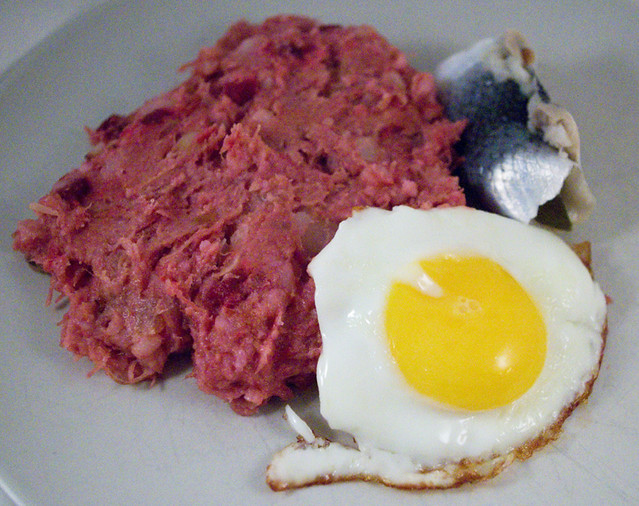
Labskaus at Frau Möller

The toppings were two eggs sunny-side up, dill pickles, pickled beets, and rollmops. I’ll confess to never having had rollmops before, but a brief examination revealed that they are a sweet pickled fish (herring, I found out later) wrapped around a cucumber pickle and held together with wooden skewers. But what was underneath the eggs? That, apparently, was the labskaus itself. I feared at first, based on the looks alone, that I’d ordered myself some kind of raw ground meat. But I took a bite, and realized that it couldn’t be. Upon tasting, I could tell it was some kind of meat (corned beef) and potato mixture. But what gave it its characteristic pink hue?

A bit of research back at the hotel when I could use the WiFi informed me that the pink came from pickled beet juice. All of these ingredients preserve well and were commonly available on seafaring vessels, making this dish popular both aboard ship and in coastal cities in Germany, Denmark, Norway and Sweden. The British have a similar dish, a beef stew called lobscouse, which is eaten by sailors and is popular in seaports like Liverpool; it is from this that the slang “Scouse” accent gets its name.


Rollmops available in Canada

When I came back home, I wanted to try to make labskaus for myself, since, as I’ve complained before, there aren’t any German restaurants around here. I decided to try a simple recipe from My Best German Recipes. Sourcing the ingredients was actually a lot harder than making the dish itself. Corned beef can’t be found out of a can for love nor money around here, so canned had to do. But which variety to choose? None of them were German. I read all of the ingredients and eventually settled on the one kind that had no sugar. I thought I’d have to make my own rollmops, but as it turns out you can buy them pre-made in most grocery stores. They even have the same shape of skewer as the ones from Frau Möller.


My labskaus

My final product was definitely edible, but paled in comparison to the ones I had in Hamburg. I would like to try to make this dish again, but this time with corned beef that has never seen a can. I think that this would make all of the difference in the world. I will have to try a specialty butcher, rather than a grocery store. I am not satisfied enough with my first attempt to try it without better meat.

World Breads: German Beer Bread

Last winter I had the chance to visit Hamburg, Germany for a week while my husband was there on business. My husband’s mother’s side of the family is German (although not from the Hamburg area), and I thought it would be a great chance to experience first-hand the culture in which she was raised. After all, my children share that side of the family’s German heritage. One day they will want to know more about where they come from, and I think it’ll be better if I know a bit more about it myself.


Cream of mushroom soup in a bread bowl.

One of the things I loved about Germany was the food. German food has a really bad reputation, if you ask me. Yes, it was hearty fare, but I was there in the winter and I found it hit the spot after wandering around in the cold. I especially liked the proliferation of bakeries. They seem to be on every corner, and they all serve delicious food. I especially liked Nur Hier (which translates to “only here” according to Google). There was a Schanzenbäckerei (“bows bakery”?) across the street from my hotel, which was great convenience-wise, but I made a point of walking further to Nur Hier because their food was that much tastier.


Nur Hier at Lange Reihe 48, 20099 Hamburg, Germany

Of course, when I got back home to Canada, there weren’t any good German bakeries to be had. No German bakeries in Ottawa at all, so far as I can tell. Although the local grocery store has a few varieties of German bread, it’s nothing compared to the fresh café fare that I enjoyed overseas. So I decided to try my hand at making my own bread. I picked up World Breads: From Pain de Campagne to Paratha by Paul Gayler (2006) at a thrift shop on a whim a while back, and inside (page 19) there’s a recipe for German Beer Bread.


German Beer Bread (Beer Brot)

It turned out pretty well considering it was the first proper loaf of bread I’d ever made on my own. Sure, it wasn’t symmetrical, but it was tasty and paired well with lunch meats and cheese. It’s a light rye with caraway seeds, which is more or less what I’d buy at the grocery store, but so much fresher because it’s homemade. Baking it also made my house smell absolutely wonderful. This is one recipe that I know I’ll be making again.