Two Weeks Until ComicCon

The countdown to ComicCon continues, and I am seeing some progress.

I’ve managed to get Thing 2’s bodysuit finished, which is, to me, the most difficult part. I hate sewing stretch fabric, but a bodysuit really needs to be stretchy. This is especially true for children, who will shed costume pieces if they find them too uncomfortable. These costumes have to work for ComicCon and Halloween, so I’d like them to be worn for more than five minutes at a time. Of course, when sewing this bodysuit I managed to put in one of the sleeves inside-out the first time. This seems to be an inevitable state of affairs for me whenever I make clothing.

I also painted Thing 2’s shoes for the costume, since we couldn’t find any in bright orange.

My Day 1 costume is pretty much complete, much to my great joy. I didn’t do a lot of sewing for this one (just the belt and the white part of the sleeves, actually), but there were a lot of little details that needed to be carefully painted and then dried. I probably could have sewn it in less time, but definitely not for less. The cap was $5.00 at Michaels, the shirt (which was blank and plain blue at the time) was $2.49 at Value Village, and the skirt was $3.99 at the same place. The gloves were $2.50 at the dollar store. I already owned multiple pairs of black leggings. The belt was made out of scrap fabric from my stash, and the buckle was made out of a $0.79 plywood circle from Michaels. The most expensive things were the shoes, which I paid $29 for (I think) at Payless, but they’ll get lots of use after the Con, so I don’t feel too bad about that purchase.

Welcome to My Craft Room

For many, many years I didn’t have a craft room. I worked wherever I could find the space: in my bedroom, my living room, all over the dining room table. Then the kids came along, and I found it increasingly more difficult to work on large projects because I had to have every last piece tidied up at the end of each crafting session. I couldn’t leave painted pieces out to dry, or pinned items ready for sewing, or even a simple needle and thread where the kids could get at it. Which is why I couldn’t have been more overjoyed when we moved to our current house and I could wall off a section of the basement as my own — separated from the rest of the house by sturdy baby gates.

I finally painted this space and really made it my own last summer. As you can see, it’s just a long stretch along one wall of my basement, “walled” off on one side by copious second-hand bookshelves. There are more shelves on the other side in the kids’ play room, and they’re all screwed together, making a solid-but-temporary barrier.

The kids aren’t babies or toddlers any more, so I can do without the baby gate and trust, for the most part, that they will leave my things alone. It’s a good thing, too, or they’d never get their costumes for ComicCon or Halloween in time, let alone all the little constant repairs that I have to make on their things.

Those first two photos were taken immediately after the renovations were complete and before I’d had a chance to get into any major projects. Right now… Well, it’s less than three weeks until ComicCon, and every surface is covered with costume pieces in the works. I’ll mostly be living in this room until then.

When I’m making costumes, especially when I need five on a short time limit, I have to multitask. Today I’m working on a ball cap, a T-shirt, a skirt, a pair of sneakers, and a head. That last “head” one is my most ambitious project this year, and I hope like heck that I manage to get it done in time.

If you already recognize what the costumes are going to be, well, you’re as big of a geek as I am. Congratulations! I’ll probably see you in a few weeks at ComicCon. Don’t hesitate to say hi!

Three Weeks Until ComicCon

There are three weeks exactly until Ottawa ComicCon, and I am starting to panic. I am a cosplayer, and the costumes I’m hoping to complete have barely been started. The next twenty one days are going to be crammed with sewing and building, in addition to the usual cooking.

To give you an idea of the kind of costumes that I make, I have put together photographs of what I consider to be my best Con costume work. I have been attending since the first Ottawa con in 2012, and I generally wear a different costume every day. Not only that, but when I bring the kids, I make costumes for them as well. So that’s five costumes I have to have ready in three weeks. I have nobody to blame for this tight deadline except myself… And that dratted cold that ate up pretty much all of last week.

The photos start with the most recent, and progress to the oldest. All costumes made by me unless otherwise specified.


Clawhauser (me), Judy Hopps (Thing 2), Gazelle (Thing 1) and Bellwether (Mom, who made her own costume) from Zootopia.
Photo by Richard Dufault Photography


Thing 2 as Judy Hopps from Zootopia.
Photo by Richard Dufault Photography


Thing 1 as Gazelle from Zootopia.
Photo by Richard Dufault Photography


Me as Edna Mode from The Incredibles.
Photo by Richard Dufault Photography


Me as April O’Neil from Teenage Mutant Ninja Turtles.
Photo by Richard Dufault Photography


Astrid (Thing 1) and Stormfly (me) from How To Train Your Dragon.
Photo by Richard Dufault Photography


Ruffnut (Kelsey Joustra), Tuffnut (Adam Joustra), and Stormfly (me) from How To Train Your Dragon. Kelsey and Adam made their own costumes.
Photo by Richard Dufault Photography


Thing 1 as Astrid from How To Train Your Dragon.


Thing 2 as Hiccup from How To Train Your Dragon.


Me as Pyro from Team Fortress 2.
Photo by Richard Dufault Photography


Pyro (me), Heavy (Ian Walton), and Sniper (Karen Turnbull) from Team Fortress 2. Ian and Karen made their own costumes.
Photo by Richard Dufault Photography


Gru (me) and a Minion (Thing 1) from Despicable Me.
Photo by Richard Dufault Photography


Thor (Thing 1) and Frigga (me) from Thor. The Thor costume is store bought.


Me as The Penguin from Batman.
Photo by Karen Turnbull.


Thing 2 as Harley Quinn from Batman.

Moncton Market

Spring has been exceptionally slow coming around these parts this year; we had a snowstorm last Friday, and the forecast is for more snow this coming Friday. Daytime temperatures have been just above freezing, while at night it has been dipping just below zero, so our snowbanks aren’t melting back very quickly. And it’s only a few days until the beginning of April!


A handicraft booth set up outside the Moncton Market building; there are many tables outdoors when the weather is nice.

Despite the weather, it’s technically spring, and spring to me means the start of the farmers’ market season. Technically it’s a little early for that; we’re not getting fresh produce for a little while yet, unless it’s from greenhouses. And yet I find myself thinking about all the great markets I’ve been to, and yearning for a chance to visit them again.


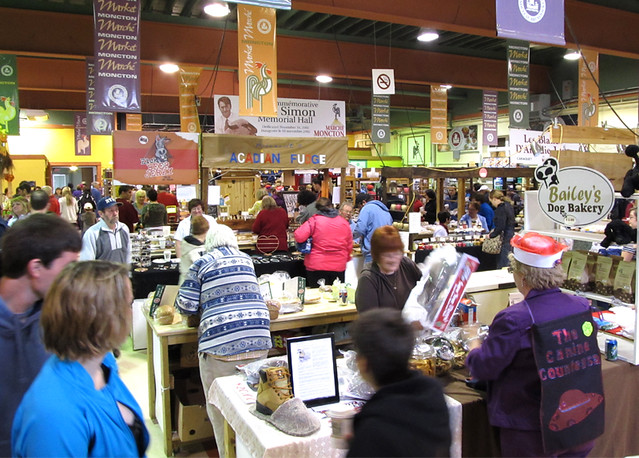
The main hall (Con Simon Memorial Hall) on an unseasonably-cool summer day.

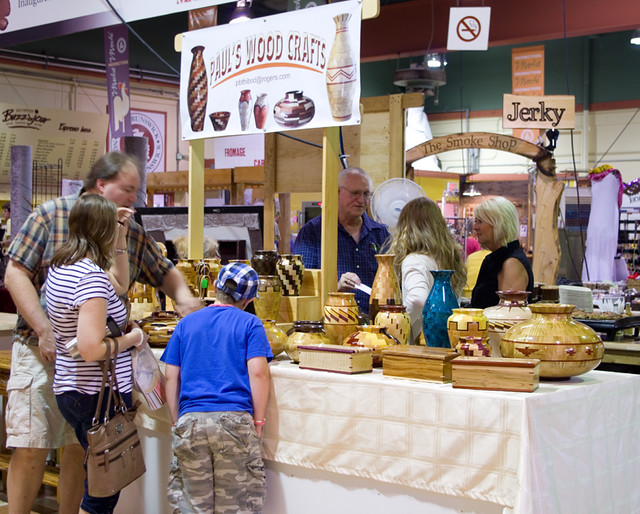
One of my favourite markets to visit while on vacation is the Moncton Market in Moncton, New Brunswick. We seem to end up there on at least one weekend every time we visit the city. It’s not specifically a farmers’ market, although it does have a large selection of fresh local produce (when in season), as well as deli and butcher booths. There is also a food court and a huge number of handicrafts for sale.


Main hall.

The Moncton Market runs all year long, and actually is set up in its own proprietary building that was built in 1995 (although this market has existed, in one form or another, since the late 1800’s). Saturday is market day, but the food court is open all week long for lunch. Due to its downtown location and proximity to office buildings, particularly government offices, there is a brisk lunch business.


Main hall.

In addition to the main hall, there is a second, later-built hall (Festival Place) and a bay area, all of which are packed with vendors and customers on market day. Festival Place is sometimes rented out for other events on non-market days. There is also a culinary center on the premises, although I’ve never seen it in use. Every time I’ve been there, it has been used as a seating area for the food court.


Accordion player in the main hall.


Maple syrup and maple candy are pretty much prerequisites for any Canadian market.

There is often live entertainment throughout the market. There may be a single busker in the main hall, a duo in the secondary hall, and an entire ensemble on the stage outside — so there’s always entertainment. Thing 2 could happily spend her entire trip to the market sucking on a maple lollipop while she watches the performers. Thing 1, on the other hand, would rather hunt down a gourmet cupcake seller. Me, I’m on the lookout for fresh, local food to bring home for dinner.

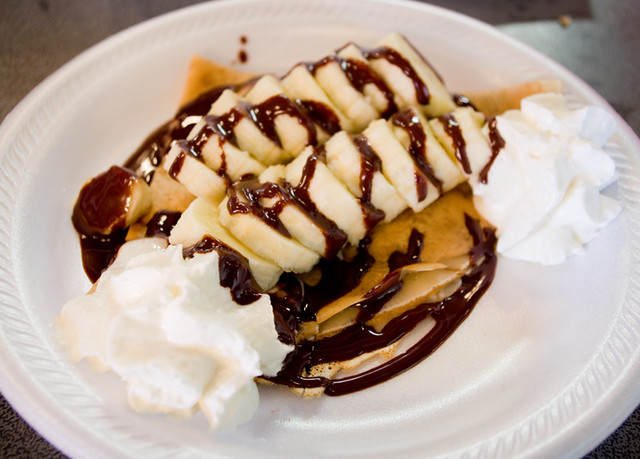
Of course, part of the fun is to pick up some breakfast or lunch at the market while you are there. I am partial to the fresh-cooked crepes and waffles; the lineup is always long, but the food is cooked fresh to order, and the delicious portions are substantial.


Fruit-covered crepe drizzled with chocolate hazelnut butter, raspberry syrup, and whipped cream. Photo by my mother.


Classic crepe with banana, chocolate hazelnut butter, and whipped cream.


Waffle with berries, apples with cinnamon-sugar, and whipped cream.

Around here, the winter (indoor) version of the Lansdowne Park Ottawa Farmers’ Market runs on Sundays from January 8th to April 30, from 10:00am to 3:00pm, in the Aberdeen Pavilion. There’s nothing specifically stated on their website, but the outdoor summer market usually starts sometime in May. The Cumberland Farmers’ Market has their Spring Market on Saturday April 8th from 9:00am to 3:00, but their main season doesn’t start until mid-June.

I can’t wait for summer market season to start again. Come on, Ottawa… Thaw!

Ribbed For Her Pleasure Sock Pattern

As with my Minecraft Creeper Blanket Pattern, I wrote this pattern years ago — July of 2007, to be precise. It is actually the first knitting pattern I ever wrote. When I took down my old blog, the patterns went with it, and since then I have had request to re-publish some of my old work.

My Ribbed For Her Pleasure Sock Pattern is a very simple sock that, due to its repetitive nature, is great for working on in front of the TV, while on the bus, or while watching small children. It works well with most sock-weight yarns and showcases self-striping yarns beautifully. This is the updated version from 2011, when I fixed an error in the heel.

Ribbed For Her Pleasure Socks
Adult Women’s Size

Materials
– Two 50g (1.764oz) 152m (166yrd) balls of sock yarn, size 1 super fine
– One set of four size US 3 (3.25mm, UK 10) double point needles

Gauge
– Sock Yarn: 28 stitches and 36 rows = 4″ x 4″ (10cm x10cm) square on US 3 (3.25mm, UK 10) needles

Instructions
– Loosely cast on 60 sts. Divide into 20 sts on 3 needles. Join and work in (K2, P2) ribbing for 1.5″ (3.81cm).

– Work in (P2, K2) for an additional 3.5″ (more or less if taller or shorter socks are desired; make sure you have additional wool if you want taller socks).

Arrange heel sts:

– Slip 6 sts from end of 1st needle onto beginning of 2nd needle, and slip 6 sts from beginning of 3rd needle onto end of 2nd needle. This should give you 14 sts on the 1st needle, 32 sts on the 2nd needle, and 14 sts on the 3rd needle.

– Divide the 32 sts on the 2nd needle onto two needles of 16 sts each and leave for the instep.

– (P2, K2) the 14sts off the first needle onto the 3rd needle. Working on these 28 sts proceed as follows:

– Next row: (WS) K1. P12. P2tog. P12. K1. (27 sts on needle)

Make heel:

– 1st row: (RS) K1. Slip 1. Repeat across row ending row with K1.
– 2nd row: K1. Purl to last stitch. K1.
– Repeat these two rows for 2 inches, ending with 1st row.

Shape heel:

– 1st row: (WS) Slip 1. P14. P2tog. P1. Turn.
– 2nd row: (RS) Slip 1. K5. SL1. K1. PSSO. K1. Turn.
– 3rd row: Slip 1. P6. P2tog. P1. Turn.
– 4th row: Slip 1. K7. SL1. K1. PSSO. K1. Turn.
– 5th row: Slip 1. P8. P2tog. P1. Turn.
– 6th row: Slip 1. K9. SL1. K1. PSSO. K1. Turn.
– 7th row: Slip 1. P10. P2tog. P1. Turn.
– 8th row: Slip 1. K11. SL1. K1. PSSO. K1. Turn.
– 9th row: Slip 1. P12. P2tog. P1. Turn.
– 10th row: Slip 1. K13. SL1. K1. PSSO. K1. Turn.
– 11th row: Slip 1. P14. P2tog. Turn.
– 12th row: Knit. (16 stitches remaining in heel)

Make instep:

– Slip 32 sts for instep onto one needle.

– 1st needle: With RS of work facing and using the heel needle, pick up 13sts. Knit 11 of these sts, then purl 2 of these sts.
– 2nd needle: Slip the two purled stitches from the end of the 1st needle to the beginning of the 2nd needle. (K2, P2) the rest of the way across instep sts.
– 3rd needle: Pick up and knit 13 sts along other side of heel.

– Sts are now divided as: 27-34-13

– Knit 7 sts from beginning of first needle onto end of 3rd needle.

– Sts are now divided as: 20-34-20

– 1st round:
– 1st needle: Knit to last 3 sts. K2 tog. K1.
– 2nd needle: (P2, K2) to the end of needle, ending with P2.
– 3rd needle: K1. Slip 1. K1. psso. Knit to end.

– 2nd round:
– 1st needle: Knit.
– 2nd needle: (P2, K2) to the end of needle, ending with P2.
– 3rd needle: Knit.

– Repeat these two rounds to 13sts on 1st needle, 34 sts on 2nd needle, and 13 sts on 3rd needle (60 sts total).

– Continue knitting as in 2nd round until foot, from picked up sts at heel, measures 5″ (12.7cm). (Alternately, continue knitting until the needles sit at the first knuckle of the big toe when this sock is tried on the foot on which it will be worn.)

Shape toe:

– Slip 2 sts from start of 2nd needle onto end of 1st needle, and slip 2 sts from end of of 2nd needle onto start of 3rd needle. This should give you 15 sts on the 1st needle, 30 sts on the 2nd needle, and 15 sts on the 3rd needle.

– 1st round:
– 1st needle: Knit to last 3 sts. K2tog. K1.
– 2nd needle: K1. Slip 1. K1. psso. Knit to last 3 sts. K2tog. K1.
– 3rd needle: K1. Slip 1. K1. psso. Knit to end.

– 2nd round: Knit.

– Repeat these two rounds until 28 sts remain (divided 7-14-7). Break yarn and graft 2 sets of 14 sts.

Sock Chibi-Totoro & Snowgie Tutorial

One of the standards of children’s crafts is sock creatures, usually starting with puppets and moving on to more complicated projects from there. Sock creatures can be cheap, quick, and easy, which is exactly what you need with kids who can be easily frustrated when learning a new skill. As a bonus, basic sewing is something that everyone should learn, and sock creatures are a great way to teach sewing without it even seeming like a lesson.

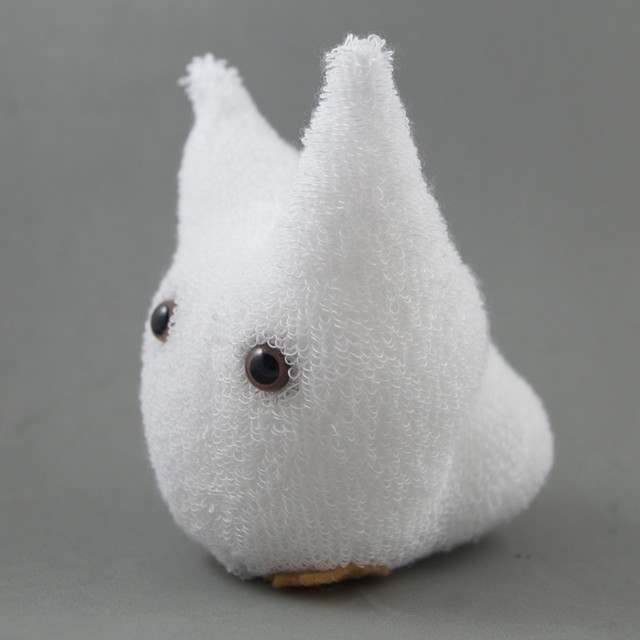
I have made tutorials for two simple sock creatures based on characters from popular children’s movies. The first is Chibi-Totoro, who is the smallest of three adorable forest spirits from the 1988 movie My Neighbor Totoro. The second is a tiny snowman created by snow queen Elsa called a Snowgie, from the 2015 short Frozen Fever (which takes place in the same world as Disney’s Frozen).


Chibi-Totoro

Sock Chibi-Totoro Stuffie

Supplies Needed:
– one white sock
– 2 safety eyes or black buttons
– scraps of tan or peach felt
– polyester stuffing
– sewing needle
– white thread
– sewing scissors

1. Lay the sock on a flat surface.

2. Using sewing scissors, cut the sock as per the above photo. Discard the ankle and the toe, or save scraps for another project.

3. Turn the remaining piece of fabric sideways, so that the heel (which will be the tail) is at the back. Cut a deep vee into the top of the sock. The actual measurements of the vee will depend on the size of sock you use.

4. Whip-stitch the top of the vee closed; this will become the ears.

5. Turn the sock inside-out to hide the seam and to make the Chibi-Totoro as fluffy as possible. Attach safety eyes or sew on buttons.

6. Stuff the creature with polyester stuffing. Sew the bottom closed using an invisible closing seam; this will also ensure that the seam lies mostly flat.

7. Take a large stitch across the back of the stuffie where you want the join between the tail and the body to be. Pull the stitch tight and tie off, hiding the ends inside the body.

8. Cut out little clawed feet out of the felt and stitch them to the bottom of the body.

9. I discovered that my Chibi-Totoro would not stay up because its tail went down too far, so I took a big stitch from the back of the body to the top of the tail and pulled tight. This decreased the angle between body and tail so that the stuffie would stand up on its own.

Now your simple Chibi-Totoro stuffie is ready to be played with!


Snowgie

Sock Snowgie Stuffie

Supplies Needed:
– two white sock
– 2 safety eyes or black buttons
– scraps of dark blue and white felt
– polyester stuffing
– sewing needle
– white thread
– sewing scissors

1. Lay one sock on a flat surface.

2. Using sewing scissors, cut the sock as per the above photo. Discard the ankle and the toe, or save scraps for another project

3. Do a running stitch around one end of the tube, then pull tight and tie off.

4. Turn tube inside out so that fluffiest side is on the outside. Attach safety eyes or sew on buttons. Stuff the creature with polyester stuffing.

5. Gather the bottom of the tube together and sew tightly closed. Don’t worry if this isn’t perfect, as it will be hidden by the feet.

6. Wrap a doubled piece of thread around the middle of the tube and tie tightly, creating a head and a body.

7. Cut two rough circles out of the widest part of the second sock. These will become the feet.

8. Stitch a running stitch around the edge of one foot, fuzziest side of the fabric facing out. Stuff the foot. Pull the running stitch as tight as possible and tie off. Repeat for second foot. Sew both feet onto the bottom of the body of the stuffie.

9. Cut mouth and teeth out of felt scraps and sew onto face of stuffie. Your Snowgie is now complete!

Recycled Crayons Tutorial

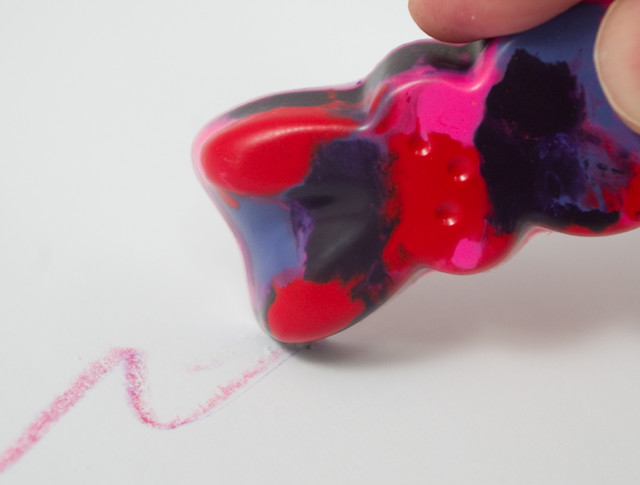
Back in Girl Guides, we recycled our crayons by melting them in the microwave or in a double boiler, then pouring the different colours in layers into muffin tins (waiting for the wax to cool a bit between layers so they didn’t mix). I wanted to do something a little simpler than that with my kids yesterday — since they are younger than I was when first did this craft, I wanted a process that involved less handling of molten wax. However, this is still an activity that is done with kids, as opposed to setting them up and letting them go.

Recycled Crayons

Supplies Needed:
– old crayons
– molded cookie pans OR silicon molds rated for use in an oven OR muffin tins
– flat cookie pans
– utility knife
– large, heavy knife OR clear zipper bag and hammer
– cutting board

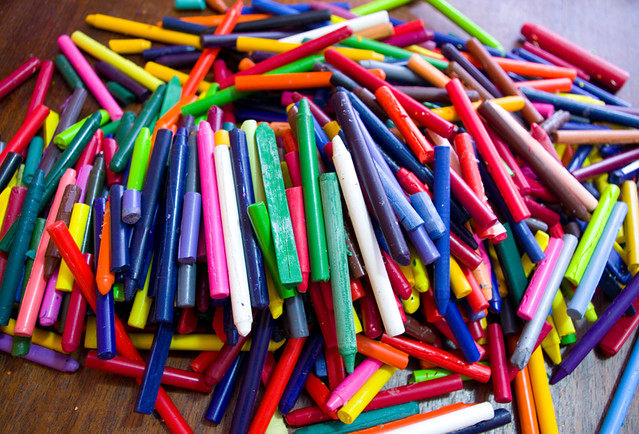
1. Sort through the kids’ crayons and separate out the old, broken ones, along with the ones that just don’t colour well.

2. Remove the paper wrappers from the crayons. The labels can be peeled off with your fingernails. However, the quickest way is to run the blade of a utility knife lightly down the paper to slit it, then peel it off. When I was doing it with my kids, I would cut the paper, and they would take it off.

3. Sort the crayons by colour.

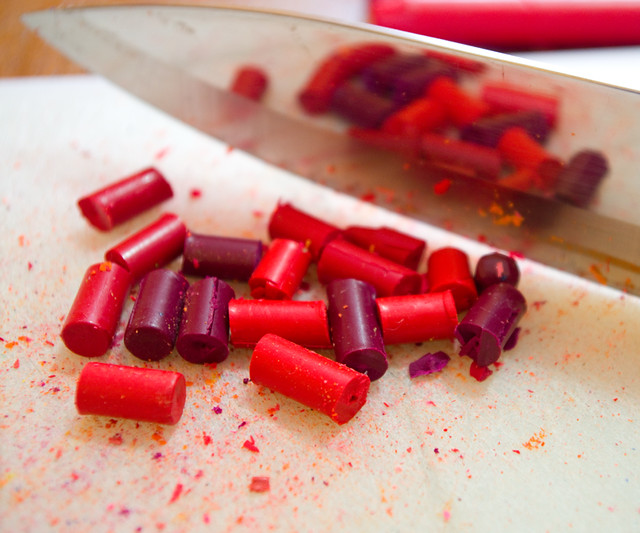
4. Protect the work surface with a cutting board, then use the large knife to chop up the crayons into chunks that are approximately 1cm (0.4″) long. Sharp knives should be handled by an adult. Alternately, put each colour of crayon into a clear zipper bag, seal the bag, and smash the crayons into large chunks with a hammer. This may damage the surface underneath and will be noisy, so I suggest working on a concrete surface with a cutting board over top, and using ear protection.

5. Fill the molded cookie pans or silicon molds or muffin tins with the chunks of crayon. The molds should be almost overflowing, as the air pockets between crayon chunks will be filled as they melt. To create colour-coordinated crayons, fill each compartment with different shades of the same colour. To create more contrast, add chunks of coordinating colours. Be careful not to mix too many colours, though, as the colours will mix and they may turn an unlovely brown.

6. Preheat the oven to 200°F (93°C) (the oven temperature needs to be low so that the wax doesn’t catch fire). Put the crayon-filled molds on top of the flat cookie pans for support; this is especially important if using silicone molds, which are flexible. Anything to do with the oven should be done by an adult.

7. Bake until crayon chunks are thoroughly melted, 15 to 30 minutes, checking every 5 minutes after first 15 minutes is up to see if there are still any lumps. Remove trays carefully from oven, being careful not to spill the wax.

8. Cool the recycled crayons thoroughly before removing them from the molds. To make removing them easier, place them in the freezer (or anywhere outside in winter in Canada, so long as it’s protected from precipitation) until thoroughly chilled. Wax shrinks when it gets cold, so it will pull away from the sides of the mold and slide out more easily.

When I made these candles, I used three different kinds of molds:

– metal, nonstick Wilton PEEPS Bunny Shaped Cookie Pans ($3.00 each at the dollar store), which released easily
– a silicone Wilton PEEPS Chicks and Bunnies Treat Mold ($4.00 each at the dollar store), which released with a little more difficulty, but cleanly
– a silicone flower-shaped IKEA PLASTIS Ice Cube Tray ($1.99 at IKEA), which stuck to the wax, obscured detail, and were very difficult to remove

All in all, I much preferred the metal pans to the silicone versions.

We packaged these crayons up into little spring-themed bags and put them aside until the week before Easter to give out at school. Of course, we had to leave a few out for the kids to colour with right away, too.

Booboo Bunnies and Chicks Tutorial

It’s day two of March Break, and it’s still much too cold for this time of year. That means more crafts with the kiddos! Today’s craft was booboo bunnies and chicks, for which I have created a brief tutorial. They’re really very simple.

You may be wondering why are they called “booboo” animals. Well, it’s because the hole in the back of the animals caused by a loop in the fabric makes a great place to tuck an ice cube. The ice cube can then be applied to a child’s booboo without it getting their hands cold, and without it dripping all over the place. As an added bonus, the cuteness of the animal distracts the child from their injury. But don’t think that this is their only use! The hole in the back makes for a great place to stash an Easter candy; I’ve seen them made with beach towels so that one of those jumbo Kinder Eggs can fit inside. I’ve also seen them used as a creative way to present washcloths at a baby shower.

Booboo Bunny

Supplies Needed:
– one facecloth or dish cloth (without a pattern is best)
– 12″ of thin ribbon
– one pink pompom
– one white pompom
– two small googly eyes (with button shanks if you plan to sew them on)
– glue gun and glue OR needle and coordinating thread
– sharp scissors

1. Trim tags off of the cloth, if there are any.

2. Starting at one corner, roll the cloth diagonally until you have a tube.

3. Keeping the tube rolled tightly, fold it in half.


Top view.


Side view.

4. Keeping the tube rolled tightly, fold the open ends of the tube backwards. Secure by tying the ribbon tightly around the cloth, about 2/3 of the way along.

5. Tie the ribbon into a bow. Trim the ends with the scissors.

6. Using the hot glue gun, stick the two halves of the face securely together (otherwise it will look like a bum). Glue the eyes, nose, and tail to the bunny. Alternatively, sew the face together, and sew on the eyes, nose and tail. Sewing is the preferred method if you plan on using the cloth for other purposes at a later date.


Bunnicula Booboo Bunny

Don’t forget, booboo bunnies can be any colour of the rainbow! I just made white ones because that is the easiest colour of face cloth to find (and the cheapest). Don’t be afraid to experiment with decorating the bunnies, either. Above I added some glued-on felt “fangs” and used red googly eyes to create a “Bunnicula”, after a creature from a favourite childhood book. Be creative!

Booboo Chick

Supplies Needed:
– one facecloth or dish cloth (without a pattern is best)
– 12″ of thin ribbon
– scraps of yellow felt
– two small googly eyes (with button shanks if you plan to sew them on)
– glue gun and glue OR needle and coordinating thread
– sharp scissors

1. to 3. Follow steps 1-3 of the Booboo Bunny tutorial.

4. Instead of folding the cloth roll back on itself, fold it to either side, creating an “M” shape. Secure by tying the ribbon tightly around the cloth, about 2/3 of the way up.

5. Cut out scraps of felt for the beak and feet, proportionate to the size of the cloth that you are using.

6. Glue both sides of the head together, then glue on the felt pieces and googly eyes. Alternatively, sew the face together, and sew on the eyes, beak, and feet.

Once again, be creative! A chick easily turns into a penguin if you use a black cloth.

Bunnies and chicks! Now you’re all set for spring.

Beginner Books Tutorial

March Break is here for those of us with kids in the English public school system in Ontario, and that means that many of us who aren’t going away on vacation are scrambling to find something for our kids to do. Usually that means digging out the bikes for the first rides of the year, or pulling on the rain boots to go puddle jumping. Well, not this year. This year has been one of the coldest months of March on record (it was about -30°C (-22°F) with the wind chill last night), following a record-breaking warm February. That means all the snow melted a bit, then turned to ice, and isn’t good for winter fun — when we want to brave the cold at all. Hence, we are planning a lot of indoor activities

Around here there are indoor play places and child-friendly museums open year-round; rec centers have special events planned; most businesses have something going on to entertain the kids. But one thing that having a huge chunk of the under-fourteen demographic off school all at the same time means is that everything is packed. So in our house we choose to make our own fun rather than wait in line or squeeze through the masses.

With that in mind, here is a tutorial for one of my kids’ favourite crafts: beginner books. There are two versions: one for the younger crowd, which only requires mastery of a pair of scissors and a blunt darning needle, and a slightly fancier one that requires more sophisticated tools, a bit of patience, and more adult supervision.

Basic Book

Supplies Needed:
– one piece of 12″ x 9″ (30.5cm x 22.9cm) coloured construction paper
– 5 to 7 pieces of 8.5″ x 11″ (21.6cm x 27.9cm) blank paper (recycled or GOOS (good on one side) is fine)
– 24″ (61cm) yarn or string
– scissors
– blunt-tipped darning needle with large hole
– art supplies for decorating front cover of book, if desired

1. Put your construction paper and blank paper on a flat surface.

2. Fold the construction paper in half. Fold the stack of blank paper in half. Place the blank paper inside the construction paper.

3. Using the scissors, cut five small slits along the folded edge of the booklet. For best results, work from the center out. Make sure that the slits go through all of the papers.

4. Thread the darning needle with the wool. Starting at inside of the the center slit and leaving about a 3″ (7.6cm) tail behind, start stitching in one direction (it doesn’t matter which).

5. When you reach the slit closest to the edge, wrap the yarn around the edge and come back up through the same hole, then continue stitching in the reverse direction. Make sure to tug the yarn snug, but not so tight that it crinkles the paper.

6. When you get to the other end of the book, wrap the yarn around the edge as you did for the opposite end, and continue stitching.

7. Stitching this way should eventually bring you back to the center of the book on the inside. Keeping the yarn snug, but once again not so snug that it wrinkles the paper, tie a double or triple knot in the yarn. Trim the yarn to about 1/2″ (1.25cm) long.

8. If desired, decorate the cover of the book, as per the first photo. Your book is done and ready to be filled!

Fancy Book


Finished fancy book using dollar store contact paper.

Supplies Needed:
– thin cardboard from a cereal box or other packaging
– self-adhesive peel-and-stick contact paper or laminate, OR wrapping paper/wallpaper, spray adhesive, and a glue stick
– 5 to 7 pieces of 8.5″ x 11″ (21.6cm x 27.9cm) blank paper (recycled or GOOS (good on one side) is fine)
– 36″ (91cm) thin ribbon
– 2 large-bore beads
– blunt-tipped darning needle with large hole
– scissors
– pen
– utility knife
– hammer
– 5 nails
– scrap wood

1. Trim the largest flat part of your cereal box until it is rectangular.

2. Trim your contact/wrapping/wall paper until it is 1″ larger all around than the cardboard.

3. Peel the backing off of the contact paper and adhere it carefully to the outside of the cardboard, pressing out air bubbles as you go. If you are using wrapping/wall paper, go outside and spray the cardboard with spray adhesive. (The spraying should be done by an adult.) Come back inside and place the sticky side of the cardboard on the back of the wrapping/wall paper. With any kind of paper, fold the excess to the inside of the box and trim the corners. If using wrapping/wall paper, stick the excess to the cardboard using a glue stick.

4. Using a pen, draw a line down the center of the interior of the cover where the spine will be. Then use a utility knife to score the line, being careful not to cut through the paper. (Cutting with sharp knives should be done by an adult.)

5. Fold the cover in half along the scored line.

6. If necessary, trim your blank paper so that it is about 1/2″ (1.25cm) smaller all the way around than the cover. Fold the blank paper in half and line it up with the center of the cover.

7. Place the scrap wood under the spine of the book. Using the hammer and being very careful to keep the pages from moving, tap the nails through the blank paper and the cover all at once. For best results, work from the center out. Remove the nails.


Finished fancy book using IKEA wrapping paper.

8. With the same technique as the basic book but starting at the bottom of the book, sew the spine together using the darning needle. Leave the tail much longer this time as ornamentation. To secure the ribbon, tie into a double knot at the bottom of the book. Thread one bead on each end of the ribbon and knot underneath to add a bit of pizzazz. Your book is done!

Optionally, you can use a glue stick to stick the first page to the inside of the front cover, and the last page to the inside of the back cover. This will create a more finished look.

I hope that your kids enjoy this craft as much as mine do!