Nan’s Pan Rolls Recipe

I’ve mentioned before that I regret not asking my grandmother for copies of her recipes; honestly, I felt like that indomitable old lady was too tough to die, until the very day that she passed away. As I grew up, I did less and less cooking with her — she would cook for me or I for her, but rarely did we cook together anymore. It became all that much more difficult once my attention (and hers as well) was focused on my children. I didn’t realize that it would be something I missed so much.


White pan rolls straight out of the oven.

In Nan’s memory, I’ve been trying to recreate her famous pan roll recipe. Whenever we were in town, or she was visiting us, Nan was always the one to cook Sunday dinner (which was always understood to mean “roast beef dinner”). Her fresh rolls were an integral part of that meal, and came to be considered by all the family as the proper accompaniment. She would start the dough and leave it to rise before she left for church in the morning, then punch it down and form the rolls immediately upon returning home. It was a Sunday ritual.


White flour pan rolls after the second rise.

To me, pan rolls should be squished as tightly as possible into their pan so that, when they rise, they rise upward and become tall and skinny once they are pulled away from their fellows. They should be yeasty, but not too fluffy, and fairly filling. They should be golden on top, crispy around the edges, and soft (but not raw) in the middle. With this recipe, I think I’ve made them as close to what Nan made as I possibly can.


White pan rolls after the second rise.

Nan’s Pan Rolls
Yields 35 rolls

In a large bowl, mix together:
4 1/2 cups (500g) all-purpose flour*
2 packages (14g) quick-rise instant yeast
2 1/2 tsp salt
Add to the dry ingredients:
3 cups very warm water (120ºF to 130ºF)
2 large eggs
1/4 cup (4 Tbsp) lard, melted
Stir by hand until mixture is more-or-less smooth.
Gradually mix in:
4 1/2 cups (500g) all-purpose flour
If the dough starts to become tough to knead, do not add any more flour. When flour is fully incorporated, dough should be smooth and elastic, but not sticky. If dough is sticky, add all-purpose flour 1 Tbsp at a time until stickiness abates.
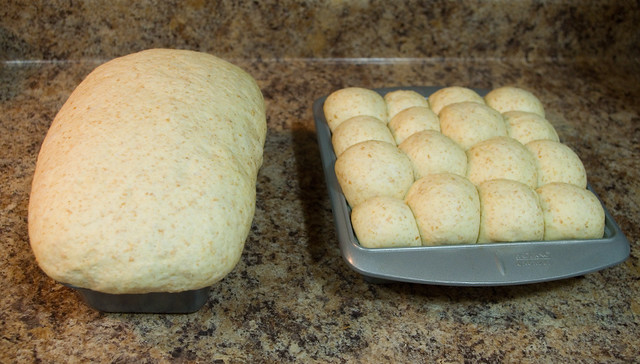

Whole wheat dough divided in half and made half into pan rolls, half into a loaf of bread, after the second rise.

Turn out dough onto a lightly floured surface and knead by hand for about 8 minutes. Oil a large mixing bowl. Form the dough into a ball and place it in the bowl. Cover the bowl with a clean, damp tea towel. Place the bowl in a warm, dry area with no drafts. Allow the dough to rise until double, about 1 hour.

Punch down the dough. Grease a 9″x13″ cake pan. Divide the dough into 35 approximately equal-sized portions. Form the portions into balls and place them in lines closely together to fill up the cake pan.** Cover the pan with a clean, damp tea towel and allow to rise again until double, about 1 hour.


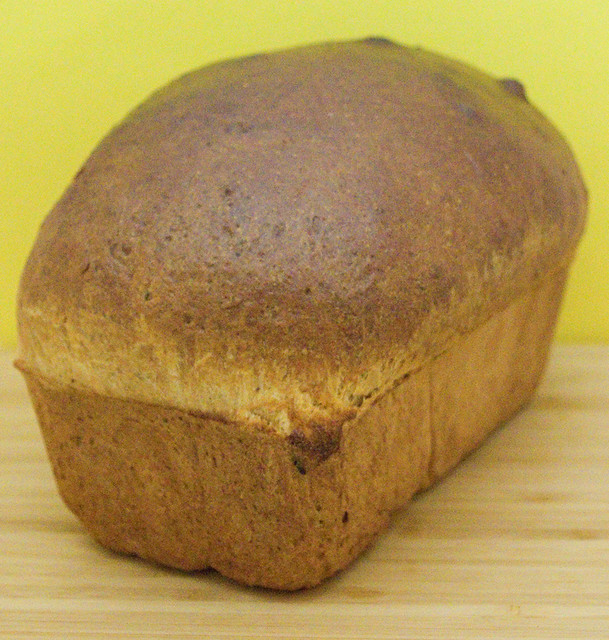
Whole wheat loaf after baking.

Preheat your oven to 450ºF (232ºC). Bake rolls for 10 minutes. Turn heat down to 350ºF (177ºC) and bake for about 20 minutes more. Check to see if they are done by removing the rolls all in one piece from the pan and tapping them on the bottom. When cooked through, they should make a hollow sound. Remove the rolls from the pan immediately and place them on a wire cooling rack.

To create the glossy shine on top of the rolls, use waxed paper to pick up:
1/2 to 1 Tbsp cold butter
Rub the tops of the rolls with the butter, keeping the waxed paper between the butter and your hand.

Nan’s pan rolls taste best when served immediately; to keep them at their freshest, pull them apart only when they are about to be eaten. These rolls will keep for three or four days if wrapped in a clean plastic bag. Make sure they are wrapped up only after totally cool, or they will go soggy.


Whole wheat pan rolls being pulled apart by my temporarily-tattooed Thing 1.

*For whole wheat bread, replace the first 4 1/2 cups of all-purpose flour with all-purpose whole wheat flour.

**Alternately, this recipe makes two good-sized loaves of bread. I used a slightly too-small loaf pan to create a “mushroom-top” loaf; if you want your loaf to have smoother sides, use a pan that is at least 9.5″x5.5″. You could also make three smaller loaves in smaller loaf pans instead of two big ones. Allow the loaves to have a second rise as per pan roll instructions. Be careful of cooking times if you change the shape of the end product. Bread loaves will take 10min at 450ºF (232ºC), and then they must be turned down to 350ºF (177ºC). However, how long they stay in at 350ºF depends on the size of loaves you make. When in doubt, bake for less time and check often to see if they’re done.

English Muffins

I love English muffins, and not because I am of British ancestry. English muffins aren’t English at all, really; the dish as we know it today was developed by Samuel Bath Thomas in New York City in the late 1800’s. However Thomas, who came from England, did base his recipe on the yeast-leavened muffins sold door-to-door in his home country, back before most people had ovens in their homes. Those were the kind of muffins that they were talking about in the song “Do You Know the Muffin Man”. In England they are just called “muffins”, and are differentiated from quick bread muffins by context.

Thomas English muffins are still sold in the United States today, but so far as I can tell aren’t distributed in Canada. So the English muffins we have here are imitations of an American product, which is in itself an imitation of a British product. I’m sure we’re not getting the most authentic muffin experience here.

So a couple of weekends ago I decided to take a stab at making my own English muffins. The first thing I had to do was make sure I had the correct equipment. Until I tried to make them, I didn’t know that English muffins weren’t baked; I discovered that I would needed a griddle (which is why they’re sometimes called “griddle muffins”).

My stove is a bit atypical. It it a hand-me-down from family who were upgrading, but it was a very fancy model (Jenn-Air F121-C) thirty years ago when it was new. Each side of the stove-top can be removed and switched out; there are simple electric burner panels, a ceramic cook-top panel, a grill panel, and a griddle panel. Although all of these extras came with the stove, I had only ever used the electric burners, so switching for the griddle was an interesting experience, seeing as the stove’s user manual disappeared ages ago.

Another piece of equipment I needed was English muffin rings… Which I didn’t have, and would have been hard to find on a Sunday morning when most stores were closed. So I chose a recipe that made a more cohesive muffin and didn’t need the rings: How To Make English Muffins from TheKitchn.com

The muffins were tasty, but I wasn’t a hundred percent satisfied with the internal texture. My muffins rose nicely, but solidly, and as such were missing the large nooks and crannies that are, to me, the signature characteristic of a proper English muffin. I’m not sure if that was a problem with the recipe or with my technique. I did the quick version of the recipe and started it that morning. TheKitchen.com says that the starter can ferment overnight and the dough can be left to rise for up to three days in the fridge, so perhaps I will try it that way next time. If I still don’t get the texture I’m looking for, I’ll invest in the English muffin rings and try a different recipe.

That being said, the muffins that I made were definitely edible, and I don’t think the batch even lasted the day. I served them with bacon, cheese, and a fried egg for lunch, and they were eaten spread with elderberry jam as snacks in the evening. My family obviously isn’t nearly as critical of my end results as I am, since they have asked me to make them again soon.

Dr. Seuss’s Birthday

Yesterday, March 2nd, was famous children’s author Dr. Seuss’s birthday; he would have been 113 this year. This year his birthday coincided with UNESCO World Book Day in the UK (they have other holidays on April 23rd, which is when the rest of the world marks it, so for the UK it’s the first Thursday in March). I’m sure that Mr. Geisel would have approved.

Dr. Seuss’s birthday is a big thing for preschool children around here. Teachers generally spend at least a day focusing on his fabulous books; some even stretch it out into a whole week of activities. The environmental themes in The Lorax alone can spread to an entire sciene unit! I read all of the Dr. Seuss books as a child (except for the few that have been published since), and when the time came to read them to my own children, I couldn’t have been more thrilled. They have such great rhythm that I don’t mind reading them again and again. It’s a good thing, too, because when my kids like a book, I end up reading it until I could recite it in my sleep.

To celebrate Dr. Seuss’ birthday, I made Green Eggs and Ham for dinner. (I was going to read the book to my youngest as well, but apparently her teachers had beaten me to the punch, so we enjoyed Fox In Socks instead.) The eggs were simple scrambled eggs with grated cheddar cheese and a bit of chopped parsley, with a couple of drops of food colouring to provide the virulent green. I couldn’t figure out any way to safely turn the ham green, so I just cut slices of PC Free From Smoked Ham and dry-fried them in a non-stick pan. I also baked a loaf of Fast White Bread (2006 edition, page 597) and scooped some honeydew melon to supplement all that protein.

For dessert I made The Cat’s Hat Parfaits; you can find the recipe via Seussville.com. My kids loved it, and it’s a very healthy dessert (basically just berries and yogurt), so I didn’t mind serving it. In our house, dessert is generally reserved for special occasions.

Lastly, here are my Thing 1 and Thing 2. This picture is ancient now. They were so wee! I made the Thing 1 costume for the Halloween prior to that Dr. Seuss’s birthday, and I was lucky that it still fit in time for her to wear it to preschool. It’s an adapted Simplicity pajama pattern made from stretch cotton, and it was so comfy that she never tired of wearing it. The Thing 2 set was bought at Chapters before my Thing 2 was born.

Dad’s Biscuits (Baking Soda Biscuits) Recipe

One of the things I loved best as a child when coming in on a cold, blustery day was opening the door to the house and having the smell of fresh-baked biscuits wash over me. To me the smell goes along with the orange glow of incandescent lights shining through a window over a dark, snow-covered landscape. It is the scent of hanging up your sled or skates, taking off your snowsuit, and coming in for dinner.

Dad’s biscuits are one of the dishes for which he is best known; childhood friends of mine fondly remember them and often requested his recipe when they moved away from home. The biscuits were more of a winter dish, not because they are heavy, but because firing up the oven on a hot day was tantamount to sacrilege. However, my Nan (Dad’s mom) occasionally used these biscuits instead of cake when she made us a fresh berry trifle during summer visits.

My mother actually wrote down this recipe in the back of her Purity Cookbook (my second-favourite cookbook, after the Joy of Cooking). She copied it from my Nan’s recipe, who had in turn gotten it from my grandfather. Unfortunately, he died long before I was born, so I can’t ask him where he got it, but I suspect that he learned it when he took his turn cooking when working as a lumberjack in northern New Brunswick.

Dad’s Biscuits (Baking Soda Biscuits)
Yields 10-12 biscuits

Preheat oven to 450°F (230°C)
In a large bowl, mix together:
2 1/2 cups all-purpose flour
1 tsp baking powder
1 tsp baking soda
2 tsp cream of tartar*
1 tsp salt
2 tsp sugar
Into the dry ingredients, place:
1/2 cup lard**
With a pastry blender or two knives, cut lard into the flour until the pieces of lard are no bigger than a pea.
To the mixture, add:
1 cup milk***
With a sturdy spoon, stir in the milk until the mixture comes together into a single mass, as in the above photo.

Grease a cookie sheet. Use a tablespoon to scoop the dough into ten to twelve roughly equal-sized portions (as per above photo). Leave at least an inch between each biscuit, as they will rise. You may have to use more than one cookie sheet to prevent the biscuits from sticking together; you may cook them in batches or side-by-side in the oven if your oven is large enough to accommodate.

Alternately, if you prefer more evenly-sized biscuits, you may roll out the dough onto a floured surface to between 3/4″ and 1″ thick. Use a round cookie cutter (one may be fashioned by cutting both ends out of a small soup can, removing the label, and giving it a good wash) or a floured drinking glass with straight sides to cut the biscuits to a uniform size.

Bake biscuits for 10 to 12 minutes at 450°F (230°C). Remove biscuits from cookie sheet and place onto cooling rack immediately after removing from oven.

These biscuits taste best the day they are baked (even better when served straight from the oven), although they will keep at room temperature in a sealed container for a few days. Make sure that they are fully cooled before they are stored, as otherwise they will go soggy.

*4 tsp baking powder may be substituted if you omit the cream of tartar and baking soda.
**Butter or vegetable shortening may be substituted for lard.
***Water may be substituted for milk.

This recipe is versatile and can be modified many different ways to create the best accompaniment to your meal.

Cheese Biscuits
Add 1/2 to 3/4 cup grated sharp cheese to the dry ingredients.

Red-Lobster-Style Cheddar Biscuits
Add 3/4 cup grated old cheddar cheese to the dry ingredients. After biscuits are baked, melt 1/2 cup butter or margarine and stir in 1/2 tsp garlic powder. While it is all still hot, brush the garlic butter mixture over the biscuits.

Rosemary Biscuits
Add 1 Tbsp dried rosemary to the dry ingredients.

Raisin Biscuits
Add 1/2 cup raisins to the dry ingredients.

Cinnamon Roll Biscuits
After dough is mixed, roll it out onto a floured surface into a rough rectangle about 1/4″ thick. In a small bowl, combine 1/2 cup sugar with 2 Tbsp cinnamon. Sprinkle the cinnamon sugar mixture evenly over the entire top of the dough. Roll the dough into a tube, then slice it into 1/2″ slices with a sharp knife or unflavoured dental floss. Bake as you would plain biscuits.

Sweet Biscuits
Add 1 Tbsp sugar or brown sugar to the dry ingredients. Use sweet biscuits instead of cake when making fresh berry trifle or individual strawberry shortcakes.

All of the biscuits taste lovely when spread with butter or margarine. The plain and sweet versions also pair well with jams, jellies, and fruit butters. The plain and savoury ones also work with meats (hot and cold) and savoury soups.

Purple Sweet Potato Bread

A few weeks ago I made one of my semi-regular trips to the Asian supermarket. I greatly enjoy shopping there; so much new stuff to try! I find the fresh fruit and vegetable section particularly appealing, as this is one of the few places in town where some of these foods can be found. On this particular trip, I found purple sweet potatoes — ones that were not just purple-skinned, but also purple-fleshed (I learned my lesson about checking the colour of the flesh before I bought them).

After peeling and boiling, this variety of sweet potato remained a vibrant deep purple. I served it a few times as a side-dish with dinner; it’s definitely not as sweet as the orange version I am most familiar with. I still had a few roots left over, so I decided to bake with them. I chose to use the Pumpkin Bread recipe from the Joy of Cooking (2006 edition, page 628). As per the book, “this loaf can be made with any cooked mashed squash, yams, or sweet potatoes”.

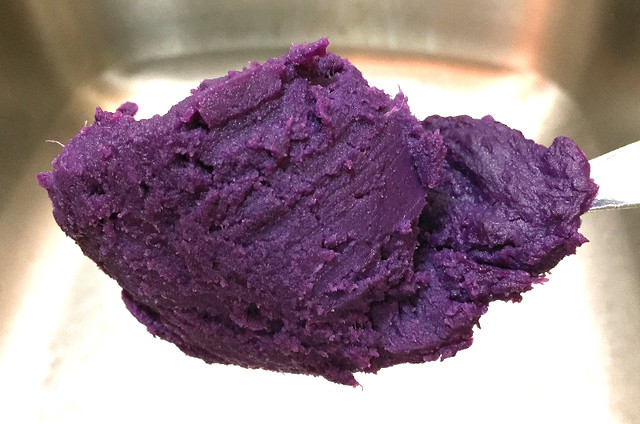
I was really hoping that the fantastic purple would come through, and I was happy to observe it in the batter, although it is diluted somewhat by the other ingredients.

Upon baking, though, I was highly disappointed by the colour. As it cooked, the loaf just turned brown, so much so that it is visually more-or-less indistinguishable from a pumpkin or orange sweet potato loaf. Obviously, some kind of chemical reaction had occurred.

Cracks on the surface of the loaf did reveal an odd green, so I decided to investigate. (I like “investigating” food, since this usually means I get to eat it.)

When sliced, it’s interesting how the outside turned brown, but the inside turned a dark, rotten turquoise. Even though the bread is only an hour or two old, it looked like it had been moldering in a damp cellar for years. Sadly, when I ate this bread, my taste buds and nose warred with my eyes; each slice was delicious and moist, and smelled delicous, but my eyes kept warning me that it was rotten, so I couldn’t enjoy it very much. (I had a similar experience with scrambled eggs turned green with food colouring for a meal of Green Eggs and Ham for a celebration of Dr. Seuss’ birthday on March 2nd a few years ago.)

I found it interesting how each slice different in its green shade, with the ones closest to the heel of the loaf being mostly brown, and the ones closer to the center of the loaf being mostly green, except for the edges.

All in all, this didn’t turn into the purple bread that I was hoping for, but as it stands, sweet potato bread made with purple sweet potatoes does have possibilities as Hallowe’en party food. That’s the one time of year that food that appears rotten while remaining safe and tasty is actually a triumph.

Bread Basket

I’ve been working on my bread-making skills over the last few weeks, much to the happiness of my family; it generally makes the house smell great even when I fail. For these experiments I have been relying predominantly on World Breads: From Pain de Campagne to Paratha by Paul Gayler (2006). It’s not a very long book (it’s subtitled “a small book of good taste”), and I’m determined to make my way through it recipe by recipe.

Broa (Portuguese Country Bread)
World Breads, page 16

This isn’t a kind of yeast bread I’d ever had before, although in texture and flavour it greatly resembled the cornmeal muffins that we eat here around Christmas. To my taste, this recipe needed either a little more sugar or a little more salt… I need more experience to figure out which, but I’m leaning more toward salt, since the recipe (and many other perfectly good ones) don’t call for sugar at all.

Dill and Curd Cheese Bread
World Breads, page 41

This bread was absolutely delicious, needing no tweaking, and I would make it again in a heartbeat. There’s not enough curd cheese (I used ricotta) to make it greasy; rather, it adds a touch of moisture and helps the bread be light and fluffy.

The dill bread recipe makes two loaves, and my family didn’t have a chance to finish it all before it started to go stale. I suppose we could have just toasted the last few slices, but instead I decided to leave them out overnight so they’d become properly hard. Then I put the slices into a plastic zipper bag and crushed the bread in the bag with a rolling pin to make fine bread crumbs. I had a bit of fresh dill left over that needed to be used, so I chopped that and added it to the bread crumbs. I then beat a couple of eggs, dipped the tilapia fillets in the egg, then dipped them into the bread crumb mixture, and fried it all lightly in a drizzle of olive oil in a nonstick pan. I served it with steamed bok choy and penne with pesto, and it was delicious.

Oatmeal Bread
World Breads, page 25

I liked the texture and heft of this bread; it was particularly good for sandwiches. However, this one too was lacking either salt or sugar to my taste, so I will have to adjust the recipe next time to see if that helps.

Seeded Granary Baton
World Breads, page 16

This loaf was full of all the seeds and heavier flour that I love in a breakfast bread, but I planned this bake very badly, as I couldn’t properly enjoy it after having just had dental work done that day. Even so, it was very tasty — I just had to be very careful how I chewed. I like that the grains/seeds can be varied to change the texture and flavour; the original recipe calls for sunflower, pumpkin, and sesame seeds (pepitas), but I would enjoy trying it with all of the interesting seeds that are available at the local bulk store.

White Soda Bread
World Breads, page 12

Wow, did I ever mess up this bread. I didn’t flatten it enough, so the center wasn’t cooked through. I cut the slashes too deep, so the bread opened up like a facehugger egg from Alien. And somehow I made a mistake with the mixing, so that instead of a nice, smooth crust, I ended up with something that strongly resembled cellulite. The flavour, for those parts that were cooked through, was quite nice, so I think I shall try it again with my newly-acquired knowledge of what not to do.

Whole Wheat Bread
Joy of Cooking, 2006 edition, page 599

I was craving a simple whole wheat loaf, so I veered away from my quest to finish all the World Breads recipes. This recipe is from my trusty standby, the Joy of Cooking. The texture and flavour of the loaves was quite nice. However, I discovered that there is a typo in my copy, one that was corrected in the more recent digital edition (which I did finally break down and buy). At the start of the recipe, it says that it should yield three 9″x5″ loaves. Yet at the end of the recipe, it instructs the cook to “allow the dough to rise in a large oiled bowl until doubled, about 1 hour, and once in 2 greased 9 x 5-inch loaf pans until doubled, about 45 minutes”. Basically, it says that the recipe yields both two or three loaves, which is definitely an error. I flipped a coin and went with two loaves, and the end result was that the loaves were huge. I had to cook them for about 15 minutes longer than indicated so that they sounded hollow when I tapped the bottoms. Next time I’ll split it into three loaves — even though the digital version says to make two loaves as well.

Sunday Dinner

Yesterday was Sunday, and that meant Sunday Dinner over at my parents’ house, in quasi-British style. It’s not something we do every weekend, but it is a regular enough event. My parents made a lovely roast beef, potatoes and carrots — and of course the always-delicious Yorkshire pudding. Now, I can’t make a tasty roast to save my life (mine are always dry, tasteless, or both), but I wanted to contribute to the meal. I woke up this morning figuring that some baking was in order.

I picked up a copy of Bread for All Seasons (1995) by Beth Hensperger a few days ago at a thrift shop, and I was dying to try out some of the recipes. My choice for dinner was Sweet Potato Cloverleafs (page 114).

The dough isn’t nearly as orange as one might think it should be, and that’s because I didn’t use an orange-fleshed sweet potato, which is usually the most common kind around here. I used a Japanese Murasaki sweet potato, which has purple skin and white flesh. These were mislabeled at the grocery store as purple sweet potatoes — when you label a sweet potato by colour, it’s supposed to be by the colour of the flesh, not by the colour of the skin. I was looking for a sweet potato with purple flesh, like the Okinawa sweet potato (which has tan skin), or the purple-skinned, purple-fleshed variety that I finally found at the local Asian market, which was also labeled “purple sweet potato”.

While I have read complaints that the Murasaki sweet potato is stringy and not at all flavourful, it did its job just fine in the context of these buns, which was to provide moisture. The cloverleafs were light and fluffy, with a hint of orange that cut through the heaviness and grease of a meal of roast and gravy. I’ll definitely be making these again — perhaps with truly purple sweet potatoes, just for the colour.

I thought I should also contribute to dessert. My youngest daughter had taken Amelia Bedelia Bakes Off (2010, Chapters.ca, Amazon.com), and at the back of the book there is a recipe for Amelia Bedelia’s Sheet Cake. (You can find the recipe via Desktop Cookbook.) Well, I didn’t want a sheet cake, but cake batter works just as well for cupcakes. The directions say to mix all the ingredients together with a fork in the baking pan, but I didn’t want to spend all day mixing. I used a plastic bowl and an electric hand mixer instead, and then I doled out the batter into muffin tins.

I found it interesting that this recipe had no animal ingredients, and could even be vegan if you sourced your supplies carefully. Not that I am a vegan, but I do occasionally cook for them. I also thought that the leavening agent was interesting: baking soda and vinegar. I’d never baked a cake with vinegar in it before, but it makes sense that baking soda and vinegar would create the gas necessary to cause the batter to rise.

I ended up with 24 cupcakes, and I had to bake them for 20 minutes for them to be cooked through. The cupcakes were a very dark brown, almost black; they are so dark that my hubby thought I might have burned them, even though they are totally soft. I’m not sure if the deep colour is caused by the kind of cocoa I used, or if it’s just because there’s 2/3 cups cocoa in there. It may be a combination of both factors. I don’t think my kids would complain if I tested the theory and made them again with a different kind of cocoa. They were a pretty solid hit.

Joy of Cooking

If I had to recommend only one cookbook, it would be the Joy of Cooking (available via Chapters.ca, Amazon.ca, and Amazon.com, and now there’s even an an app for that). This cookbook has been around since 1931 and it remains an indespensable resource. I like to give it as a sending-off or housewarming gift for young adults setting up their first place. I always keep an eye out for extra copies at thrift stores and garage sales — and although it’s not a common find (most people keep theirs even if they’re decluttering), it has been in print for eigty-six years now so there are many copies out there. My mother has the 1981 edition, which is the copy I grew up with, and after I moved out on my own I bought a 75th anniversary edition (2006).


Fast Whole Wheat Bread.

Over the last decade or so, secure in what I thought was a decent grasp of the basics, I was often tempted away from my Joy of Cooking by the Internet, library books, and my own fairly substantial collection of cookbooks. It’s just been in this last year or so that I’ve gone back to using it on a regular basis, mostly because I am determined to learn new techniques and recipes in order to break free from the slog of same-old, same-old. What I know off by heart about cooking is only a small fraction of this book. When I decided to learn how to bake my own bread (which, quite frankly, I found intimidating), I went back to my trusty standbyes.


Fast Whole Wheat Bread with homemade apple butter.

The first bread I tried from the Joy of Cooking was Fast Whole Wheat Bread (page 599, 2006 edition). It wasn’t nearly as intimidating as I’d feared. I think for health’s sake I’d like something with a higher ratio of whole wheat flour to white flour, but I have no complaints about the taste or the texture of the bread. It was quickly devoured with homemade apple and pumpkin butters, mostly by my children. (Although, let’s be honest, my parents love it when I try out new recipes, because they generally get to try some as well.)

My mother had also mentioned that she’d been craving lemon poppyseed bread, and so, emboldened by my success with the bread, I whipped up the Lemon Poppy Seed Muffins (page 635, 2006 edition). I didn’t have any fresh lemons, so I substituted lemon juice, and they turned out delicious anyway.

Now that I’ve been using the Joy of Cooking more often again, I think I may invest in a digital copy (which contains the entire 2006 edition and then some). I love my hard copy, but I think being able to refer to it quickly while grocery shopping would be extremely useful. Just last week I found ostrich and boar on sale at the grocery store, and I had to Google how to cook them. Ostrich is on page 453 and boar is on page 530 in the edition I own, as it turns out.

Valentine’s Day Cookies: Cookie Monster’s Famous Cookie Dough

My girls wanted to bring cookies for their classes for Valentine’s Day yesterday, so that meant breaking out the recipe for Cookie Monster’s Famous Cookie Dough. This is a recipe that I’ve been using since I was a child — actually, that’s probably what we were cooking in the first picture of my introduction post. In my post-childhood but pre-Internet days, my family lost the recipe, but these days the recipe can be found online via TheKitchn.com.


This dough isn’t just for Valentine’s Day; in this photo we were using the recipe for Christmas cookies.

According to my research online, apparently the recipe first appeared in Big Bird’s Busy Book in 1975, which is not where I found it. Family photos reveal that we had The Sesame Street Treasury: Volume 1 (1983), on which the first part of the recipe is printed on page 6. Presumably the cooking instructions are in a later volume. The recipe was also printed The Sesame Street Library: Volume 1 (1978), with the basic recipe on page 7 and the baking instructions on page 26, under the title Cookie Monster’s Shape Cookies.


Heart cookies before baking.

I was lucky enough to snag both a copy of Vol. 1 of the Treasury and the Library a few weeks ago from a thrift shop. There were a few more volumes there, including The Sesame Street Treasury: Volume 5, which I clearly remember reading as a child. This volume has Cookie Monster’s Cookie Faces on page 27. This is a continuance of the Famous Cookie Dough recipe and also contains baking instructions.


Heart cookies after baking.

This recipe is very forgiving and, as such, is a great recipe to do with children. The dough can be rolled and re-rolled with impunity as the kids cut out the shapes. For fluffiest results, refrigerate the prepared cookies on a baking pan for an hour or more before baking. If you do so, you may need to add a minute or two to the cooking time so that they are done all the way through.


My girls painting their Christmas cookies two years ago.

One thing you may note is not in the original recipe is the coloured glaze — although that’s clearly what I was painting on in my childhood photo. (TheKitchn.com recommends sprinkling them with sugar before baking, which would be good too.) I’m not exactly sure why we started painting the cookies. Perhaps the instructions were in another volume of the Treasury that I haven’t yet found as an adult? The “paint” is very simple: for each colour, separate an egg into two bowls or small containers. Mix a couple of drops of different food colouring with each part of the egg, and then paint onto the cookie before baking. I find that the yolk makes the most saturated colours, but since it has a yellow base it’s hard to get colours like blue (which will mix to create green). Adding a few more drops of food colouring can help “overpower” the yellow. (If for whatever reason you can’t use food colouring, natural colours work as well. For example, a few drops of beet juice can yield an amazing colour.)

Painting the cookies was my favourite part of the process as a child, and is my kids’ favourite part as well. As a bonus, glaze doesn’t make nearly as much of a mess as icing when the kids eat the cookies. Do keep in mind that the glaze will crack when baking because the cookies do expand, so there’s no point in being too precise. Save the fine detail for fancy cookies that are iced after they’re baked.

World Breads: German Beer Bread

Last winter I had the chance to visit Hamburg, Germany for a week while my husband was there on business. My husband’s mother’s side of the family is German (although not from the Hamburg area), and I thought it would be a great chance to experience first-hand the culture in which she was raised. After all, my children share that side of the family’s German heritage. One day they will want to know more about where they come from, and I think it’ll be better if I know a bit more about it myself.


Cream of mushroom soup in a bread bowl.

One of the things I loved about Germany was the food. German food has a really bad reputation, if you ask me. Yes, it was hearty fare, but I was there in the winter and I found it hit the spot after wandering around in the cold. I especially liked the proliferation of bakeries. They seem to be on every corner, and they all serve delicious food. I especially liked Nur Hier (which translates to “only here” according to Google). There was a Schanzenbäckerei (“bows bakery”?) across the street from my hotel, which was great convenience-wise, but I made a point of walking further to Nur Hier because their food was that much tastier.


Nur Hier at Lange Reihe 48, 20099 Hamburg, Germany

Of course, when I got back home to Canada, there weren’t any good German bakeries to be had. No German bakeries in Ottawa at all, so far as I can tell. Although the local grocery store has a few varieties of German bread, it’s nothing compared to the fresh café fare that I enjoyed overseas. So I decided to try my hand at making my own bread. I picked up World Breads: From Pain de Campagne to Paratha by Paul Gayler (2006) at a thrift shop on a whim a while back, and inside (page 19) there’s a recipe for German Beer Bread.


German Beer Bread (Beer Brot)

It turned out pretty well considering it was the first proper loaf of bread I’d ever made on my own. Sure, it wasn’t symmetrical, but it was tasty and paired well with lunch meats and cheese. It’s a light rye with caraway seeds, which is more or less what I’d buy at the grocery store, but so much fresher because it’s homemade. Baking it also made my house smell absolutely wonderful. This is one recipe that I know I’ll be making again.