Double-Layered Tuque Pattern

I finished up a second of my extremely-warm double-layered winter hats the other day, this time for Thing 1, and I thought I’d share the pattern. It’s a pretty easy one, as such things go. It involves the basic techniques of casting on, casting off, knitting, purling, increases (k1fb — knit one front and back), decreases (k2tog — knit two together), and knitting in the round (I prefer the magic loop technique, but whatever you are most comfortable with is fine). Don’t let the seemingly long pattern deter you! It’s mostly because the pattern contains a flat-brim and a ribbed-brim version.

A note about sizing: this hat is made to fit my 23″ head with room for a ponytail or other hairdo underneath. I’m no Brent Butt (who claims to have a 27″ head), but my head’s still large enough that it generally falls outside of the women’s hat sizing category and smack-dab into the men’s. Don’t worry, this pattern is adjustable to the size that you want it; instructions are below.


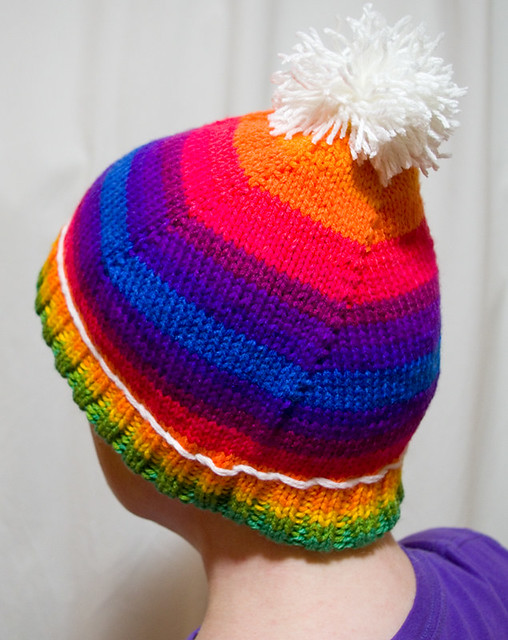
Left: plain brim hat knit in Polo Stripe colourway
Right: ribbed brim hat knit in Favorite Stripe colourway

Double-Layered Tuque
Adult male size, fits 23″ to 24″ circumference head

Materials:
– one 141g (5oz), 215m (236 yds) ball of Red Heart Super Saver Stripes yarn (100% acrylic)
– for ribbed-brim hat only: scraps of contrasting yarn for stitches & pompom
– one set of 5mm (US 8, UK 6) circular knitting needles in a length comfortable for the magic loop method (I prefer 120cm/47″ or longer)

Gauge:
– 21 stitches and 27 rows in stockinette stitch = 20cm x 20cm (4″ x 4″) square on 5mm (US 8, UK 6) needles

Instructions:

Cast on:
– Cast on 18 stitches (flat brim) OR 24 stitches (ribbed-brim).
– Place half of the stitches on each half of the circular needle so as to use the magic loop method.
– Join to work in the round, being careful not to twist.
– Knit one row, placing a stitch marker after every third (flat brim) OR fourth (ribbed brim) stitch. This will divide your work into six sections.

Increase the Crown Exterior:
– First row: *Knit until one stitch before first stitch marker. K1FB on the stitch before the stitch marker. Repeat from * until row is complete. (Every row like this will increase your work by 6 stitches.)
– Second row: Knit.
– Repeat first and second rows until you have 57 stitches per side (flat brim) OR 60 stitches per side (ribbed brim)

SIZING NOTE:

This is where you can adjust for head size. Once you have established your gauge, which you can do either with a swatch or by measuring your stitches as you go, you can calculate how many stitches you will need in total. Use one of the following formulae, depending on whether you’re measuring in metric or imperial:

(Head Circumference + 2.5cm) X Number of Stitches per CM = Desired # of Stitches

OR

(Head Circumference + 1″) X Number of Stitches per Inch = Desired # of Stitches

Then, round the stitch number up to the next multiple of six. It gets a bit more tricky for the ribbed brim version, which must also be divisible by four.

Knit the Body:
– Use a piece of differently-coloured yarn or a safety pin to mark the row where the increases end.
FLAT-BRIM:
– Knit until body measures 9cm (3.5″) from end of increases.
– Remove increase marker.
RIBBED-BRIM:
– Knit until body measures 5cm (2″) from end of increases.
– K2, P2 for and additional 3.8cm (1.5″).
– Remove increase marker.

Decrease:
FLAT-BRIM:
– Divide the number of stitches on each needle by three, and place a stitch marker after each group. Knit the next round, knitting two stitches together for the two stitches before each stitch marker. There should be 54 stitches on each needle.
RIBBED BRIM:
– Divide the number of stitches on each needle by two, and place a stitch marker after each group. Knit OR purl two stitches together, depending on what that stitch should have been in the normal order of K2, P2. There should be 58 stitches on each needle.
– Use a piece of differently-coloured yarn or a safety pin to mark the row where you made these decreases.

Knit the Body Lining:
FLAT BRIM:
– Knit until interior body measures 9cm (3.5″) from decrease marker.
– Remove decrease marker.
RIBBED BRIM:
– K2, P2 for 3.8cm (1.5″) from decrease marker.
– Knit for an additional 5cm (2″).
– Remove decrease marker.

Decrease Lining:
– Divide the number of stitches on each needle by three. For the flat-brimmed hat, unless you have adjusted for size, that means each group should be 18 stitches. For the ribbed-brim hat, the number will not be even. If you have not adjusted for size, divide the stitches 19-19-20. If you have adjusted for size, try and make the groups as even as possible.
– First row: **Knit until two stitches before first stitch marker. K2tog on the two stitches before the stitch marker. Repeat from ** until row is complete. (Every row like this will decrease your work by 6 stitches.)
– Second row: Knit.
– Repeat first and second rows until you have 12 stitches per side (flat brim) OR 18 stitches per side (ribbed brim).
– Cast off, leaving a long tail.

Finishing:
– Run the tail of yarn through the cast off stitches and draw tight, tying a secure knot.
– Run the other tail of yarn through the cast on stitches and pull tight, tying a secure knot.
– Fold the lining into the exterior of the hat so that the cast off and cast on stitches touch, back to back.
– With a few stitches of one of the yarn tails, secure the two ends of the hat together at the point. Tie one tail to the other and pull them between the two layers of fabric.
– Create a pompom out of the leftover yarn (flat brim) or out of scrap contrasting yarn (ribbed brim). Stitch it to the exterior of the peak of the hat.
– About 1cm (about 0.5″) from the bottom edge of the hat (flat brim) OR along the edge of the ribbing (ribbed brim), stitch leftover/contrasting yarn every second stitch, affixing the lining to the exterior of the hat. Then run a piece of leftover/contrasting yarn through these stitches, creating a continuous line. Make sure that these stitches are not too tight, so as not to be uncomfortable around the ears. Tie off the yarn and run it between the two layers of fabric, snipping off any extra if it protrudes.

As usual, should you note any errata in this pattern, or if any instructions need further clarification, please let me know so that I can fix it and/or make my instructions more clear!
Smelly Socks Pattern

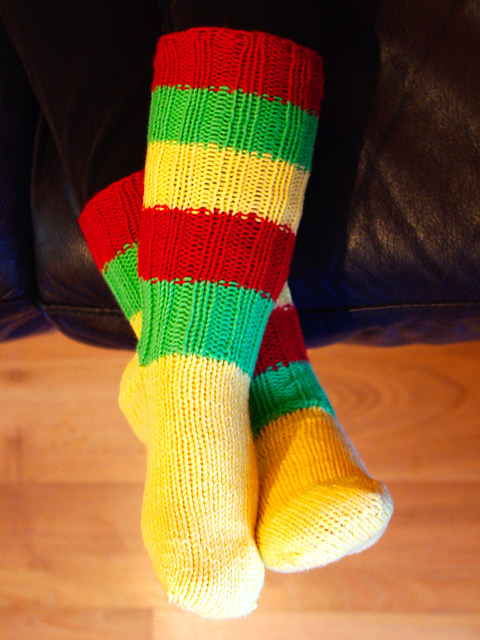
Way back when Thing 1 was only three years old and not reading by herself yet, her favourite book for quite some time was Smelly Socks by Robert Munsch (2004). I must have read that book to her a thousand times. I was raised on Munsch classics like The Paper Bag Princess Love You Forever, so I didn’t really mind.

Smelly Socks tells the tale of a girl named Tina who begs her grandfather to take her across the river to a big sock store to buy some fancy socks. She finds herself the perfect pair of red, yellow and green socks, and she cries, “Socks! Socks! Wonderful socks! I am NEVER going to take them off!” Of course, the longer Tina wears the socks, the smellier they get, until her friends get fed up and drag
her down to the river to give those socks a good washing.

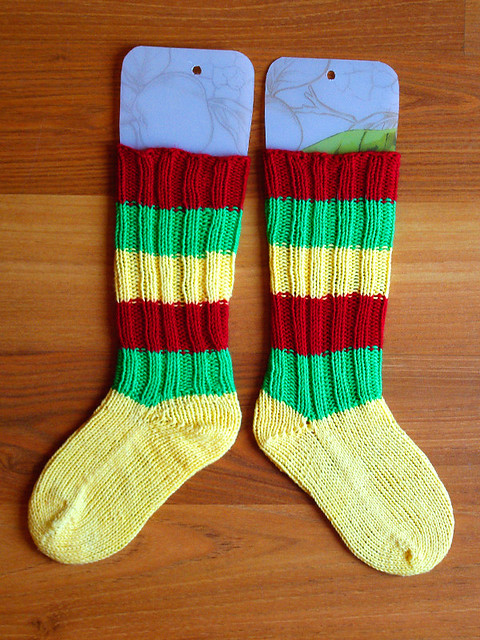
Thing 1 wanted Smelly Socks of her very own, so I just had to knit her some. (You can see the titular socks on the cover of the the book.) Over the years, those socks were worn by both of the girls, and they still never wore out! Since they’re much too small for either kiddo any more, they’re currently stored in a box of keepsakes. I thought I would share my old pattern for the socks so that other people can make keepsakes of their own.

Smelly Socks
Preschooler size; approximately children’s size 8 CDN/US

Materials:
– one ball Mandarin Petit in Yellow 2004 OR Goldenrod 2315
– one ball Mandarin Petit in Cardinal 4418
– one ball Mandarin Petit in Green 8017
– one set of 3.25mm (US 3, UK 10) circular knitting needles in a length comfortable for the magic loop method (I prefer 120cm/47″ or longer)

Each ball of Mandarin Petit is by Sandnes Garn of Norway is 100 % Egyptian 4ply cotton, weighs 50g (1.764oz), measures 180m (196.85’), and is machine-washable (air dry flat). A different yarn of the same gauge may be substituted to yield the same results.

Gauge:
– 16 stitches and 20 rows in stockinette stitch = 5cm x 5cm (2″ x 2″) square on 3.25mm (US 3, UK 10) needles

Instructions:

Cast On:

– Using the YELLOW yarn and the magic cast-on for toe-up socks technique, cast on 24 stitches divided onto two needles (12 stitches per needle).
– Knit one round. Warning: Using the magic cast-on, the cast-on loops on your second needle will be twisted. To untwist, knit the stitches on this needle through the back of the loops on the first round only.

Shape toe:
– Round 1: On each needle, K1, M1, K to within last stitch on the needle, M1, K1.
– Round 2: Knit
– Repeat these two rounds until there are 40 stitches on your needles (divided 20-20).

Make instep:

– Knit every stitch in the round until sock measures 11cm from cast-on edge to end
to the last knit stitch.

Arrange heel stitches:

– Knit across 1st needle. The heel will be turned on the 20 stitches of the 2nd needle.

Set up short row heel:

– 1st row: (RS) K19. Move working yarn as if to purl. Slip 1. Turn.
– 2nd row: (WS) Slip 1. This will wrap the yarn around the first, slipped stitch. P18. Move working yarn as if to knit (“wrap”). Slip 1. Turn.
– 3rd row: (RS) Slip 1. K17. Wrap. Turn.
– 4th row: (WS) Slip 1. P16. Wrap. Turn.
– 5th row: (RS) Slip 1. K15. Wrap. Turn.
– 6th row: (WS) Slip 1. P14. Wrap. Turn.
– 7th row: (RS) Slip 1. K13. Wrap. Turn.
– 8th row: (WS) Slip 1. P12. Wrap. Turn.
– 9th row: (RS) Slip 1. K11. Wrap. Turn.
– 10th row: (WS) Slip 1. P10. Wrap. Turn.
– 11th row: (RS) Slip 1. K9. Wrap. Turn.
– 12th row: (WS) Slip 1. P8. Wrap. Turn.

This should yield 6 wrapped stitches, 8 “live” (unwrapped) stitches, and 6 more wrapped stitches, for a total of 20 stitches on the 2nd needle.

Turn short row heel:

– 1st row: (RS) K8. Pick up (PU) the wrap and next stitch and knit them together. Wrap the next stitch so that it now has two wraps. Turn.
– 2nd row: (WS) SL1 (double-wrapped) stitch. P9. PU wrap and next stitch and purl them together. Wrap the next stitch so that it now has two wraps. Turn.
– 3rd row: (RS) SL1 (double-wrapped) stitch. K10. Pick up (PU) the wrap and next stitch and knit them together. Wrap the next stitch so that it now has two wraps. Turn.
– 4th row: (WS) SL1 (double-wrapped) stitch. P11. PU wrap and next stitch and purl them together. Wrap the next stitch so that it now has two wraps. Turn.
– 5th row: (RS) SL1 (double-wrapped) stitch. K12. Pick up (PU) the wrap and next stitch and knit them together. Wrap the next stitch so that it now has two wraps. Turn.
– 6th row: (WS) SL1 (double-wrapped) stitch. P13. PU wrap and next stitch and purl them together. Wrap the next stitch so that it now has two wraps. Turn.
– 7th row: (RS) SL1 (double-wrapped) stitch. K14. Pick up (PU) the wrap and next stitch and knit them together. Wrap the next stitch so that it now has two wraps. Turn.
– 8th row: (WS) SL1 (double-wrapped) stitch. P15. PU wrap and next stitch and purl them together. Wrap the next stitch so that it now has two wraps. Turn.
– 9th row: (RS) SL1 (double-wrapped) stitch. K16. Pick up (PU) the wrap and next stitch and knit them together. Wrap the next stitch so that it now has two wraps. Turn.
– 10th row: (WS) SL1 (double-wrapped) stitch. P17. PU wrap and next stitch and purl them together. Wrap the next stitch so that it now has two wraps. Turn.
– 11th row: (RS) SL1 (double-wrapped) stitch. K18. Turn.
– 12th row: (WS) SL1 (double-wrapped) stitch. P19. Turn.
– 13th row: (RS) K20. Pick up one stitch from the gap between Needle 1 and Needle 2.

Set up body of leg:

– Return to knittng in the round.
– 1st round:
– 1st needle: Pick up 1 stitch from the gap between Needle 2 and Needle 1. K20. Pick up a stitch from the gap between Needle 1 and Needle 2. (22 stitches on Needle 1.)
– 2nd needle: Pick up 1 stitch from the gap between Needle 1 and Needle 2. K10. Switch to GREEN yarn. K9. K2 tog. (21 stitches on Needle 2.)
– 2nd round (you are now using GREEN yarn):
– 1st needle: K2 tog. K18. K2 tog. (20 stitches on Needle 1.)
– 2nd needle: K2 tog. K19. (20 stitches on Needle 2.)

Knit body of leg:
– K2, P2 on each needle until green stripe measures 3.5cm (1.4″) high. Switch to RED yarn.
– K2, P2 on each needle until red stripe measures 3.5cm (1.4″) high. Switch to YELLOW yarn.
– K2, P2 on each needle until yellow stripe measures 3.5cm (1.4″) high. Switch to GREEN yarn.
– K2, P2 on each needle until green stripe measures 3.5cm (1.4″) high. Switch to RED yarn.
– K2, P2 on each needle until green stripe measures 3.5cm (1.4″) high. Cast of loosely, or using a stretchy bind-off.

Repeat pattern in full to yield a second sock. Voila!

As usual, should you note any errata in this pattern, please let me know so that I can fix it. I don’t exactly have a bevvy of test knitters to help me catch mistakes.

Knitting For Myself

I don’t knit for myself very often. I always have approximately a million of ideas of things that I’d like to make for other people, but inspiration often fails me when I turn my attention to something I might want. But over the Christmas holidays, after the main celebrations, I finally had a chance to sit down, binge some Netflix (loved the first season of The Punisher and the latest season of Black Mirror, in addition to the 7 Sisters movie), and knit a few things for myself.

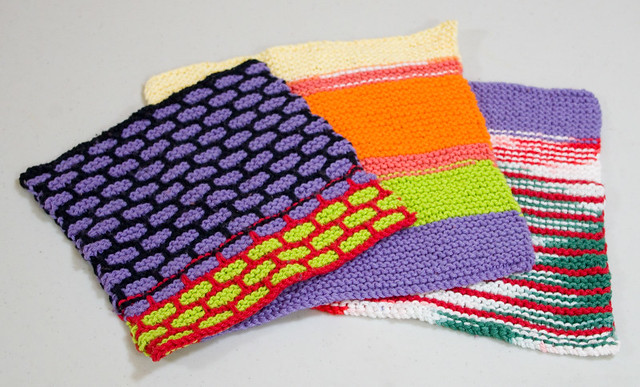
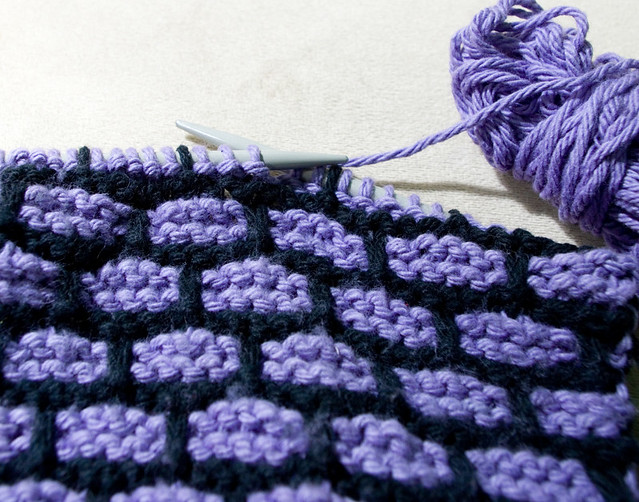
First, I wanted to use up the odds and ends of Bernat Handicrafter Cotton Yarn left over from making cloths throughout the fall. I made at least two dozen as gifts for friends, family, and my kids’ teachers. All of those ones had lovely, coordinating colours — leaving me to make ugly, mismatched cloths for myself. I thought I had enough Black Licorice and Hot Purple to make a Brick Stitch Dishcloth, but as you can see I ran short, so I just went with 45-stitch knit squares for the other ones. How they look doesn’t matter too much to me, though, since they’re just going to be used for cleaning up messes.

The second thing I knit was a hat from the Red Heart Super Saver Stripes in Favorite Stripes that I got in my Christmas stocking. I thought that something especially warm was in order since we’ve been seeing record-setting cold here lately; New Year’s Eve it went down to –28.6°C (-19.5°F) before wind chill, the coldest it’s been in 71 years. I whipped up double-layered rainbow tuque, using all but the last few meters of one ball of yarn. The hat is so thick and comfy that it muffles sound significantly when you put it on! I used some scraps of white yarn from my stash to make a pompom and to do the accent stitching. I finished it last night right before bed, and my timing couldn’t be better. The temperatures had dropped again from a relatively comfortable -5°C-ish (23°F-ish) during the day to a nighttime temperature of -20°C (-4°F), -32°C (-25.6°F) with the windchill. This is the kind of weather where the air hurts your face as soon as you walk outside, so anything to help prevent frostbite is a plus.

Christmas Gifts

I received some absolutely lovely Christmas gifts this year from friends, family, and Santa Claus. Some of the gifts would likely be of interest to other crafty- and foodie-types. My brother gave me one of those fantastic crocheted knight helmet hats and the previously-mentioned Jamie Oliver 5 Ingredients Quick & Easy Food cookbook (Jamie Oliver, 2017). My husband gave me a copy of How to Cook Indian by Sanjeev Kapoor (2011). Santa brought me some lovely worsted-weight variegated yarn, which I am currently turning into a hat. My parents bought me a funny (and very accurate) Procrasti-knitter T-shirt from White Owl Crochet.

But I do have a weakness for handmade items that combine practicality with beauty, and this year my parents picked out some absolutely lovely pieces for me. The first is a pair of wine tumbler/tea bowls from Greig Pottery. The one on the right is patterned with lupins, which is a flower that I first fell in love with on a trip to Newfoundland with my mom about eight years back. In shape and size, these vessels remind me of Japanese teacups, although they are intended for both hot and cold beverages (so far as I know, you’d never have a cold beverage in this kind of cup in Japan). They fit comfortably in my hand and the little indents — one on either side — are perfectly placed for my thumb and forefinger. As a bonus, they’re both microwave and dishwasher safe. I can’t wait to use them, possibly for some rum and eggnog before the season is over.

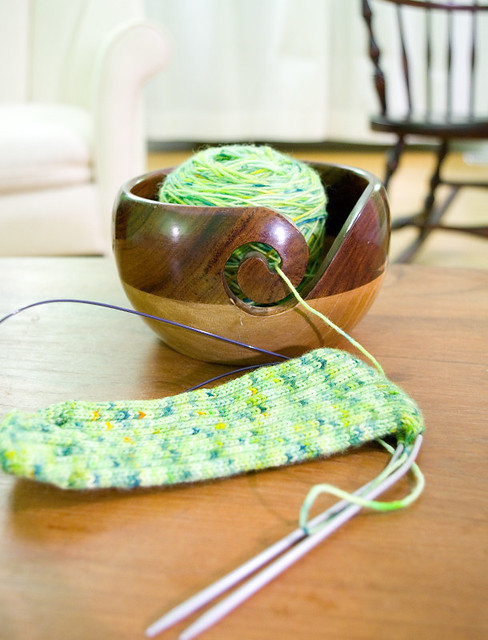
Mom and Dad also gave me this gorgeous two-tone rosewood & mango wood yarn bowl from Knitpicks. They actually gave me two hand-potted yarn bowls (in different sizes, for different-sized balls of yarn) last year for Christmas, but my kids managed to smash both of them on the same day. Needless to say, I was not amused, as the bowls sat on the table in the living room where the kids aren’t supposed to be playing in the first place. I was very vocal (possibly too vocal) about how much I missed the old bowls, so Mom actually hopped onto the Internet and ordered me a new one — one that, it should be noted, should be much more difficult to smash. Touch wood. I love the glassy-smooth finish of the wood; when I got the bowl, I couldn’t stop running my hands over it. I was especially proud of my mother for ordering it for me, since she had never before shopped online on her own, usually getting my brother or I to order things for her. I don’t see an Amazon Prime account in her future, but I like that Mom is now able to put aside her worries about online shopping, at least for items that she can’t get in town.

I want to take this opportunity to say a sincere thank-you for all of my gifts this holiday season. Although, as Garfield points out in the Christmas special that we watch every year, it’s not the giving, it’s not the getting, it’s the loving.

Busy Night

I had a billion and one things to accomplish yesterday evening, most of which I can’t even write about because they had to do with Christmas gifts for people that I know read this blog. One thing I can mention is that I did get the chance to put the last finishing touches on the Frankensteined gaming PC (made with excess parts graciously donated by our friends) that my husband and I are giving Thing 1 for Christmas. She doesn’t have Internet access yet, so here I can sigh with relief here about having at least one major gift out of the way.

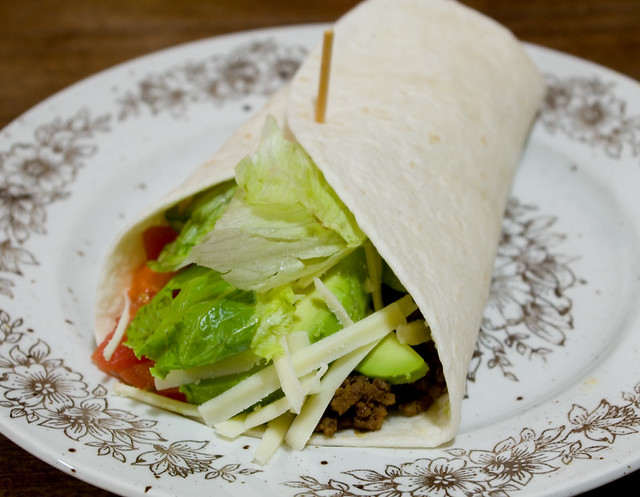
Dinner was a quick one, since I can only do so many things at once, and for a change the kitchen was not calling me. I wanted to eat at least somewhat healthily, so I made up some soft tacos with a pre-packaged spice mix. Well, I say “made up”, but mostly I just prepped all of the ingredients and set them out on the table so that everyone could fill their own tacos. I fixed mine up with spiced ground beef, avocado, lettuce, tomato, mayonnaise, and lactose-free cheddar. Also available on the table were sour cream (which I prefer over mayo, but can’t eat), homemade blender salsa canned earlier this year, and shredded cheddar cheese.

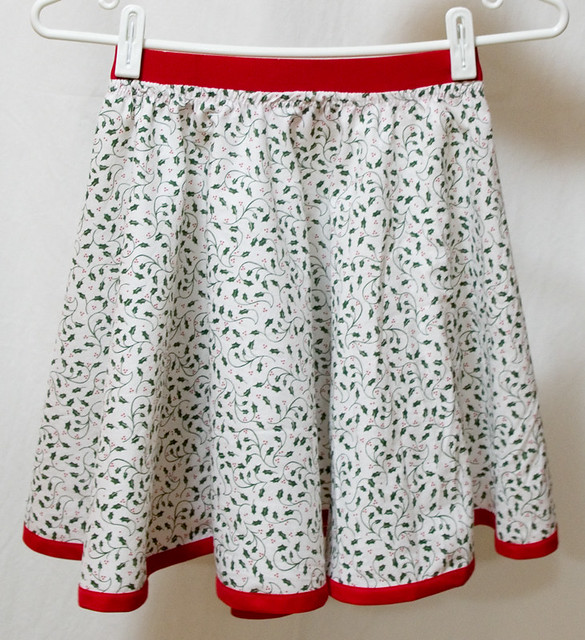
Dinner out of the way, I went on to work on some Christmas crafts. I whipped up my first-ever circle skirt for Thing 1 — which is even easier for a kid than for an adult since there aren’t any seams! A friend of mine recommended the following resources to me, which were invaluable:

Make a circle skirt without a pattern by Costuming Diary
Circle Skirt (and a follow-up instructional video by Made Everyday
The Best Way to Sew Bias Tape by Positively Splendid

I combined the techniques because I wasn’t working with a serger, and because I wanted a finished waistband edge but I also wanted the cute red elastic to show. This skirt will be worn later in the week when the girls go get their pictures taken with Santa. I still have to make a second, smaller one for Thing 2. Hopefully I can make the time tomorrow.

In every spare minute, I’m knitting away on cloths to be given as gifts. I think of this colourway as “Evil Minion“. This is either the last or second-last one, depending on how much yarn I am left with. After that, it’s time to start on knitted owls for my girls’ Guiding leaders.

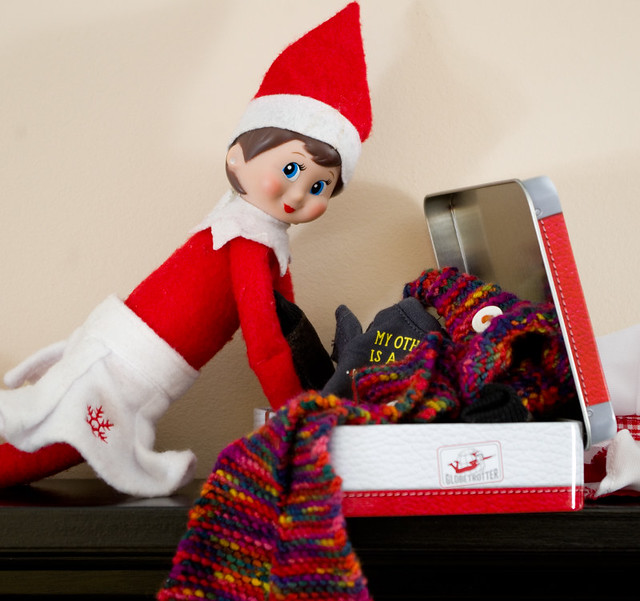
As we do every year, we have had a guest in our house starting December 1st. Candy Cane will stay until December 25th, at which point she will be whisked back to the North Pole where she will stay until next holiday season. Here she is unpacking all of her copious outfits. I know some people find The Elf on the Shelf kind of creepy, but my kids really love her and look forward to her annual arrival. We’ve never made a big deal of the “reporting back to Santa” aspect of the Elves at our house, so my kids just see her as another piece of Christmas magic.

Rip It, Rip It

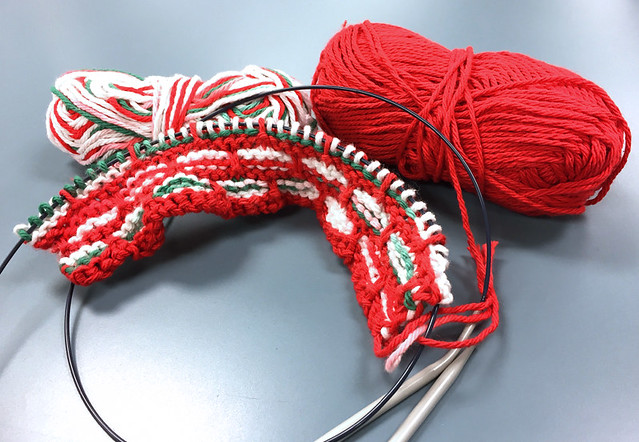
So I started up another Brick Stitch Dishcloth yesterday, this time in Christmas colours instead of Halloween. The variegated yarn contrasted so beautifully with the solid colour in the pattern’s photos that I was inspired to use red yarn alongside red/white/green multicolour yarn.

Well, that didn’t look nearly as nice as the pattern’s photos. It looked a hot mess, really, with the red from the variegated yarn blending into the solid red and confusing the pattern. I think that the operative word for a piece like this is “contrast”, i.e. the two yarns should not contain any of the same colours, although they should be complimentary.

I know a lot of people are probably thinking right now, “Who cares? It’s just a cloth. It will be used for wiping up messes and will probably be stained five minutes after it is first used.” That’s probably true. But I still care, I can’t help it. Perhaps I am too much of a perfectionist when it comes to knitting. I am the kind of knitter who will frog way back to a mistake even if it’s imperceptible to anyone but me — even if it’s “just” a cloth I’m knitting. (One of my absolute favourite bloggers, the Yarn Harlot, is this way, so I do not feel quite so alone.) I figure it could have been much worse, since I decided that I hated the colours/patterns together fairly early on in the project. Ah, well. Lesson learned.

Cloths

I’ve been laid up a bit lately, and I had to do something with my hands before I lost my mind. To that end, I picked up a bunch of Bernat Handicrafter Cotton Yarn in a variety of colours so that I could make some cloths. I love to make these to give away at Christmas; I figure that while they’re not terribly fancy, they’re a very practical gift — and you can never have too many.

I started with Bella Coco’s How To Crochet the Waffle Stitch tutorial. I cast on 34 stitches and worked the waffle pattern from there. I used, top to bottom in the photo above, Lemon Swirl Ombre, Poppy Ombre, Pale Yellow, and then Poppy Ombre again. I haven’t crocheted for years, but I found the tutorial laid everything out very clearly. The waffle pattern makes a nice, scrubby texture in this yarn that will be great for cleaning dishes.

I also knit some cloths using the free pattern on the back of the yarn ball band that’s also available for free online: the Brick Stitch Dishcloth. I’d never done this pattern before either, but I loved how it turned out. Now that the leaves are starting to change, I thought it would be fun to make some cloths in Halloween colours. They’ll probably be Christmas gifts too, but many of my friends would prefer these combinations anyway. I used Black Licorice with (from top to bottom) Hot Green, Hot Orange, Hot Purple, and Red.

Perfect Moment

I don’t believe that there is such thing as a perfect day, or a perfect week. Life being what it is, you can’t expect everything to go smoothly for that length of time — but I don’t think you should expect it to. Life is full of ups and downs. However, I think it’s important to recognize and appreciate when you have a perfect moment. This was one of mine:

I was sitting on the dock at the cottage with a good book, chocolate fudge zucchini cookies, and my knitting. We’d just been for a swim in the rather-cool lake, so I was enjoying the warmth of my hoodie. The girls were enjoying some quiet time of their own on chairs beside me, Thing 1 reading a book, and Thing 2 listening to music on her headphones. For a few minutes there was calm, peace, fresh air and a gorgeous view.

Then it was time to make dinner.

At The Park

There are a lot of public parks in the Ottawa area; a lot of them even have splash pads and water features. This means that if you’re looking to do something with the kids (or even just to get outside yourself), there is always somewhere to go and something to do — so long as it’s not pouring rain. I take advantage of this on a regular basis. My kids are old enough now to pop off together to the closest park for an hour or two. However, their range is pretty small (they only just learned to ride bikes without training wheels earlier this summer), and I wouldn’t feel comfortable with them going much further or crossing major roads alone in any case. So whenever it’s nice out and the girls are getting restless, I head out to a park.


Brewer Park


Knitting at Cardinal Creek Community Park. That day I was working on the start of an adult sock in Araucania Yars Huasco 100% extra-fine Merino wool (colour 101, dye lot 74403) on 3.5mm circular knitting needles.

We alternate between parks, sometimes staying close to home, sometimes packing a lunch and driving downtown or even across town to check out some new scenery. I stuff a novel, a knitting project, and my phone into my purse, which is enough to keep me entertained for hours. No matter where we go, I also have to bring about a tonne of sunscreen. It probably hasn’t escaped anyone that I’m a blonde and my kids are redheads, so sunscreen is not an option, it’s a necessity. The kids invariably come home soaking wet, exhausted, and happy. To me, that’s a successful summer day.

Janeway / Sisko Baby Sweater Pattern

As this week is the lead-up to ComicCon, I thought it appropriate that I re-post my pattern from my old blog for a Star-Trek-inspired baby sweater. Back in June of 2013, friends of mine were expecting their first child at any time, so I wanted to knit them an appropriately-geeky baby gift. The couple was particularly fond of Star Trek, specifically The Next Generation (TNG) and Deep Space Nine (DS9). I knew what I wanted to knit, but I couldn’t find an appropriate pattern online, so I had to come up with one myself. We didn’t know if the baby would be a boy or a girl, so I thought that a sweater based on a uniform would be most appropriate. Most notably, I used photos of Kate Mulgrew as Captain Kathryn Janeway and Avery Brooks as Captain Benjamin Sisko as references.


Sweater modeled by Thing 2, who was 18 months old at the time, and who comfortably wore a size 2. The sweater is a bit too short in the arms and body, as well as being snug. I would say it’s actually about a 12-18 month size, but as you can see, it does have some stretch.

I used Fringe Association’s tutorial for how to improvise a top-down sweater — which is full of invaluable information — as a basis for my pattern. I really needed the help, especially since at the time I’d only ever knit two other baby sweaters, and that was years prior. I had some difficulties with getting the sizing right, to start. The first two tries were disasters, the first yielding a neck that wouldn’t fit a preemie, and the second one that was too big for my four-and-a-half-year-old. Try three gave me the size I wanted: 12-18 months, with a nice stretchy neck and short collar to accommodate a baby’s big head and short neck.

Without further ado, here’s the pattern for a 12-18 month size for the sweater:

Janeway / Sisko Baby Sweater
Size 12-18 months

Materials
– 25g (half a 50g/125m (1.76oz/137yds) ball) of Debbie Bliss Baby Cashmerino in colour 340034 (cherry)
– 140g (just under three 50g/125m (1.76oz/137yds) balls) of Debbie Bliss Baby Cashmerino in colour 340300 (black)
– one set of 3.25mm (US 3, UK 10) circular knitting needles in a length comfortable for the magic loop method (I recommend 75cm/31.5″ or longer)
– 10 stitch markers

Gauge
– 29 stitches and 44 rows = 10cm x 10cm (4″ x 4″) worked in stockinette stitch

Instructions

Neck:

– Using the cherry yarn and the stretchiest cast on you know, cast on 80 stitches. Tillybuddy’s Very Stretchy Cast-On for Double and Single Ribbing is the best cast-on I’ve found for this.

– Divide the stitches so that there are 40 stitches on each needle.

– Being careful not to twist, join for working in the round.

– Work in K2, P2 ribbing for 2.5cm (1″).

Yoke:

– On each needle, place stitch markers as follows, with “|” representing a stitch marker, and the numbers enumerating the stitches:

4 | 2 | 28 | 2 | 4

– Additionally, add a different coloured stitch marker at the end of each row.

– Round 1: Knit until last stitch before first marker, KFB, knit until first stitch after second marker, KFB, knit until last stitch before third marker, KFB, knit until first stitch after fourth marker, KFB, knit to end of needle. Repeat for second needle.

– Round 2: Knit. This pattern will increase the number of stitches on each needle by four every two rounds.

– Repeat Round 1 and Round 2 until the sweater measures 9cm (3.5″) from the very start of the neck. Switch the yarn to black yarn in the middle of the back of the next Round 2.

– Continue repeating Round 1 and Round 2 until the stitches on each needle are divided as:

21 | 2 | 62 | 2 | 21

Separate the Body and Sleeves:

– Knit until you reach the first marker, remove the marker, and then knit one more stitch. Place a marker. Remove the next marker.

– Knit until you reach the next marker, remove the marker, and then knit one more stitch.

– Place the next 44 stitches on waste yarn, removing the markers as you go. (These will be for one sleeve.)

– Cast on 4 stitches, place a marker, cast on another 4 stitches.

– Knit until you reach the next stitch marker. Remove the marker, the knit one more stitch.

– Place the next 44 stitches on waste yarn, removing the markers as you go. (These will be for the other sleeve.)

– Cast on 4 stitches, place a marker, cast on another 4 stitches.

– Your stitch count should be as follows: 44 stitches on each piece of waste yarn for the sleeves, and 72 stitches on each side of what will now be the body.

Body:

– Knit until the piece measures 27cm (10.5″) from the very top of the neck.

– Work in K2, P2 rib for an additional 2.5cm (1″).

– Cast off loosely, but not too loosely. I like Jeny’s Surprisingly Stretchy Bind Off, but to keep the rib from flaring I only used it on the purl stitches, and I did a straight cast off on the knit stitches.

Sleeves:

– *Pick up the 44 stitches that were set aside for one sleeve on waste yarn, then divide them in half, putting half on each needle. Put a stitch marker between the halves.

– Pick up and knit 8 stitches in the armpit of the sleeve (where you cast on the extra 8 stitches for the body earlier).

– Place a marker halfway. This should yield you 52 stitches total (26 on each needle) on the sleeve.

– Knit the sleeve in the round until it reaches 14cm (5.5″) measured from the armpit.

– At the start and end of each needle, K2tog for one round. You should now have 48 stitches total (24 on each needle).

– Work in K2, P2 ribbing for 2.5cm (1″).

– Bind off in the same fashion as you bound off the body.**

– Repeat from * to ** for the second sleeve.

Finishing:

– Sew in ends.

– Give the whole sweater a hand wash and a good wet blocking.