Strawberry-Rhubarb Butter Recipe

One of my favourite things in the world to can is fruit butters, which are basically fruit that has been cooked, blended, and then boiled down to reduce the moisture content until the end result is smooth and spreadable. Simmering off the water increases both the flavour and the acidity, so fruit butters need less sweetening for taste or for preservation purposes. Fruit butters are a simple, wholesome kind of preserve that historically, in Canada, was a common way to make fruits last the winter. These days, they are made and eaten all year long, although most home canning happens in the summer and early fall when fruits are freshest and at their most plentiful.

Contrary to what the name may indicate, fruit butters actually don’t usually contain any dairy products, although some recipes call for a dollop of butter to prevent frothing (which I usually forgo and instead skim the froth). They are generally vegetarian and can be made vegan through proper sourcing of ingredients — as I’ve previously mentioned, some varieties of sugar use bone char as part of the filter process, so if that’s important to you, you’ll have to do your homework when choosing a brand to buy.


Strawberry-rhubarb butter will last up to a year when properly canned.

Fruit butters have easily as many uses as jams or jellies, including (but not limited to):

– a spread on bread, toast, or biscuits;
– a filling in donuts, cookies, muffins, croissants, turnovers, and tarts;
– a topping for ice cream;
– a mix-in for yogurt;
– a topping for pancakes or crepes;
– mixed with cream cheese to make a quick dip for fresh fruit or crackers; or
– an ingredient in fruit butter bread (apple being the most common)

Strawberry-rhubarb butter is the latest fruit butter I’ve made, and I’ve found that it perfectly encapsulates the tastes of late spring/early summer. Since the ingredients cook down, it’s a great way to use up rhubarb — especially if you’re searching for ways to use the stalks from an over-producing plant! I prefer to cook it in a combination of the microwave and the crock pot, because both are less prone to burning than cooking on the stove. The quickest way to ruin a batch of fruit butter is to scald it; you’ll never get rid of that burnt taste. If you choose to cook on the stove, you will have to watch your ingredients like a hawk, stir constantly, and adjust your cooking times. For these reasons, if you have a microwave and a crock pot, I highly recommend using them.


Strawberry-rhubarb butter on Dad’s biscuits.

Strawberry-Rhubarb Butter
Yields seven 250mL jars

Wash and chop until you have:
1Kg (about 8 cups) rhubarb, any variety
Place the rhubarb into a microwave-safe casserole dish with:
1/2 cup water
Cover and microwave in 3-minute increments, stirring every time you check for doneness, until the rhubarb are falling apart (approximately 15 minutes). Set rhubarb aside.
Repeat this process, cooking each fruit separately, with:
1.2Kg (about 8 cups) strawberries + 1/2 cup water
1Kg (about 8 cups) apples (any variety) + 1/2 cup water
While apples are cooking, put the rhubarb and its cooking liquid into a blender and blend until smooth. Pour rhubarb puree into crock pot. Repeat puree step with strawberries and their cooking liquid, and when they are cooked, the apples and their liquid.
To the crock pot add:
400g sugar (about 1 3/4 cups)
Stir until all elements are well combined.
Set crock pot on high and cook until resulting butter is a little bit thinner than the desired final product (fruit butter will thicken slightly as it cools). This usually takes between 24 and 48 hours. Cooking more than 48 hours is not recommended as the butter will develop a burned taste. If fruit has not thickened enough after 48 hours, finish the thickening process on the stove top, stirring regularly to prevent scalding.
Fill 250mL jars leaving 6mm head space. Process in a hot water canning bath for 30 minutes after the water returns to a boil. This fruit butter will last up to a year when processed. Alternately, the butter may simply be refrigerated for up to three weeks, or frozen (leaving additional head space for expansion) for up to six months.

Give Peas A Chance

I am very pleased to be able to say that my pea vines are starting to produce pods! My rhubarb is usually the first plant to produce edible parts come spring, with my peas are coming in a close second. Unlike the rhubarb, though, if they’re given proper TLC, these plants will give me veggies for the entire summer. Now, I don’t grow enough of them for peas to become a major part of the diet in our house, but my kids love picking them straight off the vine and will snack on them until the vines die off.

I can’t help it though, whenever I work on my pea plants, I can’t help but start humming the protest song parody by the Arrogant Worms called Carrot Juice is Murder. This was the height of humour for me as a teen, and I still know all of the words. I’m pretty sure my dad could still sing along too.

I really hope that I’m not the only one whose mental soundtrack while gardening is this song. But I’ve been told I’m weird my entire life, why should it stop now?

Dairy-Free Pumpkin Spice Cashew Spread Recipe

I’m still working through a batch of pumpkin puree that I thawed and then didn’t end up needing. One of my favourite pumpkin-based recipes is Pumpkin Spice Cream Cheese Spread by Pinch My Salt. The original recipe is simple — no cooking required, it’s as easy as throwing everything in a blender and pushing a button. Sadly, since I now have to avoid dairy products, any recipe based on cream cheese is out. So I made my own slightly-more-labour-intensive dairy-free version, and I think it tastes just like pumpkin pie.

My first version of this recipe was made with tofu, but that was a wash — despite the spices, it still mostly tasted like beans. My successful version is made with cashews as the base, which means it definitely contains nuts and is not school-safe. That’s okay, my kids can have dairy, I can send them to school with the cream-cheese-based version. My version also doesn’t use premixed pumpkin spice, but instead all of the individual spices that are usually found therein, allowing for a bit more customization. The recipe is vegetarian, and could be made vegan if you source your ingredients right (many brands of sugar, including brown sugar, use bone char as part of the filter process).

I like both versions of the spread as a dip for a freshly-cut-up cold, crisp apple. It also works well as a spread for bagels, toast, or a topping/core for muffins or cupcakes.


Pumpkin spice cashew spread with sliced gala apples

Dairy-Free Pumpkin Spice Cashew Spread
Yields about 1 1/2 cups

Pour into a heat-safe container:
1 cup roasted unsalted cashews
Cover the cashews with boiling water and leave them to sit for a minimum of 1 hour, up to 4 hours. Cashews should be plump and soft after soaking.
Drain water and place cashews in a blender.
Add to the blender:
1/2 tsp salt
1 Tbsp corn starch
3 Tbsp nutritional yeast
6 Tbsp brown sugar
1/4 cup maple syrup
1/2 cup canned pumpkin
1/2 tsp vanilla extract
1 1/2 tsp cinnamon
1/2 tsp ginger
1/4 tsp nutmeg
1/8 tsp cloves
1/8 tsp allspice
1/2 cup water
Blend mixture until smooth.
Pour mixture into a cooking pot. Stirring constantly, cook until the mixture just begins to simmer. This recipe will burn to the bottom of the pot very quickly, so stirring constantly is essential. Once the mixture has reached a simmer, remove it from the heat. Scrape the mixture into a container with a lid that seals, then refrigerate until cooled through. Serve.

Vegan Cheese

My friends know that I’ve been looking for dairy alternatives lately because, as I have mentioned before, I love dairy, but it doesn’t love me back. One of my friends send me a link to the Vegan Cheese recipe and tutorial video by The Buddhist Chef. The video makes it look really simple, so I thought hey, why not give it a shot?


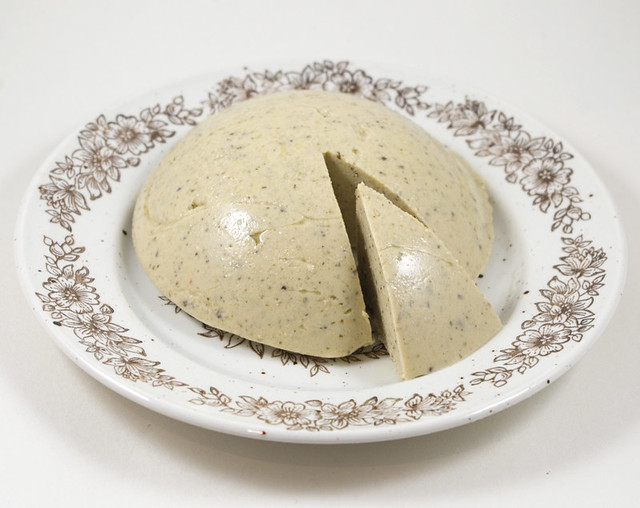
Vegan cheese molded in a bowl instead of a ramekin, hence the dome shape.

My first hurdle was sourcing the ingredients (although I had many of the basics at home). My local Bulk Barn carries roasted, unsalted cashews, and nutritional yeast. The agar agar powder, on the other hand, was difficult to find. Bulk barn didn’t carry it, and most of the health stores I tried normally carried it, but were experiencing supply issues. I finally found the powder at Kardish, at about $12 for 57g (smallest package size available), so about $21.05 per 100g. For comparison, 28g of Knox unflavoured gelatin (the animal product that agar powder is supposed to replace) is $3.29 for 28g, or $11.75 per 100g. Since I’m not a vegan, I may try this recipe with gelatin instead of agar agar powder if I make it again, just to save some money.

The recipe did come together as promised by the recipe; it was actually fairly easy to make, once I had the ingredients. Flavour-wise, I unfortunately can’t say that this dish tastes much like cheese. However, it is a tasty spread in its own right. I would put it on a bagel or a pita bread, or serve it with crackers at a party. But it can’t really be mistaken for dairy cheese. Darn it.

Also, when made in a bowl instead of a flat-bottomed ramekin, this vegan cheese visually reminds me of “chicken cutlet” silicone breast enhancers that are inserted into a bra. Possibly not the best choice on my part, aesthetic-wise, but it did make me laugh.

Quinoa Bread Recipe

At the suggestion of a friend of mine, I bought some red quinoa a while back included a small portion in a fruit salad. Well, I discovered very quickly that I don’t like it with fruit; actually, despite all of the hype and how healthy it is, I don’t care for it much at all. Use it instead of rice! Add it to your salads! Yuck, yuck, yuck. But I still had most of a bag of quinoa to use up, and I would be darned if I was just going to compost it, so I decided that I’d try making quinoa bread. And it ended up being delicious! Not just to me, either. My kids ask for seconds and my husband, who generally loathes quinoa with the fire of a thousand dying suns, actually likes it. So even if you’re not a fan of this ancient grain, I suggest that you try this bread — and don’t write off all baked goods containing quinoa (like I almost did) until you try them.

This is a heavier bread, with a density a little closer to a banana or pumpkin bread than a traditional white or whole wheat loaf. The flip side of the heaviness — mostly caused by the water in the grains — is that this bread stays moist and tender inside for quite a long time. Even when stale, it doesn’t get hard like a crusty bread can, and can still be quite good toasted or in a grilled cheese sandwich.


This loaf was made in a 9.5″ x 5.5″ loaf pan, which is why it is so low and wide.

Quinoa Bread
Yields 3 loaves

In a large pot, bring to a boil:
500mL water
1 Tbsp canola oil
1 tsp salt
To the boiling liquid, add:
1 cup red quinoa*
Bring back to a boil. Turn heat down to low and cook for 20 to 25 minutes, uncovered. When cooked, the quinoa will become transparent and a white ring will appear in the ancient grain. Remove from heat, drain, and allow to cool.
In a large bowl, mix together:
2 1/2 cups all-purpose whole wheat flour
1 1/2 tsp salt
14g (2 packages) quick rise instant yeast
Stir in:
2 1/2 cups warm water
Once contents of bowl are mostly smooth (it doesn’t have to be perfect), add the cooked, cooled quinoa. Stir until mixed.
Gradually add:
4 cups all-purpose unbleached white flour

Depending on how much water the quinoa absorbs when cooking, slightly more or less white flour will be required. The dough should be soft and the slightest bit sticky, but should not flow like a batter.

Turn out dough onto a lightly floured surface and knead by hand for about 10 minutes, dusting kneading surface, hands, and dough lightly when necessary to prevent sticking.

Oil a large mixing bowl. Form the dough into a ball and place it in the bowl. Cover the bowl with a clean, damp tea towel. Place the bowl in a warm, dry area with no drafts. Allow the dough to rise until double, about 1 1/2 to 2 hours.

Punch down the dough. Grease three 8.5″x4.5″ loaf tins. Divide the dough into two equal-sized portions. Cover the pans with a clean, damp tea towel and allow to rise again until double, about 1 1/2 to 2 hours.

Preheat oven to 400ºF (205ºC). Bake loaves for 10 minutes. Turn heat down to 350ºF (177ºC) and bake for about 20 to 25 minutes more. Check to see if the bread is done by removing a loaf from the pan and tapping it on the bottom. When cooked through, it should make a hollow sound. Remove all loaves from the pans immediately and place them on a wire cooling rack.

Slice and serve immediately, or wrap in a clean plastic bag once loaves are cool; they will last about five days before going stale.

*Any colour quinoa may be used, but red quinoa makes the most attractive visual contrast in the loaf.

Cream of Carrot Soup Recipe

I took a cooking class back in high school. It wasn’t Home Economics or Family Studies; it was a week-long course at the local college that was meant to teach us the most basic techniques of the professional chef. It was most likely offered in the hopes that the course would catch the attention of at least a few of us, and that we would return after graduation for the culinary program. We learned how to make fresh pasta, French vanilla ice cream, chocolate truffles… I have very fond memories of that class, and not just because I got to spend a week away from home.

One of the things the chef was insistent about was that we learn how to use knives properly. Well, one knife. The chef worked almost exclusively with what seemed to me to be an intimidatingly huge chef’s knife. He insisted that we learn the proper techniques of handling this knife (which I totally approve of), and then we spent the rest of one day of a five-day program chopping different kinds of vegetables. I know how important knife work is to a chef, but when the majority of a group of sixteen-year-olds aren’t likely to ever step into another professional kitchen, chopping veggies all day may not be the best way to hold their attention. However, by the end of the course I did learn to be slightly less afraid of the large knife. (Until then, I usually used a paring knife at home.)

At the end of the knife-work day, the dish that we were expected to prepare the chef’s version of cream of carrot soup. I really love the recipe, so I kept my copy and have been tweaking it ever since. So long as you skip the optional ingredients, my version is dairy-free, tree-nut and peanut free, gluten-free, and can be made vegetarian/vegan if vegetable stock is used instead of chicken stock. It’s also extremely healthy! It’s also slightly sweet, and not from adding sugar but from sweating the vegetables before boiling them — perfect for serving to picky eaters.

I make my cream of carrot soup in large quantities because it freezes really well, but if you prefer your soup fresh, I’d recommend halving or quartering the recipe. As written, it can be made using a 2.27kg (5lb) bag of carrots, which results in about 1.5kg after peeling and slicing. I like using Naturally Imperfect carrots, which are cheaper because they’re not visually perfect, but they taste just as good. Honestly, it’s all going through the blender anyway.

Cream of Carrot Soup
Yields about 7 litres
All weights indicated are measured after peeling and chopping.

Peel and dice (or slice in a food processor):
1.5kg carrots
Peel and dice:
350g yellow onions
Into a deep, heavy-bottomed stock pot pour:
1 cup olive oil
Heat the oil slowly on medium-low heat. Add the carrots and onions to the oil. Sweat the vegetables until the onions are translucent and the carrots are about half-cooked. Stir often. Do not let the vegetables brown.
Peel and dice:
600g potatoes (white- or yellow-fleshed)
Add the potatoes to the pot, and then add:
4.5L reduced-sodium chicken broth*
Bring contents of pot to a boil. Simmer until all vegetables are tender.
Puree the soup in batches using a blender or food processor. Exercise extra caution when pureeing as the soup will be hot! Fill the jar/bowl at most 2/3 full, as the soup will fly up and may dislodge the lid of the blender/food processor. As an extra precaution, you may drape a dish towel over the top of the machine and hold the lid down gently with one hand. (Do not press down too forcefully or the center section of a blender may fall into the jar — especially if the blender has a flexible lid.)
Once all of the soup has been pureed, return it to the stock pot. Gently bring the soup back to a simmer.
Season to taste with:
salt
white pepper
Serve in a bowl or soup dish.
Optionally, at serving time finish each bowl with:
2 Tbsp hot cream or 1 Tbsp cold sour cream
Garnish each bowl with:
1 sprig of parsley or 1 small basil leaf

*Chicken broth may be replaced an equal amount of vegetable broth, or homemade chicken broth, or a mix of 2.25L water and 2.25L stock made from chicken bouillon.