Janeway / Sisko Baby Sweater Pattern

As this week is the lead-up to ComicCon, I thought it appropriate that I re-post my pattern from my old blog for a Star-Trek-inspired baby sweater. Back in June of 2013, friends of mine were expecting their first child at any time, so I wanted to knit them an appropriately-geeky baby gift. The couple was particularly fond of Star Trek, specifically The Next Generation (TNG) and Deep Space Nine (DS9). I knew what I wanted to knit, but I couldn’t find an appropriate pattern online, so I had to come up with one myself. We didn’t know if the baby would be a boy or a girl, so I thought that a sweater based on a uniform would be most appropriate. Most notably, I used photos of Kate Mulgrew as Captain Kathryn Janeway and Avery Brooks as Captain Benjamin Sisko as references.


Sweater modeled by Thing 2, who was 18 months old at the time, and who comfortably wore a size 2. The sweater is a bit too short in the arms and body, as well as being snug. I would say it’s actually about a 12-18 month size, but as you can see, it does have some stretch.

I used Fringe Association’s tutorial for how to improvise a top-down sweater — which is full of invaluable information — as a basis for my pattern. I really needed the help, especially since at the time I’d only ever knit two other baby sweaters, and that was years prior. I had some difficulties with getting the sizing right, to start. The first two tries were disasters, the first yielding a neck that wouldn’t fit a preemie, and the second one that was too big for my four-and-a-half-year-old. Try three gave me the size I wanted: 12-18 months, with a nice stretchy neck and short collar to accommodate a baby’s big head and short neck.

Without further ado, here’s the pattern for a 12-18 month size for the sweater:

Janeway / Sisko Baby Sweater
Size 12-18 months

Materials
– 25g (half a 50g/125m (1.76oz/137yds) ball) of Debbie Bliss Baby Cashmerino in colour 340034 (cherry)
– 140g (just under three 50g/125m (1.76oz/137yds) balls) of Debbie Bliss Baby Cashmerino in colour 340300 (black)
– one set of 3.25mm (US 3, UK 10) circular knitting needles in a length comfortable for the magic loop method (I recommend 75cm/31.5″ or longer)
– 10 stitch markers

Gauge
– 29 stitches and 44 rows = 10cm x 10cm (4″ x 4″) worked in stockinette stitch

Instructions

Neck:

– Using the cherry yarn and the stretchiest cast on you know, cast on 80 stitches. Tillybuddy’s Very Stretchy Cast-On for Double and Single Ribbing is the best cast-on I’ve found for this.

– Divide the stitches so that there are 40 stitches on each needle.

– Being careful not to twist, join for working in the round.

– Work in K2, P2 ribbing for 2.5cm (1″).

Yoke:

– On each needle, place stitch markers as follows, with “|” representing a stitch marker, and the numbers enumerating the stitches:

4 | 2 | 28 | 2 | 4

– Additionally, add a different coloured stitch marker at the end of each row.

– Round 1: Knit until last stitch before first marker, KFB, knit until first stitch after second marker, KFB, knit until last stitch before third marker, KFB, knit until first stitch after fourth marker, KFB, knit to end of needle. Repeat for second needle.

– Round 2: Knit. This pattern will increase the number of stitches on each needle by four every two rounds.

– Repeat Round 1 and Round 2 until the sweater measures 9cm (3.5″) from the very start of the neck. Switch the yarn to black yarn in the middle of the back of the next Round 2.

– Continue repeating Round 1 and Round 2 until the stitches on each needle are divided as:

21 | 2 | 62 | 2 | 21

Separate the Body and Sleeves:

– Knit until you reach the first marker, remove the marker, and then knit one more stitch. Place a marker. Remove the next marker.

– Knit until you reach the next marker, remove the marker, and then knit one more stitch.

– Place the next 44 stitches on waste yarn, removing the markers as you go. (These will be for one sleeve.)

– Cast on 4 stitches, place a marker, cast on another 4 stitches.

– Knit until you reach the next stitch marker. Remove the marker, the knit one more stitch.

– Place the next 44 stitches on waste yarn, removing the markers as you go. (These will be for the other sleeve.)

– Cast on 4 stitches, place a marker, cast on another 4 stitches.

– Your stitch count should be as follows: 44 stitches on each piece of waste yarn for the sleeves, and 72 stitches on each side of what will now be the body.

Body:

– Knit until the piece measures 27cm (10.5″) from the very top of the neck.

– Work in K2, P2 rib for an additional 2.5cm (1″).

– Cast off loosely, but not too loosely. I like Jeny’s Surprisingly Stretchy Bind Off, but to keep the rib from flaring I only used it on the purl stitches, and I did a straight cast off on the knit stitches.

Sleeves:

– *Pick up the 44 stitches that were set aside for one sleeve on waste yarn, then divide them in half, putting half on each needle. Put a stitch marker between the halves.

– Pick up and knit 8 stitches in the armpit of the sleeve (where you cast on the extra 8 stitches for the body earlier).

– Place a marker halfway. This should yield you 52 stitches total (26 on each needle) on the sleeve.

– Knit the sleeve in the round until it reaches 14cm (5.5″) measured from the armpit.

– At the start and end of each needle, K2tog for one round. You should now have 48 stitches total (24 on each needle).

– Work in K2, P2 ribbing for 2.5cm (1″).

– Bind off in the same fashion as you bound off the body.**

– Repeat from * to ** for the second sleeve.

Finishing:

– Sew in ends.

– Give the whole sweater a hand wash and a good wet blocking.

Pumpkin-Seed & Chili-Crusted Fish Fillets with Avocado Tartar Sauce

For non-Ontarians, the idea of an LCBO may seem a little bit strange. The acronym stands for Liquor Control Board of Ontario, which is a provincially-owned retail store that sells beer, wine and spirits — and, importantly, it’s the only place where you can buy all three. The Beer Store carries beer (obviously), and a few places like the Wine Rack carry wine, and as of April 13th the Government of Ontario announced that beer will be allowed to be sold in some grocery stores… But you can’t get spirits anywhere else.

All that being said, the LCBO has gone to great lengths to follow a retail business model instead of a government one. The stores are well-kept, even fancy in some places. If a small location doesn’t carry the drink you’re looking for, you can order it online and have it shipped to your home for a fee or to your closest branch for free with a minimum purchase. Like many retail stores, they also have their own free in-house magazine: Food & Drink. These magazines (and now their website) have a great reputation for delicious recipes — and of course suggestions for the proper drinks to serve with said recipes. The magazines are stuffed with full-page glossy photographs of mouth-watering concoctions. Let’s be honest here, it’s food porn, plain and simple.


Pumpkin-seed & chili-crusted basa fillets, served with basmati rice and steamed spinach. Avocado tartar sauce not pictured.

I have been collecting Food & Drink magazines for years, but I never actually used any of their recipes. I’d ogle the photos for a bit, and then the magazine would go up on a shelf, never to be looked at again. Two years ago I just recycled the lot of them, tired of them taking up space on my bookshelf to no purpose. But the next time I went to the LCBO, I picked up the latest edition anyway.

So it’s with a great feeling of achievement that I can now say that I’ve actually made one of the Food & Drink recipes! I grabbed a copy of the magazine last week and actually cooked the food on the cover of the Early Summer 2017 edition within days. I used the Pumpkin-Seed & Chili-Crusted Fish Fillets with Avocado Tartar Sauce recipe. Of course, my version didn’t turn out nearly as pretty, but I just snapped a shot of it before we sat down to eat. But it was delicious! Pretty easy, too. I used the cheap basa fillets that I had in the freezer, which were much thinner than the recipe called for. I stacked one fillet on top of another and then crusted the stack, and that worked pretty well. I omitted the jalapeno peppers from the avocado tartar sauce because of my kids’ low tolerance for spicy foods; it was still delicious and everyone came back for seconds.

After this success, I’m thinking that I’ll browse Food & Drink next time I’m at a loss for dinner inspiration. Maybe eventually I’ll even do a second dish from there!

One Week Until ComicCon

Only one week until ComicCon, and I have been working my tail off to (hopefully) get things done in time. Sorry for the low quality cell phone pictures, but I haven’t had the time to take anything nicer.

I completed the blue bodysuit for Thing 1’s costume.

I hand-stitched Thing 2’s fun fur tail; this kind of fur tends to clog up the machine, so I worked the old-fashioned way. I also remembered why I hate working with fun fur. It sheds everywhere! You’d think I owned a golden retriever.

I made and painted a backpack, which was the last piece I needed for my day 1 costume. Hopefully it will be both practical and costume-friendly.

I built the framework for my Day 2 costume, found a foam head for it, paper-machéd the head, and painted it.

And I also wired up the skeleton head so that the eyes glow.

I really, really hope I haven’t bitten off more than I can chew, and that I’ll have all the costumes done in time!

A Healthier Burger Recipe

Last night I took advantage of the gap between spring rain storms to make up some burgers on the barbecue for the family dinner. My family absolutely adores burgers, so I’ve been looking for a way to make them healthier. Sure, tonnes of grease tastes good once in a while, but it’s not something that we should be eating regularly. Moderation in all things, including moderation. So I came up with a tasty recipe that combines lean ground beef (for flavour) with ground turkey or chicken (to reduce the fat). I also use oatmeal instead of the more traditional bread crumbs to bulk up the burgers and absorb moisture; oatmeal is full of healthy fiber and, as a bonus, has an incredibly long shelf-life. This means that these burgers are wheat and gluten free, so long as you pick the appropriate brand of sauce.

To add a bit of extra healthiness, I made the buns from scratch using the whole wheat variant of Nan’s Pan Rolls Recipe. To make hamburger buns, shape the buns individually and place them with lots of room between them on greased baking sheets between the first and second rise. The recipe makes about 24 hamburger buns.

Now, even a healthier burger isn’t a hundred percent healthy. If you really want a healthy burger dinner, you’ll have to serve it with a salad.


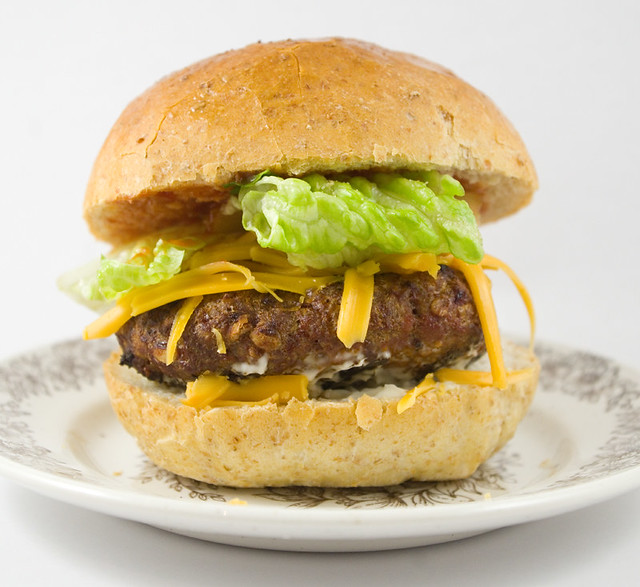
A healthier burger with ketchup, mayonnaise, shredded cheddar cheese, and romaine lettuce.

A Healthier Burger
Makes 10-12 small burgers

In a large bowl, thoroughly mix together with your hands:
500g (1.1lb) lean ground beef
500g (1.1lb) ground turkey OR chicken
1 egg
3/4 cup plain uncooked oatmeal (not instant)
2 Tbsp Worcestershire sauce OR barbecue sauce of choice
1 tsp garlic powder
1/2 tsp salt
1/4 tsp pepper
Divide the mixture into 10-12 portions*. Roll each portion into a ball, then shape the portion into a patty shape with your hands.
Preheat your grill** to about 400°F (204°C). Cook until browned evenly on both sides (with a bit of char) and until center of burger is no longer pink. (Do not serve these burgers rare because they contain poultry.)
Serve on whole wheat hamburger buns with your choice of toppings such as ketchup, mustard, relish, mayonnaise, pickles, cheese, or avocado.

*Larger burgers may be made, but cooking times should be adjusted.
**Burgers may be fried on a flat top or in a frying pan, but they taste best on a grill.

Noodle Soup

I’ve been to Japan twice so far: once in high school on an exchange program, and once in my twenties to tour with a friend. I returned from my trips with an absolute love of Japanese food. Tea ceremonies, sushi, sukiyaki, fast food, vending-machine treats: I tried everything that was put in front of me. Sure, I didn’t like 100% of it, but it was a near thing. I would eat a heck of a lot more Japanese food back here in Canada if it weren’t so expensive — and if a greater variety of dishes would cross the Pacific.


Lunch at a restaurant in Kyoto, Japan: torikatsu (breaded & deep-fried chicken cutlet) or tonkatsu (the same thing, but made with pork cutlet instead) on egg and rice; a bowl of udon soup with seaweed, green onions and kamaboko (fish cake); and two types of pickles.

One of my favourite things about eating in Japan was all of the different types of noodle dishes. My horizons really expanded from the macaroni, spaghetti, and lasagna were more that I was familiar with. In Japan, they fried their noodles, they put them in hot and cold soup, they served them with every kind of topping they could think of. Of course, now there is a lot more variety in how people use noodles in Canada; there’s a Vietnamese pho restaurant in every neighborhood, ramen is making inroads into the culinary scene, and udon is on the menu at most Asian fusion restaurants. Not to mention that you can finally get Asian noodles that aren’t instant ramen at most grocery stores. But before I went to Japan the first time, pasta that wasn’t wheat-based and served Italian- or Italian-American style was rare around here.


Hakata tonkotsu ramen (pork belly, shiitake mushroom, bamboo shoot, scallion, nori, soft-boiled egg, pork broth, ramen noodles) from Ottawa restaurant Ginza. Seriously the best ramen I have had outside of Japan.

Now I make my own noodle soup. It’s Japanese-inspired, but it’s definitely not authentic. I mean, I sometimes use turkey broth, and turkey is a meat that just isn’t used in Japan. I use locally-grown produce and meat when I can, but I also include imported spices, sauces, and canned/preserved goods when I have the opportunity. Asian fusion is the best description I can come up with, although it sounds kind of pretentious for my style of cooking. Hodgepodge, perhaps?


Prepping for noodle soup at my house. Items include frozen udon noodles, dried shrimp, sushi nori, enoki mushrooms, parboiled lotus root, thinly-sliced beef (pour boiling broth on this to cook), soft-boiled eggs, shrimp, beef balls, and baby bok choy. All ingredients have been precooked as necessary.

I don’t so much have a recipe as I have a process. First, I make the broth. Sure, I could use commercially-made broth, but I like to make my own from the bones saved from meat I’ve previously prepared. I store bones in the freezer until I have enough, then I put them (and sometimes cloves of garlic and/or dried mushrooms) in the crock pot. I fill the pot the rest of the way with water, and then I let it simmer for two days, replenishing the water as it goes down. Then I strain out all the solids, then refrigerate the broth so I can skim the fat off of the top. Of course, this makes much more broth than I can use at one sitting, but it freezes well, which means I don’t have to make the broth from scratch every time. Immediately before using the broth, I will season it with a dash of soy sauce and a tiny bit of instant dashi, although since that stuff goes really far, I don’t need much! I can use the unseasoned broth for a greater variety of dishes, so I only season as much broth as I plan to use that day.


Right before eating home-made udon. Thing 1 just couldn’t wait to sit down and dig in. The bowls on the left are smaller for the kids, and a lower noodle to broth ratio.

Then I prepare all of my toppings. I will throw almost anything into a bowl of noodle soup, so long as it’s the kind of thing that stands up well to being boiled. Most vegetables go well, as do most meats. Fruits and squash are generally too fragile. Cleaning out the fridge of leftovers is perfectly fine, since the toppings have to be precooked anyway, and will be warmed up by pouring broth over them.

Once I have all of my toppings cooked (I do a lot of it in the microwave, but in warmer seasons using the barbecue adds a lovely flavour), I bring my broth back up to a boil and separately I cook up the noodles accoring to package directions. I prefer frozen udon, but it can be any kind of long Asian noodle, really. Ramen or vermicelli are great too. Then into each bowl I put a base layer of noodles, then the toppings, and then I pour the broth over top. Last but not least I like to add a square of sushi nori when I have it — this has to be done last minute because it wilts so fast.

Here are some examples of noodle soups that I have cooked over the years. If this inspires you to try to make a noodle soup yourself, do let me know — and show me a photo! I love seeing what other people do with my recipes and tutorials.


Udon soup with beef broth, nori, soft-boiled eggs, green onions, rare beef, enoki mushrooms, lotus root, shiitake mushrooms, and baby bok choy.


Udon soup with chicken broth, nori, shrimp, dried shrimp, soft-boiled eggs, enoki mushrooms and baby bok choy.


Udon soup with chicken broth, nori, soft-boiled eggs, lotus root, enoki mushrooms, shiitake mushrooms, chicken, and baby bok choy.


Udon soup with beef broth, hard boiled eggs, dried shrimp, enoki mushrooms, chicken, and baby bok choy.


Udon soup with pork broth, nori, rare beef, soft-boiled eggs and furikake.


Late-night-snack udon soup with chicken broth, nori, soft-boiled eggs, lotus root, and green onions.


Udon soup with turkey broth, nori, baby bok choy, shrimp, dried shrimp, soft-boiled eggs, and medium-rare beef.


Udon soup with pork broth, soft-boiled eggs, lotus root, green onions, enoki mushrooms, shrimp, celery, and chicken balls.


Udon soup with pork broth, baby bok choy, shrimp, dried shrimp, well-done beef, enoki mushrooms and soft-boiled eggs.


Udon soup with turkey broth, nori, rare beef, soft-boiled eggs, dried shrimp, turkey, enoki mushrooms, and baby bok choy.


Udon soup with turkey broth, barbecued tiger shrimp, baby bok choy, hard boiled eggs, masago (seasoned capelin caviar), dried shrimp, pea shoots, enoki mushrooms, and barbecued beef steak.

Shish Taouk Spice Mix

The grocery stores around here mark some of their stock down by 50% (occasionally more) when it’s being discontinued, or they’ve bought too much, or when it’s coming up on its expiration date, or when they’re just not stocking it any more. That’s how I ended up with a bottle of Arz Fine Foods Shish Taouk (Chicken Kebab) Spices. 50% off is the best way to try foods you’ve never cooked before, because if you don’t end up liking it, well, it’s not a great financial loss.

I love just about every type of kebab; I definitely ate more than enough meat on skewers while in Istanbul a number of years back. But I’ve never actually cooked a proper kebab — I mean yeah, I’ve stuck meat and veggies on a bamboo skewer and grilled it on the barbecue, but the spices weren’t right. So I figured I’d give this a go.

For my first attempt, I didn’t actually cook the chicken up on skewers; it was one of those days when I was running late on dinner prep, and making kebabs takes time. So I just roughly chopped up some chicken and fried it with the spice mix sprinkled on top, and served it with a side of rice and a side of steamed greens. Let me tell you, it worked like a charm. Sure, it would have been better on the grill with a bit of char, but I really loved the flavour. I hope to have the chance to make proper kebabs in the near future.

Morning Glory Pumpkin Muffins

It’s ComicCon costume crunch-time, so I haven’t been spending as much time cooking as I’d like to. Nevertheless, over the weekend I was inspired by the copy of Purely Pumpkin: More Than 100 Seasonal Recipes to Share, Savor, and Warm Your Kitchen by Allison Day (2016) that I have taken out of the library again. I managed to whip up some Morning Glory Pumpkin Muffins (page 81), which were very simple and absolutely delicious. Healthy, too!

For the health-conscious, these muffins are made with spelt flour, bananas, pumpkin puree, apples, pumpkin seeds, raisins, sesame seeds, and poppy seeds. A combination like that is a great way to satisfy hunger cravings and keep you full for a while — perfect to grab when running out the door in the morning. The recipe called for vegetable oil, for which I substituted an equal amount of applesauce, which made the muffins even healthier. These muffins are also very moist and tasty, with just a bit of crunch from the seeds, which is probably why my kids have been noshing on them whenever they get the chance. Would I make this recipe again? Most definitely. Now I’m more eager than ever to try the rest of the recipes in this book!

Two Weeks Until ComicCon

The countdown to ComicCon continues, and I am seeing some progress.

I’ve managed to get Thing 2’s bodysuit finished, which is, to me, the most difficult part. I hate sewing stretch fabric, but a bodysuit really needs to be stretchy. This is especially true for children, who will shed costume pieces if they find them too uncomfortable. These costumes have to work for ComicCon and Halloween, so I’d like them to be worn for more than five minutes at a time. Of course, when sewing this bodysuit I managed to put in one of the sleeves inside-out the first time. This seems to be an inevitable state of affairs for me whenever I make clothing.

I also painted Thing 2’s shoes for the costume, since we couldn’t find any in bright orange.

My Day 1 costume is pretty much complete, much to my great joy. I didn’t do a lot of sewing for this one (just the belt and the white part of the sleeves, actually), but there were a lot of little details that needed to be carefully painted and then dried. I probably could have sewn it in less time, but definitely not for less. The cap was $5.00 at Michaels, the shirt (which was blank and plain blue at the time) was $2.49 at Value Village, and the skirt was $3.99 at the same place. The gloves were $2.50 at the dollar store. I already owned multiple pairs of black leggings. The belt was made out of scrap fabric from my stash, and the buckle was made out of a $0.79 plywood circle from Michaels. The most expensive things were the shoes, which I paid $29 for (I think) at Payless, but they’ll get lots of use after the Con, so I don’t feel too bad about that purchase.

Shepherd’s Pie Recipe

There is a lot of contention out there as to what makes a good shepherd’s pie. I distinctly remember an episode of Kitchen Nightmares where Gordon Ramsay laid into the chef because the restaurant’s shepherd’s pie contained beef instead of lamb. I didn’t actually discover that this dish is supposed to have lamb in it until about five years ago. Apparently “cottage pie” is what you call it when it’s made with beef. The dish that we called shepherd’s pie that I grew up with was always made with beef because my mother prefers it that way. I never thought to question it.

As the vegetable part of this casserole, I use corn (sweet corn, not maize), although I understand it is more traditional to use peas. I never made this dish for my British Nan, but at one time she refused to eat corn as it was “cattle feed” and believed it to be beneath her. Now, Nan lived more of her life in Canada than she did in England, so she may have relaxed her point of view somewhat, but I’ve heard this sentiment echoed by her visiting relatives. I don’t know if this is a wide-spread belief or one restricted to my family. At any rate, corn is not traditionally part of this dish.

Lastly, I structure my dish more as a casserole and less as an actual pie. Traditionally, the “crust” of the pie is supposed to be the mashed potatoes, but a quick Googling shows me that I’m not alone in putting the potatoes on top.


When the dish is served, you should be able to see the strata of meat & gravy, veggies, potato, and cheese.

Shepherd’s Pie
Serves 6-8

Peel and cut into large chunks:
8-10 (about 1Kg (2.2lbs)) medium white-fleshed potatoes*
Place the potatoes into a large cooking pot. Fill pot with water until there is an inch covering the potatoes. Bring the pot to a boil, then turn it down to a simmer. Cook potatoes until they can easily be pierced with a fork.
While the potatoes are cooking, in a non-stick frying pan heat:
1 Tbsp olive oil
Add to the oil:
1 small yellow onion (yields about 100g (3.5oz))
2 cloves garlic**
Cook on medium heat until onions are translucent with light brown edges.
To the onion mixture, add:
700g ground lamb***
Turn up the heat to medium-high and cook the lamb until it is lightly browned, regularly draining the grease.
To the meat mixture, add:
1 can of cream of mushroom soup****
1 can of water
Stir until soup is smooth. Bring the mixture to a boil, then turn down the heat and simmer gently until soup has almost reduced back to its original canned consistency.
While the meat and gravy are simmering, drain the potatoes. To the potatoes add:
2 Tbsp butter or margarine
2 Tbsp 2% milk
Whip or mash the potatoes until smooth.
Preheat the oven to 350°F (175°C)
Spread the meat and gravy mixture evenly on the bottom of a casserole dish. On top of this, pour evenly:
2 cups frozen corn
Spread the mashed potatoes evenly on top of the frozen corn. On top of the potatoes, sprinkle:
1 to 1 1/2 cups loosely-packed grated cheddar cheese
Bake casserole at 350°F (175°C) for 25 to 30 minutes, or until cheese is melted and sauce bubbles up around the edges of the potatoes.
Serve with a side of steamed vegetables, if desired.


It’s difficult to scoop portions that don’t fall apart if you bake this dish in a round casserole. If you want perfectly rectangular servings, bake it in a rectangular dish and serve in slices.

*This dish works really well with leftover mashed potatoes, so if you have enough left over from a previous meal, skip the potato preparation steps. If the potatoes are cold, a slightly longer cooking time may be in order.
**1 tsp garlic powder may be substituted for garlic cloves; however, the powder should be sprinkled over the ground meat instead of cooked with the onions.
***Meat may instead be 50%/50% ground lamb/ground beef, ground lamb/ground chicken, ground lamb/ground turkey, or any one of these meats by itself. Keep in mind that without any lamb, the flavour will not be nearly as strong.
****I like Campbell’s Cream of Cremini & Shiitake Mushroom, but any cream of mushroom soup will do. If you are averse to the texture of mushrooms in your food, run the cream of mushroom soup and water through a blender until smooth before adding them to the meat.

Simple Suppers

With ComicCon deadlines looming, I’ve been spending every spare moment working on costumes. That means that I have been making meals that can be thrown together out of what is in my fridge, freezer, and pantry. There just isn’t time to run back and forth to different grocery stores and specialty shops! I’ve also been picking meals with a short prep/cook time.


Thing 1 and Thing 2 showing off the mini loaves that they helped me make.

On Saturday I ran out of bread, so I had to make more. Now that I have the hang of the basics, I don’t find that baking bread takes much time at all. I mean, it takes time to proof, but that’s time I can spend on other things. This bread was supposed to be loaves of Nan’s pan rolls, but after I started mixing I discovered that I was at the very end of my all-purpose white flour. No problem, I’ll use half whole wheat, I thought! No luck, I was down to the last dregs of that as well. So I just combined what I had left of both of those flours with some multigrain flour, and promised myself that I’d make a grocery run soon.

I’m happy to say that they bread turned out quite nicely despite my improvisations; it was nice and fluffy, but also quite healthy due to being predominantly whole wheat and multigrain flour. The kids were very pleased with the mini loaves that they shaped in tiny pans that I found at the dollar store. Of course, those were the first bits of bread from this batch that were eaten.

Saturday dinner incorporated that fresh-made bread into a breakfast for dinner kind of meal. Eggs over hard (they were supposed to be over easy, but the cook usually ends up eating the mistakes), pork breakfast sausages, navel orange pieces, and a strawberry banana smoothie.

Last night’s dinner also used the bread, which by this time was a couple of days old, but still toasted up well. I made plain grilled cheese and served it with some quickly-thrown-together soup of turkey broth, carrots, and rice, all served with a side of (slightly-massacred) orange.

Looking back at these dishes, I realize that I need to find an additional go-to fruit or veggie to pair with quick dinners, or my family will soon become heartily sick of oranges.