Noodle Soup

I’ve been to Japan twice so far: once in high school on an exchange program, and once in my twenties to tour with a friend. I returned from my trips with an absolute love of Japanese food. Tea ceremonies, sushi, sukiyaki, fast food, vending-machine treats: I tried everything that was put in front of me. Sure, I didn’t like 100% of it, but it was a near thing. I would eat a heck of a lot more Japanese food back here in Canada if it weren’t so expensive — and if a greater variety of dishes would cross the Pacific.


Lunch at a restaurant in Kyoto, Japan: torikatsu (breaded & deep-fried chicken cutlet) or tonkatsu (the same thing, but made with pork cutlet instead) on egg and rice; a bowl of udon soup with seaweed, green onions and kamaboko (fish cake); and two types of pickles.

One of my favourite things about eating in Japan was all of the different types of noodle dishes. My horizons really expanded from the macaroni, spaghetti, and lasagna were more that I was familiar with. In Japan, they fried their noodles, they put them in hot and cold soup, they served them with every kind of topping they could think of. Of course, now there is a lot more variety in how people use noodles in Canada; there’s a Vietnamese pho restaurant in every neighborhood, ramen is making inroads into the culinary scene, and udon is on the menu at most Asian fusion restaurants. Not to mention that you can finally get Asian noodles that aren’t instant ramen at most grocery stores. But before I went to Japan the first time, pasta that wasn’t wheat-based and served Italian- or Italian-American style was rare around here.


Hakata tonkotsu ramen (pork belly, shiitake mushroom, bamboo shoot, scallion, nori, soft-boiled egg, pork broth, ramen noodles) from Ottawa restaurant Ginza. Seriously the best ramen I have had outside of Japan.

Now I make my own noodle soup. It’s Japanese-inspired, but it’s definitely not authentic. I mean, I sometimes use turkey broth, and turkey is a meat that just isn’t used in Japan. I use locally-grown produce and meat when I can, but I also include imported spices, sauces, and canned/preserved goods when I have the opportunity. Asian fusion is the best description I can come up with, although it sounds kind of pretentious for my style of cooking. Hodgepodge, perhaps?


Prepping for noodle soup at my house. Items include frozen udon noodles, dried shrimp, sushi nori, enoki mushrooms, parboiled lotus root, thinly-sliced beef (pour boiling broth on this to cook), soft-boiled eggs, shrimp, beef balls, and baby bok choy. All ingredients have been precooked as necessary.

I don’t so much have a recipe as I have a process. First, I make the broth. Sure, I could use commercially-made broth, but I like to make my own from the bones saved from meat I’ve previously prepared. I store bones in the freezer until I have enough, then I put them (and sometimes cloves of garlic and/or dried mushrooms) in the crock pot. I fill the pot the rest of the way with water, and then I let it simmer for two days, replenishing the water as it goes down. Then I strain out all the solids, then refrigerate the broth so I can skim the fat off of the top. Of course, this makes much more broth than I can use at one sitting, but it freezes well, which means I don’t have to make the broth from scratch every time. Immediately before using the broth, I will season it with a dash of soy sauce and a tiny bit of instant dashi, although since that stuff goes really far, I don’t need much! I can use the unseasoned broth for a greater variety of dishes, so I only season as much broth as I plan to use that day.


Right before eating home-made udon. Thing 1 just couldn’t wait to sit down and dig in. The bowls on the left are smaller for the kids, and a lower noodle to broth ratio.

Then I prepare all of my toppings. I will throw almost anything into a bowl of noodle soup, so long as it’s the kind of thing that stands up well to being boiled. Most vegetables go well, as do most meats. Fruits and squash are generally too fragile. Cleaning out the fridge of leftovers is perfectly fine, since the toppings have to be precooked anyway, and will be warmed up by pouring broth over them.

Once I have all of my toppings cooked (I do a lot of it in the microwave, but in warmer seasons using the barbecue adds a lovely flavour), I bring my broth back up to a boil and separately I cook up the noodles accoring to package directions. I prefer frozen udon, but it can be any kind of long Asian noodle, really. Ramen or vermicelli are great too. Then into each bowl I put a base layer of noodles, then the toppings, and then I pour the broth over top. Last but not least I like to add a square of sushi nori when I have it — this has to be done last minute because it wilts so fast.

Here are some examples of noodle soups that I have cooked over the years. If this inspires you to try to make a noodle soup yourself, do let me know — and show me a photo! I love seeing what other people do with my recipes and tutorials.


Udon soup with beef broth, nori, soft-boiled eggs, green onions, rare beef, enoki mushrooms, lotus root, shiitake mushrooms, and baby bok choy.


Udon soup with chicken broth, nori, shrimp, dried shrimp, soft-boiled eggs, enoki mushrooms and baby bok choy.


Udon soup with chicken broth, nori, soft-boiled eggs, lotus root, enoki mushrooms, shiitake mushrooms, chicken, and baby bok choy.


Udon soup with beef broth, hard boiled eggs, dried shrimp, enoki mushrooms, chicken, and baby bok choy.


Udon soup with pork broth, nori, rare beef, soft-boiled eggs and furikake.


Late-night-snack udon soup with chicken broth, nori, soft-boiled eggs, lotus root, and green onions.


Udon soup with turkey broth, nori, baby bok choy, shrimp, dried shrimp, soft-boiled eggs, and medium-rare beef.


Udon soup with pork broth, soft-boiled eggs, lotus root, green onions, enoki mushrooms, shrimp, celery, and chicken balls.


Udon soup with pork broth, baby bok choy, shrimp, dried shrimp, well-done beef, enoki mushrooms and soft-boiled eggs.


Udon soup with turkey broth, nori, rare beef, soft-boiled eggs, dried shrimp, turkey, enoki mushrooms, and baby bok choy.


Udon soup with turkey broth, barbecued tiger shrimp, baby bok choy, hard boiled eggs, masago (seasoned capelin caviar), dried shrimp, pea shoots, enoki mushrooms, and barbecued beef steak.

Shish Taouk Spice Mix

The grocery stores around here mark some of their stock down by 50% (occasionally more) when it’s being discontinued, or they’ve bought too much, or when it’s coming up on its expiration date, or when they’re just not stocking it any more. That’s how I ended up with a bottle of Arz Fine Foods Shish Taouk (Chicken Kebab) Spices. 50% off is the best way to try foods you’ve never cooked before, because if you don’t end up liking it, well, it’s not a great financial loss.

I love just about every type of kebab; I definitely ate more than enough meat on skewers while in Istanbul a number of years back. But I’ve never actually cooked a proper kebab — I mean yeah, I’ve stuck meat and veggies on a bamboo skewer and grilled it on the barbecue, but the spices weren’t right. So I figured I’d give this a go.

For my first attempt, I didn’t actually cook the chicken up on skewers; it was one of those days when I was running late on dinner prep, and making kebabs takes time. So I just roughly chopped up some chicken and fried it with the spice mix sprinkled on top, and served it with a side of rice and a side of steamed greens. Let me tell you, it worked like a charm. Sure, it would have been better on the grill with a bit of char, but I really loved the flavour. I hope to have the chance to make proper kebabs in the near future.

Morning Glory Pumpkin Muffins

It’s ComicCon costume crunch-time, so I haven’t been spending as much time cooking as I’d like to. Nevertheless, over the weekend I was inspired by the copy of Purely Pumpkin: More Than 100 Seasonal Recipes to Share, Savor, and Warm Your Kitchen by Allison Day (2016) that I have taken out of the library again. I managed to whip up some Morning Glory Pumpkin Muffins (page 81), which were very simple and absolutely delicious. Healthy, too!

For the health-conscious, these muffins are made with spelt flour, bananas, pumpkin puree, apples, pumpkin seeds, raisins, sesame seeds, and poppy seeds. A combination like that is a great way to satisfy hunger cravings and keep you full for a while — perfect to grab when running out the door in the morning. The recipe called for vegetable oil, for which I substituted an equal amount of applesauce, which made the muffins even healthier. These muffins are also very moist and tasty, with just a bit of crunch from the seeds, which is probably why my kids have been noshing on them whenever they get the chance. Would I make this recipe again? Most definitely. Now I’m more eager than ever to try the rest of the recipes in this book!

Shepherd’s Pie Recipe

There is a lot of contention out there as to what makes a good shepherd’s pie. I distinctly remember an episode of Kitchen Nightmares where Gordon Ramsay laid into the chef because the restaurant’s shepherd’s pie contained beef instead of lamb. I didn’t actually discover that this dish is supposed to have lamb in it until about five years ago. Apparently “cottage pie” is what you call it when it’s made with beef. The dish that we called shepherd’s pie that I grew up with was always made with beef because my mother prefers it that way. I never thought to question it.

As the vegetable part of this casserole, I use corn (sweet corn, not maize), although I understand it is more traditional to use peas. I never made this dish for my British Nan, but at one time she refused to eat corn as it was “cattle feed” and believed it to be beneath her. Now, Nan lived more of her life in Canada than she did in England, so she may have relaxed her point of view somewhat, but I’ve heard this sentiment echoed by her visiting relatives. I don’t know if this is a wide-spread belief or one restricted to my family. At any rate, corn is not traditionally part of this dish.

Lastly, I structure my dish more as a casserole and less as an actual pie. Traditionally, the “crust” of the pie is supposed to be the mashed potatoes, but a quick Googling shows me that I’m not alone in putting the potatoes on top.


When the dish is served, you should be able to see the strata of meat & gravy, veggies, potato, and cheese.

Shepherd’s Pie
Serves 6-8

Peel and cut into large chunks:
8-10 (about 1Kg (2.2lbs)) medium white-fleshed potatoes*
Place the potatoes into a large cooking pot. Fill pot with water until there is an inch covering the potatoes. Bring the pot to a boil, then turn it down to a simmer. Cook potatoes until they can easily be pierced with a fork.
While the potatoes are cooking, in a non-stick frying pan heat:
1 Tbsp olive oil
Add to the oil:
1 small yellow onion (yields about 100g (3.5oz))
2 cloves garlic**
Cook on medium heat until onions are translucent with light brown edges.
To the onion mixture, add:
700g ground lamb***
Turn up the heat to medium-high and cook the lamb until it is lightly browned, regularly draining the grease.
To the meat mixture, add:
1 can of cream of mushroom soup****
1 can of water
Stir until soup is smooth. Bring the mixture to a boil, then turn down the heat and simmer gently until soup has almost reduced back to its original canned consistency.
While the meat and gravy are simmering, drain the potatoes. To the potatoes add:
2 Tbsp butter or margarine
2 Tbsp 2% milk
Whip or mash the potatoes until smooth.
Preheat the oven to 350°F (175°C)
Spread the meat and gravy mixture evenly on the bottom of a casserole dish. On top of this, pour evenly:
2 cups frozen corn
Spread the mashed potatoes evenly on top of the frozen corn. On top of the potatoes, sprinkle:
1 to 1 1/2 cups loosely-packed grated cheddar cheese
Bake casserole at 350°F (175°C) for 25 to 30 minutes, or until cheese is melted and sauce bubbles up around the edges of the potatoes.
Serve with a side of steamed vegetables, if desired.


It’s difficult to scoop portions that don’t fall apart if you bake this dish in a round casserole. If you want perfectly rectangular servings, bake it in a rectangular dish and serve in slices.

*This dish works really well with leftover mashed potatoes, so if you have enough left over from a previous meal, skip the potato preparation steps. If the potatoes are cold, a slightly longer cooking time may be in order.
**1 tsp garlic powder may be substituted for garlic cloves; however, the powder should be sprinkled over the ground meat instead of cooked with the onions.
***Meat may instead be 50%/50% ground lamb/ground beef, ground lamb/ground chicken, ground lamb/ground turkey, or any one of these meats by itself. Keep in mind that without any lamb, the flavour will not be nearly as strong.
****I like Campbell’s Cream of Cremini & Shiitake Mushroom, but any cream of mushroom soup will do. If you are averse to the texture of mushrooms in your food, run the cream of mushroom soup and water through a blender until smooth before adding them to the meat.

Simple Suppers

With ComicCon deadlines looming, I’ve been spending every spare moment working on costumes. That means that I have been making meals that can be thrown together out of what is in my fridge, freezer, and pantry. There just isn’t time to run back and forth to different grocery stores and specialty shops! I’ve also been picking meals with a short prep/cook time.


Thing 1 and Thing 2 showing off the mini loaves that they helped me make.

On Saturday I ran out of bread, so I had to make more. Now that I have the hang of the basics, I don’t find that baking bread takes much time at all. I mean, it takes time to proof, but that’s time I can spend on other things. This bread was supposed to be loaves of Nan’s pan rolls, but after I started mixing I discovered that I was at the very end of my all-purpose white flour. No problem, I’ll use half whole wheat, I thought! No luck, I was down to the last dregs of that as well. So I just combined what I had left of both of those flours with some multigrain flour, and promised myself that I’d make a grocery run soon.

I’m happy to say that they bread turned out quite nicely despite my improvisations; it was nice and fluffy, but also quite healthy due to being predominantly whole wheat and multigrain flour. The kids were very pleased with the mini loaves that they shaped in tiny pans that I found at the dollar store. Of course, those were the first bits of bread from this batch that were eaten.

Saturday dinner incorporated that fresh-made bread into a breakfast for dinner kind of meal. Eggs over hard (they were supposed to be over easy, but the cook usually ends up eating the mistakes), pork breakfast sausages, navel orange pieces, and a strawberry banana smoothie.

Last night’s dinner also used the bread, which by this time was a couple of days old, but still toasted up well. I made plain grilled cheese and served it with some quickly-thrown-together soup of turkey broth, carrots, and rice, all served with a side of (slightly-massacred) orange.

Looking back at these dishes, I realize that I need to find an additional go-to fruit or veggie to pair with quick dinners, or my family will soon become heartily sick of oranges.

Loco Moco Redux

Yesterday I spent the day with my friends working on costumes; long crafting sessions are much much more fun with company. We took a pause around dinner time to feed the ravening hordes before we went out to hit a few shops for more supplies. For the second time ever, I whipped up some Loco Moco.

The first time I made Loco Moco using Guy Fieri’s recipe, I followed it to the letter. This time I altered it a bit to accommodate the tastes of the people I was feeding. First of all, I reduced the portion size. The recipe calls for two cups of cooked rice, two quarter-pound hamburgers, and two fried eggs per person, and I think that is just way too much food. Secondly, instead of forming hamburgers, I kept the ground beef loose, which I find much easier to eat on top of rice. Thirdly, because one of my guests does not like the texture of mushrooms (but has no problem with the flavour), I ran the gravy through the blender before serving. All in all, the changes I made affected the flavour a little, but I think they made it a more appropriately-sized and easy-to-eat meal for my family. I know that may not be true loco moco for the purists, but you can’t please everyone. At least this pleased my family and guests.

Wild Boar Medallions

Looking to expand my culinary horizons, I picked up a few packages of frozen boar meat from the grocery store a while back. The fact that it was on clearance might have dictated my choice somewhat; most wild meat is, well, wildly out of my budget. The best special was on wild boar medallions wrapped in pork bacon from Natural Frontier Foods. I had seen something similar before done with chicken (M&M Meats does a decent one), but I’d never tried boar before.


Wild boar medallions with bacon, mashed sweet potatoes, and mashed potatoes.

The original plan was to barbecue, but it pissed down rain all day, and even if I did juggle the food and an umbrella, I didn’t want to deal with the mud in the back yard. Instead, I put the meat on a broiler pan and baked it in the oven, then served it with mashed sweet potatoes and mashed potatoes. Granted, it wasn’t the prettiest meal, but I enjoyed it.

My first impression of boar meat is that it’s really not much like domesticated pig at all. The bacon wrapping did confuse the issue a bit, but I found the meat denser, leaner, and redder — much more like steak in texture. The flavour was a bit gamy, but nowhere near as much as venison or even lamb. It was also an extremely rich dish; it didn’t take much for me to fill up. Would I eat it again? Most definitely. However, I think I’m the only one in my house who would. My husband thought it was too gamy, and my children just ate the bacon and left most of the boar behind. I ended up with almost half of the meat packaged up in the fridge as leftovers. Perhaps I will slice it thin and make myself wild boar sandwiches for lunch for the next few days. It definitely won’t go to waste!

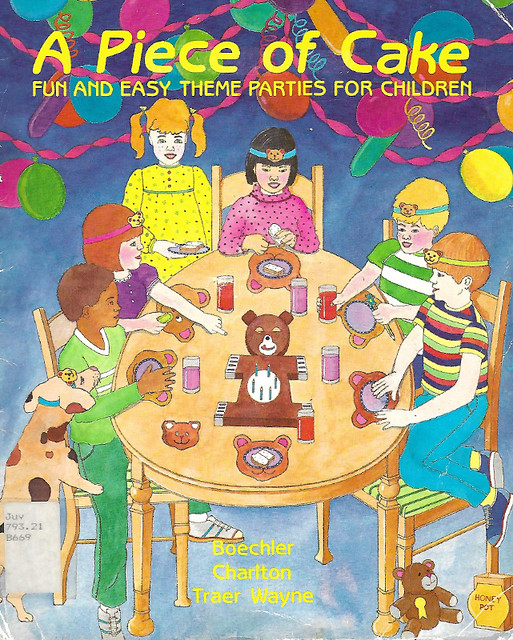
Teddy Bear Birthday Cake

When I was eight years old, my mother threw me a teddy bear birthday party. I hadn’t thought about it in years, but it suddenly came to mind when I was perusing the used book sale at the public library. There, on the shelf, was a discontinued copy of A Piece of Cake: Fun and Easy Theme Parties for Children (Gwenn Boechler, 1987), which pretty much had my birthday party pictured on the front.

We decorated those headbands (which the book calls party hats). We made teddy bear paper-bag puppets. We ate that cake.

I love it when I find books like this! Books that contain patterns or recipes for things I remember doing or gifts I remember receiving as a child. It doesn’t happen often, but I think that’s why I treasure it so much when I am lucky enough to stumble upon them.

The highlight of the birthday party was, I think, the teddy bear cake. I know my mother baked me a cake for every birthday until I was a teen (at which point she either made me a blueberry cream cheese flan, or I baked my own cake), sometimes two if my actual birthday and my birthday party ended up being too far apart. Although I do have vague recollections of rainbow sprinkles, I honestly couldn’t tell you anything specific about the cakes Mom baked, except on this year. I remember looking at the instructions for how to put it together. I remember icing the cake. I remember that the candies we used for the claws had black licorice centers, like a Good & Plenty. I remember that the nose and tongue were Smarties.

On the whole, what I remember the most is being so proud of this awesome cake — which is funny, because my mom, unbeknownst to me, thought that it was a terrible failure. No part of it turned out the way she wanted it to. According to her, making this cake was what convinced her that she had no talent whatsoever at cooking. But to me, it was a triumph.

(I heartily disagree with the idea that Mom can’t cook, by the way. Who do you think is responsible for all of those lovely Sunday dinners?)

I guess it just goes to show you that children perceive the world completely differently than adults do. We can all be so critical of ourselves and our work. But a child doesn’t notice if a cake slumps to one side, or if it’s store-bought cake mix, or if the decorations don’t turn out quite as intended. What they remember — especially if you cook together — is the pride of accomplishment. Maybe us adults could use a hit of that in our day-to-day life. There’s nothing wrong with striving to do better, but there’s also nothing wrong with being proud of your work. If it makes someone happy, that’s perfection enough.

Cream of Carrot Soup Recipe

I took a cooking class back in high school. It wasn’t Home Economics or Family Studies; it was a week-long course at the local college that was meant to teach us the most basic techniques of the professional chef. It was most likely offered in the hopes that the course would catch the attention of at least a few of us, and that we would return after graduation for the culinary program. We learned how to make fresh pasta, French vanilla ice cream, chocolate truffles… I have very fond memories of that class, and not just because I got to spend a week away from home.

One of the things the chef was insistent about was that we learn how to use knives properly. Well, one knife. The chef worked almost exclusively with what seemed to me to be an intimidatingly huge chef’s knife. He insisted that we learn the proper techniques of handling this knife (which I totally approve of), and then we spent the rest of one day of a five-day program chopping different kinds of vegetables. I know how important knife work is to a chef, but when the majority of a group of sixteen-year-olds aren’t likely to ever step into another professional kitchen, chopping veggies all day may not be the best way to hold their attention. However, by the end of the course I did learn to be slightly less afraid of the large knife. (Until then, I usually used a paring knife at home.)

At the end of the knife-work day, the dish that we were expected to prepare the chef’s version of cream of carrot soup. I really love the recipe, so I kept my copy and have been tweaking it ever since. So long as you skip the optional ingredients, my version is dairy-free, tree-nut and peanut free, gluten-free, and can be made vegetarian/vegan if vegetable stock is used instead of chicken stock. It’s also extremely healthy! It’s also slightly sweet, and not from adding sugar but from sweating the vegetables before boiling them — perfect for serving to picky eaters.

I make my cream of carrot soup in large quantities because it freezes really well, but if you prefer your soup fresh, I’d recommend halving or quartering the recipe. As written, it can be made using a 2.27kg (5lb) bag of carrots, which results in about 1.5kg after peeling and slicing. I like using Naturally Imperfect carrots, which are cheaper because they’re not visually perfect, but they taste just as good. Honestly, it’s all going through the blender anyway.

Cream of Carrot Soup
Yields about 7 litres
All weights indicated are measured after peeling and chopping.

Peel and dice (or slice in a food processor):
1.5kg carrots
Peel and dice:
350g yellow onions
Into a deep, heavy-bottomed stock pot pour:
1 cup olive oil
Heat the oil slowly on medium-low heat. Add the carrots and onions to the oil. Sweat the vegetables until the onions are translucent and the carrots are about half-cooked. Stir often. Do not let the vegetables brown.
Peel and dice:
600g potatoes (white- or yellow-fleshed)
Add the potatoes to the pot, and then add:
4.5L reduced-sodium chicken broth*
Bring contents of pot to a boil. Simmer until all vegetables are tender.
Puree the soup in batches using a blender or food processor. Exercise extra caution when pureeing as the soup will be hot! Fill the jar/bowl at most 2/3 full, as the soup will fly up and may dislodge the lid of the blender/food processor. As an extra precaution, you may drape a dish towel over the top of the machine and hold the lid down gently with one hand. (Do not press down too forcefully or the center section of a blender may fall into the jar — especially if the blender has a flexible lid.)
Once all of the soup has been pureed, return it to the stock pot. Gently bring the soup back to a simmer.
Season to taste with:
salt
white pepper
Serve in a bowl or soup dish.
Optionally, at serving time finish each bowl with:
2 Tbsp hot cream or 1 Tbsp cold sour cream
Garnish each bowl with:
1 sprig of parsley or 1 small basil leaf

*Chicken broth may be replaced an equal amount of vegetable broth, or homemade chicken broth, or a mix of 2.25L water and 2.25L stock made from chicken bouillon.

Hot Cross Buns

I find myself extremely happy that it’s not my responsibility to cook the formal Easter dinner this year, since my whole household, myself included, is still sick with a nasty cold. I did manage to haul my butt out of bed on to prepare hot cross buns in time for Good Friday. I think that’s the limit of my abilities at the moment.

For those not familiar with the hot cross bun, they’re basically a slightly sweet, spiced bun that studded with black currants and topped with an “X” or “+”, depending on which way you look at it. The Good Friday holiday for Christians is the commemoration of the death of Jesus upon the cross; the cross on the bun is said to represent the crucifixion, which is why hot cross buns are traditionally served on that day.

I used the “Hot Cross Buns” recipe on page 37 of Baking Bread: Recipes From Around the World for the Complete Home Baker by Audrey Ellison (1995). Unfortunately, I was not terribly impressed by the recipe. First of all, it calls for “shortcrust pastry leftovers for crosses”, without explaining the quantities or techniques necessary. Since I hadn’t made any pastry recently, I went with the second option of “a simple paste [made] from 2 tablespoonfuls each of flour and water”. That ended up being much too runny. I increased the flour to 3 Tbsp, and even then I had to pipe on the crosses because the mixture was so loose.

Additionally, either the cooking time was too long or the temperature was too high, since my first batch was burned by the time I went to check up on it by the minimum recommended time. I double-checked that the temperature on the oven was as instructed after the burned ones came out, and it was correct. So I’m not sure what went on there.

Maybe it’s because I’m sick and have no patience, but this particular recipe ended up being a huge pain in the neck. But at least I have homemade hot cross buns for breakfast, which I think makes it worth it.