Cleaning Enameled Cast Iron

I picked up a box of old, used kitchenware a while back, and buried down deep at the bottom was what looked like an enameled cast iron casserole dish. It was in pretty rough shape.
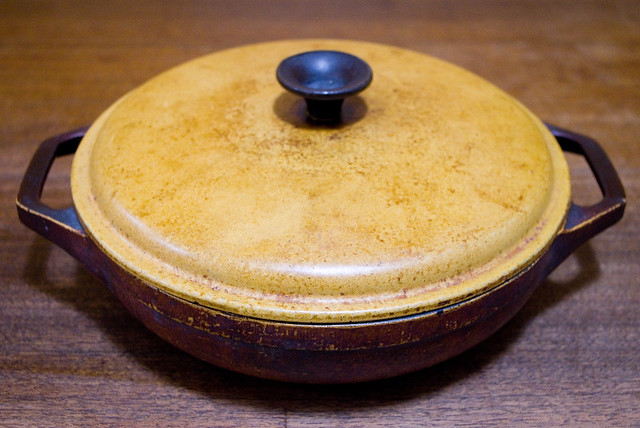
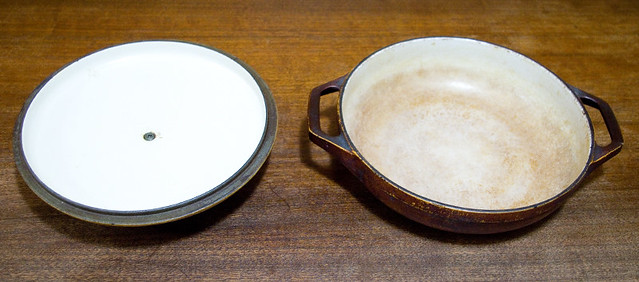
The inside wasn’t too badly off; there seemed to be some staining, but no chips or pits in the coating. The outside, however, was a mess:
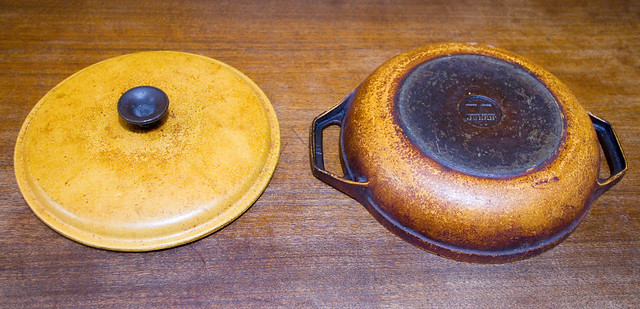
My best guess is that the previous owner(s) had regularly cleaned the inside where food would actually touch, but were lackadaisical at best about cleaning the exterior. There was a brand name on the bottom, but it was so covered in gunk that I couldn’t quite make it out. But it seemed like a solid piece, so I decided to give cleaning it up a shot.
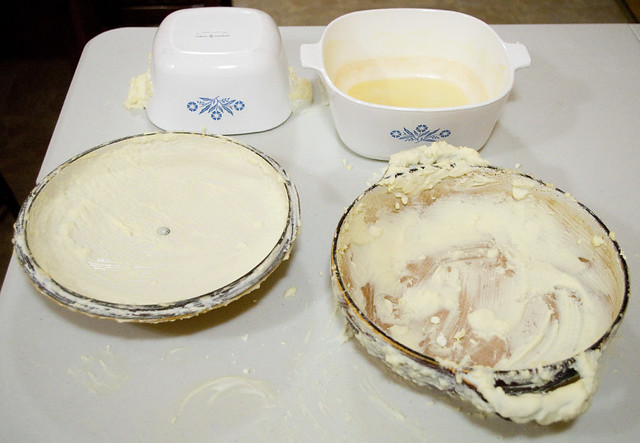
(I was also going to write about two vintage Pyrex dishes from the same box that had cleaned up really nicely with a lot of elbow grease, but yesterday I managed to bump into them and send them crashing to the floor. They hit each other on the way down and shattered into teeny tiny little pieces. They were only Cornflower Blue dishes, probably about 30 to 40 years old and not terribly rare, but after all that work I was — and still am — rather pissed off that I made such a stupid mistake. Anyway, that’s why there are Pyrex casseroles in that photo as well.)

One of the suggestions that I found online was to coat the piece in a paste of baking soda and lemon or lime juice, so I tried that first. If nothing else, it smelled nicer than any other cleaner I tried!

It actually made a pretty good dent in polishing up the interior.

However, it didn’t have the penetrating power to get a the worst of the exterior’s years of caked-on grease. I’m going to keep this technique in my arsenal for future reference, though, since it did do wonders for the areas where the damage wasn’t so bad, like on the outside of the lid.

The next tip I tried was to soak the pot overnight in a solution of two parts water to one part vinegar. This made so little difference that I didn’t even bother taking a picture. It was just a waste of time.

My friend suggested that I fill the sink with water and add two dishwasher pods, which did end up being the technique I was looking for. Even so, I had to soak for 12 hours, give it a scrub, change the water, and then return it to soak. This technique took three days, but just look how it turned out!
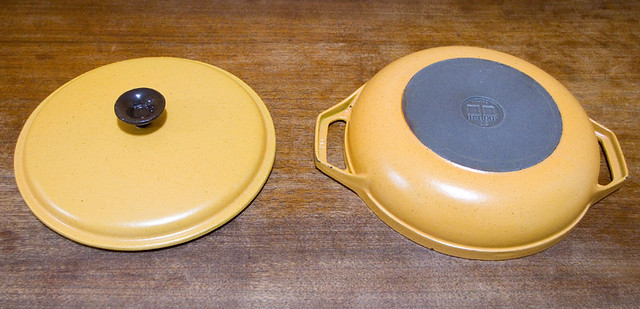
While it was soaking, I was finally able to get a good look at the logo. It’s a Nomar braiser, and my research dates it from the late 1960’s to early 1970’s:
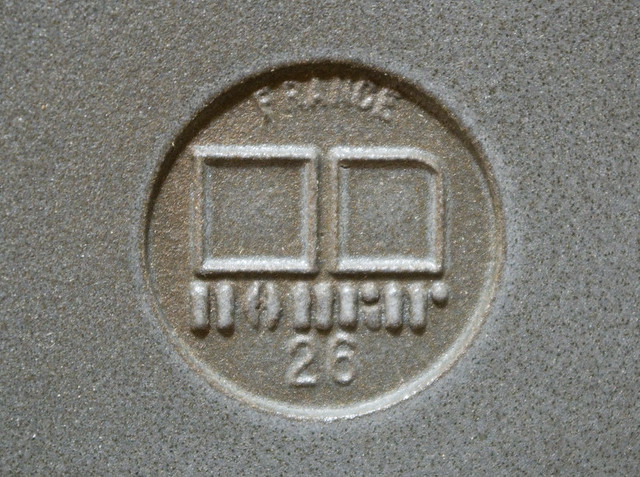
At some point Nomar was bought out by Staub, which is a competitor of Le Creuset. Apparently, back when they went by the Nomar name, the brand was an even stronger competitor. And Le Creuset is the be-all and end-all of cast iron ware these days!
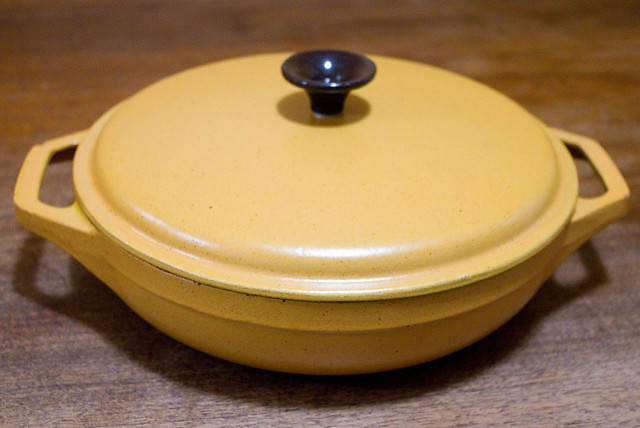
My roaster holds about 2.5L, which puts it between Le Creuset’s 1.5L and 3.5L braisers… Which retail for $200 and $340 CAD, respectively. So my piece old Nomar was definitely worth the work I put into it!

And I have to say, it’s awfully pretty.
Polly Put the Kettle On

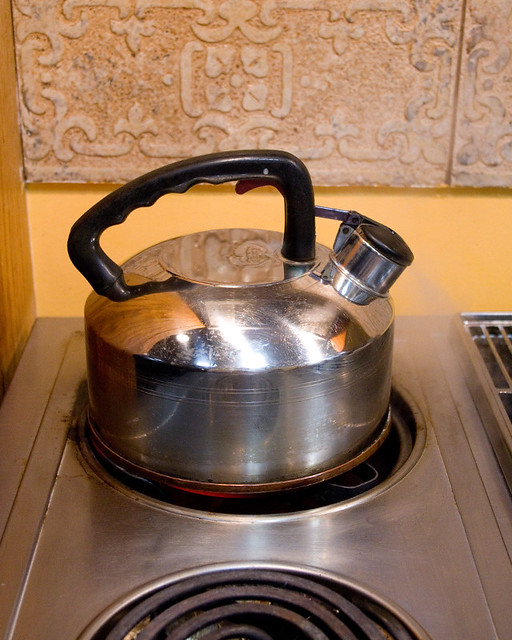
I got a box of old kitchenware to go through recently, and at the bottom of that box was a vintage (1976, if I’m reading the label right) whistling tea kettle. I gave it a scrub and put it on the stove to boil some water to clean the inside, and I was struck by how at home it looked there. I mean, obviously it belongs on a stove, but how much it fit in with my idea of home.

You see, when I was a kid this was exactly the kind of kettle we’d have permanently set on our kitchen stove. My parents are inveterate tea-drinkers (orange pekoe only, thank you very much), and there was always a pot of tea on the stove or a kettle on the boil. The kettle only left the stove on special occasions when Mom was cooking an extremely large or complicated meal. One of the first things I learned how to prepare was tea to my parents’ specifications. To this day, “Put the kettle on!” is slang for, “I’m coming over for a visit and a chat!”


The engraving on the bottom reads “Product of West Bend Company, West Bend, Wisconsin, Made in U.S.A., SINGING TEA KETTLE, Stainless steel with solid copper bottom, 2 1/2 quart, 7 76”

When I was really little, we had a kettle similar to this one but without the whistle. Apparently at one point my father forgot that it was on the stove and left the room, and the kettle boiled dry and then melted. So my mom bought a kettle with a whistle as a replacement. This kettle (or ones like it, since they do sometimes develop leaks) lasted for some years until my father filled the kettle, put it on the stove, and then went out to the garage for some reason. The kettle screamed away until it was boiled dry, and then it too melted down. Exasperated, my mother went out to the store and bought an electric kettle with an automatic shut-off. Dad, being a creature of habit, soon filled the brand new plastic kettle and put it on the stove, then turned the burner on. He didn’t leave the room this time, but he didn’t notice the mistake he’d made until the plastic melted. Don’t ask me how he didn’t smell it.

Since then, my parents have bought other kettles, all of which live on a counter that’s not near the stove and all of which are totally different shapes than the whistling kettles that I remember them having as a child. Dad learned his lesson, we hope, and has not melted a kettle since, and never will again, knock on wood. Despite the kettle saga, to me the “proper” kind is a stainless-steel whistling kettle that just covers the larger burner rings. The kettle singing is a cue that I am home, and Mom and Dad are home, and things can’t be all that bad because someone is making tea.

Own Two Hands: The Flea Market Stall

I’ve been giving it a lot of deliberation, and I have decided that it’s time to branch out with my passions. Much as I enjoy cooking, I don’t think I’m skilled enough to do it as a business. However, possibly as an offshoot of my enjoyment of food, I love thrifting for vintage and antique kitchenware and houseware. But I have been doing it for so long that I don’t really need anything anymore! So I’m opening a flea market stall where I can sell some of my fantastic finds.

I’ve started with the Russell Flea market, which is a new market that runs some Saturdays from 9:00am to 3:00pm at Russell High School (982 North Russell Road, Russell, ON). Here’s my schedule so far:

Own Two Hands at Russell Flea
Saturday, March 24th, 2018, 9:00am to 3:00pm
Saturday, April 7th, 2018, 9:00am to 3:00pm
Saturday, May 19th, 2018, 9:00am to 3:00pm
Saturday, June 2nd, 2018, 9:00am to 3:00pm
Saturday, June 16th, 2018, 9:00am to 3:00pm
Saturday, June 30th, 2018, 9:00am to 3:00pm


Some of the vintage Tupperware that will be appearing in my stall.

I’m also planning on participating in other markets, like hopefully 613flea, and perhaps Stittsville’s Carp Road Flea Market, and McHaffie’s Flea Market. I will keep an updated list of where I’ll be on my About page. For now, though, I’m taking things slowly as I am on the steep end of the learning curve.

So what does this mean in terms of my blog? Not much, to be completely honest. I will still write about cooking, and food, and recipes, and thrifting, and family. I’m basically expanding what I do out of the blogosphere and into the material world.

I look forward to seeing you at the market!