First Day of Spring Chicken

Today is the first day of spring. It’s also the vernal equinox in the northern hemisphere, which means that the days will be longer than the nights and continue getting longer from now until the summer solstice. The official changing of the seasons is all over my social media, but given that I live in Canada, it seems rather… Optimistic.


My pallet trellis in my back garden.

I totally understand how everyone wants it to be spring; this March went in like a lamb, and was preceded by record-breaking high temperatures in February. It looks like it will go out like a lion, with snow predicted again at the end of this week and the start of next week. For people who aren’t used to this climate, winter seems never-ending. But for those of us who grew up with it, we can see the little hints of spring: the days are regularly are above freezing in the afternoon; snow has melted back from the roads and sunniest areas of yards; snowbanks have compacted so that they’re no longer higher than my head; and we’re starting to actually have humidity in the air again.

It’s at times like this that I really feel for my European (mostly British) ancestors. I recently watched the Historical Farm series from the BBC. What struck home the most about the show was how green things remain in winter; in fact, the show often speaks of winter crops or winter harvests. Nothing grows here in the winter. To a great degree, everything stops when it starts to dip below freezing. I mean, we do still go outside, and our most famous sport, hockey, pretty much requires this kind of weather. But special care must be taken, and a huge part of our lives simply moves indoors. As for the animals, birds fly south, and many creatures hibernate or semi-hibernate. Outside of hunting and fishing, there’s not much you can do to gather food in the winter, which is why preserving is so historically important. (There’s a great food preservation exhibit at the Canadian Agriculture and Food Museum.) Effective food preservation could literally be the difference between life and death. These days, with commercial transport of food from all over the world, we can get fresh food almost as easily in winter as in summer, although supplies can become short in the event of a big snowstorm. Also, some things remain purely seasonal — and at the end of the winter, even the imported food is of lesser quality.

So it’s not truly spring here yet, no matter what the calendar says. Although I have begun to crave fresh spring produce, frozen or truck-ripened imports are all that’s available for now. That doesn’t mean that the food has to be bad, though. Take this roast chicken: it’s staple around our house because it tastes great, but takes very little effort. Basically, a chicken — thawed, giblets and neck removed — is placed in a roasting pan with a rack, then is sprinkled with a mixture of spices. I learned my favourite combination for poultry from my mother, which is:

– parsley
– sage
– rosemary
– thyme
– summer savoury
– garlic powder
– sea salt

This mixture is also great as seasoning for bread stuffing.

The chicken is baked in the oven at 350°F (177°C) for 20 minutes per pound, plus 15 minutes. Keeping the skin on means that it doesn’t have to be basted. The chicken is done when it pulls apart with a fork and has no pink spots.


Baked chicken with chicken skin, mashed potatoes, corn, and baby bok choy.

I generally serve this style of chicken with mashed potatoes and steamed vegetables. Since no part of the meal requires close supervision at all times, it’s the perfect thing for when I have to cook dinner and do something else at the same time, such as help the kids with their homework or supervise bath time.

Saint Patrick’s Day Dinner

This past Friday was Saint Patrick’s Day, and although I baked Guinness Yeast Bread to celebrate, I also needed to plan something for dinner. I thought a hearty Irish stew might be nice. I went through my cookbooks for something appropriate, but I didn’t find anything quite right. I searched the Internet and found a great recipe: Beef and Guinness Stew by Chef John at Allrecipes.com.

It didn’t have nearly as much broth as the stews I’m used to; it was really more like meat and gravy than a stew. That being said, it was absolutely delicious, and went well served atop mashed potatoes. Everyone in my house finished theirs down to the last drop, which is quite the compliment. (Trying to find something that everyone in this house likes is quite challenging.) I mean, it starts with bacon, and the next step is to fry the beef in the bacon fat. There’s your flavour right there. I would definitely make this stew again, probably next time beef roasts go on sale.

I also figured that a special occasion dinner required dessert. I made the cinnamon roll variation of my Dad’s Biscuits recipe. They’re not really Irish, I guess (from what I’ve read, cinnamon rolls were invented in Sweden), but at least the base of the recipe is baking soda biscuits, which is kind of like soda bread… Right? Ah well, there’s no rule that says I have to stick to a theme. Because of the extra sugar in the cinnamon rolls, they brown up very quickly, so don’t expect them to be as light-coloured as the original biscuits. They’re delicious warm from the oven, spread with a dollop of butter or margarine. If you can’t get them fresh, zap them in the microwave for 15 seconds or so to warm them, then butter.

German Cuisine Inspiration

A lot of my inspiration for learning how to cook “gut bürgerliche Küche” comes from my trip last year to Hamburg, since I wasn’t exposed to much German cuisine when I was growing up. Hamburg is a port city, and as such a lot of their food features ingredients from both the sea and from their trading partners. What North Americans may consider to be traditional German food tends to be Bavarian, which is both further inland and further south — and much different in both ingredients and flavour.

Of course, since we were staying in hotels, we never had a chance for a truly home-cooked meal. But I thought I would put the photos of some of my meals up here to act as future inspiration in my personal challenge to become more competent at cooking German food.


Breakfast at Dat Backhus, Lange Reihe 29, 20099 Hamburg, Germany. What I believe was smoked salmon and pickled egg on a half of a bun. There was some kind of mayonnaise concoction between the fish and the bread.


My dinner at a German pub on Lange Reihe. I had breaded and fried fish, fries, and a salad.


My husband’s dinner at the German pub. He had sausage and gravy, mashed potatoes, and sauerkraut.


Breakfast at Stadt Backerei (City Bakery), Lange Reihe 52, 20099 Hamburg, Germany. The bun on the left held a mix of salad shrimp and mayonnaise. The one on the right was scrambled eggs and bacon.


My husband’s fish in cream sauce at a restaurant right off of the pier and Landungsbrücken station.


My fried fish sampler and salad at the same restaurant.


My meatloaf (possibly Leberkäse?) that I ate at a restaurant in Berlin. Honestly, this was the only dish that I truly disliked during my trip. It tasted over-preserved and reminded me way too much of canned meat.


My husband, on the other hand, ordered pork knuckle from the same restaurant in Berlin, and it was absolutely delicious. I want one of my own sometime!


Hamburg Pho at Pho Duc, Steindamm 103, 20099 Hamburg, Germany. The noodles are wider than I am used to for pho. What makes it a Hamburg specialty? Apparently beef meatballs, fresh beef, and braised beef slices. It was very tasty.


My steak and potato dinner on my last night of the trip was at a higher-end restaurant, and it was delicious, although I don’t think it really counts as typical German food. I believe the restaurant was actually Mediterranean.

Beginner’s German Cooking

My husband and I have been married for almost ten years now, and we have been together for fifteen. For all of that time, I have been the primary cook in the house. So I hope you can understand how surprised I was when my husband complained a month or so ago that I have made all kinds of foods based in my Canadian and British heritage, but I never cooked anything from his German background except the occasional bratwurst. This was the first time he’d requested German food in the fifteen years we have been together. I really wish he’d said something sooner. New cuisine has a learning curve!


Königsberg Meatballs from page 70 of Grandma’s German Cookbook by Linn Schmidt & Birgit Hamm (2012). Delicious and very filling. Served here with boiled potato cubes.

Now, I love trying new dishes, that’s not the problem. It’s just that I had never cooked anything specifically German before. (This was before my experimentation with labskaus.) I asked my mother-in-law if she could suggest any books or other resources that might help; she gave me her extra copy of her favourite German cookbook, ‘Round the World Cooking Library: German Cooking by Arne Krüger (1973). From the introduction:

“A word that the Germans themselves use to describe many aspects of German life is “gründlich”, meaning solid. Like most national characteristics, the German reputation for extreme thoroughness and heavyhanded seriousness has been exaggerated. But no one — and particularly not the Germans themselves — would deny the German passion for organizing everything down to the smallest detail, or their profound distrust of improvisation. This applies not only to their cars and cameras, but to their cooking as well. German cooking may not possess the fantasy and imagination of Italian cooking, or the delicate refinements of French cooking, but this does not mean that German cooking is bad. On the contrary. German home cooking (which the Germans call “gut bürgerliche Küche”, or good plain cooking) is honest, down-to-earth, simple and substantial; it is perfectly in tune with the earnest spirit of German life.”

(As an aside, I ran “gut bürgerliche Küche” through Babelfish, and it came back with “good middle class cuisine”, which seems close enough.)


Chicken Stroganoff from page 78 of The German Kitchen: Traditional Recipes, Regional Favorites by Christopher and Catherine Knuth (2013). Quite tasty. I thought stroganoff was a Russian dish, but in this book it was presented as German, so what do I know? Served here with brown rice and steamed white & orange sweet potato cubes.

While German Cooking has been a great resource, I needed to read up further. I scoured my local library for German cookbooks and put a whole stack of them on reserve when they weren’t immediately available. I’ve read and reread them a number of times. I’ve tried out a few of the dishes and I think I am starting to get a rough grasp on them. I think the hardest part so far has been finding the proper ingredients. One bread recipe, for example, called for (among other ingredients) spelt flour and malt powder. I was finally able to find the spelt flour in a health food shop, but the malt powder eluded me for some time. I eventually went to a brew-your-own-beer place, which did have wheat malt powder for sale. I never did find barley malt powder, which I’m told is the standard in Europe. Also, sometimes the malt is sweet, and is sold in a syrup that is eaten the same way one would eat molasses here. Is there a powdered version of this syrup, like how you can get maple sugar? If there is, I haven’t seen it. Which kind of malt powder did they mean? It’s probably perfectly obvious to someone who has made this these dishes before, but for a beginner in German cuisine… I’m just not conversant with all the variations of the ingredients. But I am learning!

Chicken Noodle Soup

Back in high school, before the Internet was really a thing and email had only just caught on, I had a pen pal from Japan. I would spend hours composing letters to her, trying desperately to form coherent sentences with an extraordinarily limited grasp of the Japanese language. Her letters, written for the most part in English, showed her struggle with a new language as well. Even so, we communicated fairly well without being able to rely on body language, tone of voice, or facial expression (if at a fairly low grade level). That is, until I mentioned chicken noodle soup.

My pen-pal wrote that she had been suffering through a cold, and I made an offhand comment in my reply along the lines of, “Make sure you have your chicken noodle soup!” Her reply was sheer confusion. These days she would have Googled it on her smartphone, but that wasn’t an option back then. What was so special about chicken noodle soup?


Chicken noodle soup made with ditalini noodles, with a bacon and avocado sandwich on homemade German Beer Bread (World Breads: From Pain de Campagne to Paratha, page 19).

To be honest, the chicken noodle soup that I had when I was growing up wasn’t special at all. It came from a can if I was lucky; it would be plopped as a gelatinous tube of goo into a pot with a couple of cans of water, then stirred until smooth and heated until warmed through. If I was unlucky, or if we were camping, we had the dried soup mix instead. I have to admit that I didn’t really like either of these options, and it’s not because I don’t like instant soups. I use cream of mushroom soup in a number of recipes, and dried onion soup mix is a key ingredient in a great chip dip. I thought that I just didn’t like chicken noodle soup. (This didn’t stop me from having it when I was sick, though. Also being pampered by my mom, drinking flat ginger ale, burrowing under a pile of blankets on the couch to watch bad daytime TV, and draping my head with a towel then holding it over a bowl of hot water to let the steam clear my sinuses.)


Chicken noodle soup made with ditalini noodles and a few more spices, with a chicken salad, cheddar cheese, and spinach sandwiches on homemade Nan’s Pan Rolls, and navel orange slices on the side.

Then, last week I had a crock pot full of chicken bones simmering away for broth, and I thought to myself, “Why not?” I had never made chicken noodle soup from scratch before. I knew that if I didn’t end up liking it, the rest of the family likes the canned version, so it probably wouldn’t go to waste. I followed the Chicken Noodle Soup recipe on page 125 of the Joy of Cooking (2006 edition). And you know what? I actually quite liked it. Homemade doesn’t taste much like the canned stuff at all.

I was happy enough with the recipe that I made soup and sandwiches again yesterday after having to pick my daughter up sick from school. The jury’s out on whether this soup has any true health benefits, but it’s warm and comforting and easy on the stomach, so it’s good to eat when you’re not feeling well. It’s not much more difficult to turn into a meal than the canned stuff, either — so long as you have some broth in the freezer (which I almost always do).

Did I ever properly explain the chicken noodle soup tradition to my Japanese pen pal? Knowing my grasp of the language, probably not. I did try. I even sent her a package of the dried stuff and gave my best shot at translating the directions. Should she ever come to Canada, I think I’d like her to try my homemade version. Then she might understand why, to many Canadians, chicken noodle soup is a true comfort food.

Dr. Seuss’s Birthday

Yesterday, March 2nd, was famous children’s author Dr. Seuss’s birthday; he would have been 113 this year. This year his birthday coincided with UNESCO World Book Day in the UK (they have other holidays on April 23rd, which is when the rest of the world marks it, so for the UK it’s the first Thursday in March). I’m sure that Mr. Geisel would have approved.

Dr. Seuss’s birthday is a big thing for preschool children around here. Teachers generally spend at least a day focusing on his fabulous books; some even stretch it out into a whole week of activities. The environmental themes in The Lorax alone can spread to an entire sciene unit! I read all of the Dr. Seuss books as a child (except for the few that have been published since), and when the time came to read them to my own children, I couldn’t have been more thrilled. They have such great rhythm that I don’t mind reading them again and again. It’s a good thing, too, because when my kids like a book, I end up reading it until I could recite it in my sleep.

To celebrate Dr. Seuss’ birthday, I made Green Eggs and Ham for dinner. (I was going to read the book to my youngest as well, but apparently her teachers had beaten me to the punch, so we enjoyed Fox In Socks instead.) The eggs were simple scrambled eggs with grated cheddar cheese and a bit of chopped parsley, with a couple of drops of food colouring to provide the virulent green. I couldn’t figure out any way to safely turn the ham green, so I just cut slices of PC Free From Smoked Ham and dry-fried them in a non-stick pan. I also baked a loaf of Fast White Bread (2006 edition, page 597) and scooped some honeydew melon to supplement all that protein.

For dessert I made The Cat’s Hat Parfaits; you can find the recipe via Seussville.com. My kids loved it, and it’s a very healthy dessert (basically just berries and yogurt), so I didn’t mind serving it. In our house, dessert is generally reserved for special occasions.

Lastly, here are my Thing 1 and Thing 2. This picture is ancient now. They were so wee! I made the Thing 1 costume for the Halloween prior to that Dr. Seuss’s birthday, and I was lucky that it still fit in time for her to wear it to preschool. It’s an adapted Simplicity pajama pattern made from stretch cotton, and it was so comfy that she never tired of wearing it. The Thing 2 set was bought at Chapters before my Thing 2 was born.

Loco Moco

I am being completely honest when I tell you that I know absolutely very little about Hawaiian cuisine. It’s not just for reasons of distance; Hawaii is something like 5,000km from here, but Japan is about twice that, and I do know some things about Japanese food. Yet I can’t think of a single Hawaiian restaurant in this city. I’ve never seen any classes offered locally on how to cook Hawaiian food. We just don’t have a lot of Hawaiian people who have immigrated here, and who would blame them when you compare their tropical paradise with our frozen Canadian winters?

Given my lack of knowledge on the subject, it should surprise no one that I was stumped the other day when a Food Network show I was watching started talking about Loco Moco. Running the words through an online translator yielded, disturbingly, “crazy mucus” from Spanish — an unfortunate name, but no worse than “toad in the hole” or “bubble and squeak”. I then learned through Wikipedia that “the traditional loco moco consists of white rice, topped with a hamburger patty, a fried egg, and brown gravy”. “Well,” I thought, “That doesn’t sound hard. Let’s give it a go.”

I used the first recipe that came up when I searched for “Loco Moco recipe”: Guy Fieri’s Loco Moco. I don’t have any context to know how accurate this recipe is, but it was very tasty. Even my children requested that I make this comfort food again, and they are my harshest critics. Be warned, though, that this recipe says that it makes two servings, but it made enough for my family of four with leftovers. I know food portions are generally larger in the US, but do you really need a whole cup of rice (before cooking, so about two cups cooked), two quarter-pound hamburgers, and two fried eggs per person? That’s one heck of a lot of food.

Since we liked this dish so much, I think I may look into more Hawaiian dishes when I have the chance. Poké looks delicious, given that I love the sushi bowls that it resembles (and there are some restaurants in town that serve it now). Spam musubi looks like fun as well.

Sushi Bowls Recipe

Sushi bowls are a favourite go-to when I am running short of time to make dinner. Basically, a sushi bowl a bowl half-filled with rice, half-filled with sushi-style toppings. This dish takes as long as the rice takes to cook, so about 25min if you use sushi or basmati rice (much longer if you use brown or wild rice). This is a shortcut to some of the flavours of sushi without taking hours to roll it all up and years to perfect the craft.

Below you’ll find my recipe to make the sushi bowl pictured. Of course, feel free to experiment with the toppings. Vegetarian? Try avocado, cucumber, and mango. Will you eat only California rolls? Try imitation crab meat, cucumber, and avocado. Do you like barbecue? Try barbecue eel, which comes per-prepped at many Asian grocery stores and just requires reheating. Raw fish doesn’t frighten you? Try fresh sashimi-quality salmon, tuna, butterfish, and snapper. Like little bursts of saltiness? Include some tobiko (flying fish roe) or larger salmon roe. Want a little creaminess to your dinner? Drizzle the contents of the bowl with Japanese Kewpie mayonnaise. Prefer a little spice? Drizzle with Japanese spicy mayonnaise. Be creative! You don’t have to prepare this dish the same way twice if you don’t want to.

Sushi Bowls
Yields four adult servings

Rice
In a strainer, rinse until water runs clear:
2 cups sushi rice
Cook rice as per package directions*.

Toppings
While rice is cooking, boil a pot of water, leaving room for:
4 large eggs**
Once the water is at a rolling boil, add the eggs one by one gently to the water, using a spoon. Set a timer for six minutes. Once the time is up, remove the pot directly from the heat and carefully pour out the water. Refill the pot with cold water and wait for the eggs to cool (you may have to replace the water once or twice more to speed the process). Once the eggs are cool, remove them from the water, then peel them and set them aside.
Separately, peel and chop into bite-sized pieces:
2 ripe avocados
1 ripe mango
Wash and cut into bite-sized pieces:
1 small cucumber
Cut up with scissors into small strips:
2 sheets nori (sheets of Japanese seaweed)
Unpackage, wash, and peel if necessary:
16 precooked large shrimp
Open and set aside:
150g package smoked salmon

When the rice is finished cooking, fluff with chopsticks or a fork. Dish the rice evenly into four deep bowls. On top of the rice, into each bowl place:
– 1 soft-boiled egg (cut in half immediately before placing on the rice)
– 1/2 an avocado
– 1/4 of the mango
– 1/4 of the cucumber
– 1/4 of the nori strips
– 4 of the shrimp
– 1/4 of the smoked salmon.
Serve.

*When rice is cooked, you may drizzle it with 2 Tbsp rice vinegar. My kids don’t like the vinegar, so I don’t make it this way when I make it for them, but the vinegar tang will make it taste much more like sushi. (The word “sushi” actually refers to the cooked vinegared rice, *not* raw fish.)
**Soft-boiled eggs may be replaced with scrambled eggs. When you are mixing your eggs, season with 1 Tbsp of mirin (a sweet Japanese rice-wine sauce). This will make the scrambled eggs taste more like the kind that are used in tamago sushi (egg sushi).

P.S. Yes, I know I have more eggs in the picture than I have in the recipe. Of the people in my family, I’m the only one who likes two, so I averaged out the recipe somewhat. If you want more eggs, make more eggs!

Labskaus

On my trip to Hamburg last winter, I ate out often on Lange Reihe, a street with many restaurants not far from my hotel. On one such excursion I stopped in for lunch at Frau Möller (apparently named after the owner’s dog): a local pub that was busy whenever I walked past. I sat at the bar, since the rest of the pub was packed. The waiter was able to provide me with an English menu, thank heavens, because my accent is so bad that I can’t get a native-speaker to understand my small spattering of German.


Frau Möller at Lange Reihe 96, 20099 Hamburg, Germany

One section of the menu was labeled “Hamburg stuff”, which caught my attention immediately. Why visit another country if you’re not willing to try the local dishes? I was intrigued by the entry for labskaus, which had a description of the side-dishes but not the dish itself. I asked the server what it was, but his English failed him and he just shrugged and said, “Labskaus is… Labskaus.” So I had to try it.


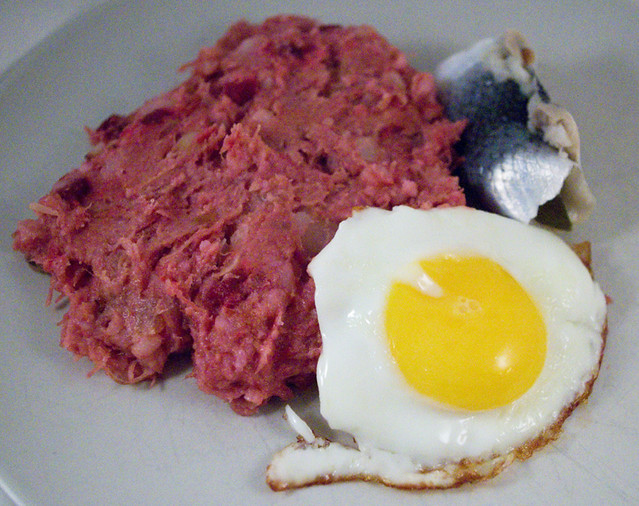
Labskaus at Frau Möller

The toppings were two eggs sunny-side up, dill pickles, pickled beets, and rollmops. I’ll confess to never having had rollmops before, but a brief examination revealed that they are a sweet pickled fish (herring, I found out later) wrapped around a cucumber pickle and held together with wooden skewers. But what was underneath the eggs? That, apparently, was the labskaus itself. I feared at first, based on the looks alone, that I’d ordered myself some kind of raw ground meat. But I took a bite, and realized that it couldn’t be. Upon tasting, I could tell it was some kind of meat (corned beef) and potato mixture. But what gave it its characteristic pink hue?

A bit of research back at the hotel when I could use the WiFi informed me that the pink came from pickled beet juice. All of these ingredients preserve well and were commonly available on seafaring vessels, making this dish popular both aboard ship and in coastal cities in Germany, Denmark, Norway and Sweden. The British have a similar dish, a beef stew called lobscouse, which is eaten by sailors and is popular in seaports like Liverpool; it is from this that the slang “Scouse” accent gets its name.


Rollmops available in Canada

When I came back home, I wanted to try to make labskaus for myself, since, as I’ve complained before, there aren’t any German restaurants around here. I decided to try a simple recipe from My Best German Recipes. Sourcing the ingredients was actually a lot harder than making the dish itself. Corned beef can’t be found out of a can for love nor money around here, so canned had to do. But which variety to choose? None of them were German. I read all of the ingredients and eventually settled on the one kind that had no sugar. I thought I’d have to make my own rollmops, but as it turns out you can buy them pre-made in most grocery stores. They even have the same shape of skewer as the ones from Frau Möller.


My labskaus

My final product was definitely edible, but paled in comparison to the ones I had in Hamburg. I would like to try to make this dish again, but this time with corned beef that has never seen a can. I think that this would make all of the difference in the world. I will have to try a specialty butcher, rather than a grocery store. I am not satisfied enough with my first attempt to try it without better meat.

Bread Basket

I’ve been working on my bread-making skills over the last few weeks, much to the happiness of my family; it generally makes the house smell great even when I fail. For these experiments I have been relying predominantly on World Breads: From Pain de Campagne to Paratha by Paul Gayler (2006). It’s not a very long book (it’s subtitled “a small book of good taste”), and I’m determined to make my way through it recipe by recipe.

Broa (Portuguese Country Bread)
World Breads, page 16

This isn’t a kind of yeast bread I’d ever had before, although in texture and flavour it greatly resembled the cornmeal muffins that we eat here around Christmas. To my taste, this recipe needed either a little more sugar or a little more salt… I need more experience to figure out which, but I’m leaning more toward salt, since the recipe (and many other perfectly good ones) don’t call for sugar at all.

Dill and Curd Cheese Bread
World Breads, page 41

This bread was absolutely delicious, needing no tweaking, and I would make it again in a heartbeat. There’s not enough curd cheese (I used ricotta) to make it greasy; rather, it adds a touch of moisture and helps the bread be light and fluffy.

The dill bread recipe makes two loaves, and my family didn’t have a chance to finish it all before it started to go stale. I suppose we could have just toasted the last few slices, but instead I decided to leave them out overnight so they’d become properly hard. Then I put the slices into a plastic zipper bag and crushed the bread in the bag with a rolling pin to make fine bread crumbs. I had a bit of fresh dill left over that needed to be used, so I chopped that and added it to the bread crumbs. I then beat a couple of eggs, dipped the tilapia fillets in the egg, then dipped them into the bread crumb mixture, and fried it all lightly in a drizzle of olive oil in a nonstick pan. I served it with steamed bok choy and penne with pesto, and it was delicious.

Oatmeal Bread
World Breads, page 25

I liked the texture and heft of this bread; it was particularly good for sandwiches. However, this one too was lacking either salt or sugar to my taste, so I will have to adjust the recipe next time to see if that helps.

Seeded Granary Baton
World Breads, page 16

This loaf was full of all the seeds and heavier flour that I love in a breakfast bread, but I planned this bake very badly, as I couldn’t properly enjoy it after having just had dental work done that day. Even so, it was very tasty — I just had to be very careful how I chewed. I like that the grains/seeds can be varied to change the texture and flavour; the original recipe calls for sunflower, pumpkin, and sesame seeds (pepitas), but I would enjoy trying it with all of the interesting seeds that are available at the local bulk store.

White Soda Bread
World Breads, page 12

Wow, did I ever mess up this bread. I didn’t flatten it enough, so the center wasn’t cooked through. I cut the slashes too deep, so the bread opened up like a facehugger egg from Alien. And somehow I made a mistake with the mixing, so that instead of a nice, smooth crust, I ended up with something that strongly resembled cellulite. The flavour, for those parts that were cooked through, was quite nice, so I think I shall try it again with my newly-acquired knowledge of what not to do.

Whole Wheat Bread
Joy of Cooking, 2006 edition, page 599

I was craving a simple whole wheat loaf, so I veered away from my quest to finish all the World Breads recipes. This recipe is from my trusty standby, the Joy of Cooking. The texture and flavour of the loaves was quite nice. However, I discovered that there is a typo in my copy, one that was corrected in the more recent digital edition (which I did finally break down and buy). At the start of the recipe, it says that it should yield three 9″x5″ loaves. Yet at the end of the recipe, it instructs the cook to “allow the dough to rise in a large oiled bowl until doubled, about 1 hour, and once in 2 greased 9 x 5-inch loaf pans until doubled, about 45 minutes”. Basically, it says that the recipe yields both two or three loaves, which is definitely an error. I flipped a coin and went with two loaves, and the end result was that the loaves were huge. I had to cook them for about 15 minutes longer than indicated so that they sounded hollow when I tapped the bottoms. Next time I’ll split it into three loaves — even though the digital version says to make two loaves as well.