Fish Stories

According to Wikipedia, the Canadian province of Ontario contains approximately 250,000 lakes annd 100,000 plus kilometers of rivers. This means that about 1/5 of the world’s fresh water is in this province. So I guess it should come as no surprise that many people raised here spend a lot of their recreational time out at “the lake” or “the river”. A lot of us learn to fish from a very young age, which is funny when you realize how few of us ever actually catch enough to cook even a single meal.


Thing 1 fishing.

My father started taking me fishing when I was about five years old, so you’d think that that would mean that I’m an expert by now. Not even close. I mean, I can go fishing in a shallow, weedy area using a spinner lure and worms as bait, and I can catch yellow perch, northern sunfish, and pumpkinseed sunfish like there’s no tomorrow. But I was always taught that, except on those rare occasions where you get a huge specimen, it just wasn’t worth it to take these fish home for dinner. I’ve also caught some monster pike, but they’re not good eating unless you’re truly desperate, as they are slimy, bony, and difficult to clean. Upon occasion, I’ve caught decent-sized walleye and carp, but only in waterways adjoining major cities that I consider too polluted for safe eating.


Thing 2 fishing.

Only in the last few years have I become truly interested in eating the fish that I catch; before that it was 100% catch-and-release. The prize fish for eating around here are smallmouth bass, largemouth bass, and trout, with the latter being the most desirable. Of course, this means that this year so far I’ve only caught the one smallmouth bass, which started flopping on the line while I was trying to get a picture and somehow broke my wire leader (which I attached to my line on the off chance that I’d catch a pike, which can bite through a normal line). No, the metal did not snap; the ferrule securing the wire loop slipped open, and not only did the fish get away, it took my lure with it! So that means that really, this year so far anyway, I have been skunked for edible fish. How demoralizing.

It’s still a lot of fun to fish though, especially with my kids. Thing 1 prefers to root through her tackle box and sort through her lures rather than fish. Thing 2 generally alternates between running along the shoreline and seemingly trying to hook herself with her wildly-cast lures. Even so, we have a great time. I’m lucky enough that my lack of fishing success doesn’t mean that my family will go hungry, so we have the luxury of being pretty terrible at it but enjoying ourselves anyway.

Canada Agriculture and Food Museum

We decided to forego the the crowds downtown on Canada Day; in retrospect, this ended up being a really good idea because the wait ended up being two to five hours to get onto Parliament Hill. There is no way that my kids would have had the patience for that — even if I did! After all, living in the nation’s capital means we can visit the area any time. Why contend with the crush?

Instead, we headed out to the Canada Agriculture and Food Museum, which is away from the downtown core. Parking was out into overflow lots, but otherwise it wasn’t too busy; I’ve seen it more packed when a bunch of school/camp trips all arrive simultaneously. Like most of the museums that are open on Canada Day, the Agriculture Museum had free admission, although we did have to pay $6.00 for parking. So all in all, it was a cheap day out.


Thing 2 checking ever-so-gently petting a sleepy calf.

There were all kinds of special demonstrations planned for Canada Day. We got a chance to check out the Chantecler chicken demo, ice cream making, the Great Canadian Quiz, the kids craft & games station, and the afternoon milking. Of course, we also had to make our way through all of the barns and pens to visit all of the animals. Thing 2, unsurprisingly, was the most fascinated by all of the animals.


Thing 2 on my husband’s shoulders while they watch the afternoon milking.

This kind of museum probably doesn’t have a huge amount of appeal to people from farming communities, where the knowledge to be garnered from the exhibits is part of everyday life, at least in part. I mean, day to day I can’t see the history of canola oil production in Canada being something that comes up, but if you live with livestock then it’s not going to be all that exciting to see them in a museum. However, for city folks like my family, it’s very interesting. I also think that it’s important for everyone to understand where their food comes from and how much time and effort goes into feeding our country. And of course for the kids, being allowed to touch some of the animals means that the place ends up being like a large petting zoo.


Thing 1 checking out the replica root cellar in the food preservation exhibit.

As a home cook, I found the Food Preservation: The Science You Eat exhibit to be particularly interesting. I like how you literally have to walk through the history up to the modern day. I’m also a big fan of area where you can manually control the time lapse video (forward, back, and speed) of decomposing food. I’ve always found that kind of thing to be fascinating.


Jars in the food preservation exhibit.

There is a section of the exhibit dedicated to home canning as well, which is very relevant to my interests.

All in all, we had a wonderful day out! We even got lucky with the weather and managed to avoid most of the rain. We’ve been to the Agriculture Museum many times before, and it never ceases to entertain and educate. I highly recommend visiting this museum if you have the chance.

Maple Rhubarb Crisp & Maple Leaf Cookies

I was trying to be as Canadian as possible this week and made maple rhubarb crisp from the recipe on page 116 of Sweet Ontario Pure Maple Syrup: Our favourite Maple Recipes, which is published by the Ontario Mable Syrup Producers’ Association. I picked up a copy of this cookbook this past weekend at the Cumberland Farmers’ Market, which is where I also picked up the rhubarb for the recipe. I didn’t purchase any good Ontario maple syrup at the time, but only because I already had two big jugs in my fridge. Can’t get much more local than that!


Maple rhubarb crisp topped with non-dairy whipped topping

I was really happy with how this recipe turned out. The crisp was the perfect blend of sweet and tart. I’m really looking forward to trying other recipes in this cookbook, such as the french toast casserole and maple BBQ chicken.

Of course, I had to check out some of the Canada-150-themed foods that are being sold in preparation for the big day. The above cookie was from a two-cookie decorating kit that retails at Walmart for $1.50. They aren’t half bad, given the price! My kids are going to decorate their own tomorrow. For an American company, Walmart carries an awful lot of Canadiana. But as the Arrogant Worms quipped in The Mountie Song:

“Where would you get a tank?”
“Walmart.”
“Oh.”

Speaking of the Arrogant Worms, here’s their song Proud to be Canadian, from the album Live Bait.

I hope you all have a safe and happy Canada Day!

Ketchup Chip Chicken & Canada Day Rice Krispies Squares

It’s a hectic time of year, what with the kids’ end of school and all of the events that that entails, and all of the preparation for Canada’s 150th. So last night I focused on easy, stress-free food.

For dinner I whipped up some ketchup chip chicken, rice, and sliced gala apples. I’d read somewhere that it’s possible to use crushed potato chips as breading, and apparently ketchup chips are only available in Canada, so I combined the ideas for this celebration-themed meal. To bread the chicken thighs, I first dredged them in flour, then dipped them in beaten eggs, and then finally rolled them in ketchup chip crumbs. About 40min in the oven at at 350°F (175°C) on an oiled broiler pan, and it was done. While the chicken was cooking, I steamed my rice and chopped up my apples, and dinner was complete.

Not surprisingly, if you use potato chips as a breading, the final product ends up tasting like the flavour of chips you choose. The smell of this chicken strongly reminded me of hot dogs; perhaps the smell I associate with hot dogs is really that of warm ketchup and vinegar. The chips provide a nice crunch that I think would work equally well on the barbecue or, if you’re feeling really decadent, deep fried.

I also had to make up treats for my kids’ school Canada Day celebration, so I went with the time-honoured last-minute classic of Rice Krispies Squares using the microwave version of the recipe found on the box (and online). I used maple-flavoured marshmallows instead of regular ones for a more Canadian twist.

To make the treats look more appropriate for the holiday, I sprinkled them with red and white sprinkles. The presentation wasn’t all it could have been, but I wanted to use recyclable dishes so that I didn’t have to worry about the kids breaking them or not bringing them home. After making these squares, I kind of felt like the woman in the old Rice Krispies commercial, except I definitely haven’t had the chance to indulge in a good book!

Poutine & Cupcakes

Continuing this week’s pre-Canada-150 lead-up, I’d like to start with some iconic Canadian music: The Log Driver’s Waltz. The song became an integral part of art culture in Canada in 1979, when an became the soundtrack of arguably the most popular animated short in the Canada Vignettes series released by the National Film Board. The short, along with the other Vignettes, was aired on the CBC (Canadian Broadcasting Corporation) between programs as filler, so it was very possible to catch this song multiple times a day throughout the 1980’s. There is also a French-language version entitled La valse du maître draveur. The chorus of the English version is as follows:

For he goes birling down and down white water
That’s where the log driver learns to step lightly
Yes, birling down and down white water
The log driver’s waltz pleases girls completely

Birling, by the way, isn’t a word in common parlance even in Canada (at least not anymore), but it according to the the Free Dictionary, it is “a game of skill, especially among lumberjacks, in which two competitors try to balance on a floating log while spinning it with their feet. Also called logrolling.”

The timber trade in general is a huge part of the history of Canada as a whole, and the Ottawa area in particular. The trade blossomed in the early 1800’s, with log rafts and booms being a common sight on the Ottawa River for over a hundred years. Related trades played a large part in the development of the city, with a large number of local trades becoming part of the cultural landscape in the sawmills and their later cousins the pulp and paper mills.


Homemade poutine

The timber industry was dominated by backbreaking labour, what would now be called blue-collar work, and in a similar vein, the famous French-Canadian dish of poutine is considered a very blue-collar dish (although honestly everyone eats it, no matter their level of wealth). Poutine would probably have been appreciated by log drivers, but it didn’t come into being until the 1950’s, when the local trade was on its last legs. Poutine is a mouth-wateringly delicious pub grub combination of french fries, cheese curds, and gravy. The one that I made yesterday, pictured above, also had chunks of the ground beef that I used to make the gravy from scratch. I made the fries using the Baked French Fries I recipe on Allrecipies — although I set the oven to 400°F (205°C) instead of the higher temperature in the directions, as per suggestions in the comments. Poutine may look like a hot mess, but it tastes fantastic, and it’s particularly good while/after a few drinks.


Strawberry cupcake with buttercream icing & a maple-leaf-shaped strawberry gummy

Of course, you have to follow a meal of meat and carbs with dessert, right? My family ate these strawberry cupcakes with buttercream frosting following the poutine (I don’t know how they had any room left). The cupcakes were Sprinkles’ Strawberry Cupcakes from Martha Stewart. They came out looking great, but I was a little disappointed in the flavour; I’d hoped they would taste more like the strawberry puree that was in the batter, but mostly what I could taste was vanilla. Originally I had planned to make a maple buttercream frosting, but I don’t know what I did wrong and the frosting separated as soon as I stopped mixing. I was so disappointed! I ended up using store-bought Duncan Hines buttercream frosting (which contains neither butter nor cream), which was a blow to my pride, but at least my friends with milk allergies could eat it. And hey, the cupcakes looked red and white for Canada Day!

Nan’s Strawberry Shortcake Recipe

It’s less than a week until Canada Day (July 1st), and this year it’s a big deal because it’s the country’s sesquicentennial, 150 years since Confederation. It’s a pretty big deal around here. There are all kinds of events planned surrounding the holiday, much more extensive than the usual celebrations. I’m not sure yet what we’re going to take part in, but it’s worth noting that most of the museums are free on Canada Day (especially useful if it’s raining but you still want to do something), and the fireworks are always spectacular.

Until the big day, though I thought I’d cook some typically-Canadian or Canada-themed dishes to start the celebrations. Canadian cuisine is really hard to pin down, as it’s very regional and is strongly influenced by the immigrants that settled in the area. Since I am predominantly of British descent, my idea of Canadian food is British-Canadian, but since I live in an area with a strong French-Canadian presence, that affects my idea of typical Canadian food as well. If you live in a different part of Canada, or come from a different heritage, your idea of typical Canadian food may be totally different — and that’s totally okay. As former PM Joe Clark put it, “Canada has a cuisine of cuisines. Not a stew pot, but a smorgasbord.”


Nan’s strawberry shortcake made with non-dairy whipped topping

The first dish I made to celebrate Canada Day was nice red-and-white strawberry shortcake, according to my Nan’s (my dad’s mom’s) recipe. It’s a fairly simple recipe that can be whipped up quickly. If you’d prefer a no-bake red-and-white dessert recipe, I would suggest The Cat’s Hat Parfaits.

Nan’s Strawberry Shortcake
Yields 10-12 personal-sized shortcakes

Make up a batch of
Dad’s Biscuits
However, replace the 2 tsp of sugar in the recipe for
3 Tbsp sugar
This will make a sweeter biscuit that is more suitable for dessert.
When shaping the biscuits, instead of using the drop-off-a-spoon method used in the photos, roll out the dough onto a floured surface to between 3/4″ and 1″ thick. Use a round cookie cutter or a floured drinking glass with straight sides to cut the biscuits to a uniform size. Follow the rest of the instructions as per the recipe.

While the biscuits are baking, cut up about:
1/2 cup of strawberries per shortcake
Only cut up as much as you’ll need to serve right away, as strawberries tend to go bad more quickly once they’re cut.
In a separate bowl, whip together until fluffy:
one 237mL package whipped cream
2 tsp sugar
1 tsp vanilla
Alternately, you may use spray whipped cream in a can, or non-dairy whipped topping.

When the biscuits are done and cool enough to handle, assemble the shortcakes on small serving plates or in bowls. Start with the bottom half of a biscuit, then a layer of strawberries, then whipped cream, then the top half of the biscuit, more strawberries, and top with whipped cream. Serve.

Alternately, make the biscuits in advance and assemble the shortcakes immediately before serving. Do not assemble them in advance, or they will get soggy.

Ottawa Farmers’ Market

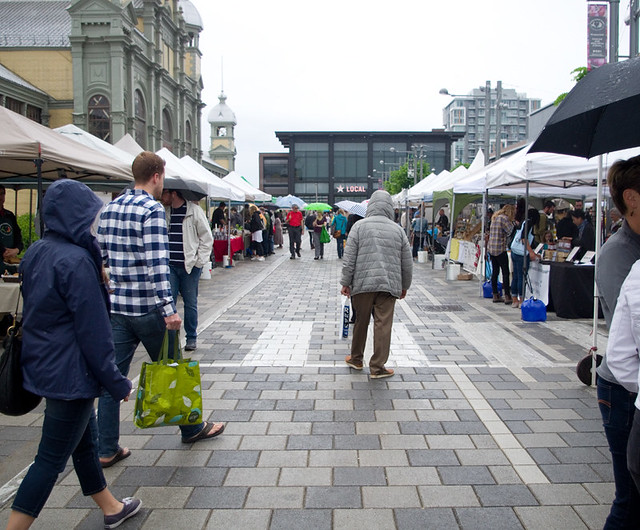
I had my first chance to check out this year’s Ottawa Farmers’ Market at Lansdowne Park this past Sunday. This being Canada (first outdoor plantings generally happen during the Victoria Day weekend at the end of May) and especially with the flooding we’ve had this spring, there wasn’t a lot of fresh produce out yet. We probably have at least a couple of weeks before garlic scapes (one of my all-time favourite ingredients) start coming into season. However, there were lots of baked goods, preserves, freshly-cooked food, and locally-grown plants. It was a rainy, chilly day, but we still had a lovely time. First came the exploring:


The Ottawa Farmers’ Market at Lansdowne Park, with the Aberdeen Pavilion (also known as the “Cattle Castle”) on the left.


Potted herbs for sale.


Maple Country Sugar Bush


Acorn Creek Garden Farm


DiversiTea


Asparagus


The Right Bite

Then of course we had to stop for lunch:


The Hot Potato Company


My baked potato wedge poutine from The Hot Potato Company


Raon Kitchen


Thing 1’s chicken bimbap from Raon Kitchen

Then of course we had to get dessert; this week it was tarts from Savoury Pursuits Fine Foods:


Savoury Pursuits Fine Foods

And then back to exploring!


Linda’s Garden

The weather is promising to be much nicer this coming weekend — actually summery weather in June, who’d’ve thunk it? Here are some of the local markets that are running this (and every) weekend until fall:

Ottawa Farmers’ Market: Orleans
Thursdays, 12:00pm – 7:00pm
Ray Friel Center, 1585 Tenth Line

Cumberland Farmers’ Market
Saturdays, 8:00am – 1:00pm
R.J. Kennedy Community Centre / Cumberland Arena, 1115 Dunning Road

Ottawa Farmers’ Market: Byron Park – Westboro
Saturdays, 9:30am – 3:00pm
Byron Park, 432-454 Richmond Road

Ottawa Farmers’ Market – Lansdowne Park
Sundays, 9:00am – 3:00pm
Aberdeen Square, Lansdowne Park, 450 Queen Elizabeth Drive

Tulip Festival

Yesterday was lovely, if hot (30°C with a humidex of 36°C), so I headed out to Dow’s Lake to check out the gardens that were planted for the Canadian Tulip Festival. If a tulip festival sounds like something more apropos to the Netherlands than Canada, that’s kind of the point.


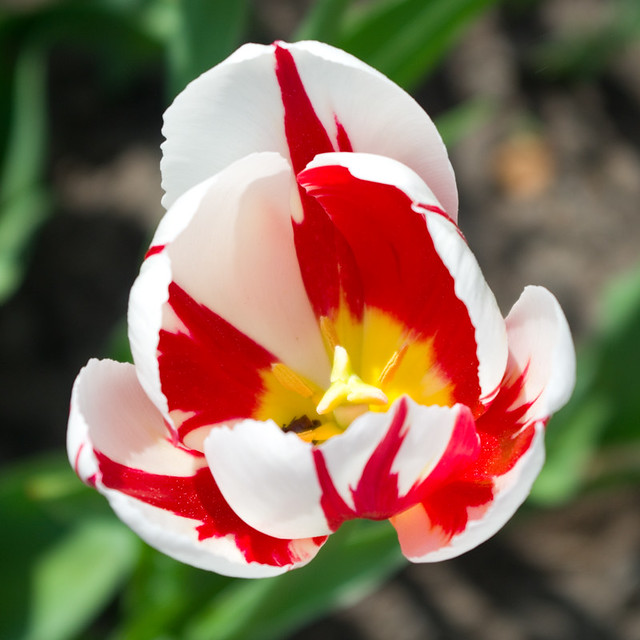
Canada 150 tulip.

There is a strong bond between the two countries, primarily because in 1945 Canadian troops participated in the liberation of the Netherlands and then helped to rebuild the country after the war. Not surprisingly, some 1,800 war brides and 400 children came back to Canada following the troops. Additionally, in 1940 Princess Juliana (who later became Queen of the Netherlands) and her two daughters, Princesses Beatrix (who grew up to be Queen for 33 years) and Irene fled from the Nazis to take refuge in Ottawa during the second World War. Prince Bernhard and Princess Juliana’s third daughter, Princess Margriet Francisca, was born in the Ottawa Civic Hospital during this period of exile. The “Canadian” princess was later baptized at St. Andrew’s Presbyterian Church on June 29th, 1943, with the Governor General of Canada as one of her godparents.


Canada 150 tulips.

After the end of the war and the return of the Dutch Royal Family, Princess Juliana and the people of the Netherlands sent, among other things, 100,000 tulip bulbs to Canada in thanks. In 1946, Princess Juliana gave an additional 20,000 bulbs, and since 1958 the Royal Family has sent 10,000 bulbs annually. The Canadian Tulip Festival has been running since 1951 and obviously not all of the nearly one million bulbs planted each year in the capital region are gifts from the Netherlands, but all of the flowers are a symbol of international friendship.


Canada 150 tulips, with the Rideau Canal and Carleton University in the background.

This year is particularly important, as it is Canada’s sesquicentennial — the 150th anniversary of Confederation. Basically, the year has been planned as a giant birthday party for the country, and the Tulip Festival is part of that celebration. Specifically, a Dutch grower was commissioned by the Government of Canada to breed a tulip especially for the occasion, with red and white petals meant to mimic the Canadian flag. I’ve read that when some people planted these bulbs privately, they came up orange or pink, but the ones planted by the National Capital Commission came up in the promised red and white. Perhaps the variation available for public purchase in garden centers was a different cultivar?

At any rate, when the weather is fine, a walk through the gardens for the Tulip Festival is definitely worth fighting the traffic downtown. My favourite spot is Commissioners Park at Dow’s Lake, although I’m told that Parliament Hill and Major’s Hill Park are also planted beautifully for the season. Of course, you can check out the art installation of 5-foot-tall painted tulips at Lansdowne Park as well.

Lobster Rolls

The weather is finally changing to something vaguely resembling summer, and this is the time of year that I start thinking about all the summer trips to the Maritimes that I made as a child, and then again as an adult. We would drive there from Ontario, and it seemed that as soon as you crossed the border between Québec and New Brunswick, the food culture changed from land to sea. Just pop into a New Brunswick fast food restaurant in order to compare: McDonald’s in New Brunswick serves (very poor) lobster rolls, and Subway serves a (reasonable) seafood sub. The culinary transition is rather abrupt, because it’s not like the terrain and agriculture of eastern Québec and western New Brunswick are at all different. But New Brunswick is a maritime province, and this is reflected in the culture and the cuisine. Which isn’t to say that there isn’t a strong agricultural foundation in the province as well; with an area almost the size of Ireland with one sixth the population, there is room for multiple local industries.


Golden Fry, Shediac, New Brunswick.

Most people who visit New Brunswick head for the coast. The best value for money as a tourist is generally to rent a cottage within walking distance of the sea, or if that’s not possible, to stay in an inn or B&B within a short drive of the beach. The town of Shediac (the self-proclaimed Lobster Capital of the World) has capitalized on its proximity to the gorgeous Parlee Beach Provincial Park and has, over the years, become somewhat overdone, over-hyped and overpriced. The town almost shuts down except for the months of July and August. There are some good seafood restaurants there during tourist season — but some of the best food in town can be found at the Golden Fry (560 Main St, Shediac).
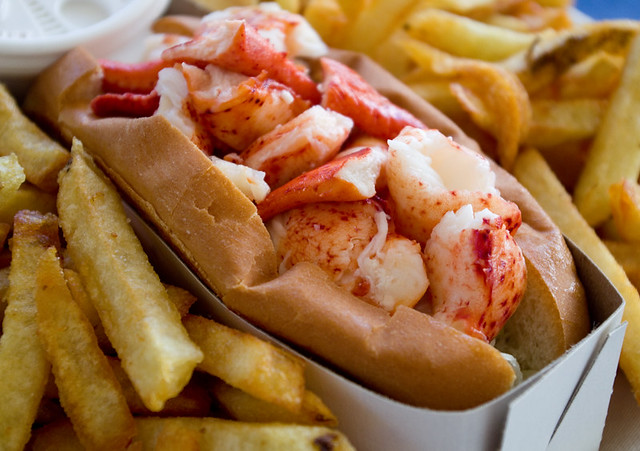

Lobster roll and fries at the Golden Fry.

The place doesn’t look like much; it’s just a small building off the side of the road, with a gravel parking lot and some plastic tables and chairs out front. It’s takeout, pure and simple — it makes me think that a french fry truck grew roots and decided to stay in one place. But oh my goodness, their food is so good! Take the lobster roll, for example. It’s a toasted, buttered New England roll stuffed to bursting with chunks of fresh, cold lobster meat. Their their fries are fresh-cut, their poutine uses real cheese curds, their fried clams are crisp on the outside, soft in the center… A lot of the fancier restaurants in town could take lessons from this place, especially since “lobster roll and fries” is a standard menu item in the area no matter where you dine.


Bouctouche Beach.

To me, though, Shediac has been done to death. The town is packed to the gills during tourist season, the traffic can be gnarly, everything is overpriced compared to the same things just out of town, the cottages are so close they’re practically town houses… For my seaside vacation, I prefer something a little calmer. This is why I’ve fallen in love with the town of Bouctouche, which is a short drive up Highway 11. Like Shediac and Pointe-du-Chêne (which also has some lovely beaches), it is on the Northumberland Strait, and as such boasts some of the warmest ocean water temperatures on the Atlantic coast north of Virginia. Unlike Shediac, it hasn’t become a tourist trap, although Bouctouche does boom in summer. It’s a little further away from Moncton, and hence from the Moncton airport, so people aren’t as likely to make the effort.


Irving Eco-Center, La Dune de Bouctouche boardwalk.


Irving Arboretum.


Irving Arboretum.

The town of Bouctouche has benefited from being where James Dergavel Irving founded J.D. Irving Ltd. (the company most well-known these days for Irving gas stations) in 1882. The company/family has funded a big chunk of the most beautiful spots in town, like the Irving Arboretum, which is packed with scenic walking and biking trails, and the Irving Eco-Centre, La Dune de Bouctouche, which contains the local saltwater beach as well as a boardwalk and hiking trails.


Buctouche river.

In addition to the coastal attractions, the Buctouche river flows through Bouctouche and neighbouring towns, emptying into Buctouche Bay in the Northumberland Strait. This means that the town also has freshwater angling, boating, and scenery.
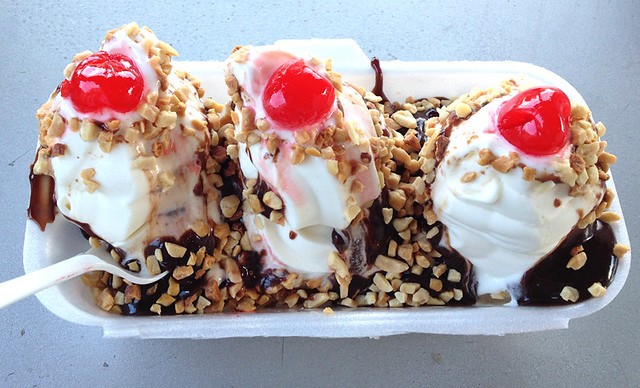

Banana split at Le Petit Crèmier, Bouctouche, NB.

One of my kids’ favourite places in Bouctouche was Le Petit Crèmier (103 Irving Blvd), which is the local ice cream parlour. Once again, it’s take-out only, but their ice cream is great, their portions generous, and the sheer variety of what they serve is mind-boggling. It’s totally worth a stop on a hot day (or, if you’re like me, any day).


Pirate de la Mer restaurant, Bouctouche, NB

The hidden gem of Bouctouche, food-wise, is Pirate de la Mer (10 rue Industrielle, across the street from the small mall containing the Co-Op and the liquor store). There’s nothing much to the restaurant when you see it from the outside. It’s in a plain red industrial building, with a couple of picnic tables out front, and a gravel parking lot. But if you head there on the weekend or at dinner time, be prepared for up to a half an hour wait in line just to place your order, with another half hour before your food is made. The place is popular with the locals and with tourists. It is not uncommon for there to be not enough seating for everybody, which is why a good portion of their clientele orders their food to go. The amply-sized parking lot gets full fast, with overflow parking on the road. After my first visit, I would order my food a half an hour in advance or so, giving them lots of time to prep while I headed over and then waited in line. This way the food was hot and ready to go as soon as I paid.


Double lobster roll, fries & coleslaw at Pirate de la Mer.

The lobster rolls at Pirate de la Mer are mouth-watering — enough so that I make a special trip to Bouctouche to order them, even when I’m not staying in town. Their fries are crispy deliciousness, and I’m told that their coleslaw is first rate (I don’t like coleslaw). In addition, they make their own tartar sauce – they’ll give you the option between their version and pre-made Kraft stuff. Go with their version. It’s definitely not a fancy restaurant, but I haven’t had better seafood at anywhere that charges four or five times more for “gourmet” and “ambiance”. If you want to eat somewhere prettier, you can always get your food to go and head up the road to the Arboretum or the beach.


Lobster roll at Pirate de la Mer.

There is no excuse for visiting the Maritimes without indulging in seafood. Unless you hate the stuff, I guess. Or are allergic. Or vegetarian. Or your religion prohibits it. Other than that, though, there is no excuse. If you can afford to travel, then you can afford at least one seafood meal — especially since, in New Brunswick, a lot of seafood dishes are on par or cheaper than any other kind of meat. So indulge! You won’t regret it.

Maple Mustard Glazed Salmon & Maple Barbecue Sauce

Because maple syrup is, well, a syrup, most people think of it first in sweet dishes like candy or fudge or cookies. However, it does add a fantastic note to savoury dishes as well.

One of the simplest recipes of which I have eaten a great deal — first prepared by my mother, later by me — is Maple Mustard Glazed Salmon from Jo Cooks. It’s basically four ingredients mixed together and poured over salmon, then baked. It’s delicious enough to serve at a dinner party, but quick enough to whip up as a busy evening meal. Maple goes well with mustard; not too surprising, really, given that honey mustard has a similar flavour profile and has been a grocery store standard for years.

Yesterday I served the salmon with one of my favourite last-minute dishes: fresh linguine (although you can use any kind of pasta, fresh or dried) with cooked spinach, cream cheese, and a little salt and pepper. I also added half an avocado on the side; my kids will eat avocado by preference over just about any other fruit or vegetable.

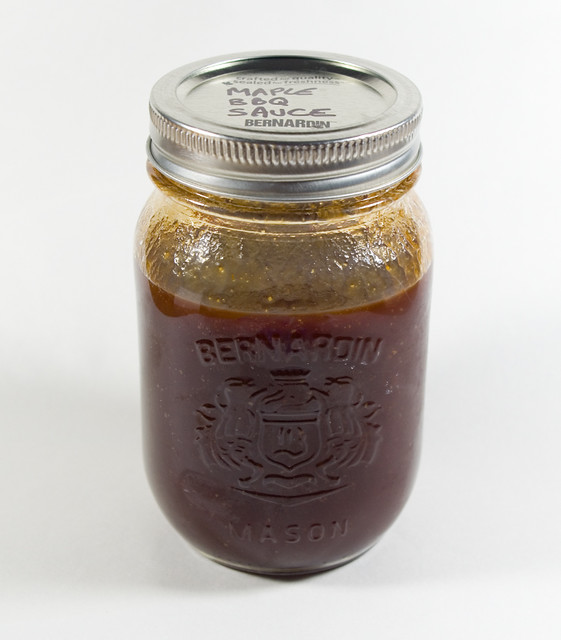
Maple is also great as part of a barbecue sauce. Lots of commercial sauces, such as Diana Sauce (a Kraft product) and President’s Choice, come in a maple variant. But it’s really easy to whip up one of your own! There are many recipes available online, but I am particularly fond of the no-cook Maple Barbecue Sauce on page 238 of The New Canadian Basics Cookbook (1999). It’s tangy, sweet, and just acidic enough to tenderize a tough steak if left to marinade. I wanted to fire up the grill and use this sauce yesterday, but the chilly downpours and the snow still freezing the barbecue cover to the ground made this inadvisable. I am sure that my jar of sauce will get a good workout over the coming months.