Mr. Ubbink’s Crepes Recipe

Crepes are one of the first thing that I learned how to cook without the need for parental supervision. I used to go visit my elementary school best friend almost every second weekend (she’d be over at my house if I wasn’t over at hers), and her father taught us his technique. Crepes do take a bit of practice, and you do have to read the recipe properly — there was one memorable occasion when we read “1/4 teaspoon salt” as “1/4 cup salt”, creating an end product that was highly inedible.


Replica crepes in a Montreal shop window (2005)

By the time I hit high school, it became a tradition to make crepes in the morning whenever I hosted sleepovers. I would make crepes up in bulk when I had a birthday party in order to feed all of my guests breakfast. My friends came to expect it; it was now a tradition!

I still use Mr. Ubbink’s recipe whenever I make crepes, which isn’t as often as when I was a kid, although I do still break them out for special occasions. The recipe is both dependable and flexible, although as with most crepes, flipping them takes a bit of practice. Don’t be discouraged if you make “scrambled” crepes the first few times, since they taste just fine so long as you cook them thoroughly, and they can still be topped as you wish.


Savoury crepe filled with cheddar cheese, Monterrey Jack cheese, and summer sausage; topped with a sunny side up egg and chopped chives

Mr. Ubbink’s Crepes
Yields 4-5 large crepes

In a large bowl, mix together:
1 cup all-purpose flour
1/4 tsp salt
Add to bowl:
1 large egg
1 1/2 cups milk
1 tsp vanilla
Mix all ingredients together with a whisk or a hand mixer. Blend until batter is smooth.

Apply a small amount of cooking spray, butter, or margarine to a large non-stick frying pan. Preheat the pan to medium-high. Pour 1 large ladle-full of crepe mixture into the pan, tilting to spread the batter into a circle that covers the bottom of the pan. Fry until the crepe has darkened in colour and is just starting to show spots of golden brown. Carefully flip the crepe and fry the other side until spots of golden start to appear on that side as well. Repeat until all the batter is gone. This type of crepe is best rolled into a tube, sometimes with fillings such as fresh fruit inside the tube.

If you are making a crepe inside of which you wish to have a melted ingredient such as cheese or chocolate chips, the technique is slightly different (it’s actually a lot like cooking and omelet). Cook the first side, flip, and then add the filling to half of the cooked side. Fold the crepe in half over the filling. Cook until the bottom is slightly golden, flip carefully so that the filling doesn’t fall out, and cook the last side until it is starting to turn golden and the filling has melted. You may need to turn the burner down so that the filled crepe can cook more slowly, allowing the filling to melt without burning the batter.


Sweet crepe filled with fruit salad (Asian pears, strawberries, blueberries, bananas, and grapes) and maple syrup, topped with whipped cream.

Suggested toppings/fillings:

Sweet
berries, fresh cut fruit, drained canned fruit, jam, chocolate chips, syrup, whipped cream, ice cream, nut butter, fruit butter, icing/brown/granulated sugar, marshmallows and chocolate chips, caramel sauce, custard, chopped nuts, apples and cinnamon sugar

Savoury
deli meat, cooked chopped roast meat, fish, plain steamed vegetables, steamed vegetables with a cream sauce, asparagus and cream cheese, salmon and cream cheese and capers, shredded cheese, bacon and eggs, poached eggs and salsa, spinach and feta, avocado and fried mushrooms, canned tuna and mayonnaise and lettuce

Basically, just about anything you could bake into a cookie or put in a sandwich is good in/on a crepe! (They can also be a great vehicle for using up leftovers.)

Hasenpfeffer, Hamburger Kasserolle, and Zucherkuchen

My quest to learn how to successfully prepare at least a few German dishes continues. It has been… Interesting. Lately I’ve met with more failure than success.


Hasenpfeffer served with mashed potatoes and acorn squash with butter and brown sugar.

Over March Break I made Hasenpfeffer (rabbit in wine gravy) from the recipe on page 60 of ‘Round the World Cooking Library: German Cooking by Arne Krüger (1973). It’s a fiddly dish, made all the more so by the fact that I’d never cooked rabbit before. I had eaten rabbit, but I distinctly remember it being gamier. Perhaps the one that I had before was wild-caught, where as the one I used was farm-reared? Whatever the reason, I was expecting more flavour from the meat. However, it was fall-off-the-bone tender and the sauce was quite nice. My only complaint was the saltiness: I double- and triple-checked the recipe, and it called for two tablespoons of salt. I know that when you follow a recipe for the first time you should follow it to the letter, but I should have let my good sense prevail and halved or quartered the salt.

Would I make it again? Only if the rabbit was on sale — it’s really expensive around here, and you don’t get much meat off of one animal. I think the red wine gravy (with less salt) might be nice on chicken or beef, though. It would definitely be worth trying.


Hamburger Kasserolle

This weekend I tried Hamburger Kasserolle (‘Round the World Cooking Library: German Cooking, page 35), which did not go so well. Someone like me who doesn’t speak German may assume that this is a casserole with ground beef in it, but the “Hamburger” in this case means “from Hamburg” — so the protein is actually seafood. First of all, this is a 1970’s book, so like many from the era it calls for frozen or canned versions of at least half of the ingredients, and then adds some rice and a can of cream of mushroom soup. I chose to go with an equivalent amount of fresh ingredients (I really can’t stand canned mushrooms, for example), and I think that went well. This casserole also calls for a rather large amount of seafood, which was nice, but pretty pricey.

I think that the reason I really didn’t like the end product was the artichoke hearts. The recipe calls for them frozen, but I couldn’t find them frozen or canned at any of my local grocery stores. I opted to buy them fresh, but despite pre-cooking them in the microwave and then baking them for half an hour, the artichoke hearts were rubbery and gross. They squeaked between my teeth when I chewed. Not pleasant.

Would I make this one again, even if I got rid of the artichokes? Probably not. I can think of much better ways to prepare seafood, even frozen stuff, than by baking it in cream of mushroom soup.


Zucherkuchen

Last but not least, on Sunday I gave a shot at what I think was my first ever German sweet: Zuckerkuchen (sugar cake) from page 81 of Classic German Baking (2016). I took this book out of the library, but I’m starting to think that I may have to buy a copy of it for myself. Zucherkuchen is a yeasted cake, which is something I’ve never made before — every other cake I’ve made has been leavened with baking powder or soda. It’s a cake that is rich with butter and sugar, but not much else, so I can see how it would appeal to even the pickiest eaters, i.e. most children. It’s denser than most of the cakes I’ve had, somewhere between a cake and a square I think, and it’s cohesive enough that slices can be picked up and eaten with the hands. I was worried that I might not have got it right, but from the writeup in the book and descriptions online, I think I’m actually pretty close.

So would I make this recipe again? Most definitely. And I think my kids would want me to as well.

First Day of Spring Chicken

Today is the first day of spring. It’s also the vernal equinox in the northern hemisphere, which means that the days will be longer than the nights and continue getting longer from now until the summer solstice. The official changing of the seasons is all over my social media, but given that I live in Canada, it seems rather… Optimistic.


My pallet trellis in my back garden.

I totally understand how everyone wants it to be spring; this March went in like a lamb, and was preceded by record-breaking high temperatures in February. It looks like it will go out like a lion, with snow predicted again at the end of this week and the start of next week. For people who aren’t used to this climate, winter seems never-ending. But for those of us who grew up with it, we can see the little hints of spring: the days are regularly are above freezing in the afternoon; snow has melted back from the roads and sunniest areas of yards; snowbanks have compacted so that they’re no longer higher than my head; and we’re starting to actually have humidity in the air again.

It’s at times like this that I really feel for my European (mostly British) ancestors. I recently watched the Historical Farm series from the BBC. What struck home the most about the show was how green things remain in winter; in fact, the show often speaks of winter crops or winter harvests. Nothing grows here in the winter. To a great degree, everything stops when it starts to dip below freezing. I mean, we do still go outside, and our most famous sport, hockey, pretty much requires this kind of weather. But special care must be taken, and a huge part of our lives simply moves indoors. As for the animals, birds fly south, and many creatures hibernate or semi-hibernate. Outside of hunting and fishing, there’s not much you can do to gather food in the winter, which is why preserving is so historically important. (There’s a great food preservation exhibit at the Canadian Agriculture and Food Museum.) Effective food preservation could literally be the difference between life and death. These days, with commercial transport of food from all over the world, we can get fresh food almost as easily in winter as in summer, although supplies can become short in the event of a big snowstorm. Also, some things remain purely seasonal — and at the end of the winter, even the imported food is of lesser quality.

So it’s not truly spring here yet, no matter what the calendar says. Although I have begun to crave fresh spring produce, frozen or truck-ripened imports are all that’s available for now. That doesn’t mean that the food has to be bad, though. Take this roast chicken: it’s staple around our house because it tastes great, but takes very little effort. Basically, a chicken — thawed, giblets and neck removed — is placed in a roasting pan with a rack, then is sprinkled with a mixture of spices. I learned my favourite combination for poultry from my mother, which is:

– parsley
– sage
– rosemary
– thyme
– summer savoury
– garlic powder
– sea salt

This mixture is also great as seasoning for bread stuffing.

The chicken is baked in the oven at 350°F (177°C) for 20 minutes per pound, plus 15 minutes. Keeping the skin on means that it doesn’t have to be basted. The chicken is done when it pulls apart with a fork and has no pink spots.


Baked chicken with chicken skin, mashed potatoes, corn, and baby bok choy.

I generally serve this style of chicken with mashed potatoes and steamed vegetables. Since no part of the meal requires close supervision at all times, it’s the perfect thing for when I have to cook dinner and do something else at the same time, such as help the kids with their homework or supervise bath time.

Saint Patrick’s Day Dinner

This past Friday was Saint Patrick’s Day, and although I baked Guinness Yeast Bread to celebrate, I also needed to plan something for dinner. I thought a hearty Irish stew might be nice. I went through my cookbooks for something appropriate, but I didn’t find anything quite right. I searched the Internet and found a great recipe: Beef and Guinness Stew by Chef John at Allrecipes.com.

It didn’t have nearly as much broth as the stews I’m used to; it was really more like meat and gravy than a stew. That being said, it was absolutely delicious, and went well served atop mashed potatoes. Everyone in my house finished theirs down to the last drop, which is quite the compliment. (Trying to find something that everyone in this house likes is quite challenging.) I mean, it starts with bacon, and the next step is to fry the beef in the bacon fat. There’s your flavour right there. I would definitely make this stew again, probably next time beef roasts go on sale.

I also figured that a special occasion dinner required dessert. I made the cinnamon roll variation of my Dad’s Biscuits recipe. They’re not really Irish, I guess (from what I’ve read, cinnamon rolls were invented in Sweden), but at least the base of the recipe is baking soda biscuits, which is kind of like soda bread… Right? Ah well, there’s no rule that says I have to stick to a theme. Because of the extra sugar in the cinnamon rolls, they brown up very quickly, so don’t expect them to be as light-coloured as the original biscuits. They’re delicious warm from the oven, spread with a dollop of butter or margarine. If you can’t get them fresh, zap them in the microwave for 15 seconds or so to warm them, then butter.

Guinness Yeast Bread Recipe

March 17th is Saint Patrick’s Day, which to be honest isn’t observed very seriously in this neck of the woods. However, since I do have some Irish blood in me, I thought it might be nice to cook up a dinner that reflects (some of) my roots. Irish stew sounded great, since it’s more or less my default stew anyway. To go along with dinner, I wanted to make some Guinness bread. I searched my recipe books and online to find a recipe, and what I found was leavened with baking soda. Although I know that this is traditional, I’m not a big fan of the flavour of baking soda, so I turned my hand to creating my own, yeast-leavened recipe.

This is a very dark bread, more akin to what Maritimers call brown bread (coloured by molasses) than what is called brown bread on the Prairies (whole wheat bread). The Guinness adds a natural yeasty flavour and a rich colour. The recipe includes oatmeal, so these loaves are very dense and filling. This bread is delicious served with cheese, sausages, sliced lunch meats, and hearty stews.

Guinness Yeast Bread
Yields 2 loaves

In a large bowl, mix together:
1 cup (125g) large-flake oatmeal
1 1/2 cups 2% milk
Cover and leave to soak for 4 hours in the fridge.
Add to the bowl:
one 500mL can of Guinness beer, warmed to between 120ºF to 130ºF (49ºC to 54ºC)
2 Tbsp cooking molasses
In a second bowl, stir together:
4.5 cups (600g) all purpose whole wheat flour
10g quick-rise instant yeast
1 tsp salt
Add dry ingredients to wet ingredients. Stir together until well combined.
Gradually incorporate:
4 1/2 cups (500g) bread flour

Turn out dough onto a lightly floured surface and knead by hand for about 8 minutes. When kneaded, the dough should be smooth and elastic, but not sticky. If dough is sticky, add bread flour 1 Tbsp at a time until stickiness abates.

Oil a large mixing bowl. Form the dough into a ball and place it in the bowl. Cover the bowl with a clean, damp tea towel. Place the bowl in a warm, dry area with no drafts. Allow the dough to rise until double, about 1 hour.

Punch down the dough. Grease two 9.5″x5.5″ loaf tins. Divide the dough into two equal-sized portions. Cover the pans with a clean, damp tea towel and allow to rise again until double, about 1 hour.

Lightly spritz the loaves with:
water
Dust the loaves with:
1 Tbsp large-flake oatmeal

Preheat oven to 450ºF (232ºC). Bake loaves for 10 minutes. Turn heat down to 350ºF (177ºC) and bake for about 30 to 40 minutes more. Check to see if the bread is done by removing a loaf from the pan and tapping it on the bottom. When cooked through, it should make a hollow sound. Remove both loaves from the pans immediately and place them on a wire cooling rack.

Guinness yeast bread can be eaten immediately, but it keeps well for up to a week if wrapped in a clean plastic bag. Make sure they are wrapped up only after totally cool, or they will go soggy.

German Cuisine Inspiration

A lot of my inspiration for learning how to cook “gut bürgerliche Küche” comes from my trip last year to Hamburg, since I wasn’t exposed to much German cuisine when I was growing up. Hamburg is a port city, and as such a lot of their food features ingredients from both the sea and from their trading partners. What North Americans may consider to be traditional German food tends to be Bavarian, which is both further inland and further south — and much different in both ingredients and flavour.

Of course, since we were staying in hotels, we never had a chance for a truly home-cooked meal. But I thought I would put the photos of some of my meals up here to act as future inspiration in my personal challenge to become more competent at cooking German food.


Breakfast at Dat Backhus, Lange Reihe 29, 20099 Hamburg, Germany. What I believe was smoked salmon and pickled egg on a half of a bun. There was some kind of mayonnaise concoction between the fish and the bread.


My dinner at a German pub on Lange Reihe. I had breaded and fried fish, fries, and a salad.


My husband’s dinner at the German pub. He had sausage and gravy, mashed potatoes, and sauerkraut.


Breakfast at Stadt Backerei (City Bakery), Lange Reihe 52, 20099 Hamburg, Germany. The bun on the left held a mix of salad shrimp and mayonnaise. The one on the right was scrambled eggs and bacon.


My husband’s fish in cream sauce at a restaurant right off of the pier and Landungsbrücken station.


My fried fish sampler and salad at the same restaurant.


My meatloaf (possibly Leberkäse?) that I ate at a restaurant in Berlin. Honestly, this was the only dish that I truly disliked during my trip. It tasted over-preserved and reminded me way too much of canned meat.


My husband, on the other hand, ordered pork knuckle from the same restaurant in Berlin, and it was absolutely delicious. I want one of my own sometime!


Hamburg Pho at Pho Duc, Steindamm 103, 20099 Hamburg, Germany. The noodles are wider than I am used to for pho. What makes it a Hamburg specialty? Apparently beef meatballs, fresh beef, and braised beef slices. It was very tasty.


My steak and potato dinner on my last night of the trip was at a higher-end restaurant, and it was delicious, although I don’t think it really counts as typical German food. I believe the restaurant was actually Mediterranean.

Beginner’s German Cooking

My husband and I have been married for almost ten years now, and we have been together for fifteen. For all of that time, I have been the primary cook in the house. So I hope you can understand how surprised I was when my husband complained a month or so ago that I have made all kinds of foods based in my Canadian and British heritage, but I never cooked anything from his German background except the occasional bratwurst. This was the first time he’d requested German food in the fifteen years we have been together. I really wish he’d said something sooner. New cuisine has a learning curve!


Königsberg Meatballs from page 70 of Grandma’s German Cookbook by Linn Schmidt & Birgit Hamm (2012). Delicious and very filling. Served here with boiled potato cubes.

Now, I love trying new dishes, that’s not the problem. It’s just that I had never cooked anything specifically German before. (This was before my experimentation with labskaus.) I asked my mother-in-law if she could suggest any books or other resources that might help; she gave me her extra copy of her favourite German cookbook, ‘Round the World Cooking Library: German Cooking by Arne Krüger (1973). From the introduction:

“A word that the Germans themselves use to describe many aspects of German life is “gründlich”, meaning solid. Like most national characteristics, the German reputation for extreme thoroughness and heavyhanded seriousness has been exaggerated. But no one — and particularly not the Germans themselves — would deny the German passion for organizing everything down to the smallest detail, or their profound distrust of improvisation. This applies not only to their cars and cameras, but to their cooking as well. German cooking may not possess the fantasy and imagination of Italian cooking, or the delicate refinements of French cooking, but this does not mean that German cooking is bad. On the contrary. German home cooking (which the Germans call “gut bürgerliche Küche”, or good plain cooking) is honest, down-to-earth, simple and substantial; it is perfectly in tune with the earnest spirit of German life.”

(As an aside, I ran “gut bürgerliche Küche” through Babelfish, and it came back with “good middle class cuisine”, which seems close enough.)


Chicken Stroganoff from page 78 of The German Kitchen: Traditional Recipes, Regional Favorites by Christopher and Catherine Knuth (2013). Quite tasty. I thought stroganoff was a Russian dish, but in this book it was presented as German, so what do I know? Served here with brown rice and steamed white & orange sweet potato cubes.

While German Cooking has been a great resource, I needed to read up further. I scoured my local library for German cookbooks and put a whole stack of them on reserve when they weren’t immediately available. I’ve read and reread them a number of times. I’ve tried out a few of the dishes and I think I am starting to get a rough grasp on them. I think the hardest part so far has been finding the proper ingredients. One bread recipe, for example, called for (among other ingredients) spelt flour and malt powder. I was finally able to find the spelt flour in a health food shop, but the malt powder eluded me for some time. I eventually went to a brew-your-own-beer place, which did have wheat malt powder for sale. I never did find barley malt powder, which I’m told is the standard in Europe. Also, sometimes the malt is sweet, and is sold in a syrup that is eaten the same way one would eat molasses here. Is there a powdered version of this syrup, like how you can get maple sugar? If there is, I haven’t seen it. Which kind of malt powder did they mean? It’s probably perfectly obvious to someone who has made this these dishes before, but for a beginner in German cuisine… I’m just not conversant with all the variations of the ingredients. But I am learning!

Nan’s Pan Rolls Recipe

I’ve mentioned before that I regret not asking my grandmother for copies of her recipes; honestly, I felt like that indomitable old lady was too tough to die, until the very day that she passed away. As I grew up, I did less and less cooking with her — she would cook for me or I for her, but rarely did we cook together anymore. It became all that much more difficult once my attention (and hers as well) was focused on my children. I didn’t realize that it would be something I missed so much.


White pan rolls straight out of the oven.

In Nan’s memory, I’ve been trying to recreate her famous pan roll recipe. Whenever we were in town, or she was visiting us, Nan was always the one to cook Sunday dinner (which was always understood to mean “roast beef dinner”). Her fresh rolls were an integral part of that meal, and came to be considered by all the family as the proper accompaniment. She would start the dough and leave it to rise before she left for church in the morning, then punch it down and form the rolls immediately upon returning home. It was a Sunday ritual.


White flour pan rolls after the second rise.

To me, pan rolls should be squished as tightly as possible into their pan so that, when they rise, they rise upward and become tall and skinny once they are pulled away from their fellows. They should be yeasty, but not too fluffy, and fairly filling. They should be golden on top, crispy around the edges, and soft (but not raw) in the middle. With this recipe, I think I’ve made them as close to what Nan made as I possibly can.


White pan rolls after the second rise.

Nan’s Pan Rolls
Yields 35 rolls

In a large bowl, mix together:
4 1/2 cups (500g) all-purpose flour*
2 packages (14g) quick-rise instant yeast
2 1/2 tsp salt
Add to the dry ingredients:
3 cups very warm water (120ºF to 130ºF)
2 large eggs
1/4 cup (4 Tbsp) lard, melted
Stir by hand until mixture is more-or-less smooth.
Gradually mix in:
4 1/2 cups (500g) all-purpose flour
If the dough starts to become tough to knead, do not add any more flour. When flour is fully incorporated, dough should be smooth and elastic, but not sticky. If dough is sticky, add all-purpose flour 1 Tbsp at a time until stickiness abates.


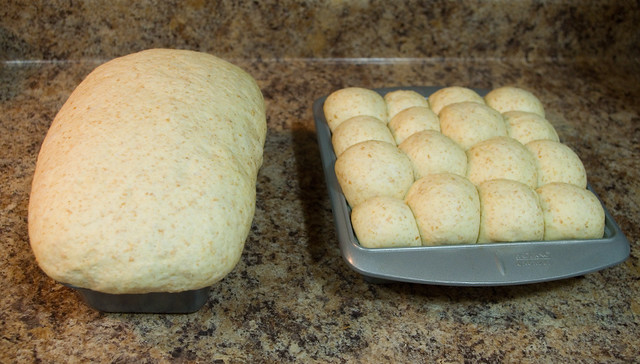
Whole wheat dough divided in half and made half into pan rolls, half into a loaf of bread, after the second rise.

Turn out dough onto a lightly floured surface and knead by hand for about 8 minutes. Oil a large mixing bowl. Form the dough into a ball and place it in the bowl. Cover the bowl with a clean, damp tea towel. Place the bowl in a warm, dry area with no drafts. Allow the dough to rise until double, about 1 hour.

Punch down the dough. Grease a 9″x13″ cake pan. Divide the dough into 35 approximately equal-sized portions. Form the portions into balls and place them in lines closely together to fill up the cake pan.** Cover the pan with a clean, damp tea towel and allow to rise again until double, about 1 hour.


Whole wheat loaf after baking.

Preheat your oven to 450ºF (232ºC). Bake rolls for 10 minutes. Turn heat down to 350ºF (177ºC) and bake for about 20 minutes more. Check to see if they are done by removing the rolls all in one piece from the pan and tapping them on the bottom. When cooked through, they should make a hollow sound. Remove the rolls from the pan immediately and place them on a wire cooling rack.

To create the glossy shine on top of the rolls, use waxed paper to pick up:
1/2 to 1 Tbsp cold butter
Rub the tops of the rolls with the butter, keeping the waxed paper between the butter and your hand.

Nan’s pan rolls taste best when served immediately; to keep them at their freshest, pull them apart only when they are about to be eaten. These rolls will keep for three or four days if wrapped in a clean plastic bag. Make sure they are wrapped up only after totally cool, or they will go soggy.


Whole wheat pan rolls being pulled apart by my temporarily-tattooed Thing 1.

*For whole wheat bread, replace the first 4 1/2 cups of all-purpose flour with all-purpose whole wheat flour.

**Alternately, this recipe makes two good-sized loaves of bread. I used a slightly too-small loaf pan to create a “mushroom-top” loaf; if you want your loaf to have smoother sides, use a pan that is at least 9.5″x5.5″. You could also make three smaller loaves in smaller loaf pans instead of two big ones. Allow the loaves to have a second rise as per pan roll instructions. Be careful of cooking times if you change the shape of the end product. Bread loaves will take 10min at 450ºF (232ºC), and then they must be turned down to 350ºF (177ºC). However, how long they stay in at 350ºF depends on the size of loaves you make. When in doubt, bake for less time and check often to see if they’re done.

Chicken Noodle Soup

Back in high school, before the Internet was really a thing and email had only just caught on, I had a pen pal from Japan. I would spend hours composing letters to her, trying desperately to form coherent sentences with an extraordinarily limited grasp of the Japanese language. Her letters, written for the most part in English, showed her struggle with a new language as well. Even so, we communicated fairly well without being able to rely on body language, tone of voice, or facial expression (if at a fairly low grade level). That is, until I mentioned chicken noodle soup.

My pen-pal wrote that she had been suffering through a cold, and I made an offhand comment in my reply along the lines of, “Make sure you have your chicken noodle soup!” Her reply was sheer confusion. These days she would have Googled it on her smartphone, but that wasn’t an option back then. What was so special about chicken noodle soup?


Chicken noodle soup made with ditalini noodles, with a bacon and avocado sandwich on homemade German Beer Bread (World Breads: From Pain de Campagne to Paratha, page 19).

To be honest, the chicken noodle soup that I had when I was growing up wasn’t special at all. It came from a can if I was lucky; it would be plopped as a gelatinous tube of goo into a pot with a couple of cans of water, then stirred until smooth and heated until warmed through. If I was unlucky, or if we were camping, we had the dried soup mix instead. I have to admit that I didn’t really like either of these options, and it’s not because I don’t like instant soups. I use cream of mushroom soup in a number of recipes, and dried onion soup mix is a key ingredient in a great chip dip. I thought that I just didn’t like chicken noodle soup. (This didn’t stop me from having it when I was sick, though. Also being pampered by my mom, drinking flat ginger ale, burrowing under a pile of blankets on the couch to watch bad daytime TV, and draping my head with a towel then holding it over a bowl of hot water to let the steam clear my sinuses.)


Chicken noodle soup made with ditalini noodles and a few more spices, with a chicken salad, cheddar cheese, and spinach sandwiches on homemade Nan’s Pan Rolls, and navel orange slices on the side.

Then, last week I had a crock pot full of chicken bones simmering away for broth, and I thought to myself, “Why not?” I had never made chicken noodle soup from scratch before. I knew that if I didn’t end up liking it, the rest of the family likes the canned version, so it probably wouldn’t go to waste. I followed the Chicken Noodle Soup recipe on page 125 of the Joy of Cooking (2006 edition). And you know what? I actually quite liked it. Homemade doesn’t taste much like the canned stuff at all.

I was happy enough with the recipe that I made soup and sandwiches again yesterday after having to pick my daughter up sick from school. The jury’s out on whether this soup has any true health benefits, but it’s warm and comforting and easy on the stomach, so it’s good to eat when you’re not feeling well. It’s not much more difficult to turn into a meal than the canned stuff, either — so long as you have some broth in the freezer (which I almost always do).

Did I ever properly explain the chicken noodle soup tradition to my Japanese pen pal? Knowing my grasp of the language, probably not. I did try. I even sent her a package of the dried stuff and gave my best shot at translating the directions. Should she ever come to Canada, I think I’d like her to try my homemade version. Then she might understand why, to many Canadians, chicken noodle soup is a true comfort food.

English Muffins

I love English muffins, and not because I am of British ancestry. English muffins aren’t English at all, really; the dish as we know it today was developed by Samuel Bath Thomas in New York City in the late 1800’s. However Thomas, who came from England, did base his recipe on the yeast-leavened muffins sold door-to-door in his home country, back before most people had ovens in their homes. Those were the kind of muffins that they were talking about in the song “Do You Know the Muffin Man”. In England they are just called “muffins”, and are differentiated from quick bread muffins by context.

Thomas English muffins are still sold in the United States today, but so far as I can tell aren’t distributed in Canada. So the English muffins we have here are imitations of an American product, which is in itself an imitation of a British product. I’m sure we’re not getting the most authentic muffin experience here.

So a couple of weekends ago I decided to take a stab at making my own English muffins. The first thing I had to do was make sure I had the correct equipment. Until I tried to make them, I didn’t know that English muffins weren’t baked; I discovered that I would needed a griddle (which is why they’re sometimes called “griddle muffins”).

My stove is a bit atypical. It it a hand-me-down from family who were upgrading, but it was a very fancy model (Jenn-Air F121-C) thirty years ago when it was new. Each side of the stove-top can be removed and switched out; there are simple electric burner panels, a ceramic cook-top panel, a grill panel, and a griddle panel. Although all of these extras came with the stove, I had only ever used the electric burners, so switching for the griddle was an interesting experience, seeing as the stove’s user manual disappeared ages ago.

Another piece of equipment I needed was English muffin rings… Which I didn’t have, and would have been hard to find on a Sunday morning when most stores were closed. So I chose a recipe that made a more cohesive muffin and didn’t need the rings: How To Make English Muffins from TheKitchn.com

The muffins were tasty, but I wasn’t a hundred percent satisfied with the internal texture. My muffins rose nicely, but solidly, and as such were missing the large nooks and crannies that are, to me, the signature characteristic of a proper English muffin. I’m not sure if that was a problem with the recipe or with my technique. I did the quick version of the recipe and started it that morning. TheKitchen.com says that the starter can ferment overnight and the dough can be left to rise for up to three days in the fridge, so perhaps I will try it that way next time. If I still don’t get the texture I’m looking for, I’ll invest in the English muffin rings and try a different recipe.

That being said, the muffins that I made were definitely edible, and I don’t think the batch even lasted the day. I served them with bacon, cheese, and a fried egg for lunch, and they were eaten spread with elderberry jam as snacks in the evening. My family obviously isn’t nearly as critical of my end results as I am, since they have asked me to make them again soon.