Dairy-Free Pumpkin Spice Cashew Spread Recipe

I’m still working through a batch of pumpkin puree that I thawed and then didn’t end up needing. One of my favourite pumpkin-based recipes is Pumpkin Spice Cream Cheese Spread by Pinch My Salt. The original recipe is simple — no cooking required, it’s as easy as throwing everything in a blender and pushing a button. Sadly, since I now have to avoid dairy products, any recipe based on cream cheese is out. So I made my own slightly-more-labour-intensive dairy-free version, and I think it tastes just like pumpkin pie.

My first version of this recipe was made with tofu, but that was a wash — despite the spices, it still mostly tasted like beans. My successful version is made with cashews as the base, which means it definitely contains nuts and is not school-safe. That’s okay, my kids can have dairy, I can send them to school with the cream-cheese-based version. My version also doesn’t use premixed pumpkin spice, but instead all of the individual spices that are usually found therein, allowing for a bit more customization. The recipe is vegetarian, and could be made vegan if you source your ingredients right (many brands of sugar, including brown sugar, use bone char as part of the filter process).

I like both versions of the spread as a dip for a freshly-cut-up cold, crisp apple. It also works well as a spread for bagels, toast, or a topping/core for muffins or cupcakes.


Pumpkin spice cashew spread with sliced gala apples

Dairy-Free Pumpkin Spice Cashew Spread
Yields about 1 1/2 cups

Pour into a heat-safe container:
1 cup roasted unsalted cashews
Cover the cashews with boiling water and leave them to sit for a minimum of 1 hour, up to 4 hours. Cashews should be plump and soft after soaking.
Drain water and place cashews in a blender.
Add to the blender:
1/2 tsp salt
1 Tbsp corn starch
3 Tbsp nutritional yeast
6 Tbsp brown sugar
1/4 cup maple syrup
1/2 cup canned pumpkin
1/2 tsp vanilla extract
1 1/2 tsp cinnamon
1/2 tsp ginger
1/4 tsp nutmeg
1/8 tsp cloves
1/8 tsp allspice
1/2 cup water
Blend mixture until smooth.
Pour mixture into a cooking pot. Stirring constantly, cook until the mixture just begins to simmer. This recipe will burn to the bottom of the pot very quickly, so stirring constantly is essential. Once the mixture has reached a simmer, remove it from the heat. Scrape the mixture into a container with a lid that seals, then refrigerate until cooled through. Serve.
Mom’s Homemade Macaroni & Cheese Recipe

One of my daughters was having a friend over for dinner tonight, so I made up my mom’s famous homemade macaroni and cheese. This dish is pretty much a guaranteed crowd-pleaser with the under-10 set, who are often more difficult to please and are less willing to try something new. It’s exponentially better than instant pasta and powdered cheese. In my opinion, my mother makes the best macaroni and cheese in the world; it was such a favorite of mine that I requested it for my birthday dinner for at least twenty years in a row. It made me very sad when I realized that my dairy intolerance means that I’d have to give up eating mom’s mac & cheese.

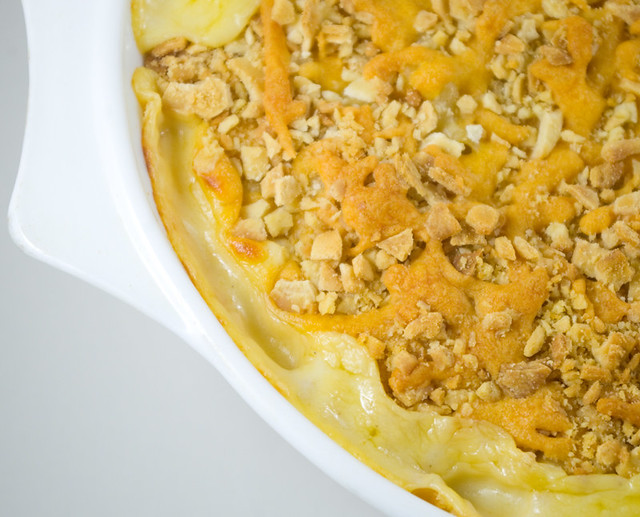
Mom’s recipe originally came from the back of a box of dried macaroni noodles, but over the years she tweaked and perfected it until it bears little resemblance to the original. This recipe makes a lovely creamy cheese sauce for the pasta and creates a crispy crunch on the top of the casserole. The crispy top is generally everyone’s favorite part and is fought over in my house.

Mom’s Homemade Macaroni and Cheese
Serves 4

According to the directions on the package, cook:
2 cups uncooked dried macaroni
Preheat oven to 350°F.
In a medium-sized saucepan or in the microwave in an oven- and microwave-safe casserole dish, melt:
3 Tbsp butter
Whisk into the butter:
3 Tbsp all-purpose white flour
1 tsp salt
1/8 tsp black pepper
Stir in:
3 cups 2% milk
Cook over medium heat, stirring regularly (with a whisk works best) until thickened to the consistency of a white sauce. Alternately, cook in the microwave, stirring every 3 minutes to remove lumps, until the desired consistency is achieved.
Add:
2 cloves of garlic, peeled and finely chopped or grated
1/2 tsp Worcestershire sauce
1/2 tsp table mustard
2 cups coarsely grated old cheddar cheese
Optionally, you may add:
(1 medium onion, finely chopped)
Stir mixture until cheese is fully melted and ingredients are evenly mixed. Add the previously-cooked macaroni and stir well. Fill a 2.5-quart (2.3L) oven-safe casserole dish with this mixture. If sauce was prepared in the microwave, simply add the noodles to the mixture already in the casserole dish.
With a rolling pin, crush:
8 salted soda crackers* (about 25g (0.9oz))
Mix crushed crackers with:
1/4 cup grated old cheddar cheese
Sprinkle this mixture evenly on top of the contents of the casserole dish.
Bake uncovered for 20-30 minutes.
Generously serves four adults.

*I prefer Premium Plus or Premium Plus Whole Wheat crackers, but there’s no reason that other kinds of crackers can’t be used. I have made this recipe so many times — and relied on whatever I had in my pantry at the time — that I have probably used everything going. The crushed crackers used in the photos were actually Original Baked Naan Crisps by Sarah’s Fine Foods.

This recipe is very flexible. Here are some variations that I have tried:

– This dish freezes very well. When preparing portions for the freezer, skip the baking step when preparing. Instead re-heat the entire casserole in the oven at 350°F (175°C), which will re-melt the cheese and crisp up the topping. Bake until cheese starts to bubble and the center of the casserole is warm, which generally takes between 30min and 1 hour, depending on how large the portions are that you have frozen. You can reheat frozen portions in the microwave, but the topping won’t get crispy.

– This dish also travels and reheats well, so it’s perfect to bring to potluck meals.

– Use a different kind of pasta. Most smaller pastas, such as penne, rotini, rigatoni, shells, or wagon wheels, work just as well as macaroni. Penne rigate is a favorite of mine and is probably used more often than macaroni in our household. Whatever you choose, you’ll need about two cups of dried pasta.


This dish, to me, is the only truly proper one for making Mom’s homemade macaroni and cheese (although in reality any appropriately-sized casserole dish works equally well). It’s just that this is what my mom used for the entirety of my childhood: a Pyrex casserole dish from the late 1970’s/early 1980’s with flowers on the side.

– Use fresh pasta instead of dried. The yield for fresh pasta is different than dried, but in the end you’ll need about five cups of cooked pasta.

– For a healthier dish, use whole-wheat pasta.

– If you’re cooking without a stove, prepare the sauce in a microwave and bake the final casserole in a toaster oven. You can even “bake” the casserole in the microwave, but the top won’t get crispy (as I learned the hard way when my oven broke when cooking dinner for my in-laws for the first time).

– Change up the cheese; use a blend of cheddar and mozzarella/Gouda/etc., or switch up the cheese entirely. Sharp cheeses work best.

– To make baby food for an older baby, use whole-wheat noodles that are made without eggs and whole-fat milk. Skip the onions and the crispy top. Run the macaroni and cheese through a blender/food mill/food processor to make it smooth, adding whole milk gradually until the desired consistency is reached. This works best while the mixture is still warm, as it does congeal when it cools. My daughters loved their macaroni and cheese baby food — and now they’re huge fans of the regular kind.

Quinoa Bread Recipe

At the suggestion of a friend of mine, I bought some red quinoa a while back included a small portion in a fruit salad. Well, I discovered very quickly that I don’t like it with fruit; actually, despite all of the hype and how healthy it is, I don’t care for it much at all. Use it instead of rice! Add it to your salads! Yuck, yuck, yuck. But I still had most of a bag of quinoa to use up, and I would be darned if I was just going to compost it, so I decided that I’d try making quinoa bread. And it ended up being delicious! Not just to me, either. My kids ask for seconds and my husband, who generally loathes quinoa with the fire of a thousand dying suns, actually likes it. So even if you’re not a fan of this ancient grain, I suggest that you try this bread — and don’t write off all baked goods containing quinoa (like I almost did) until you try them.

This is a heavier bread, with a density a little closer to a banana or pumpkin bread than a traditional white or whole wheat loaf. The flip side of the heaviness — mostly caused by the water in the grains — is that this bread stays moist and tender inside for quite a long time. Even when stale, it doesn’t get hard like a crusty bread can, and can still be quite good toasted or in a grilled cheese sandwich.


This loaf was made in a 9.5″ x 5.5″ loaf pan, which is why it is so low and wide.

Quinoa Bread
Yields 3 loaves

In a large pot, bring to a boil:
500mL water
1 Tbsp canola oil
1 tsp salt
To the boiling liquid, add:
1 cup red quinoa*
Bring back to a boil. Turn heat down to low and cook for 20 to 25 minutes, uncovered. When cooked, the quinoa will become transparent and a white ring will appear in the ancient grain. Remove from heat, drain, and allow to cool.
In a large bowl, mix together:
2 1/2 cups all-purpose whole wheat flour
1 1/2 tsp salt
14g (2 packages) quick rise instant yeast
Stir in:
2 1/2 cups warm water
Once contents of bowl are mostly smooth (it doesn’t have to be perfect), add the cooked, cooled quinoa. Stir until mixed.
Gradually add:
4 cups all-purpose unbleached white flour

Depending on how much water the quinoa absorbs when cooking, slightly more or less white flour will be required. The dough should be soft and the slightest bit sticky, but should not flow like a batter.

Turn out dough onto a lightly floured surface and knead by hand for about 10 minutes, dusting kneading surface, hands, and dough lightly when necessary to prevent sticking.

Oil a large mixing bowl. Form the dough into a ball and place it in the bowl. Cover the bowl with a clean, damp tea towel. Place the bowl in a warm, dry area with no drafts. Allow the dough to rise until double, about 1 1/2 to 2 hours.

Punch down the dough. Grease three 8.5″x4.5″ loaf tins. Divide the dough into two equal-sized portions. Cover the pans with a clean, damp tea towel and allow to rise again until double, about 1 1/2 to 2 hours.

Preheat oven to 400ºF (205ºC). Bake loaves for 10 minutes. Turn heat down to 350ºF (177ºC) and bake for about 20 to 25 minutes more. Check to see if the bread is done by removing a loaf from the pan and tapping it on the bottom. When cooked through, it should make a hollow sound. Remove all loaves from the pans immediately and place them on a wire cooling rack.

Slice and serve immediately, or wrap in a clean plastic bag once loaves are cool; they will last about five days before going stale.

*Any colour quinoa may be used, but red quinoa makes the most attractive visual contrast in the loaf.

Slow Cooker Clam Chowder Recipe with Dairy-Free Options

I’m taking a break today from ComicCon recap to post a recipe that a few people have asked for: my slow cooker clam chowder. I developed this recipe for two reasons: 1) I love dairy, but it doesn’t love me back, so if I want clam chowder I have to make it for myself with a dairy substitute, and 2) I had packages of frozen clams in my freezer that I’d bought on sale and I had no idea what I wanted to do with them. I Googled for ideas, and for the most part the consensus seemed to be that frozen clams are gross and tough, so don’t buy them in the first place. Well, in the past I’ve learned that simmering tough cuts of meat in liquid for a really long time can make just about anything palatable, and that technique works well with cheap frozen clams. As a bonus, all of the ingredients can be prepped the night before, and then most of them are thrown into the slow cooker as you get ready for work. This chowder really only needs attention in the last hour or so, and even then not much.

A note regarding dietary requirements: I make my clam chowder dairy-free using almond milk, and nobody can tell the difference. If you’re allergic to nuts, try soy milk or rice milk instead. If you prefer dairy, use 2% milk. Also, clam chowder can’t really be made vegetarian or vegan — all you’d be left with is potato soup (which can be good, but is no longer clam chowder). However, if you don’t eat pork, turkey bacon may be substituted, although it will change the flavour somewhat.


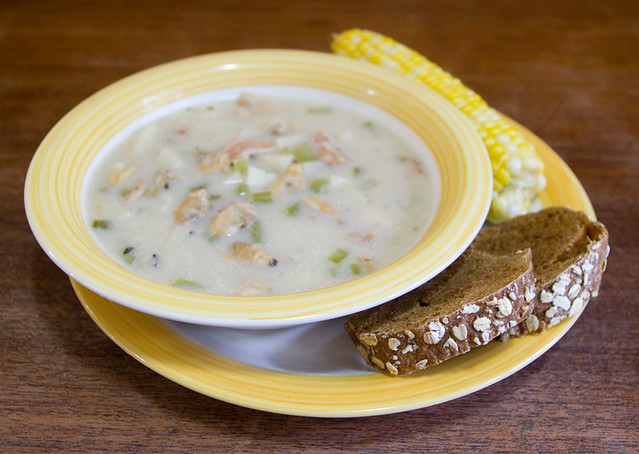
Slow cooker clam chowder, served here with microwave oatmeal wheat bread and corn on the cob.

Slow Cooker Clam Chowder (Dairy-Free)
Serves 8-10
Total cooking time: 8 hours

Thaw as per package directions:
2 packages of frozen clams (340g each)
In a frying pan, cook until crispy:
1 package reduced-salt bacon (375g package)
Place cooked bacon on a plate that is covered with a few pieces of paper towel; dab the bacon lightly to remove excess grease.
In the frying pan, reserve:
1 Tbsp bacon grease
Discard any additional bacon grease. In pan in which the bacon was cooked, in reserved grease, fry gently until soft and lightly browned:
2 yellow onions (approx 175g)
While onions are frying, chop into bite-sized pieces:
bacon cooked in previous steps
2 cups celery (approx 225g)
Peel and chop into bite-sized pieces:
6 cups white-fleshed potatoes (approx 1100g)
Peel and mince:
1 clove garlic
When onions are done cooking, add them and all previous ingredients to slow cooker. In addition, add:
6 bottles clam juice (236mL each)
1 tsp salt
1 tsp fresh thyme*
1/2 tsp pepper
1 Tbsp dried parsley
Cook in slow cooker for 7hrs on high, until potatoes are tender**.
In a large measuring cup or mixing bowl, whisk together:
4 cups almond OR soy OR rice OR 2% milk
4 Tbsp corn starch
Stir in the milk and corn starch into the mixture in the slow cooker. Cook until it reaches the desired thickness, about 1 additional hour.
I serve this soup immediately and freeze the leftovers; it also refrigerates well. If you are planning on serving this at a gathering, it can be prepared in advance and reheated immediately prior to serving.

*1/2 tsp dried thyme may be substituted for fresh.
**If you have an older slow cooker, you may need to adjust cooking times, as older slow cookers (pre-1980 or so) do not get as hot. If you’ve cooked it for the required time and the potatoes still aren’t tender, the recipe may be finished on the stove, being careful not to boil or scald the liquid.

Shepherd’s Pie Recipe

There is a lot of contention out there as to what makes a good shepherd’s pie. I distinctly remember an episode of Kitchen Nightmares where Gordon Ramsay laid into the chef because the restaurant’s shepherd’s pie contained beef instead of lamb. I didn’t actually discover that this dish is supposed to have lamb in it until about five years ago. Apparently “cottage pie” is what you call it when it’s made with beef. The dish that we called shepherd’s pie that I grew up with was always made with beef because my mother prefers it that way. I never thought to question it.

As the vegetable part of this casserole, I use corn (sweet corn, not maize), although I understand it is more traditional to use peas. I never made this dish for my British Nan, but at one time she refused to eat corn as it was “cattle feed” and believed it to be beneath her. Now, Nan lived more of her life in Canada than she did in England, so she may have relaxed her point of view somewhat, but I’ve heard this sentiment echoed by her visiting relatives. I don’t know if this is a wide-spread belief or one restricted to my family. At any rate, corn is not traditionally part of this dish.

Lastly, I structure my dish more as a casserole and less as an actual pie. Traditionally, the “crust” of the pie is supposed to be the mashed potatoes, but a quick Googling shows me that I’m not alone in putting the potatoes on top.


When the dish is served, you should be able to see the strata of meat & gravy, veggies, potato, and cheese.

Shepherd’s Pie
Serves 6-8

Peel and cut into large chunks:
8-10 (about 1Kg (2.2lbs)) medium white-fleshed potatoes*
Place the potatoes into a large cooking pot. Fill pot with water until there is an inch covering the potatoes. Bring the pot to a boil, then turn it down to a simmer. Cook potatoes until they can easily be pierced with a fork.
While the potatoes are cooking, in a non-stick frying pan heat:
1 Tbsp olive oil
Add to the oil:
1 small yellow onion (yields about 100g (3.5oz))
2 cloves garlic**
Cook on medium heat until onions are translucent with light brown edges.
To the onion mixture, add:
700g ground lamb***
Turn up the heat to medium-high and cook the lamb until it is lightly browned, regularly draining the grease.
To the meat mixture, add:
1 can of cream of mushroom soup****
1 can of water
Stir until soup is smooth. Bring the mixture to a boil, then turn down the heat and simmer gently until soup has almost reduced back to its original canned consistency.
While the meat and gravy are simmering, drain the potatoes. To the potatoes add:
2 Tbsp butter or margarine
2 Tbsp 2% milk
Whip or mash the potatoes until smooth.
Preheat the oven to 350°F (175°C)
Spread the meat and gravy mixture evenly on the bottom of a casserole dish. On top of this, pour evenly:
2 cups frozen corn
Spread the mashed potatoes evenly on top of the frozen corn. On top of the potatoes, sprinkle:
1 to 1 1/2 cups loosely-packed grated cheddar cheese
Bake casserole at 350°F (175°C) for 25 to 30 minutes, or until cheese is melted and sauce bubbles up around the edges of the potatoes.
Serve with a side of steamed vegetables, if desired.


It’s difficult to scoop portions that don’t fall apart if you bake this dish in a round casserole. If you want perfectly rectangular servings, bake it in a rectangular dish and serve in slices.

*This dish works really well with leftover mashed potatoes, so if you have enough left over from a previous meal, skip the potato preparation steps. If the potatoes are cold, a slightly longer cooking time may be in order.
**1 tsp garlic powder may be substituted for garlic cloves; however, the powder should be sprinkled over the ground meat instead of cooked with the onions.
***Meat may instead be 50%/50% ground lamb/ground beef, ground lamb/ground chicken, ground lamb/ground turkey, or any one of these meats by itself. Keep in mind that without any lamb, the flavour will not be nearly as strong.
****I like Campbell’s Cream of Cremini & Shiitake Mushroom, but any cream of mushroom soup will do. If you are averse to the texture of mushrooms in your food, run the cream of mushroom soup and water through a blender until smooth before adding them to the meat.

Cream of Carrot Soup Recipe

I took a cooking class back in high school. It wasn’t Home Economics or Family Studies; it was a week-long course at the local college that was meant to teach us the most basic techniques of the professional chef. It was most likely offered in the hopes that the course would catch the attention of at least a few of us, and that we would return after graduation for the culinary program. We learned how to make fresh pasta, French vanilla ice cream, chocolate truffles… I have very fond memories of that class, and not just because I got to spend a week away from home.

One of the things the chef was insistent about was that we learn how to use knives properly. Well, one knife. The chef worked almost exclusively with what seemed to me to be an intimidatingly huge chef’s knife. He insisted that we learn the proper techniques of handling this knife (which I totally approve of), and then we spent the rest of one day of a five-day program chopping different kinds of vegetables. I know how important knife work is to a chef, but when the majority of a group of sixteen-year-olds aren’t likely to ever step into another professional kitchen, chopping veggies all day may not be the best way to hold their attention. However, by the end of the course I did learn to be slightly less afraid of the large knife. (Until then, I usually used a paring knife at home.)

At the end of the knife-work day, the dish that we were expected to prepare the chef’s version of cream of carrot soup. I really love the recipe, so I kept my copy and have been tweaking it ever since. So long as you skip the optional ingredients, my version is dairy-free, tree-nut and peanut free, gluten-free, and can be made vegetarian/vegan if vegetable stock is used instead of chicken stock. It’s also extremely healthy! It’s also slightly sweet, and not from adding sugar but from sweating the vegetables before boiling them — perfect for serving to picky eaters.

I make my cream of carrot soup in large quantities because it freezes really well, but if you prefer your soup fresh, I’d recommend halving or quartering the recipe. As written, it can be made using a 2.27kg (5lb) bag of carrots, which results in about 1.5kg after peeling and slicing. I like using Naturally Imperfect carrots, which are cheaper because they’re not visually perfect, but they taste just as good. Honestly, it’s all going through the blender anyway.

Cream of Carrot Soup
Yields about 7 litres
All weights indicated are measured after peeling and chopping.

Peel and dice (or slice in a food processor):
1.5kg carrots
Peel and dice:
350g yellow onions
Into a deep, heavy-bottomed stock pot pour:
1 cup olive oil
Heat the oil slowly on medium-low heat. Add the carrots and onions to the oil. Sweat the vegetables until the onions are translucent and the carrots are about half-cooked. Stir often. Do not let the vegetables brown.
Peel and dice:
600g potatoes (white- or yellow-fleshed)
Add the potatoes to the pot, and then add:
4.5L reduced-sodium chicken broth*
Bring contents of pot to a boil. Simmer until all vegetables are tender.
Puree the soup in batches using a blender or food processor. Exercise extra caution when pureeing as the soup will be hot! Fill the jar/bowl at most 2/3 full, as the soup will fly up and may dislodge the lid of the blender/food processor. As an extra precaution, you may drape a dish towel over the top of the machine and hold the lid down gently with one hand. (Do not press down too forcefully or the center section of a blender may fall into the jar — especially if the blender has a flexible lid.)
Once all of the soup has been pureed, return it to the stock pot. Gently bring the soup back to a simmer.
Season to taste with:
salt
white pepper
Serve in a bowl or soup dish.
Optionally, at serving time finish each bowl with:
2 Tbsp hot cream or 1 Tbsp cold sour cream
Garnish each bowl with:
1 sprig of parsley or 1 small basil leaf

*Chicken broth may be replaced an equal amount of vegetable broth, or homemade chicken broth, or a mix of 2.25L water and 2.25L stock made from chicken bouillon.

Buckwheat Pancakes Recipe

Buckwheat crepes (crêpes au sarrasin) are traditional in Québec this time of year, served with a generous helping of maple syrup, of course. However, that’s not the dish with which I was raised. My father learned how to cook this kind of food from his father, who, as I’ve mentioned before, worked as a lumberjack in northern New Brunswick. There my grandfather was expected to take his turn cooking for the camp. What was passed down, therefore, was not a delicate crepe, but a hearty pancake meant to fill bellies as quickly as possible, and to fuel heavy manual labour for the rest of the day.

I prefer to eat buckwheat pancakes in the colder months, saving lighter or thinner versions for the summer when the heat makes lighter meals more appealing. However, if you prefer a heavier pancake, a nuttier flavour, or if you have a sensitivity to wheat or gluten, then can be eaten all year round. Despite its name, buckwheat is a totally different kind of plant than wheat; it’s actually more closely related to rhubarb than anything else (although it tastes nothing like it).


Stack of pancakes using a 50/50 buckwheat/all-purpose flour mix.

Buckwheat Pancakes
Yields 12 six-inch diameter pancakes*

In a large bowl, mix together:
3 cups buckwheat flour**
2 Tbsp sugar
2 Tbsp baking powder
1 tsp salt
In another large bowl, combine:
3 1/2 cups milk
2 eggs
4 Tbsp vegetable oil
1 tsp vanilla
Whisk together wet ingredients until they become a smooth mixture. Add wet ingredients to dry ingredients. Beat with an electric or hand mixer until batter is smooth, scraping the sides of the bowl occasionally with a rubber spatula to remove lumps.

*This recipe may be halved if desired. However, keep in mind that pancakes reheat well in the microwave, and leftovers can become a quick hot breakfast for the next day(s).
**For a lighter pancake, substitute 1 1/2 cups all-purpose flour for the same amount of buckwheat flour.

The most difficult part of making pancakes, the part that takes a bit of practice to get right, is the frying. Lightly coat the cooking surface of a heavy, non-stick frying pan with cooking spray. Place the pan on the burner, turn the heat on to just a little bit higher than medium heat, and immediately pour a ladle-full of batter directly into the center of the pan. (Never preheat an empty nonstick pan.) The batter will spread out without help to its optimal thickness. Watch the cooking pancake carefully for bubbles to appear on its surface. When the bubbles pop and leave little craters behind that don’t immediately refill in with batter, it’s time to flip the pancake. (See above photo.)

The pancake should stay in one solid piece when it is flipped. The trick is to cook it slowly so that the batter is almost (but not quite) solid at the time of flipping. If the pancake isn’t cooked long enough, the top layer of batter will just slide off. If it is cooked at too high of a heat, the pancake will be burned on one side by the time it is ready to be flipped. Have patience! Buckwheat pancakes are especially thick and therefore need more time at a lower heat to cook all the way through. Cook each side until it is golden brown.


Pancake using a 50/50 buckwheat/all-purpose flour mix, topped with fresh fruit, maple syrup, and whipped cream.

Traditionally, buckwheat pancakes are served with butter and maple syrup. However, they are a great base for many toppings. If you can’t get (or don’t like) maple syrup, any kind of syrup or sweet sauce will do; corn syrup, honey, berry syrups, and artificially-flavoured syrups are fine. Dust pancakes with white, brown, or icing sugar for a classy touch. Jams, jellies, fruit butters, and nut butters are delicious as spreads. The pancakes can be topped with fresh or canned fruit, adding whipped cream if you have it. They are also a good vehicle for flavouring inside the pancake itself; for added punch, sprinkle a few chocolate or butterscotch chips or small blueberries over the batter as soon as it has been poured into the pan. You can include those kinds of ingredients in the bowl of batter itself, but I like adding them at the time of cooking so that I don’t have to make up multiple batches to appeal to different peoples’ tastes.

Mr. Ubbink’s Crepes Recipe

Crepes are one of the first thing that I learned how to cook without the need for parental supervision. I used to go visit my elementary school best friend almost every second weekend (she’d be over at my house if I wasn’t over at hers), and her father taught us his technique. Crepes do take a bit of practice, and you do have to read the recipe properly — there was one memorable occasion when we read “1/4 teaspoon salt” as “1/4 cup salt”, creating an end product that was highly inedible.


Replica crepes in a Montreal shop window (2005)

By the time I hit high school, it became a tradition to make crepes in the morning whenever I hosted sleepovers. I would make crepes up in bulk when I had a birthday party in order to feed all of my guests breakfast. My friends came to expect it; it was now a tradition!

I still use Mr. Ubbink’s recipe whenever I make crepes, which isn’t as often as when I was a kid, although I do still break them out for special occasions. The recipe is both dependable and flexible, although as with most crepes, flipping them takes a bit of practice. Don’t be discouraged if you make “scrambled” crepes the first few times, since they taste just fine so long as you cook them thoroughly, and they can still be topped as you wish.


Savoury crepe filled with cheddar cheese, Monterrey Jack cheese, and summer sausage; topped with a sunny side up egg and chopped chives

Mr. Ubbink’s Crepes
Yields 4-5 large crepes

In a large bowl, mix together:
1 cup all-purpose flour
1/4 tsp salt
Add to bowl:
1 large egg
1 1/2 cups milk
1 tsp vanilla
Mix all ingredients together with a whisk or a hand mixer. Blend until batter is smooth.

Apply a small amount of cooking spray, butter, or margarine to a large non-stick frying pan. Preheat the pan to medium-high. Pour 1 large ladle-full of crepe mixture into the pan, tilting to spread the batter into a circle that covers the bottom of the pan. Fry until the crepe has darkened in colour and is just starting to show spots of golden brown. Carefully flip the crepe and fry the other side until spots of golden start to appear on that side as well. Repeat until all the batter is gone. This type of crepe is best rolled into a tube, sometimes with fillings such as fresh fruit inside the tube.

If you are making a crepe inside of which you wish to have a melted ingredient such as cheese or chocolate chips, the technique is slightly different (it’s actually a lot like cooking and omelet). Cook the first side, flip, and then add the filling to half of the cooked side. Fold the crepe in half over the filling. Cook until the bottom is slightly golden, flip carefully so that the filling doesn’t fall out, and cook the last side until it is starting to turn golden and the filling has melted. You may need to turn the burner down so that the filled crepe can cook more slowly, allowing the filling to melt without burning the batter.


Sweet crepe filled with fruit salad (Asian pears, strawberries, blueberries, bananas, and grapes) and maple syrup, topped with whipped cream.

Suggested toppings/fillings:

Sweet
berries, fresh cut fruit, drained canned fruit, jam, chocolate chips, syrup, whipped cream, ice cream, nut butter, fruit butter, icing/brown/granulated sugar, marshmallows and chocolate chips, caramel sauce, custard, chopped nuts, apples and cinnamon sugar

Savoury
deli meat, cooked chopped roast meat, fish, plain steamed vegetables, steamed vegetables with a cream sauce, asparagus and cream cheese, salmon and cream cheese and capers, shredded cheese, bacon and eggs, poached eggs and salsa, spinach and feta, avocado and fried mushrooms, canned tuna and mayonnaise and lettuce

Basically, just about anything you could bake into a cookie or put in a sandwich is good in/on a crepe! (They can also be a great vehicle for using up leftovers.)

Guinness Yeast Bread Recipe

March 17th is Saint Patrick’s Day, which to be honest isn’t observed very seriously in this neck of the woods. However, since I do have some Irish blood in me, I thought it might be nice to cook up a dinner that reflects (some of) my roots. Irish stew sounded great, since it’s more or less my default stew anyway. To go along with dinner, I wanted to make some Guinness bread. I searched my recipe books and online to find a recipe, and what I found was leavened with baking soda. Although I know that this is traditional, I’m not a big fan of the flavour of baking soda, so I turned my hand to creating my own, yeast-leavened recipe.

This is a very dark bread, more akin to what Maritimers call brown bread (coloured by molasses) than what is called brown bread on the Prairies (whole wheat bread). The Guinness adds a natural yeasty flavour and a rich colour. The recipe includes oatmeal, so these loaves are very dense and filling. This bread is delicious served with cheese, sausages, sliced lunch meats, and hearty stews.

Guinness Yeast Bread
Yields 2 loaves

In a large bowl, mix together:
1 cup (125g) large-flake oatmeal
1 1/2 cups 2% milk
Cover and leave to soak for 4 hours in the fridge.
Add to the bowl:
one 500mL can of Guinness beer, warmed to between 120ºF to 130ºF (49ºC to 54ºC)
2 Tbsp cooking molasses
In a second bowl, stir together:
4.5 cups (600g) all purpose whole wheat flour
10g quick-rise instant yeast
1 tsp salt
Add dry ingredients to wet ingredients. Stir together until well combined.
Gradually incorporate:
4 1/2 cups (500g) bread flour

Turn out dough onto a lightly floured surface and knead by hand for about 8 minutes. When kneaded, the dough should be smooth and elastic, but not sticky. If dough is sticky, add bread flour 1 Tbsp at a time until stickiness abates.

Oil a large mixing bowl. Form the dough into a ball and place it in the bowl. Cover the bowl with a clean, damp tea towel. Place the bowl in a warm, dry area with no drafts. Allow the dough to rise until double, about 1 hour.

Punch down the dough. Grease two 9.5″x5.5″ loaf tins. Divide the dough into two equal-sized portions. Cover the pans with a clean, damp tea towel and allow to rise again until double, about 1 hour.

Lightly spritz the loaves with:
water
Dust the loaves with:
1 Tbsp large-flake oatmeal

Preheat oven to 450ºF (232ºC). Bake loaves for 10 minutes. Turn heat down to 350ºF (177ºC) and bake for about 30 to 40 minutes more. Check to see if the bread is done by removing a loaf from the pan and tapping it on the bottom. When cooked through, it should make a hollow sound. Remove both loaves from the pans immediately and place them on a wire cooling rack.

Guinness yeast bread can be eaten immediately, but it keeps well for up to a week if wrapped in a clean plastic bag. Make sure they are wrapped up only after totally cool, or they will go soggy.

Nan’s Pan Rolls Recipe

I’ve mentioned before that I regret not asking my grandmother for copies of her recipes; honestly, I felt like that indomitable old lady was too tough to die, until the very day that she passed away. As I grew up, I did less and less cooking with her — she would cook for me or I for her, but rarely did we cook together anymore. It became all that much more difficult once my attention (and hers as well) was focused on my children. I didn’t realize that it would be something I missed so much.


White pan rolls straight out of the oven.

In Nan’s memory, I’ve been trying to recreate her famous pan roll recipe. Whenever we were in town, or she was visiting us, Nan was always the one to cook Sunday dinner (which was always understood to mean “roast beef dinner”). Her fresh rolls were an integral part of that meal, and came to be considered by all the family as the proper accompaniment. She would start the dough and leave it to rise before she left for church in the morning, then punch it down and form the rolls immediately upon returning home. It was a Sunday ritual.


White flour pan rolls after the second rise.

To me, pan rolls should be squished as tightly as possible into their pan so that, when they rise, they rise upward and become tall and skinny once they are pulled away from their fellows. They should be yeasty, but not too fluffy, and fairly filling. They should be golden on top, crispy around the edges, and soft (but not raw) in the middle. With this recipe, I think I’ve made them as close to what Nan made as I possibly can.


White pan rolls after the second rise.

Nan’s Pan Rolls
Yields 35 rolls

In a large bowl, mix together:
4 1/2 cups (500g) all-purpose flour*
2 packages (14g) quick-rise instant yeast
2 1/2 tsp salt
Add to the dry ingredients:
3 cups very warm water (120ºF to 130ºF)
2 large eggs
1/4 cup (4 Tbsp) lard, melted
Stir by hand until mixture is more-or-less smooth.
Gradually mix in:
4 1/2 cups (500g) all-purpose flour
If the dough starts to become tough to knead, do not add any more flour. When flour is fully incorporated, dough should be smooth and elastic, but not sticky. If dough is sticky, add all-purpose flour 1 Tbsp at a time until stickiness abates.


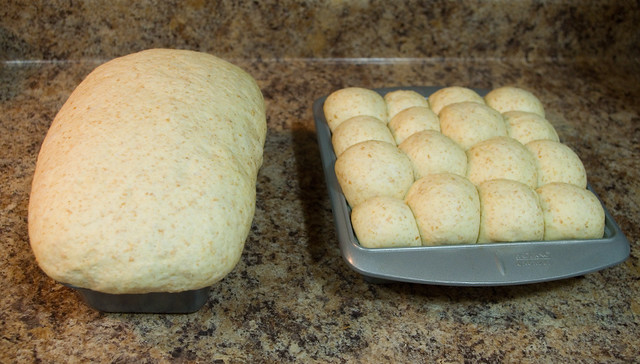
Whole wheat dough divided in half and made half into pan rolls, half into a loaf of bread, after the second rise.

Turn out dough onto a lightly floured surface and knead by hand for about 8 minutes. Oil a large mixing bowl. Form the dough into a ball and place it in the bowl. Cover the bowl with a clean, damp tea towel. Place the bowl in a warm, dry area with no drafts. Allow the dough to rise until double, about 1 hour.

Punch down the dough. Grease a 9″x13″ cake pan. Divide the dough into 35 approximately equal-sized portions. Form the portions into balls and place them in lines closely together to fill up the cake pan.** Cover the pan with a clean, damp tea towel and allow to rise again until double, about 1 hour.


Whole wheat loaf after baking.

Preheat your oven to 450ºF (232ºC). Bake rolls for 10 minutes. Turn heat down to 350ºF (177ºC) and bake for about 20 minutes more. Check to see if they are done by removing the rolls all in one piece from the pan and tapping them on the bottom. When cooked through, they should make a hollow sound. Remove the rolls from the pan immediately and place them on a wire cooling rack.

To create the glossy shine on top of the rolls, use waxed paper to pick up:
1/2 to 1 Tbsp cold butter
Rub the tops of the rolls with the butter, keeping the waxed paper between the butter and your hand.

Nan’s pan rolls taste best when served immediately; to keep them at their freshest, pull them apart only when they are about to be eaten. These rolls will keep for three or four days if wrapped in a clean plastic bag. Make sure they are wrapped up only after totally cool, or they will go soggy.


Whole wheat pan rolls being pulled apart by my temporarily-tattooed Thing 1.

*For whole wheat bread, replace the first 4 1/2 cups of all-purpose flour with all-purpose whole wheat flour.

**Alternately, this recipe makes two good-sized loaves of bread. I used a slightly too-small loaf pan to create a “mushroom-top” loaf; if you want your loaf to have smoother sides, use a pan that is at least 9.5″x5.5″. You could also make three smaller loaves in smaller loaf pans instead of two big ones. Allow the loaves to have a second rise as per pan roll instructions. Be careful of cooking times if you change the shape of the end product. Bread loaves will take 10min at 450ºF (232ºC), and then they must be turned down to 350ºF (177ºC). However, how long they stay in at 350ºF depends on the size of loaves you make. When in doubt, bake for less time and check often to see if they’re done.