Teacup Pin Cushion Tutorial

My kids are learning to sew, so I thought that it was time that they had pincushions of their own. I’ve seen teacup pin cushions around at flea markets and craft fairs, so I thought we’d make a go of whipping up some of our own. They’re really easy and right up the kids’ alwy, patience-wise.

Teacup Pin Cushion

Materials:
– 1 teacup (saucer optional)
– 1 square of cotton or cotton-blend fabric, about 3X as wide as the teacup’s top
– polyester fiberfill
– thread

Supplies Needed:
– fabric scissors
– needle
– hot glue gun & glue
– pins

1. It all starts with a teacup — but none of Grandma’s fine china! We bought ours for about $2.00 at a local charity thrift shoppe. If you’re not into tea, a coffee or espresso cup works well, or an egg cup, or even a sake glass. We even made one using a miniature terracotta pot (picked up for about $0.75 at a gardening supply store). Basically, it has to be an opaque container that you like the looks of that’s about the size of an old teacup, or smaller. You will also need to pick out a piece of coordinating fabric that’s about three times as wide as the mouth of your vessel.

1.B. OPTIONAL STEP: If you’re very crafty, you can embroider a design on your fabric at this stage.

2. Using a pair of fabric scissors, cut your fabric into a circle about three times as wide as the opening of your teacup. It doesn’t have to be perfect, since this end will be hidden inside the bottom of the cup where nobody will ever see it.

3. Using a running stitch, stitch around the outside edge of the circle, about 1cm from the edge. Use a sturdy thread, but don’t worry about the colour, since this will be hidden as well. Tie a knot at each end of the thread, but do not stitch that knot into the fabric.

4. Making sure that the fabric is inside-right, pull the thread taut to gather the fabric, but do not tie a knot. This will make a little pouch.

5. Stuff the pouch firmly with fiberfill.

6. Draw the thread as taut as possible and tie it off securely. This will create a small cushion.

7. Stuff the cushion into the teacup, making sure that the end with the stitching and the gathering is at the bottom of the cup.

8. Affix the cushion inside the cup using hot glue. I found that I got the neatest results by pushing the fabric down below the edge of the cup, and then running a bead of hot glue quickly about 0.5cm lower than the edge of the cup. Then I carefully released pressure on the cushion until it sat at the height I wanted, holding it in place while the glue dried. Otherwise, the cushion kept trying to puff much too far out of the cup.

9.B. OPTIONAL STEP: Using hot glue or by sewing, decorate the pin cushion. You can add a border of ribbon or trim around the edge of the cup to conceal the glue. Buttons, lace, small pompoms, googly eyes, felt cutouts, silk flowers… If you’re so inclined, this is a great time to be creative.

And that’s really all there is to it!

As for our last March Break craft, Thing 2 went with a more contemporary look.

Whereas I made mine in a little flower pot. I created the floral element by sticking sewing pins through little fabric flowers bought in a confetti-like pack from the dollar store.

And Thing 1 used the fabric flowers slightly differently, pinning them into place with her pincushion’s pins.
Vintage Tupperware

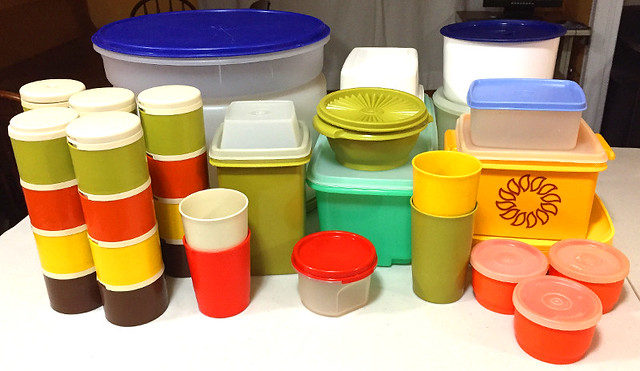
As I write this I am fighting symptoms and hoping to heck that I’m not coming down with whatever the kids had, so I thought I’d just make a quick post about my recent awesome thrifting find. I managed to come into a whole lot of vintage Tupperware:

Okay, some of it is more modern than vintage, and the Pick A Deli (the olive green tall, rectangular container) is missing the lifter/strainer bit, but it was a really awesome find. I was especially happy with the colourful 1970’s stacking spice containers on the left, although the parts of the 1980’s picnic set with the yellow plates with and the stackable container with the orange sunburst were a close second. I’ve only started collecting this stuff recently, and I didn’t realize until I started how much a part of my childhood these containers were.

Polly Put the Kettle On

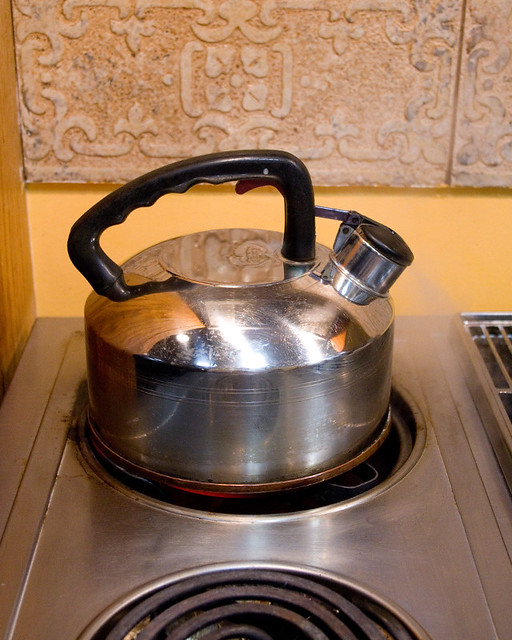
I got a box of old kitchenware to go through recently, and at the bottom of that box was a vintage (1976, if I’m reading the label right) whistling tea kettle. I gave it a scrub and put it on the stove to boil some water to clean the inside, and I was struck by how at home it looked there. I mean, obviously it belongs on a stove, but how much it fit in with my idea of home.

You see, when I was a kid this was exactly the kind of kettle we’d have permanently set on our kitchen stove. My parents are inveterate tea-drinkers (orange pekoe only, thank you very much), and there was always a pot of tea on the stove or a kettle on the boil. The kettle only left the stove on special occasions when Mom was cooking an extremely large or complicated meal. One of the first things I learned how to prepare was tea to my parents’ specifications. To this day, “Put the kettle on!” is slang for, “I’m coming over for a visit and a chat!”


The engraving on the bottom reads “Product of West Bend Company, West Bend, Wisconsin, Made in U.S.A., SINGING TEA KETTLE, Stainless steel with solid copper bottom, 2 1/2 quart, 7 76”

When I was really little, we had a kettle similar to this one but without the whistle. Apparently at one point my father forgot that it was on the stove and left the room, and the kettle boiled dry and then melted. So my mom bought a kettle with a whistle as a replacement. This kettle (or ones like it, since they do sometimes develop leaks) lasted for some years until my father filled the kettle, put it on the stove, and then went out to the garage for some reason. The kettle screamed away until it was boiled dry, and then it too melted down. Exasperated, my mother went out to the store and bought an electric kettle with an automatic shut-off. Dad, being a creature of habit, soon filled the brand new plastic kettle and put it on the stove, then turned the burner on. He didn’t leave the room this time, but he didn’t notice the mistake he’d made until the plastic melted. Don’t ask me how he didn’t smell it.

Since then, my parents have bought other kettles, all of which live on a counter that’s not near the stove and all of which are totally different shapes than the whistling kettles that I remember them having as a child. Dad learned his lesson, we hope, and has not melted a kettle since, and never will again, knock on wood. Despite the kettle saga, to me the “proper” kind is a stainless-steel whistling kettle that just covers the larger burner rings. The kettle singing is a cue that I am home, and Mom and Dad are home, and things can’t be all that bad because someone is making tea.

New Toy

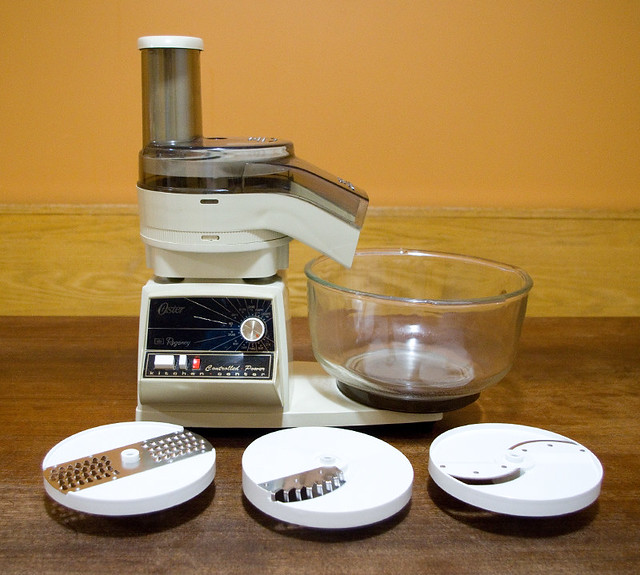
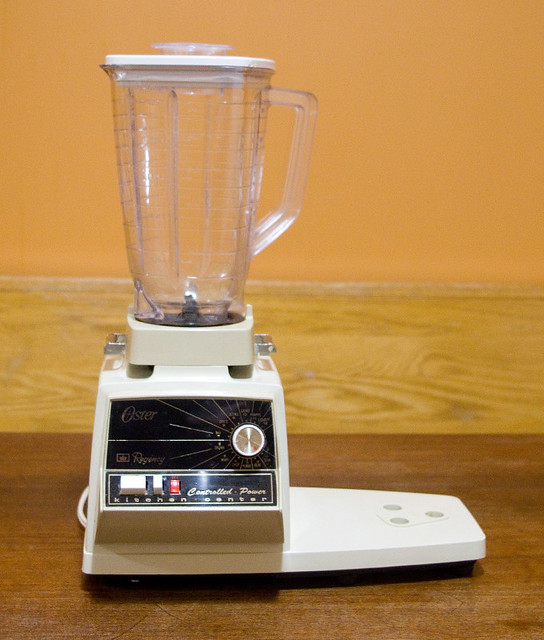
So I have a bit of thing for hunting for interesting vintage kitchen gear. Part of this is the love of the hunt, part of it is because I love the look of older pieces, and part of it is because I actually use a lot of these things and I just can’t afford to buy them new. And, let’s face it, the phrase “Reduce, Reuse, Recycle!” was beaten so thoroughly into my head as a child that I just can’t shake it free. My new toy is a case in point: a Oster Regency Kitchen Center, circa 1983.

Oster Kitchen Center Slicer Shredder Salad Maker
Kitchen Center with slicer/shredder/salad maker/French fry cutter attachment and four cutting discs (shredder, French fry cutter, thick slicer, and thin slicer).

I adore the styling of the KitchenAid and Smeg stand mixers, but heaven knows that I can’t afford one. I do have a beautiful Dormeyer Princess mixer, but so far I only have the mixer attachment for it. My new-to-me Kitchen Center has slicer/shredder/salad maker/French fry cutter, mixer/doughmaker, and blender attachments. Actually, it originally came with a grinder as well, but that part went missing sometime in the last 35 years.


Kitchen Center with blender attachment.

Also missing: the mixing bowls! Well, two bowls that looked about right came with it, but it turns out that they weren’t the correct ones. I shopped around at my local thrift stores and found a total of four that work for about $20, which is reasonable when you consider they’d be about $70 on Amazon.

I was a little worried when I took the machine apart to clean it and realized that some of the gears are plastic. I have a bad habit of putting too much strain on my machines and stripping plastic gears. I’ve ruined a couple of blenders that way. Luckily, the gears for the blender attachment are all metal. We’ll see if the other attachments’ gears are durable enough to withstand my not-so-tender ministrations.


Kitchen Center with mixer/dough maker attachment.

I have to admit that the part I am most enthused about is the stand mixer/dough maker. So many recipes and instructional videos just call for you to use one. I mean sure, it’s possible to do it all by hand, but sometimes I just don’t want to put in all that effort. Also, it can sometimes be a bit tricky to translate directions (especially timing/consistency) from machine mixing to hand mixing.

Apparently there were a whole lot of other attachments that were additional, optional purchases. The one that interests me the most was the pasta accessory, which included five processing discs for thin or thic spaghetti, lasagne, rigatoni, and fettuccine. Unfortunately, it looks like it attached to the (missing) grinder. So I’ll be keeping an eye out for these pieces during my future thrifting expeditions. There may be homemade ramen in my future yet!

Vintage Stand Mixer

It’s come up before that I like old things, not just because they’re old, but for reasons that are:

a) stylistic (some of them are just pretty);
b) environmental (why buy new and add to pollution when there are working older versions of the same thing out there?); and
c) budgetary (old/used items tend to be cheaper than new, unless they’re very rare)

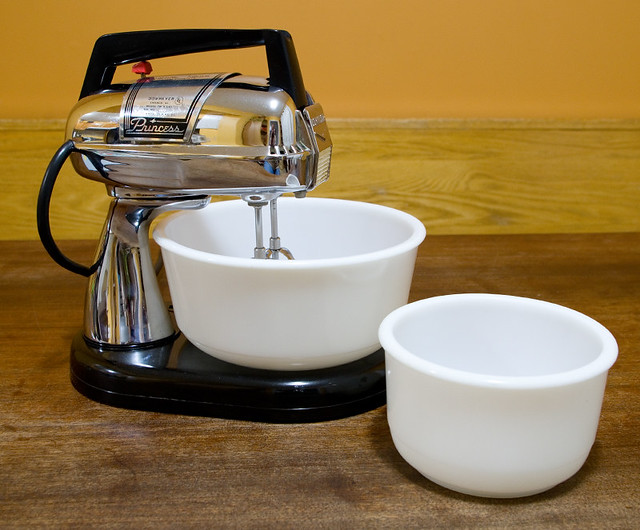
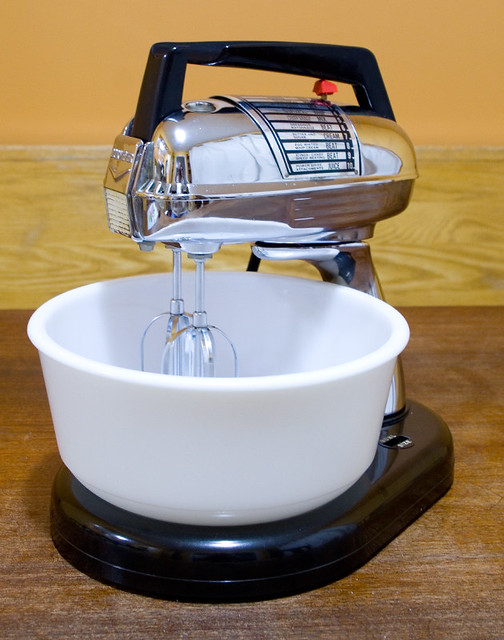
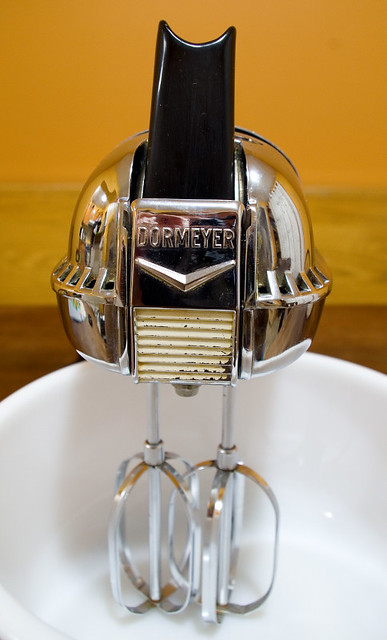
So it’s no surprise that when I recently found a really cheap vintage Dormeyer Princess stand mixer from the 1950’s up for sale, I jumped on the opportunity. I took the chance and bought it based only on some pretty bad photos, but I figured the risk was worth it. As I suspected, it needed a bit of work, but nothing I couldn’t handle.

The main part of the mixer needed a bit of cleaning.

However, what I was most worried about was the state of the power cord, which was dangerously frayed. It looked like it had been poorly repaired more than once. So I went out and bought a completely new cord and installed that — a fairly painless process, as it turns out.

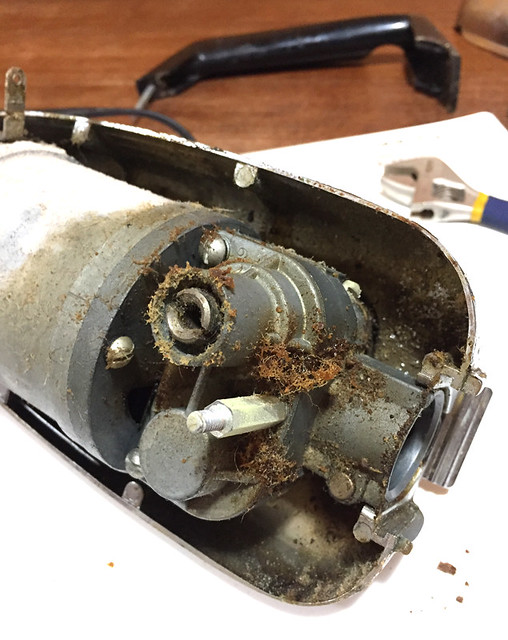
When I opened up the main body, it was disgustingly gungy inside. I took it apart as much as possible, washed all the non-mechanical bits in hot soapy water, and wiped down the motor and all electrical/mechanical bits down thoroughly.

Now it’s clean inside and out, the wiring is safe, and it works like a charm!

It’s pretty, too. I think the styling is very reminiscent of an old Chevrolet.

In the end, the total cost to me was about $30, plus an hour or two of work. Not bad when a nice modern KitchenAid stand mixer costs about $600. Apparently there was originally a juicer and a meat grinder attachment for this model, which I’ll keep an eye out for while thrifting. I wonder if I could find a dough hook that would work with it as well? That would be lovely.

Book Fair

This past weekend was a busy one, and it would have been even busier if I hadn’t been sick on Sunday. It started off in grand fashion with a trip to the Rockcliffe Park Book Fair. They advertised that they had over 30,000 used books, CDs, DVDs and records… And I think they delivered.

To be totally honest, a sale like this is a little slice of heaven for me. I’ve been a bookworm ever since I can remember; it was one of the things that I was teased the most for as a kid. That didn’t slow me down, though, and now I wear the label with pride. All of these books piled high in a gym brings me right back to the happiest days of my childhood, when the Scholastic Book Fair would come to my school. I would bring the money my parents gave me, plus all of my saved allowance money, so that I could bring a stack of books home with me to keep. (Libraries are like a second home to me, but having books I didn’t have to give back was an extra-special treat.) Of course, now that I’m an adult I can drive out to a bookstore any time, but the prices at a used book fair are so much more affordable — and it’s somewhere that I can pick up vintage and out-of-print books as well as new releases.

I came home with two big bags of books, mostly novels and a few Christmas gifts. (Yes, I do buy some of my gifts second-hand; there’s a lot of stuff that is just as good that should be reused instead of going to the dump, and some things just aren’t available any more.) I did find a few cookbooks that I just had to have, though.

Julia Child’s Menu Cookbook (Julia Child, 1991) — This one is a reprint of Julia child & Company and Julia Child & More Company. It’s hard to believe, but this is the first Julia Child cookbook that I have ever owned.
The Ontario Harvest Cookbook: An Exploration of Fests and Flavours (Julia Aitken & Anita Stewart, 1996)
Incredible Edibles: 43 Fun Things to Grow in the City (Sonia Day, 2010) — Okay, not technically a cookbook, but it’ll lead to more cooking in the end.
A Modern Kitchen Guide: A complete Book of Up-to-Date Recipes and Household Hints (Farmer’s Advocate and Canadian Countryman, 1946) — This is the book with the blank red spine. It’s one’s old enough that I haven’t found it online, which makes it all the more interesting to me.
A Little Canadian Cookbook (Faustina Gilbey, 1994) — This one is autographed by the illustrator!
Totally Bread Cookbook (Helene Siegel & Karen Gillingham, 1999)

What a great haul! And what a lovely way to spend a few hours for a bookworm like me!

But What Is It? Part 2

A while back I wrote about the interesting handmade tool that I found at the cottage that my parents rented for the summer. I wasn’t sure what it was at the time, and honestly I’m still not a hundred percent sure of its intended purpose. The consensus seems to be that it was made for chopping, which makes sense to me, but further details are elusive. The pictures I took back then were mediocre at best, so I promised that I’d take some better ones. I kept forgetting to post them, but here they (finally) are:

If anyone has any additional knowledge as to what this may be, I have to say that I remain quite curious. However, it has been pointed out to me that one-off handmade tools often have a specific purpose known only to the owner, so this may forever remain a mystery.

Salmon Puff

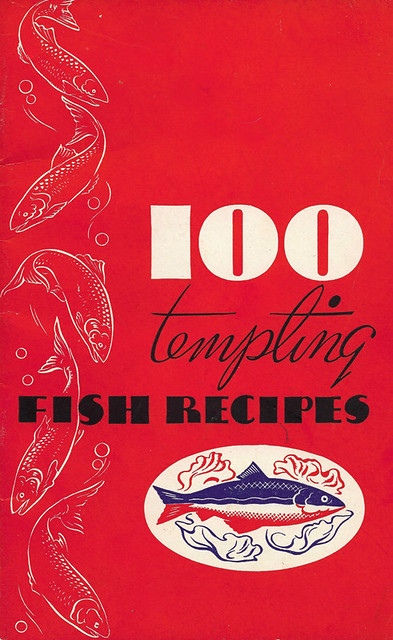
Keeping with this week’s rather unintentional theme of preparing dishes from old cookbooks, last night I tried a dish from 100 Tempting Fish Recipes. This book (well, at 56 pages, it’s more of a pamphlet) was issued by the Department of Fisheries (Ottawa, Canada) in 1939, although I have a 1949 reprint. It’s well out of print now and I haven’t found any copies for sale on the Web, but a digital copy is available online at Early Canadiana Online if you have a membership (which I do not). The site does have a free 18-page preview.

You can get a general idea of the age of this book just by the typography. Another dead giveaway of its age are the sometimes-vague cooking directions. For example, the recipe that I used was the Salmon Puff on page 23, and the baking directions were “Place in a buttered casserole, dot with butter and bake in a moderate oven until brown.” The term “moderate oven” is used a lot in this book and could, I think, denote a number of temperature settings. The timing is also vague; these days, you’d get an instruction along the lines of “Bake in an oven preheated to 350° until brown, about 20 to 30 minutes.” Not that older recipes can’t be precise, but newer ones generally give much more detail. I think that part of this is because the authors expected the reader to have a background of knowledge that would make what the author meant obvious. It’s probably also due to the fact that publication costs went down over time, so it was possible to be wordier (and include photographs of the final product) when every word didn’t carry as much financial weight at printing time. Heck, even between in my 1949 copy 100 Tempting Fish Recipes and the 1960 The I Hate To Cook Book by Peg Bracken (which is still in print), there’s a notable shift toward more precise instructions. The author actually bemoans this in the introduction:

…[T]hey’re always telling you what any chucklehead would know. “Place dough in pan to rise and cover with a clean cloth,” they say. What did they think you’d cover it with?

This terrible explicitness also leads them to say, “Pour mixture into 2 1/2 qt. saucepan.” Well, when you hate to cook, you’ve no idea what size your saucepans are, except big, middle-sized, and little. Indeed, the less attention called to your cooking equipment the better. You buy the minimum, grudgingly, and you use it till it falls apart.

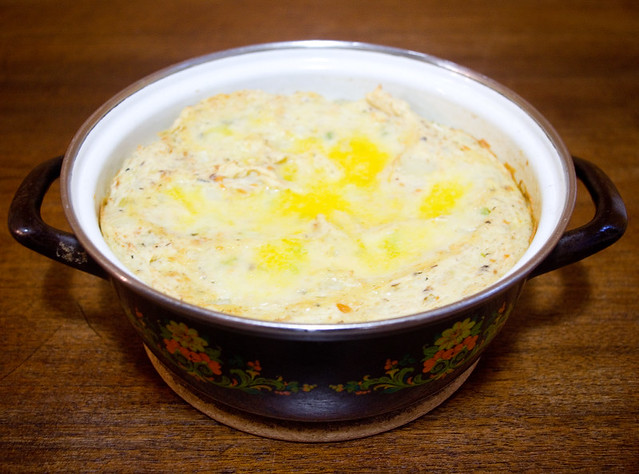
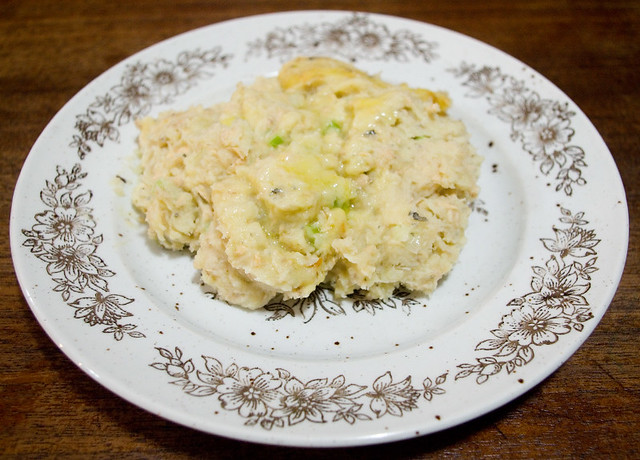
Back to yesterday’s recipe. It’s what I would consider to be a “pantry casserole”, i.e. a dinner that, with a reasonably-stocked Canadian pantry and fridge, one is likely to have all of the ingredients already at home. The salmon, which would normally be the ingredient most easily spoiled, is canned. You’d think that with a pound of salmon in there, the dish would at least have a bit of a pink tinge, but potatoes make up the bulk and leach it of all colour. I think that this is a good metaphor for the dish overall, actually. It’s just very… Beige. Not great, not bad; edible, but uninspired. Even a sprinkling of paprika as garnish would liven it up a little. Peg Bracken has great things to say about garnish on page 15 of The I Hate to Cook Book:

The reason for these little garnishes is that even though you hate to cook, you don’t always want this fact to show, as it so often does with a plateful of nude food. So you put light things on dark things (like Parmesan on spinach) and dark things on light things (like parsley on sole) and sprinkle paprika on practically everything within reach. Sometimes you end up with a dinner in which everything seems to be sprinkled with something, which gives a certain earnest look to the whole performance, but it still shows you’re trying.

(Seriously, though, I highly recommend this book, even if you hate to cook. Especially if you hate to cook. It’s a fun read.)

The salmon puff would have benefited greatly from a side of steamed vegetables or a salad, both to enhance the presentation and the nutritional values. Surprisingly, I think I may use this recipe again in the future specifically because it is an easy pantry casserole. Heaven knows some winter days I just don’t want to brave the roads for more exciting ingredients. Also, it would be a great way to use up leftover mashed potatoes. I mean, everyone in my family ate their dinner, nobody complained, and some even had seconds. Nobody had anything great to say about the dish, but when it comes to feeding kids, a lack of complaints is pretty high praise.

But What Is It?

The cottage that my parents are renting is sixty or more years old (or at least the original section is), and has been both a family cottage and a year-round home in that time. Even though nobody lives there any more, the remnants of occupation remain — meaning that there are all kinds of interesting things tucked away in the back of cupboards, drawers, and shelves. In the kitchen/dining area alone we spotted a full set of vintage silverware (silver plate) and crystal glassware, alongside classic Pyrex mixing bowls, a potato ricer, and ornamental tea tins from the 1970’s. We’ve also found less likely things, like an old Mechano set, a wooden chess set, a bound book a couple of hundred pages long about one family’s genealogy, and what we think are authentic woven Navajo bowls. And then there’s this:

I haven’t the slightest clue what to make of it. The board under this device is about a foot long, to give an idea of scale, and the handle fits comfortably in my hand. But is it even something that’s supposed to go in the kitchen? Or does it really belong in the workshop in the basement, but was never put away? Or is it some kind of small farm implement (a not unreasonable supposition as there are bits of vintage/antique farming equipment decorating some of the exterior walls)?

As you can see, the tool is hinged, and still opens and closes smoothly. Based on the beveled edges of the triangular part, I would deduce it’s for cutting things — but what? Cigars? Cigarettes? Vegetables? Cheese? I haven’t the foggiest. Or is it a weird door knocker? Or perhaps just a novelty doodad made out of salvaged parts, used as a conversation piece to elicit confusion from guests?

My searches of the Internet have yielded nothing similar, and I know so little on this subject that I have an enormously broad range of search terms with which to start. Does anyone out there have a clue as to what this is supposed to be?

(Honestly, this is worse than the time I was trying to find a Kartoffelfeuer like my in-laws have. That was the only name they’d every used to refer to a very specialized cooking pot. Literally translated from German, the name means “potato fire”, but it’s actually a kind of terracotta potato baking pot. It’s also known as a “diable à patates” (Devil with potatoes? Potato devil?) in French or a “patatiera” in Italian — or so I discovered in my research. At any rate, I didn’t know that the style I was looking for is specifically a “Thomas Kartoffelfeuer“. I spent a really long time looking through information about potato fires, cooking your potato in a fire, etc. If you don’t know the right terminology, especially in a language that is not your first, it can be really difficult to find the right information.)

New Cookware

When it comes to garage sale and thrift store shopping, my mother is my role model. Actually, that’s true when it comes to shopping in general. My mom can go into a clothing store and find three pairs of trousers and a shirt, all that fit well, all for 75% off or greater, in less than fifteen minutes. I will go into the same store and come back with maybe one of those pieces. It’s as if she has some kind of supernatural ability to sniff out bargains.

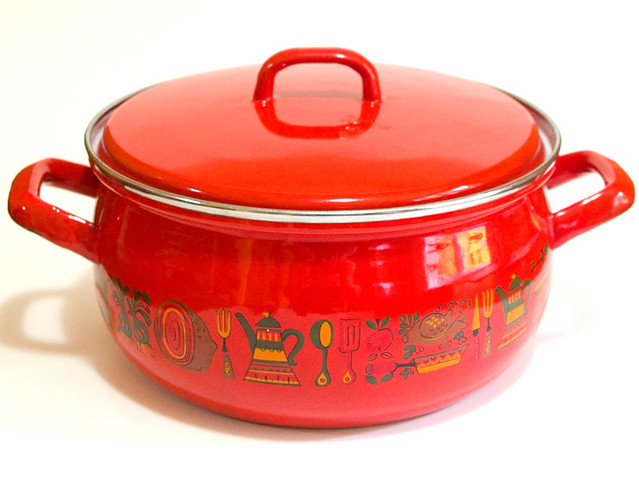
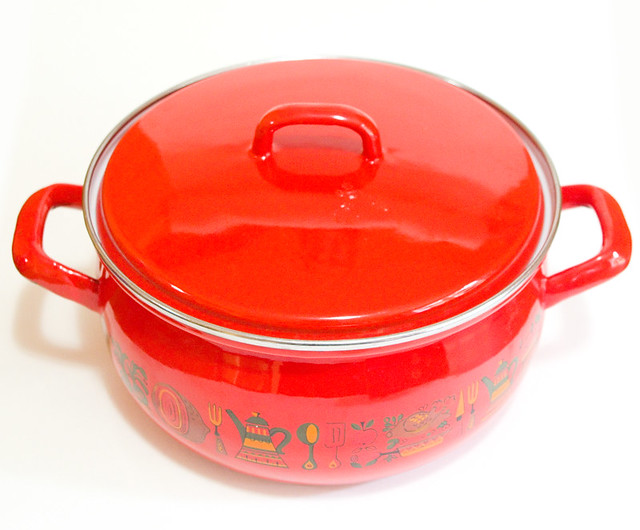
Case in point: my mom bought me some new cookware at garage sales this past month, both for about $2.00 apiece. The first was a pretty vintage 1970’s-ish Dutch oven. I love this style of enameled piece, and although my mom gave me her old one a while back, she was not ashamed to admit that this one was in better shape. As a bonus, it’s also bigger.

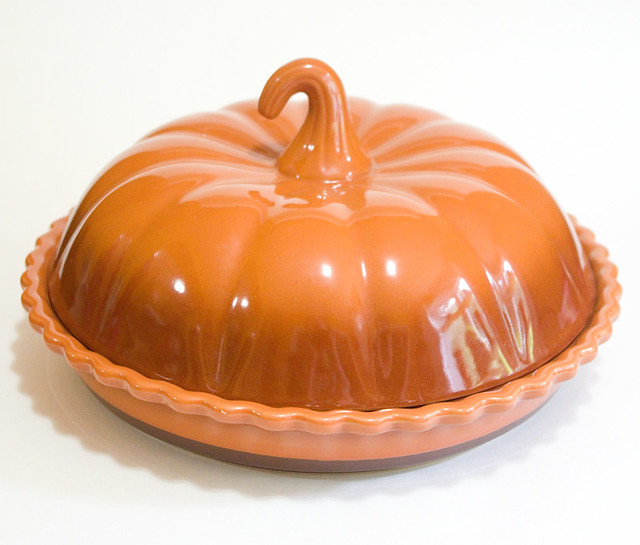
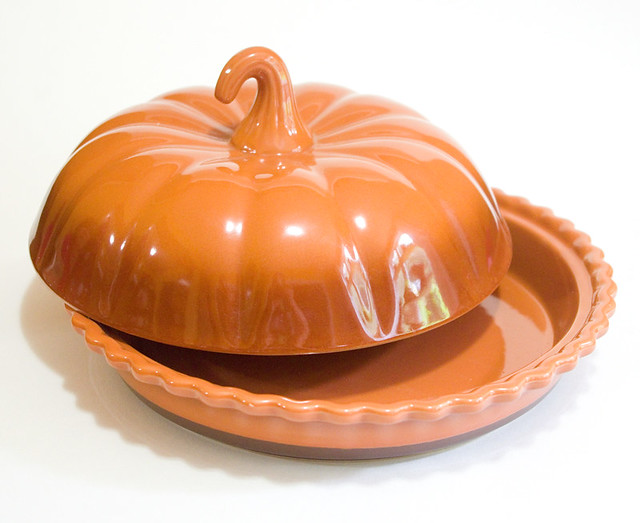
Mom also found me this adorable pumpkin pie plate, virtually brand new; it still had the cardboard insert to protect between the top and bottom parts from each other. I doubt it has ever been used. I think it will be perfect for Thanksgiving and Christmas dinners, when pumpkin pie is often my main contribution to the meal. The temperature at night is telling me that fall isn’t far off, so it won’t be long until I get a chance to use this dish.