Leftover Stew

Yesterday was a toss-up for reasons not to send the kids to school: on the one hand, it was a snow day, and on the other, they were both sick anyway. So I kept dinner simple and made a stew out of all of the leftover bits and pieces I had in the fridge. Honestly, a traditional stew (at least the way I learned it) is a bit of whatever you’ve got around anyway, so it seems fitting.

The stew contained beef, onions, garlic, carrots, baby potatoes, celery, homemade beef broth, store-bought beef broth, pearl barley, red wine, fresh thyme, fresh sage, a bay leaf, and salt. I whipped it up in the Instant Pot in about 45mins, including preheating/venting time. It wasn’t the best stew I have ever made, but it was tasty, hearty, warm, and went down easily for those with sore throats. I’ll consider it a win.

Socks of Many Colours: Complete!

I’m still trying to adhere to my New Year’s resolutions, so I’ve been knitting away at my socks of many colours. I managed to get through a small pile of yarn scraps, but I haven’t made as big of a dent into my total accumulation as I was hoping.

It seems like I spent more time sewing in ends than I did actually knitting.

But I am rather happy with the final result! These super-warm woolen socks have a stretchy ribbed knit and are very comfortable. I rather like the colours, but I’m sure they’re not to everybody’s tastes. I rarely keep my knit items for myself, so I’ll have to figure out who has feet similar sized to mine who also likes this particular pattern mishmash. My kids would very happily wear them, but the size is much too large.

On to the next scrap project! I’m thinking that I need a new pair of wrist warmers, since my hands have been getting rather chilly when gaming in the evening.

Hearty Hamburger Soup

The plague, aka the nasty cold with a sore throat and a cough that has been going around, hit our house hard this week. While I am desperately trying to fend it off, Thing 2 and my husband have succumbed, and Thing 1 is starting to show symptoms. It’s also been ridiculously (if seasonally) cold the last few days, averaging about -35°C (-31°F) at night with the wind chill. All of this together means that the best thing for everyone to eat is a nice, hearty soup.

So last night I made Hearty Hamburger Soup in my Instant Pot. It’s actually a stove top recipe, but it’s easy enough to adapt; I just did all the sautéing in the cooker, drained off the fat, added the rest of the ingredients and then pressure cooked for 30min. This is a dish that I’ve been meaning to make for years, and the ingredients are generally the kind of thing I have stocked in my pantry and freezer. I’m told that my aunt makes a killer version of this dish, but I haven’t been able to wheedle her recipe away from her. The Allrecipes version was quite nice, though. I made the accompanying bread earlier that day in the bread machine; it was Egg-Enriched White Loaf on page 67 of Bread Machine: How to Prepare and Bake the Perfect Loaf by Jennie Shapter (2002).

Thing 1’s Stir-Fried Ginger Chicken

Thing 1 is learning how to cook, by which I don’t mean just helping me in the kitchen, but actually planning and preparing entire meals. She’s been able to successfully manage pre-packaged food for a while now, so she wanted to step up her game. I gave her free run of my cookbooks last week, but I suggested that for now she stick with some of the ones meant for beginners that I’d picked up over the years. She really likes Essential Cooking Basics: The New Cook by Mary Berry & Marlena Spieler (1997), I think at least in part because it’s full of detailed step-by-step photos, but isn’t only targeted at children. She prepared this dish almost entirely by herself, although I remained nearby to field (many, many) questions and to introduce her to some new techniques.

She chose to make Stir-Fried Ginger Chicken (page 88), which is the kind of meal that takes a lot more time to peel and chop than to actually cook. She was only just starting to prepare when she cut open a sweet pepper to find another tiny pepper growing inside! I’d read about this phenomenon before, but hadn’t chanced upon it myself; it’s called parthenocarpy, which is a kind of internal proliferation of a fruit without fertilization. Basically, it’s a tiny natural clone of the larger pepper — and it’s perfectly edible.


Yes, I know the knife in the background shouldn’t have been left blade-up; Thing 1 put it in the dishwasher moments after this photo was taken.

Knife skills are, I think, one of the most essential parts of learning to cook efficiently. I’m no speed demon myself, but I’m reasonably quick I manage not to cut myself most of the time. I find that even a lot of adults are awkward and slow with a knife in the kitchen, so I hope that starting Thing 1 early acquiring this skill will mean it’s easier for her as she grows up.

Another part of learning how to cook is learning how to adapt a recipe to what you have. I, for example, don’t have a good wok any more, so the dish had to be cooked in a large non-stick frying pan, which meant that the instructions had to change a little bit. Also, I couldn’t find the specific kind of noodle that the recipe called for, so a few adaptations had to be made for that.

Thing 1’s final dish was perfectly prepared: the veggies were still a little crunchy, the chicken was moist, and the noodles were al dente. Everyone went back for seconds, and there was still enough for Thing 1 to take as leftovers for lunch the next day — and show off to her friends.

A Taste of Lebanon

When I was a kid, my mother liked to tell me the story of how she and my father met some of their friends back in the day. You see, Mom and Dad didn’t go to university directly after finishing high school; Dad earned a college diploma first, and Mom worked for a while. This meant that they were a few years older (and hopefully more mature) than most of their classmates. Not only that, but they had gotten married before they started university as well, which was (and I think still is) extremely unusual. This combination of factors meant that they didn’t really fit in with a lot of their peers. However, there was an extremely small community of international students attending the university at the time, and a lot of them were also older, and few were even married couples. My parents naturally fell in with this group of students and they became great friends. This meant that my parents (who are both white and from not only small towns, but military small towns) learned a lot about a number of international cultures and foods when otherwise they probably wouldn’t have done so.
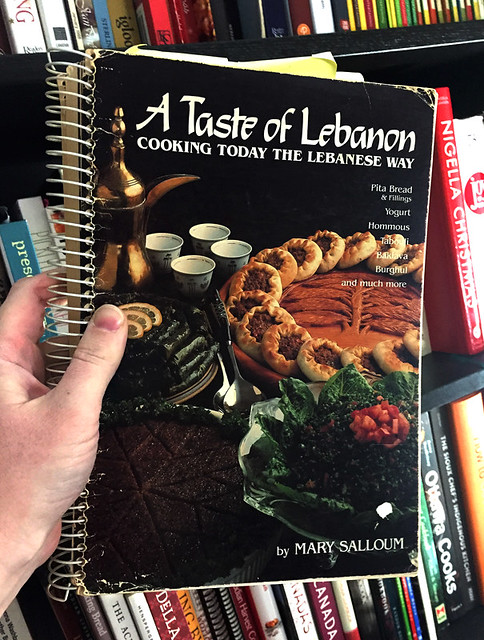
A number of their friends were from Lebanon, and one of them (or possible a few of them, I may be misremembering) wanted to help publish a Lebanese cookbook to be sold in Canada. It was to include a lot of dishes that were common knowledge in Lebanon, but were considered “unusual” and “exotic” at the time throughout most of Canada. My parents got to be the testers for a lot of these dishes, since the authors were trying to tailor the recipes to a wider audience. Always enthusiastic about trying new foods, my parents were very happy guinea pigs.

Now, I think that A Taste of Lebanon: Cooking Today the Lebanese Way (Mary Salloum, 1983) is the book that this eventually became. My father bought my mother a copy for Christmas the year it first came out. My parents used that book regularly until it was passed down to me a few years ago when I started to show a greater interest in cooking.
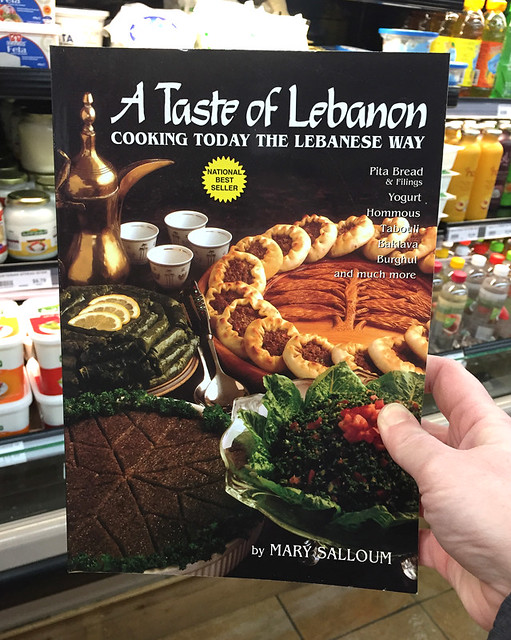
Imagine my surprise, then, to stumble upon a brand new copy of this book at the Mid-East Food Centre; I didn’t realize that it was still in print! Not bad, considering it’s been more than 35 years. A quick search online revealed that it’s also available online as well. I would definitely highly recommend getting a copy of this book if you’re interested in Lebanese cooking even a little bit. As a bonus, it is a Canadian publication, so it focuses on ingredients that are actually available here.
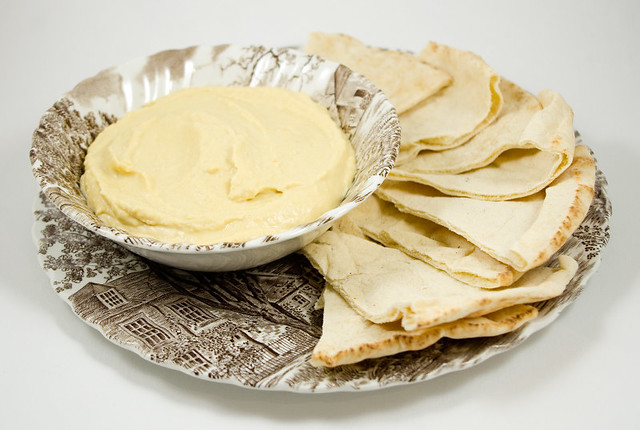
Finding this book still for sale prompted me to go back to my own copy and make one of the easiest of the recipes therein: hommous bi tahini, i.e. chick pea dip with sesame seed paste. You can buy a large variety of types of hummus in just about every chain grocery store these days, since it’s considered healthy and trendy now. But when I was a kid my parents had to make it for us. Actually, since it’s a no-cook recipe (all you need is a blender), it makes a lot of sense to make your own hummus if you can.

I based the prices here on the everyday listings found on the Superstore website; you could probably find a lot of these ingredients even cheaper if you shop the sales.

Suraj chick peas @ $0.88 for a 540mL can = $0.88
Alkanater tahina @ $8.58 for 907ml, 60ml used = $0.57
Rooster Garlic @ $0.58 for 3 bulbs with 10 cloves each, 1 clove used = $0.02
Windsor iodized table salt @ $1.28 for 1kg, 2.84g used = $0.004
No Name lemon juice @ $2.48 for 946ml, 60ml used = $0.16

Total cost for 1 batch = $1.634

Now compare that to the pre-made prices, which start at $3.47 for a comparable amount, and go up to about $5.00 for the fancier stuff. That’s a pretty big saving if you make it yourself, and it’ll add up if you’re the kind of person who eats it regularly!

Now, my favourite way to eat hummus is on fresh pita bread — and one of the next recipes on my list is pita bread itself, which is also in this cookbook. But I know a lot of health-conscious people prefer it as a veggie dip, as it’s great with sliced sweet peppers, carrots, or celery. (Of course, it’s vegetarian, vegan, and gluten-free too — not that these dietary trends were even on the radar of this classic food.) A Taste of Lebanon recommends that hummus and pita be served with any fish recipe, baked kibbi, tabouli, barbequed chicken, or shish kabob. It is truly one of the most versatile dishes I have ever made.

Breaded Chicken Thighs with Baby Potatoes & Miso Greens

I’ve been trying to cut down on food waste in my house, and one of the things that goes to waste a lot of the time is the heels and mis-cuts of my homemade bread. You’d think it would get eaten up since it’s fresh and honestly tastes the same as the rest of the loaf, but the kids especially tend to leave it to go stale or even moldy. What I’ve started to do is take the stale ends and whizz it through the food processor to make bread crumbs, which was suggested by Jamie Oliver in this video. (I know it’s an ad, but it had some good tips!) This go around the crumbs were mostly from a loaf of rosemary Bread Machine Fluffy Herb Bread, which is a great herb to combine with chicken.

To add a bit more flavour, I broke out the Ikea FALKSALT sampler that my husband got for Christmas. I can’t seem to find a listing for it online, but it comes with four blends of sea salt: natural, wild garlic, oak smoked, and wild garlic. I chose the oak smoked for this dish, so I ground up a bit and added it to the bread crumbs. I dipped the chicken thighs in flour, then beaten eggs, and then bread crumbs. Then I baked it all for about half an hour, until the meat was cooked all the way through but still juicy.

To finish the meal, I also boiled up some baby potatoes that I bought over a month ago and had forgotten about in the fridge, and the leftover miso greens from the night before. Truly, this meal was all about avoiding food waste — but it was also delicious! Simple, too.

Green Tea Salmon with Coconut Rice & Miso Greens

When I bought the salmon for yesterday’s dinner, I had the option of buying just enough for one meal at a rather high price, or picking up a club pack that would make two meals for only a dollar or two more. Bulk discounts are a really big thing here and, if you can work with it, can save you an awful lot of money. Owning a deep freeze is a great way to buy in bulk without having to eat the same thing for a week. However, most ocean fish that gets to us here is frozen, since we’re about 1,100km away from the Atlantic coast in our country, and 500km away if we drive south to the States. I didn’t want to re-freeze the extra salmon, so we ended up eating it two days in a row. I’d been itching to try out some of the recipes from my new-to-me copy of Jamie’s 15 Minute Meals (Jamie Oliver, 2012), and the green tea salmon with coconut rice & miso greens on page 138 looked like it was packed with flavour.

I like how this book gives very specific directions for how to prepare these dishes in the least amount of time. That being said, this dish definitely took more than 15 minutes, mostly because of the rice. The instructions call for basmati rice to cook in light coconut milk for only 10 minutes — but I have never managed to make decent basmati on the stove in less than 25, and I cook it a lot. I tried to shave off a little time by cooking it in the Instant Pot (which didn’t exist when this book was written), but with the preheating, a 12-minute automatic cook time, and 10 minutes of releasing pressure naturally, it was still closer to a 25-minute cooking time. So I had to time my other preparation around the rice so that all of the elements finished at the same time. That actually made things much easier for me, since I’m definitely slower at my knife-work than Jamie.

My other issue with this recipe, and it’s become a big of a pet peeveas I’ve written before, is that the ingredients aren’t measured by something objective like volume or weight. Rather, they were given such measurements as “bunches” or “thumb-sized”. It’s fine to be able to throw in a pinch of this and a dash of that once I know a recipe well, but when I’m trying it for the first time I want it to be as much like the original as possible. Also, a “bunch” can change size from store to store and season to season — and I’m pretty sure that we use slightly different varieties of veggies than over in the UK, so their sizes can vary considerably. This can throw off proportions and potentially ruin a recipe. In this recipe, I threw in a whole bunch of cilantro instead of half a bunch, because the bunches where I was shopping seemed really small. Also, I had to use broccoli instead of broccolini, since my local grocery store didn’t carry the latter at all; luckily that particular bunch also had an approximate weight measurement as well.

Despite my pickiness about the recipe, I was very happy with the final dishes. The salmon with its green tea coating was surprisingly delicious, the coconut rice was lovely (and so easy!), and the veggies were crisp and fresh-tasting. I think the dressing would have been better with a little olive oil added to thin it out, since it had such a strong flavour that you really didn’t need much. The oil probably would have made my poor old blender deal with the whole thing better too, since it didn’t like working with such small quantities or low levels of liquid (my blender is older than I am). I think that making this sauce into a salad dressing for fresh greens would be absolutely lovely — unless I’m making it for someone who finds that cilantro tastes like soap. Luckily, I’m not one of them!

Yuan-Style Salmon & Spinach with Bonito Flakes

After all of the work (and many hours of ingredient hunting) over the weekend for Sunday’s dinner, I thought I’d keep things a bit more simple on Monday night. I’d been meaning to try out some of the recipes from Ten-Minute Bento (Megumi Fuji, 2007), since they all looked delicious and relatively simple. I went through my cupboards to determine what I already had, prepped my shopping list, and then went out for the day. Easy peasy, right? Except that halfway through the day my eldest called from school to tell me she was feeling sick, and could I come and pick her up. So much for picking up the missing ingredients with the girls after school, then. Instead of the leisurely dinner prep I had been hoping for, I chucked the rice in the Instant Pot right before my husband came home, made a mad dash for the grocery store once he arrived, and returned home as quickly as possible. I know, I could have changed my dinner plans entirely, but at this point it would probably have taken longer to find another recipe, scrounge the house for ingredients, and likely defrost something from the freezer.

Luckily the recipes in this book are as simple as described, if not necessarily as quick. (It’s not a ten-minute bento if you have to cook the rice, marinade the fish for ten minutes, and then grill each side of the fish for 4 minutes per side. Just saying.) I upped the portions to make the bento on page 21 for four people, and we all greatly enjoyed our yuan-style salmon & spinach with bonito flakes. I would definitely make this recipe again. Honestly, if it hadn’t been for circumstances delaying me from getting the ingredients earlier, it would have been a snap! As a bonus, making the sticky rice in the Instant Pot was super easy and came out perfectly.

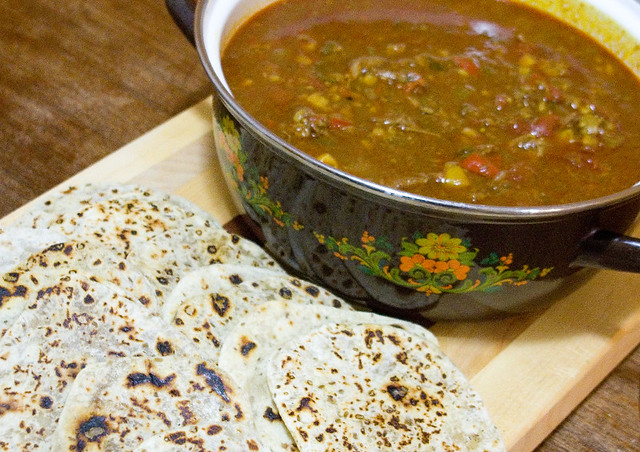
Rogan Ghosh & Rotis

Last night I wanted to do something a little different for Sunday dinner, but I still wanted it to be warm and hearty. The temperatures on the weekend had dipped below -30°C (-22°F), which calls for solid comfort food in my opinion. On Saturday afternoon I delved into my new Christmas-gift-card acquisition, The Complete Indian Instant Pot Cookbook: 130 Traditional & Modern Recipes (Chandra Ram, 2018) and picked rogan ghosh, aka lamb stew (page 2019) and rotis from the plethora of recipes that I wanted to try. It was the first time I ever attempted to cook an Indian dish from scratch, although I’ve used pre-packaged sauces and curry pastes many times.

It’s a good thing that I started prepping on Saturday, because I had a really hard time finding some of the ingredients! I discovered quickly that most chain supermarkets around here don’t carry lamb shoulder, and as it turns out some of the more specialty stores like the Mid-East Food Centre, where I’ve had great luck in the past, had been shorted on their order that week. I hit at least six stores before I ended up at George’s Meat Shop, which luckily had the lamb in stock. Neither they nor any of the other places I visited carried serrano chilies, nor did the next three, at which point I admit that I just gave up and asked Google for a good substitution. Apparently jalapeno peppers are similar in taste but not nearly as hot, so I went with those and simply doubled the amount of peppers. Luckily that worked out okay. But if anyone has any suggestions as to where in the Ottawa area carries serrano chilies, please let me know!

I chopped up my meat and slathered it with marinade on Saturday night, leaving the prepping of the spices and the vegetables until Sunday. What with the speed of the Instant Pot, all of that chopping took significantly longer than the actual cook time of the dish. The finished product was definitely worth it, though. My whole family loved it, and it wasn’t too spicy for anyone (always something I have to take into account with our rather over-sensitive tongues). I was pretty sure it wouldn’t be too spicy, though, given that we all eat lots of jalapenos my homemade salsa. I think that the only mediocre part of this meal (although not at all horrible) was my rotis, which in retrospect I didn’t roll nearly thin enough. I loved their flavour, but I need a lot more practice to make rotis I’m actually proud of.

After some Googling, I’ve learned that apparently you can make the stew using mutton, goat, or even beef. I really liked the rich flavour of the lamb, so I can’t see using beef instead unless it’s out of budgetary consideration, but I like the gaminess of mutton and goat, so I might eventually give them a go. I assume that these would have a longer cook time because the meat is tougher, though.

Maple Syrup Gone Bad

I threw a couple of waffles in the toaster the other day (they’re a special treat around here), at which point I realized that the kids had finished the last of the jar of maple syrup that had been in the fridge. So I went into the cupboard to refill the smaller fridge container, and I found this:

It looks a little dodgy, with that ring of residue around the side, doesn’t it? But I shrugged it off, thinking that some of the top level had crystallized, since it has happened before. But when I opened the jug there was a puff of released gas and a distinct smell of alcohol. It had started to ferment.

I have never in my life had this happen before. I have kept open maple syrup both in the fridge and in the cupboard for years, and the worst thing that has ever happened is that it has crystallized. I honestly thought that it was like honey. I think that this is the combination of having left it in the cupboard and buying it from a farmer’s market*. Don’t get me wrong, I love farmer’s market food! But most of the time there isn’t the same quality control from batch to batch, and this batch could have been bottled too soon. If the temperature didn’t get high enough and/or the ratio of water to syrup was too high, bacteria could survive and the syrup would spoil faster. In a commercial setting, such factors are much more highly regulated.

After discovering this I did some reading and realized that maple syrup can intentionally be fermented to create maple mead, but this is usually done by introducing a specific kind of bacteria (yeast). Since I had no idea what kind of bacteria were in this bottle — and were now creating slow-moving bubbles, once the cap was open — I had to rinse it all down the drain.

I’m kicking myself especially hard about this one because there was so much left in the jug (well over a liter), and because it is Canada. In winter. I could have just left the stupid thing in our uninsulated garage and it would probably have been fine. But I ran out of space in the fridge over the Christmas holidays and left the biggest bottle in the cupboard instead.

Ah, well. I’ll just have to buy some more come spring.

*This was bought from an out-of-town market, and I won’t name the source because heck, this could have been entirely the fault of my food safety practices. But I would like to note for the record that I have never, ever, had any of our local producers’ syrup go bad. Actually, no syrup of any kind has ever gone bad on me before this — which is why it surprised me so much!