Signs of Life

The “on this day” features on my phone and Facebook and whatnot keep reminding me that last year at this time the city was really greening up. Leaves were unfurling, plants were sprouting, and spring had definitely sprung. This year, not so much. I mean, that’s probably a good thing, because it’s only been two weeks since we had an ice storm. For those who don’t live in northern climes, ice or snow on leaves instead of bare branches puts a whole lot of weight on trees, meaning a lot more breakage and overall damage. Not to mention the frost damage that would have affected lower-growing plants. So in the long run it’s probably good that spring is springing slowly this year, even if it does mean that things like Ontario parks have had to have a delayed opening.

But if you look closely, you can see some signs of life, like buds on a lilac bush:

Or on a pear tree:

And hardy rhubarb sprouting up despite being thoroughly trampled by the fence installation guys in the fall:

With any luck, my harvest will be better than last year’s.

Of course, the tiger lilies are one of the first plants to shoot up after the snow recedes — they generally survive the last few freezes of the season just fine:

And the first dandelions have started to bloom:

I have to admit that I’m not a huge fan of digging dandelions out of my lawn and my gardens, but they are one of the earliest foods for bees in the spring before the rest of the plants flower. So, yay!

I don’t generally plant my gardens until after the May 2-4 weekend, as late frosts can kill tender young plants. Given the weather we’ve had this year, I may be extra-cautious and not plant for another week after that, at the start of June. I mean, it hit 28°C (82.4°F) yesterday out of the blue, but average temperatures for May are generally much lower than that. However, I still enjoy seeing the native and perennial plants coming back in force after the temperatures rise.

Winter is Coming

Although I am much better, my kids are still fighting their colds. Last night I decided to go the more traditional route, dinner-wise, in an attempt to help them get well. I don’t know that it actually helped, but it didn’t hurt at any rate, and it was pretty tasty.

I made up a batch of chicken noodle soup based roughly on the recipe on page 125 of the Joy of Cooking (2006 edition, Rombauer & Becker). I added carrots and rosemary mostly because it’s what I happened to have around the house. I served the soup alongside fresh-baked Poppy Seed Loaf (page 138, Bread Machine: How to Prepare and Bake the Perfect Loaf (Jennie Shapter, 2002)) with avocado slices on top. Unlike me, the rest of the family ate their bread with butter and scooped the avocado out of the skins directly with a little bit of salad dressing on top.

Last night ended up involving a lot more food prep than just supper, though. The forecast called for the temperature to drop precipitously overnight to a low of -10°C (14°F) with a windchill of -20°C (-4°F). I had left a few frost-hardy plants in the garden after the main harvest, but I knew that cold this intense would kill them. So I had to bring in two good-sized bunches of celery, which I washed and trimmed the leaves off of, then put in a jug of water in the fridge for use over the next week or so.

I had a whole mess of Swiss chard to bring in — believe it or not, this was all from only two bunches!

I washed it all, then chopped the stems into bite-sized pieces, which I bagged to freeze in single-use packages over the winter in soups, stews, stir-fries and casseroles. The leaves don’t freeze nearly so well, so they’re still drying off in my sink while I figure out what to do with that much chard. A friend suggested a soup, but I don’t have a recipe yet.

My uncarved Halloween pumpkins had to come inside; freezing isn’t terribly hard on them as a general rule, especially if you’re just going to cook them, but a frozen-solid gourd is really difficult to prepare. Heck, it would take an axe or a sledgehammer just to get through it!

I also brought in the last of my summer herbs so they didn’t get frostbitten (along with half a case of Coke that I’d been cooling outdoors since the Halloween party; cool fall temperatures mean that the outdoors makes a great refrigerator for non-perishables). There are two pots of lavender, one of mint, one of rosemary, and one of parsley. Some of them I will eventually dry, others I will preserve (I have an interesting recipe for parsley jelly I want to try). They’d survive just fine in the house all winter, but the pots are quite large and take up my whole patio window. I think I will just plant new herbs in the spring and not deal with the hassle.

Jack-o’-Lantern Herb Pots

I grow most of my indoor plants (and some of my outdoor ones) in terracotta pots a) because I like the look of them, and b) because they’re inexpensive. I generally have a row of herbs growing in a window planter all year long. I was looking for a way to spruce them up for Halloween on the cheap.

I came up with this quick craft — and I do mean quick, as in it took me less than ten minutes to decorate five pots. There are all kinds of tutorials out there for how to paint or draw on terracotta pots to make them look like Jack-o’-lanterns, which is simplified by the pots already conveniently being orange. I wanted something a little less permanent, since I didn’t want to have to re-pot my herbs for every holiday.

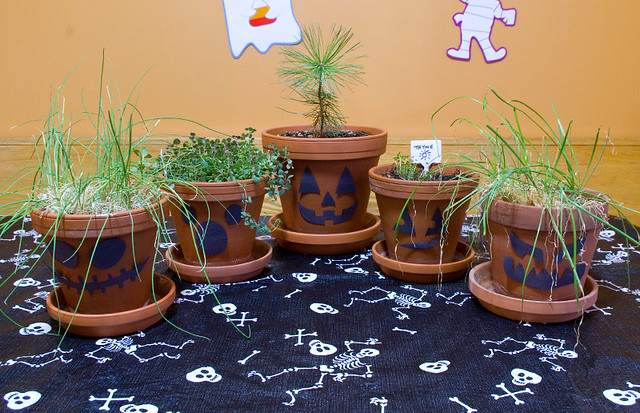
I took a sheet of black construction paper and cut it out freehand into the appropriate shapes. If you’re not comfortable drawing or cutting freehand, you can always Google “Jack-o’-lantern face template” and either trace one of those designs or print it and cut it out. I then stuck the pieces onto the pot with tape. Any tape will work, but for something so temporary I prefer to use painter’s tape (any brand), which isn’t meant to stick forever and rarely leaves any sticky residue behind.

I really like how they all turned out! The plants in the pots make fun “hair” for the Jack-o’-lantern faces, which tickles my kids to no end. Those plants are, left to right: chives, oregano, baby pine tree (okay, technically not an herb; this craft will honestly work with any kind of plant, I just like how quickly and thickly herbs grow), thyme, and garlic chives.

I think that this craft cost me maybe a quarter? Of course, I already had the potted plants. If you don’t have that, the pots generally run only a few dollars for the smaller sizes (they’re generally available at dollar stores and at WalMart all year round), and you can pick up a small pot of herbs for only a few dollars more at your local grocery store or garden center. As a bonus, after Halloween you can use the herbs in your cooking.

Last of the Zucchini

One of the biggest challenges about this time of year, at least to me, is to either eat or preserve all of the fresh produce that comes my way before it goes bad. It seems to me like the utmost example of taking what you have for granted to let food — especially fresh, homegrown, delicious food — go bad. Practically speaking, this does mean freezing, drying, or canning a lot of it to eat over the coming winter. But it also means a lot of meals made with just-picked ingredients.

Over the last few days I’ve finally managed to cook my way through all of the zucchini from my friends’ gardens (although I may end up with more in the next little while, not that I’m complaining). Last night for dinner we dug into another loaf of Harvest Garden Bread (which contains zucchini), Baked Panko Zucchini Sticks, and haddock baked under a generous coating of Blender Salsa (page 92 of Preserving by the Pint: Quick Seasonal Canning for Small Spaces (Marisa McClellan, 2014)), which was made almost entirely from produce grown in my garden.

Then it was Double Chocolate Zucchini Muffins for dessert. I had never tried this recipe before, but it was highly recommended to me by a friend, and now I realize why. These muffins are moist, dark, rich, and chocolatey. They also aren’t as unhealthy as other muffins with similar flavour. I mean, it would be a stretch to actually call them health, what with the chocolate chips and the oil in there, but there is more zucchini in the recipe by volume than flour, and that has to count for something, right? 10/10, will definitely bake this one again.

Harvest

Even though the days have been lovely, it is now the beginning of October, so the nights are getting colder and there is often the threat of frost. This means it’s time to bring in the harvest. I dug up about half of my garden last week, and it wasn’t all mutant carrots!

Please excuse the long grass. My plants were hanging over the sides of the wooden garden border, so I figured I should pull them all up before mowing.

I picked the last of the hot peppers and dug up the few shallots that survived the season. For some reason, most of my shallots didn’t sprout this year. I will freeze the hot peppers with the intention of making hot sauce at a later date.

I tried growing lemongrass this year, which was very pretty but didn’t yield a huge amount of edible parts. It’s supposedly a perennial, but the root ball may not survive the harsh Canadian winter. We shall see if it sprouts in the spring.

I’m still harvesting ripe cherry tomatoes, much to my surprise. Last week’s heat wave meant that the plants haven’t started to die down as much as usual by this time of year.

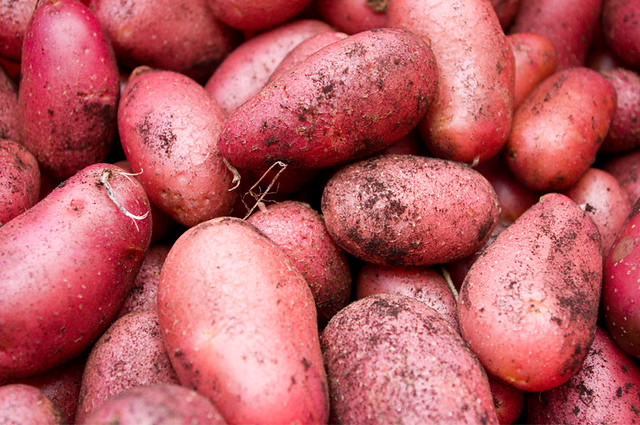
I had a total yield of about 30lbs of Prince of Orange potatoes. These potatoes are apparently a pretty new breed. They have reddish skins and a dark yellow interior (actually pretty close to my Creampak carrots when cooked). They also have a stronger flavour than traditional white-fleshed potatoes, which I really like. I may plant these again next year, or may be I’ll alternate with Violet Queens, which have purple skins and flesh. I figure hey, if I’m going to grow it myself, why be satisfied with the few varieties that are available at the average grocery store?

Carrots

I love both cooking with and eating carrots, so I’ve been planting them in my garden for a couple of years. I haven’t had great success, though. Last year, one of my carrots looked like this:

(That’s a dime for size reference.)

So when I planted my carrots this year, I didn’t have any great expectations. Instead of growing them from seeds like I’d tried in previous years, I bought pre-started seedlings from Laporte Gardens. I hoped I’d get a few decent-sized carrots and probably some finger-sized ones as well. Little did I know that I was growing MONSTERS.


Thing 1 helping me harvest the carrots.

I left lots of space between each planted seedling (so I never had to thin them), made sure they got lots of water (not a problem this year) and that they weren’t being eaten alive by pests or crowded out by weeds. I also fertilized the entire garden with sheep manure compost early in the spring. And that was all I did. I’d learned the hard way that you really just have to leave root vegetables alone for as long as possible so that they develop fully. Um… Mission accomplished, I guess?

(Yes, I know now that I probably should have re-buried the carrots as they began to poke out of the ground so they didn’t discolor, but I didn’t know that back when it mattered. My carrots have never before grown so large.)

So yeah, that’s Thing 1 holding up one of the carrots/carrot clusters that she pulled up for me. It’s almost as big as her head.

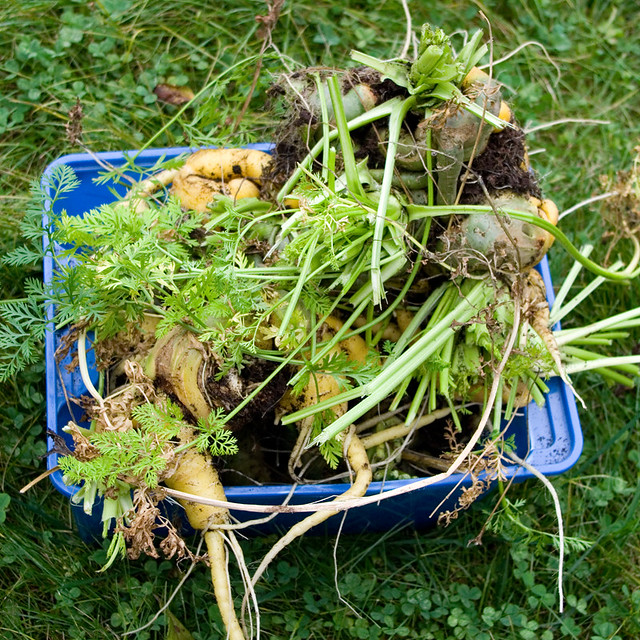
Instead of the roots growing long and straight, they looped back upon themselves multiple times, creating gnarled, mutant bunches. Even in the spots where there was only one top, the roots looked like this.

These are creampak carrots, by the way. They’re supposed to be yellow instead of the more common orange.

All in all, my small planting of carrots yielded a root harvest that overfills a 11″ x 15″ x 7¾” IKEA GLES box.

Washed and untangled, the carrots looked more like the vegetables I’m used to. The photo above is of only one of the root balls. I kept giggling as I washed and separated, since it all seemed so absurd to me. This is honestly the funniest plant I have ever grown… And I have grown some weird-looking plants.

Thing 1 washed and cut up some of the smaller bits, then harvested a few cherry tomatoes from the garden to make her own carrot and tomato salad. I was very proud of her for taking the initiative to make a dish out of the food she’d helped harvest. She insisted that I photograph her creation and put it on “the blog”.

I included part of the harvest in yesterday’s dinner, which was steamed carrots, whipped potatoes (which are Prince of Orange potatoes and almost the same colour as the Creampak carrots when cooked), and maple & cinnamon sausages. After spending the afternoon in the garden, the whole family cleaned their plates.

Dealing With the Autumn Harvest

Yesterday I spent most of the day and well into the evening trying to use up some of the produce from my garden before it went bad. This time of year can be a real challenge when everything needs to be harvested, cleaned, prepared, and often canned or frozen all at once. And I haven’t even started dealing with my root vegetables, which are starting to pop out of the soil they’re getting so big!

I harvested the four pears that were growing on my tiny little pear tree. The three on the left were of one type, and the one on the right is another. The tree has four different kinds of pears grafted onto the main trunk, but I stupidly removed the labels and now I can’t remember what varieties there were. I’m pretty sure the odd one out on the right is a Bartlett, though. I considered trying to bake something with the pears, but my kids claimed them for their lunches.

My black sweet pepper plants only yielded one black pepper; unfortunately, the others all died or turned out to be green peppers. I really only grew these as an experiment anyway, since I’m not a huge pepper fan, so I gave them to my mother.

My apple tree is starting to drop its fruit; sadly, the poor tree suffers from a nasty case of apple scab despite my care, and a lot of the fruit aren’t good to eat. Apple scab itself is safe (although it’s ugly), but it does mean that the fruit often ends up cracked and rotting on the tree, or creates areas where it’s easier for pests to crawl inside. Even so, I have lots of apples to use up in recipes — this variety is very tart, so it’s best cooked.

I’m still harvesting a lot of tomatoes; although I feared frost a few weeks ago, this past week has been one of summer-like heat, so my tomatoes are actually still flowering! What fruit is on the vine is ripening nicely, so I may not have too many green tomatoes to deal with this year (even though I have a few great recipes for those too). Last night I made up another batch of Blender Salsa from page 92 of Preserving by the Pint: Quick Seasonal Canning for Small Spaces (Marisa McClellan, 2014), since my husband likes that version so much. The above photo was taken immediately after removing the jars from the hot water canner.

The basil plant in my mom’s garden needed to be cut back for the season, so she let me have all of the leaves in exchange for some of the pesto I made with them. Pesto is one of my favourite sauces to make because it’s so darned easy and can be made with so many leafy greens. I’ve made pesto before out of beet leaves, nasturtium leaves, and garlic scapes. The one that I made last night was the most common type: basil, garlic, olive oil, and Parmesan cheese.

Before I made the salsa and the pesto, I set aside two large tomatoes and a tablespoon of basil so that I could bake Fresh Tomato and Basil Loaf. The recipe is found on page 156 of Bread Machine: How to Prepare and Bake the Perfect Loaf (Jennie Shapter, 2002). This bread is started in the bread machine, which mixes, kneads, and proofs the dough. Then the dough is removed from the machine and additional ingredients are kneaded in by hand, the dough is left to rise in a loaf pan, and then the bread is baked in the oven. The addition of the tomatoes made this dough really sticky and unpleasant to knead, and I made an enormous mess, but it was totally worth it since this bread is delicious. I will definitely be using this recipe again.

MosaïCanada 150

This past week I took the kids to MosaïCanada 150, which is a massive garden installation in celebration of Canada’s 150th birthday. The exhibition is being held in Jacques-Cartier Park in Gatineau, Québec (right across the river from Ottawa) from June 30th to October 15th, from 10:00am to 7:00pm. And it’s free! Well, the garden is, but parking isn’t.

The girls and I took a picnic lunch and stayed for a couple of hours, much to their delight. As a family we really do enjoy playing tourist, even in our own city. We ended up with perfect weather! I took what seems like a million pictures, but I’ve narrowed it down to my favourite pieces and the ones that resonate the most with my heritage.


Canada 150: A Powerful Symbol


Engine CPR 374

I’ve always loved trains.


Anne of Green Gables (waiting at for the train at the station)

I loved the Anne of Green Gables books as a child, and I faithfully watched the televised version with Megan Follows with my parents. I haven’t had a chance to check out the new version; although I’ve heard good things, I don’t know if it can compare in my mind with the nostalgia that the old version induces.


The Lobster Fisherman

I don’t know that any of my ancestors were lobster fishermen, but they’re iconic to the East Coast, where my family is definitely from.


The Canadian Horse

My girls loved this sculpture the most. They pointed out to me that it greatly resembles the scene at the end of The Last Unicorn where the unicorns emerge en masse from the sea. I particularly liked the use of grasses for the mane, which flowed in the breeze.


The Prospector (panning for gold)

We spent a lot of time in elementary school learning about the Klondike Gold Rush. I especially liked how the fountain in this piece added motion as the prospector “washed” his pan.


The Voyageur

Similarly, I remember many lessons on the French-Canadian Voyageurs.


Mother Earth: The Legend of Aataentsic

I have to admit, I’m not familiar with The Legend of Aataentsic, but Mother Earth and Mother Nature are stories told all over the world in different forms. I was especially impressed by this sculpture, which was the crowning glory of the exhibition. No other display was done on such a grand scale, or with such flow and attention to detail.


Mother Earth: The Legend of Aataentsic


Mother Earth: The Legend of Aataentsic

If you’re in the Ottawa/Gatineau region before October 15th, I highly recommend visiting the MosaïCanada 150 garden. I hope to be able to go back again in the fall once the leaves have started to change colour; I expect it will be gorgeous.

Salsa & Cherries

Canning season is in full swing, with my garden producing enough ripe tomatoes for a good-sized batch of something every couple of days, and fruits and vegetables at the cheapest they’ve been all year at the farmer’s market and supermarket. Although most days are still quite warm, it cools down quite a bit after dark, so I’ve been taking advantage of the lowered temperatures to get some canning done in the evenings after the kids go to bed. Sometimes this doesn’t work out so well when a recipe unexpectedly refuses to thicken up and I end up getting to bed around two o’clock in the morning, but I’d take a late night over canning in the heat any day.


Mild tomato salsa, all ingredients from my garden except the onions.

In addition to trying to preserve family recipes, another reason I started this blog was to keep track of recipes I’d tried, which ones I liked, and any changes I’d make in the future. Last year I didn’t write any of this stuff down, and when it came to canning season again I had the hardest time remembering what recipes I used. Sure, some of them are quite distinct, but did I get them online? Did I find them in any of my copious number of cookbooks?

The salsa above is a case in point. I mean, salsa is extremely popular and easy to make. Every canning book has at least one salsa recipe. So I figured that this year what I’d do is make a small batch from each of the recipes that interested me, and pick the one I liked best for next year. The photo above is Smoky Tomato Salsa, from page 255 of Put ‘Em Up! Fruit (Sherri Brooks Vinton, 2013). This was a pretty decent salsa, although it didn’t turn out as smoky as the writeup suggested. Perhaps I will try chipotle powder instead of smoked Spanish paprika next time. Additionally, the recipe was really, really watery, and I had to boil it down for quite some time to get my preferred consistency. This was totally my fault because I used whole cherry tomatoes instead of peeled, seeded and diced tomatoes as specified in the recipe. Last year I peeled all of those tiny tomatoes and it was so tedious that I decided never again. Because I had to boil it down, this concentrated the vinegar and the sugar a little too much for my liking. I think that next time if I use cherry tomatoes I will just elimiate the sugar altogether (cherry tomatoes are much sweeter than regular-sized ones anyway). I would also cut down the vinegar to half a cup (8 Tbsp). The yield of this recipe was three to four 500mL jars of salsa, which should still make the mixture acidic enough to be safe for hot-water canning. (Lemon juice and vinegar have a similar PH, and Pat Crocker’s Preserving recommends adding 1 Tbsp bottled lemon juice to a 500mL jar, and even halving the vinegar makes it 2+ Tbsp per jar.)


Amaretto cherries.

Another recipe that I tried this year is Amaretto Black Cherries from page 126 of Preserving: The Canning and Freezing Guide for All Seasons (Pat Crocker, 2011). I overfilled a few of the jars and had to remove some of the syrup-coated cherries before sealing, and I was very impressed by the flavour. I can only imagine what they’ll taste like after soaking in the syrup for a couple of months. They’re like a tipsy maraschino cherry. When I was a kid and we bought cheap fruit salad preserved in syrup, I would always save the cherries for last because they were my favourite part. In addition to eating these cherries straight out of the jar or as a dessert topping, Preserving also includes a recipe for Amaretto Clafoutis with burnt Almonds on page 128. I will definitely have to try making this dish once the cold weather hits.

Late Summer Garden

Right now my garden is bursting at the seams — okay, well, all except the peas, which have died back somewhat. My potatoes are starting to pop out of the ground (they don’t grow down very well because of the hard clay under the garden), and I have to keep re-covering them with soil so they are not damaged by the sun. Before I planted the garden this year, I doubled the amount of soil, which seems to have delayed potatoes popping up, but didn’t keep it from happening.

Even tied back, my tomato plants have passed “threatening to take over” and are now simply the rulers of the garden. When I look out the window behind them, it’s like looking through a jungle to the back yard. If you can see me hiding back there, you’ll get an idea of how tall the plants have grown — and they’d be taller if I had taller stakes to support them, but their fruit is weighing them down.

Today’s harvest included a whole lot of cherry tomatoes, banana peppers, jalapeno peppers, and hot peppers — along with handfuls of herbs to use in cooking tonight.