Dill Pickles

By now I am well into seasonal canning mode. Two weeks ago I started with my first batch of strawberry rhubarb butter, and last week I found a great sale on mini cucumbers in bulk, so I had to make dill pickles. We were on the last jar from the batch that I made right before Christmas anyway, and fresh pack dill pickles must rest for at least a month in a cool, dark place before eating to develop flavour. I mean, they’re safe to eat right away, but they taste better after some time.

This is what my canning setup looks like, with some adaptations depending on what food I’m preparing. For large batches or large cans, I tend to have two hot water baths boiling at the same time. The largest pot on the right is actually my pressure canner, but it works quite well as a large hot water canner if I don’t clip the lid closed. The smaller pot near the front is where I brought my pickling liquid to the boil. I’ll admit it, I take the quick and easy route when I make dill pickles and I use Bernardin Dill Pickle Mix. It means that I can completely skip the typical fermentation stage; I just have to wash and cut up the cucumbers, pack them into hot sterilized jars, pour over the pickling liquid, seal, and then process the jars in a hot water bath. This means that I can make up a huge batch of pickles in a matter of a few hours (as opposed to about five days with the fermented method).

This year I tried out a type of jar I’d never used before, ones that have a vintage-look green tint. Normally these jars are about twice the price of the standard clear glass jars of the same size, but I was lucky enough to find a whole bunch of them at $4.00 for a six pack ($0.66/jar) at, of all places, Dollarama. I bought out that location’s entire stock. I mean, a twelve pack of the same size regular jar at Canadian Tire currently goes for about $12.99 ($1.08/jar), so it was definitely a bargain.

One of the reasons that coloured jars used to be considered better for canning purposes is that they allow less light to pass through the glass, and hence the food stayed good longer. Exposure to sunlight can cause canned goods to decompose faster and/or to discolour, which is why historically most food storage is in a cool, dry, dark place. The coloured glass is just one more way to help. These days, though, it’s mostly a fashion thing, a hearkening back to the old-fashioned canning jar look. I personally think that the green-tinted jars are great for pickles (or any other green preserve), but that they’d sadly make different-coloured foods look like they’d gone off in the jar. Even if the food was fine, it might not be eaten just because of its looks. I mean, have you ever tried to eat green eggs and ham? I know that even when I make the eggs myself and am sure that they are safe, I can have a difficult time choking them down because my brain is telling me that they’ve gone off because of the colour. So I think that I will stick to using the green jars for cucumber pickles, or for crafts or storage where the colour doesn’t matter.

Canada Agriculture and Food Museum

We decided to forego the the crowds downtown on Canada Day; in retrospect, this ended up being a really good idea because the wait ended up being two to five hours to get onto Parliament Hill. There is no way that my kids would have had the patience for that — even if I did! After all, living in the nation’s capital means we can visit the area any time. Why contend with the crush?

Instead, we headed out to the Canada Agriculture and Food Museum, which is away from the downtown core. Parking was out into overflow lots, but otherwise it wasn’t too busy; I’ve seen it more packed when a bunch of school/camp trips all arrive simultaneously. Like most of the museums that are open on Canada Day, the Agriculture Museum had free admission, although we did have to pay $6.00 for parking. So all in all, it was a cheap day out.


Thing 2 checking ever-so-gently petting a sleepy calf.

There were all kinds of special demonstrations planned for Canada Day. We got a chance to check out the Chantecler chicken demo, ice cream making, the Great Canadian Quiz, the kids craft & games station, and the afternoon milking. Of course, we also had to make our way through all of the barns and pens to visit all of the animals. Thing 2, unsurprisingly, was the most fascinated by all of the animals.


Thing 2 on my husband’s shoulders while they watch the afternoon milking.

This kind of museum probably doesn’t have a huge amount of appeal to people from farming communities, where the knowledge to be garnered from the exhibits is part of everyday life, at least in part. I mean, day to day I can’t see the history of canola oil production in Canada being something that comes up, but if you live with livestock then it’s not going to be all that exciting to see them in a museum. However, for city folks like my family, it’s very interesting. I also think that it’s important for everyone to understand where their food comes from and how much time and effort goes into feeding our country. And of course for the kids, being allowed to touch some of the animals means that the place ends up being like a large petting zoo.


Thing 1 checking out the replica root cellar in the food preservation exhibit.

As a home cook, I found the Food Preservation: The Science You Eat exhibit to be particularly interesting. I like how you literally have to walk through the history up to the modern day. I’m also a big fan of area where you can manually control the time lapse video (forward, back, and speed) of decomposing food. I’ve always found that kind of thing to be fascinating.


Jars in the food preservation exhibit.

There is a section of the exhibit dedicated to home canning as well, which is very relevant to my interests.

All in all, we had a wonderful day out! We even got lucky with the weather and managed to avoid most of the rain. We’ve been to the Agriculture Museum many times before, and it never ceases to entertain and educate. I highly recommend visiting this museum if you have the chance.

Poutine & Cupcakes

Continuing this week’s pre-Canada-150 lead-up, I’d like to start with some iconic Canadian music: The Log Driver’s Waltz. The song became an integral part of art culture in Canada in 1979, when an became the soundtrack of arguably the most popular animated short in the Canada Vignettes series released by the National Film Board. The short, along with the other Vignettes, was aired on the CBC (Canadian Broadcasting Corporation) between programs as filler, so it was very possible to catch this song multiple times a day throughout the 1980’s. There is also a French-language version entitled La valse du maître draveur. The chorus of the English version is as follows:

For he goes birling down and down white water
That’s where the log driver learns to step lightly
Yes, birling down and down white water
The log driver’s waltz pleases girls completely

Birling, by the way, isn’t a word in common parlance even in Canada (at least not anymore), but it according to the the Free Dictionary, it is “a game of skill, especially among lumberjacks, in which two competitors try to balance on a floating log while spinning it with their feet. Also called logrolling.”

The timber trade in general is a huge part of the history of Canada as a whole, and the Ottawa area in particular. The trade blossomed in the early 1800’s, with log rafts and booms being a common sight on the Ottawa River for over a hundred years. Related trades played a large part in the development of the city, with a large number of local trades becoming part of the cultural landscape in the sawmills and their later cousins the pulp and paper mills.


Homemade poutine

The timber industry was dominated by backbreaking labour, what would now be called blue-collar work, and in a similar vein, the famous French-Canadian dish of poutine is considered a very blue-collar dish (although honestly everyone eats it, no matter their level of wealth). Poutine would probably have been appreciated by log drivers, but it didn’t come into being until the 1950’s, when the local trade was on its last legs. Poutine is a mouth-wateringly delicious pub grub combination of french fries, cheese curds, and gravy. The one that I made yesterday, pictured above, also had chunks of the ground beef that I used to make the gravy from scratch. I made the fries using the Baked French Fries I recipe on Allrecipies — although I set the oven to 400°F (205°C) instead of the higher temperature in the directions, as per suggestions in the comments. Poutine may look like a hot mess, but it tastes fantastic, and it’s particularly good while/after a few drinks.


Strawberry cupcake with buttercream icing & a maple-leaf-shaped strawberry gummy

Of course, you have to follow a meal of meat and carbs with dessert, right? My family ate these strawberry cupcakes with buttercream frosting following the poutine (I don’t know how they had any room left). The cupcakes were Sprinkles’ Strawberry Cupcakes from Martha Stewart. They came out looking great, but I was a little disappointed in the flavour; I’d hoped they would taste more like the strawberry puree that was in the batter, but mostly what I could taste was vanilla. Originally I had planned to make a maple buttercream frosting, but I don’t know what I did wrong and the frosting separated as soon as I stopped mixing. I was so disappointed! I ended up using store-bought Duncan Hines buttercream frosting (which contains neither butter nor cream), which was a blow to my pride, but at least my friends with milk allergies could eat it. And hey, the cupcakes looked red and white for Canada Day!

Vegan Mac ‘N’ Cheese: Canadian Edition

A friend of mine sent me a link to the Gotta Have It Vegan Mac ‘N’ Cheese recipe from Tasty (video available here), since they know of my love for macaroni and cheese, but I’m currently forgoing dairy. I gave it a try the other day, and I have to say it was actually pretty good. As I’ve found with so many dairy-free or vegan versions of other recipes, it was a little bit off from what I’m used to, but this one was tasty enough that my kids asked for seconds, which is a pretty good recommendation in our house.


Vegan mac ‘n’ cheese in the “proper” macaroni and cheese casserole dish.

One thing that I found was that the “cheese” had a problematic texture. Even when I got it to the proper consistency, it thickened really quickly as soon as it started to cool. The vegetable puree was just starch on top of the starch of the noodles, with no fat or oil to smooth it out and make it flow. I think that the addition of an oil of some kind (olive or canola) would greatly improve the texture of the sauce. Additionally, this sauce could be used as the start of a number of different kinds of casseroles. I think adding cooked vegetables (for the vegans) or canned salmon/tuna would add some variety and flavour.


Vegan mac ‘n’ cheese with a side of steamed sugar snap peas drizzled with Heinz Sweet Teriyaki & Ginger Vegetable Sauce.

I think the reason I keep wanting to add things to this recipe is that the base flavour was incredibly bland. When I made this recipe for my family, I used the seasoning ideas in my mom’s homemade macaroni & cheese recipe and added 1/2 tsp Worcestershire sauce and 1/2 tsp table mustard. Also, I didn’t find that I needed an onion and onion powder; just the fresh onion would have sufficed. I think that the flavour of the sauce could have been boosted by using a clove of fresh garlic instead of garlic powder.

So would I make this recipe again? Most likely, but with all the modifications I’ve previously mentioned. I mean, there are a dozen changes and versions that have been made to my family’s mac ‘n’ cheese recipe, so don’t take it as a bad thing that I would do the same to someone else’s dish.


Canadian Eh? Shapes Pasta

Now, what made this vegan mac ‘n’ cheese particularly Canadian? I used Canadian Eh? Shapes Pasta, which is available at Bulk Barn. The shapes are a bear, a maple leaf, and a moose. Sadly, the shapes were mostly obscured by the “cheese” sauce; I think these noodles would work better in soups if you want to see the shapes. However, they tasted just fine! I have extra that will probably make their way into my lunch for the Canada Day weekend. Oh, and they’re also all-vegetable, if you’re trying to keep your pasta dishes vegan.

Oh, and on a semi-related pre-Canada-Day note, I present you with the Arrogant Worms and their “anthem” called Canada’s Really Big. Enjoy!

Nan’s Strawberry Shortcake Recipe

It’s less than a week until Canada Day (July 1st), and this year it’s a big deal because it’s the country’s sesquicentennial, 150 years since Confederation. It’s a pretty big deal around here. There are all kinds of events planned surrounding the holiday, much more extensive than the usual celebrations. I’m not sure yet what we’re going to take part in, but it’s worth noting that most of the museums are free on Canada Day (especially useful if it’s raining but you still want to do something), and the fireworks are always spectacular.

Until the big day, though I thought I’d cook some typically-Canadian or Canada-themed dishes to start the celebrations. Canadian cuisine is really hard to pin down, as it’s very regional and is strongly influenced by the immigrants that settled in the area. Since I am predominantly of British descent, my idea of Canadian food is British-Canadian, but since I live in an area with a strong French-Canadian presence, that affects my idea of typical Canadian food as well. If you live in a different part of Canada, or come from a different heritage, your idea of typical Canadian food may be totally different — and that’s totally okay. As former PM Joe Clark put it, “Canada has a cuisine of cuisines. Not a stew pot, but a smorgasbord.”


Nan’s strawberry shortcake made with non-dairy whipped topping

The first dish I made to celebrate Canada Day was nice red-and-white strawberry shortcake, according to my Nan’s (my dad’s mom’s) recipe. It’s a fairly simple recipe that can be whipped up quickly. If you’d prefer a no-bake red-and-white dessert recipe, I would suggest The Cat’s Hat Parfaits.

Nan’s Strawberry Shortcake
Yields 10-12 personal-sized shortcakes

Make up a batch of
Dad’s Biscuits
However, replace the 2 tsp of sugar in the recipe for
3 Tbsp sugar
This will make a sweeter biscuit that is more suitable for dessert.
When shaping the biscuits, instead of using the drop-off-a-spoon method used in the photos, roll out the dough onto a floured surface to between 3/4″ and 1″ thick. Use a round cookie cutter or a floured drinking glass with straight sides to cut the biscuits to a uniform size. Follow the rest of the instructions as per the recipe.

While the biscuits are baking, cut up about:
1/2 cup of strawberries per shortcake
Only cut up as much as you’ll need to serve right away, as strawberries tend to go bad more quickly once they’re cut.
In a separate bowl, whip together until fluffy:
one 237mL package whipped cream
2 tsp sugar
1 tsp vanilla
Alternately, you may use spray whipped cream in a can, or non-dairy whipped topping.

When the biscuits are done and cool enough to handle, assemble the shortcakes on small serving plates or in bowls. Start with the bottom half of a biscuit, then a layer of strawberries, then whipped cream, then the top half of the biscuit, more strawberries, and top with whipped cream. Serve.

Alternately, make the biscuits in advance and assemble the shortcakes immediately before serving. Do not assemble them in advance, or they will get soggy.

Cooking for the Family

I do most of the family cooking, which probably comes as no surprise to anyone. I used to have a weeknight repertoire of about ten dishes, but a while back I got tired of making the same old, same old all the time, and I decided to branch out. I think it has changed our diets for the better, at the very least cutting down on how much red meat we eat and increasing our consumption of fruits and vegetables. From a health perspective, that has to be a good thing. From taste and presentation perspectives, well, there have been some bumps in the road of learning, but we’ve come through mostly unscathed. Here are a few of the family meals I’ve cooked lately:

I decided to take my own advice and whipped up some garlic scape pesto, which I then spread on top of trout fillets and baked. I served the pesto trout alongside mashed potatoes and asparagus. It was a super-easy dinner.

I blame the fact that I broke the over-easy eggs for this breakfast on the fact that I’d been up since 5:00am in order to drive my mother to the airport. The statement, “I am not a morning person” does not even begin to touch how muzzy and uncoordinated I am when it’s early. Even so, I was back in time to see the kids off to school, and to make them up a hot breakfast of fresh-baked Dad’s biscuits, eggs, and fruit salad (bananas, strawberries, apples, and navel oranges). I can count on one hand how often I’ve been up early enough to cook breakfast before I send the kids off to school, and I honestly wish it was zero. They are old enough now to make their own cold cereal, microwave oatmeal, or toast — and I could not be happier.

For last night’s dinner I rifled through my pantry and pulled out some sauces I’d purchased ages ago, but hadn’t yet tried. I marinated the steak for about eight hours in Sempio Kalbi Marinade, then I threw it on the grill. It was delicious! It has an flavour that I recognize from the Asian fusion buffets around here. It also made the beef nice and tender. The mixed vegetables (carrots, sweet potato, snap peas, and garlic scapes) were steamed first, then lightly coated in Heinz Sweet Teriyaki & Ginger Vegetable Sauce, which I have never seen before and can’t even seem to find online. It was fairly good, although I don’t know if I’d go out of my way to buy it again. The kids really liked it, but they are big fans of anything teriyaki anyway.

I think that I need to continue to clean out my pantry and use up all of the “oh, that looks interesting” food purchases that I made and then promptly forgot about. If I’m lucky, all of those meals will be received as well as these three were.

Dairy-Free Pumpkin Spice Cashew Spread Recipe

I’m still working through a batch of pumpkin puree that I thawed and then didn’t end up needing. One of my favourite pumpkin-based recipes is Pumpkin Spice Cream Cheese Spread by Pinch My Salt. The original recipe is simple — no cooking required, it’s as easy as throwing everything in a blender and pushing a button. Sadly, since I now have to avoid dairy products, any recipe based on cream cheese is out. So I made my own slightly-more-labour-intensive dairy-free version, and I think it tastes just like pumpkin pie.

My first version of this recipe was made with tofu, but that was a wash — despite the spices, it still mostly tasted like beans. My successful version is made with cashews as the base, which means it definitely contains nuts and is not school-safe. That’s okay, my kids can have dairy, I can send them to school with the cream-cheese-based version. My version also doesn’t use premixed pumpkin spice, but instead all of the individual spices that are usually found therein, allowing for a bit more customization. The recipe is vegetarian, and could be made vegan if you source your ingredients right (many brands of sugar, including brown sugar, use bone char as part of the filter process).

I like both versions of the spread as a dip for a freshly-cut-up cold, crisp apple. It also works well as a spread for bagels, toast, or a topping/core for muffins or cupcakes.


Pumpkin spice cashew spread with sliced gala apples

Dairy-Free Pumpkin Spice Cashew Spread
Yields about 1 1/2 cups

Pour into a heat-safe container:
1 cup roasted unsalted cashews
Cover the cashews with boiling water and leave them to sit for a minimum of 1 hour, up to 4 hours. Cashews should be plump and soft after soaking.
Drain water and place cashews in a blender.
Add to the blender:
1/2 tsp salt
1 Tbsp corn starch
3 Tbsp nutritional yeast
6 Tbsp brown sugar
1/4 cup maple syrup
1/2 cup canned pumpkin
1/2 tsp vanilla extract
1 1/2 tsp cinnamon
1/2 tsp ginger
1/4 tsp nutmeg
1/8 tsp cloves
1/8 tsp allspice
1/2 cup water
Blend mixture until smooth.
Pour mixture into a cooking pot. Stirring constantly, cook until the mixture just begins to simmer. This recipe will burn to the bottom of the pot very quickly, so stirring constantly is essential. Once the mixture has reached a simmer, remove it from the heat. Scrape the mixture into a container with a lid that seals, then refrigerate until cooled through. Serve.

New Noodles

I love my noodle dishes, so I’ve been trying to expand my horizons by trying out some of the more interesting types of noodles that I can find. The most recent ones that caught my attention were the King Soba noodles that I stumbled upon at my local Bulk Barn. King Soba specializes in wheat- and gluten-free products, which is luckily not a major concern in our house as none of us have a wheat allergy or celiac disease, but I know that this is of a great deal of concern to some. My greatest concern when it comes to noodles are: a) do they cook up well, and b) do they taste good?


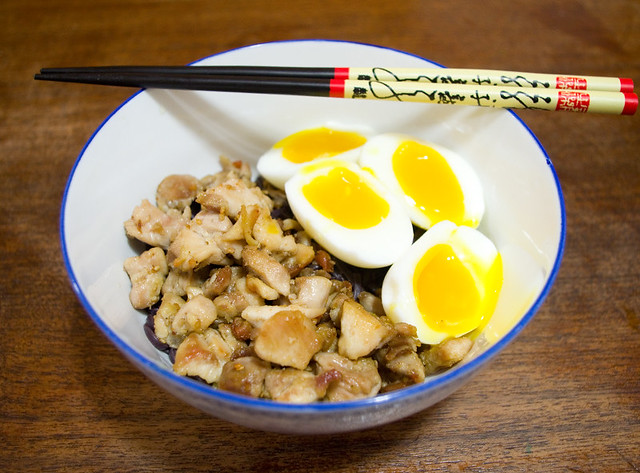
Sesame chicken with soft-boiled eggs and black rice noodles


Sesame chicken with soft-boiled eggs and black rice noodles

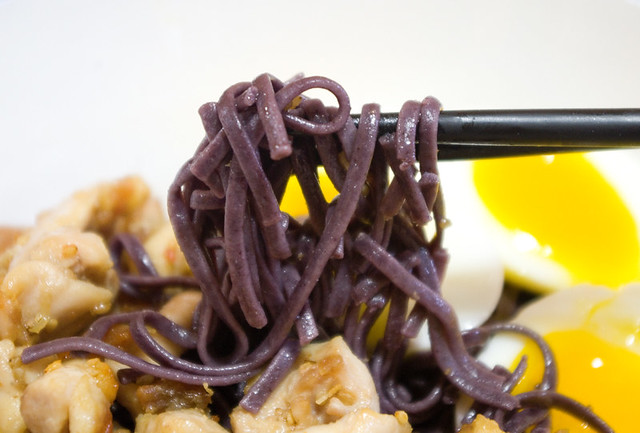
The first kind I tried was Organic Black Rice Noodles ($4.29CAD/250g). They weren’t really a true black, but actually a really dark purple, much to my (and my kids’) delight. I followed the package directions, and the noodles cooked up perfectly. They were tasty too, with a slightly nutty flavour. I served them with my take on sesame chicken — basically chopped chicken thighs fried up with a couple of diced cloves of garlic, a drizzle of sesame oil, and a generous sprinkle of toasted sesame seeds. Of course, I also included some soft-boiled eggs, which are a staple in our household.


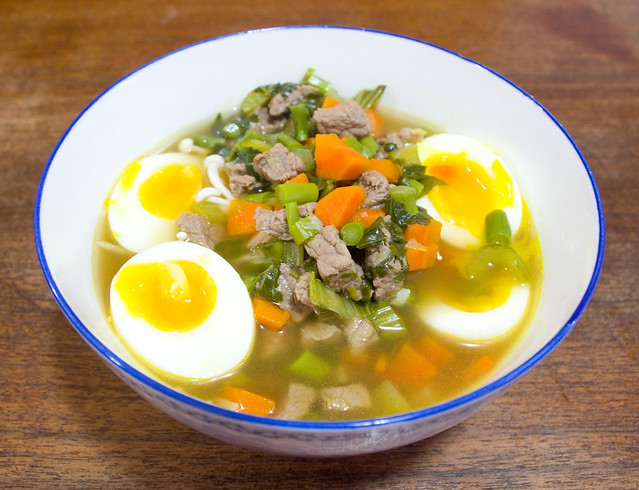
Beef and vegetable soup with soft-boiled eggs and brown rice & wakame noodles


Beef and vegetable soup with soft-boiled eggs and brown rice & wakame noodles

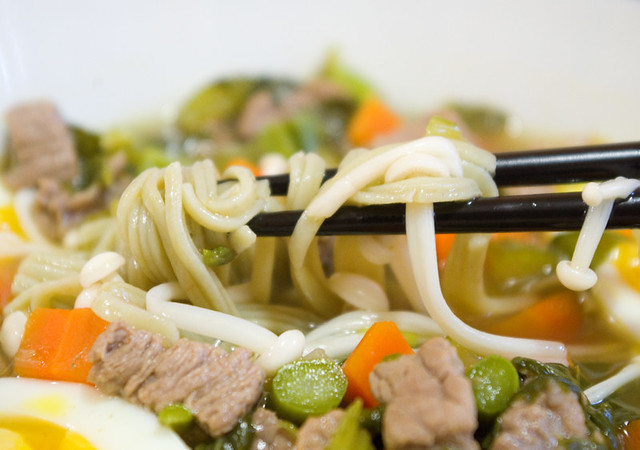
The second type I tried was Organic Brown Rice & Wakame Noodles ($3.99CAD/250g). Despite being a darker colour in the package, they cooked up to a very light green. After the fabulous colour of the black rice noodles, the intensity was slightly disappointing. However, they tasted just fine, although the subtlety of the wakame flavour was lost on me. These noodles got a thumbs-up from me and the family anyway. I served them in a beef broth soup flavoured with a dash of Memmi, with a whole bunch of chopped vegetables (carrots, asparagus, bok choy, celery, enoki mushrooms) and a bit of beef thrown in. Oh, and some more soft-boiled eggs, of course.

I think that my only complaint about both of the types of King Soba noodles that I tried was that they really, really wanted to stick together. While this didn’t affect the flavour at all, this made them very difficult to eat, especially for my children, who are not terribly adept with chopsticks yet. Should I buy them again (and I probably will), I will add a drizzle of oil to the cooking water and see if it solves the problem.

Ottawa Farmers’ Market

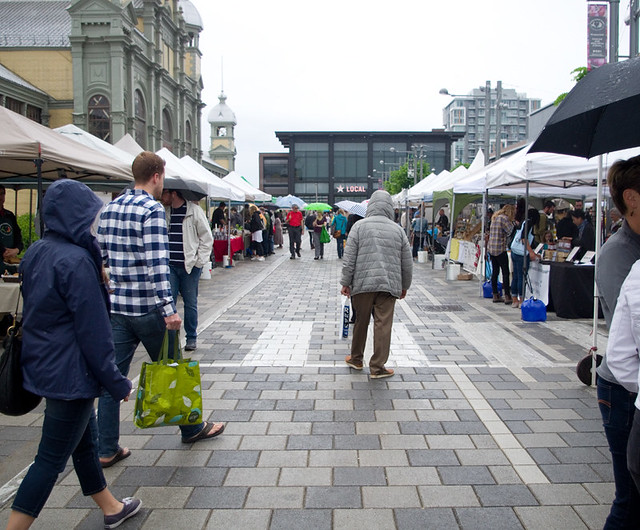
I had my first chance to check out this year’s Ottawa Farmers’ Market at Lansdowne Park this past Sunday. This being Canada (first outdoor plantings generally happen during the Victoria Day weekend at the end of May) and especially with the flooding we’ve had this spring, there wasn’t a lot of fresh produce out yet. We probably have at least a couple of weeks before garlic scapes (one of my all-time favourite ingredients) start coming into season. However, there were lots of baked goods, preserves, freshly-cooked food, and locally-grown plants. It was a rainy, chilly day, but we still had a lovely time. First came the exploring:


The Ottawa Farmers’ Market at Lansdowne Park, with the Aberdeen Pavilion (also known as the “Cattle Castle”) on the left.


Potted herbs for sale.


Maple Country Sugar Bush


Acorn Creek Garden Farm


DiversiTea


Asparagus


The Right Bite

Then of course we had to stop for lunch:


The Hot Potato Company


My baked potato wedge poutine from The Hot Potato Company


Raon Kitchen


Thing 1’s chicken bimbap from Raon Kitchen

Then of course we had to get dessert; this week it was tarts from Savoury Pursuits Fine Foods:


Savoury Pursuits Fine Foods

And then back to exploring!


Linda’s Garden

The weather is promising to be much nicer this coming weekend — actually summery weather in June, who’d’ve thunk it? Here are some of the local markets that are running this (and every) weekend until fall:

Ottawa Farmers’ Market: Orleans
Thursdays, 12:00pm – 7:00pm
Ray Friel Center, 1585 Tenth Line

Cumberland Farmers’ Market
Saturdays, 8:00am – 1:00pm
R.J. Kennedy Community Centre / Cumberland Arena, 1115 Dunning Road

Ottawa Farmers’ Market: Byron Park – Westboro
Saturdays, 9:30am – 3:00pm
Byron Park, 432-454 Richmond Road

Ottawa Farmers’ Market – Lansdowne Park
Sundays, 9:00am – 3:00pm
Aberdeen Square, Lansdowne Park, 450 Queen Elizabeth Drive

Mom’s Homemade Macaroni & Cheese Recipe

One of my daughters was having a friend over for dinner tonight, so I made up my mom’s famous homemade macaroni and cheese. This dish is pretty much a guaranteed crowd-pleaser with the under-10 set, who are often more difficult to please and are less willing to try something new. It’s exponentially better than instant pasta and powdered cheese. In my opinion, my mother makes the best macaroni and cheese in the world; it was such a favorite of mine that I requested it for my birthday dinner for at least twenty years in a row. It made me very sad when I realized that my dairy intolerance means that I’d have to give up eating mom’s mac & cheese.

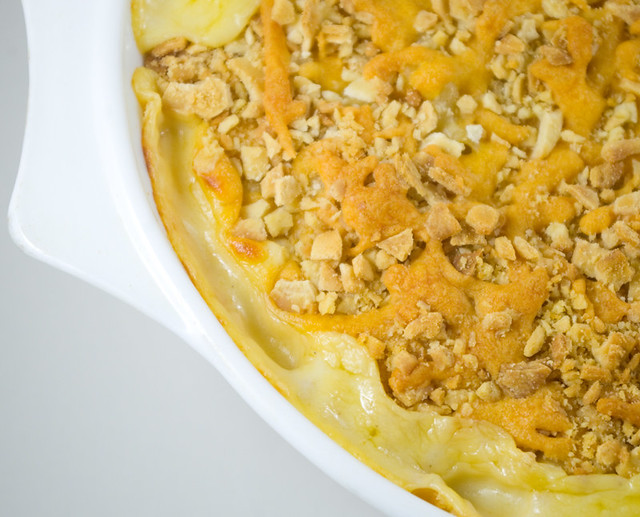
Mom’s recipe originally came from the back of a box of dried macaroni noodles, but over the years she tweaked and perfected it until it bears little resemblance to the original. This recipe makes a lovely creamy cheese sauce for the pasta and creates a crispy crunch on the top of the casserole. The crispy top is generally everyone’s favorite part and is fought over in my house.

Mom’s Homemade Macaroni and Cheese
Serves 4

According to the directions on the package, cook:
2 cups uncooked dried macaroni
Preheat oven to 350°F.
In a medium-sized saucepan or in the microwave in an oven- and microwave-safe casserole dish, melt:
3 Tbsp butter
Whisk into the butter:
3 Tbsp all-purpose white flour
1 tsp salt
1/8 tsp black pepper
Stir in:
3 cups 2% milk
Cook over medium heat, stirring regularly (with a whisk works best) until thickened to the consistency of a white sauce. Alternately, cook in the microwave, stirring every 3 minutes to remove lumps, until the desired consistency is achieved.
Add:
2 cloves of garlic, peeled and finely chopped or grated
1/2 tsp Worcestershire sauce
1/2 tsp table mustard
2 cups coarsely grated old cheddar cheese
Optionally, you may add:
(1 medium onion, finely chopped)
Stir mixture until cheese is fully melted and ingredients are evenly mixed. Add the previously-cooked macaroni and stir well. Fill a 2.5-quart (2.3L) oven-safe casserole dish with this mixture. If sauce was prepared in the microwave, simply add the noodles to the mixture already in the casserole dish.
With a rolling pin, crush:
8 salted soda crackers* (about 25g (0.9oz))
Mix crushed crackers with:
1/4 cup grated old cheddar cheese
Sprinkle this mixture evenly on top of the contents of the casserole dish.
Bake uncovered for 20-30 minutes.
Generously serves four adults.

*I prefer Premium Plus or Premium Plus Whole Wheat crackers, but there’s no reason that other kinds of crackers can’t be used. I have made this recipe so many times — and relied on whatever I had in my pantry at the time — that I have probably used everything going. The crushed crackers used in the photos were actually Original Baked Naan Crisps by Sarah’s Fine Foods.

This recipe is very flexible. Here are some variations that I have tried:

– This dish freezes very well. When preparing portions for the freezer, skip the baking step when preparing. Instead re-heat the entire casserole in the oven at 350°F (175°C), which will re-melt the cheese and crisp up the topping. Bake until cheese starts to bubble and the center of the casserole is warm, which generally takes between 30min and 1 hour, depending on how large the portions are that you have frozen. You can reheat frozen portions in the microwave, but the topping won’t get crispy.

– This dish also travels and reheats well, so it’s perfect to bring to potluck meals.

– Use a different kind of pasta. Most smaller pastas, such as penne, rotini, rigatoni, shells, or wagon wheels, work just as well as macaroni. Penne rigate is a favorite of mine and is probably used more often than macaroni in our household. Whatever you choose, you’ll need about two cups of dried pasta.


This dish, to me, is the only truly proper one for making Mom’s homemade macaroni and cheese (although in reality any appropriately-sized casserole dish works equally well). It’s just that this is what my mom used for the entirety of my childhood: a Pyrex casserole dish from the late 1970’s/early 1980’s with flowers on the side.

– Use fresh pasta instead of dried. The yield for fresh pasta is different than dried, but in the end you’ll need about five cups of cooked pasta.

– For a healthier dish, use whole-wheat pasta.

– If you’re cooking without a stove, prepare the sauce in a microwave and bake the final casserole in a toaster oven. You can even “bake” the casserole in the microwave, but the top won’t get crispy (as I learned the hard way when my oven broke when cooking dinner for my in-laws for the first time).

– Change up the cheese; use a blend of cheddar and mozzarella/Gouda/etc., or switch up the cheese entirely. Sharp cheeses work best.

– To make baby food for an older baby, use whole-wheat noodles that are made without eggs and whole-fat milk. Skip the onions and the crispy top. Run the macaroni and cheese through a blender/food mill/food processor to make it smooth, adding whole milk gradually until the desired consistency is reached. This works best while the mixture is still warm, as it does congeal when it cools. My daughters loved their macaroni and cheese baby food — and now they’re huge fans of the regular kind.