Summer Supper

Yesterday’s supper was very simple and was also completely based on what I found on sale at the grocery store over the weekend. A decent steak was on sale for less than the going rate for ground beef, so we had steak. Corn on the cob was only $0.15 per ear, so we had corn. Peaches and strawberries are in season and I had a few too many in my fridge, so I made pie for dessert.

Since I was busy making the pies indoors, my husband cooked the steaks (with a sprinkle of Montreal steak spice) and the corn (still in its husk) on the barbecue. The steak was melt-in-your-mouth tender, and the corn, while not the sweetest, was still tasty. In retrospect, the steaks were a little large. Okay, they were huge. I cut off about a third of mine to give to Thing 1, and my husband shared his with Thing 2, and we still were stuffed before we got to the corn. That’s okay, we had the corn as a night snack, along with some pie.

If you’re wondering what the brown lumps are at the end of my corn cobs, they are corn holders shaped like beavers eating corn. I thought that they were cute in the store, but they aren’t dishwasher safe so I wasn’t going to buy them. Surprisingly, it was my husband who fell in love with them and insisted that we bring them home (on my condition that he can hand-wash them if he likes them so much).

The pie was peach and strawberry with streusel topping, which was still warm and gooey from the oven when we cut into it. As usual, I used the Purity Pastry crust from page 73 of the Purity Cookbook (2001 edition), which remains my favourite. For the filling, I used the fresh fruit pie formula on page 228 of The Canadian Living Cookbook by Carol Ferguson (1987), and the streusel topping recipe on page 226. I cut the sugar back by a third, since I like the flavour of my pies to have a stronger emphasis on the the fruit flavour instead of the sweetness. To be honest, what I’d really wanted to make was plain peach streusel pie, as it is recommended in the meal planning section of the book as part of a typical Ontario country-style feast. However, I didn’t quite have enough peaches, and I did have some strawberries that needed eating, so I improvised.

Fish Sandwich & Side Salad

Dinner last night was a fresh and summery breaded cod sandwich served with a spinach and goat cheese salad. I’d love to say that this was due to a fantastic advanced planning, but it was mostly because I had picked up both the fish and the salad ingredients at 50% off because they needed to be eaten soon. Also, I’d been feeling like a fast food fish burger, but I thought I could manage something better at home.

The cod was dipped in egg, then in a combination of dried dill and panko (Japanese bread crumbs), then lightly fried in a bit of olive oil. The bread was the lightly toasted basic white bread on page 14 of The Complete Guide to Bread Machine Baking from Better Homes and Gardens (1999). For a bit of additional flavour, I spread President’s Choice tartar lightly on one half of the bread, and for crunch I added some chopped romaine lettuce. This made for a lovely light sandwich that nonetheless was quite filling.

The salad is based on one that I love to buy pre-made at the grocery store (when it’s on sale, of course), which is really easy to make at home. The base is baby spinach, which it topped with quartered strawberries, drained canned mandarin slices (the kind in pear juice, not syrup), sliced cucumbers, and blanched, sliced almonds. My favourite cheese for this salad is Woolwich Dairy Soft Unripened Goat Cheese Crumbles, which are much milder and creamier than most other goat cheeses I’ve tried. As a bonus, goat cheese doesn’t seem to upset my stomach, so yay for dairy I can actually eat!

Bread and Soup

I wasn’t feeling super-adventurous yesterday, so I stuck with a few recipes that I knew generally go well. First was a poppy seed loaf (Bread Machine: How to Prepare and Bake the Perfect Loaf (Jennie Shapter, 2002), page 138). Much to my surprise, my husband, who generally doesn’t cook much, actually is getting into this whole breadmaker thing; he whipped up this loaf a couple of times before I tried the recipe myself. This loaf is light and fluffy, but the seeds add a lovely crunch, and the crust is golden and crispy even when cooked on the “light crust” setting.

One thing we’ve learned about cooking from this book is that my bread machine (the Black & Decker All-In-One Deluxe Horizontal Breadmaker) is really a medium-sized machine according to this book, while I had thought it was a large. A medium-sized machine is defined as ones that “make loaves using 450-500g/1lb 2oz/4-4 1/2 cups of flour” (page 7, Bread Machine). Now, you see, I would have known that if I’d been paying enough attention, but for some reason I assumed my machine had a larger capacity than it does, and I directed my husband to make the largest version of the white bread recipe (page 66) for his first try at breadmaker baking. Well, while the bread was rising it expanded so much that it pushed the lid open and the dough started oozing out of the bread machine. My husband punched the dough down and cut some of it out, and that seemed to be the solution until the start of the baking cycle, when the dough pushed the lid open again once the temperature increased. At that point we were worried that the dough might continue to grow and slide down the side of the pan and onto the heating element, possibly resulting in a fire. So my husband rescued the dough and I prepped two small loaf pans, and we finished up the bread in the oven. Because the bread had started to cook a little in the breadmaker, the consistency was a little off, but it was still edible (and a darn sight better than some store-bought bread I have tried). Since this fun episode, we’ve been using the recipe for a medium-sized bread machine and we have yet to have any problems.

Yesterday I also went back to my old standby of udon noodle soup for dinner, which always uses the same technique but ends up slightly different every time. I used homemade chicken broth seasoned with a dash of soy sauce and a tiny bit of dashi granules. The toppings were soft-boiled egg, precooked shrimp, raw enoki mushrooms, steamed bok choy, steamed carrots, nori, seasoned capelin caviar, and raw chopped green onions. The rest of my family also had fish balls in their soup, but I’m not a huge fan.

Indian Coconut Curry

Last night I decided to make coconut curry again, but with a more Indian flavour. The one that I made previously was more of a Thai dish (although certainly not an authentic one), mostly because I used Blue Dragon Thai Red Curry Paste. This time I used Pataks Mild Curry Paste; the company specializes in flavours originating in India.

As is probably evident from the picture, I made a few more changes, based mostly on what was in my fridge and pantry. I replaced the carrots with mushrooms, I switched the shrimp for chopped chicken breast, and I served the dish over rice instead of with noodles. Also notably, I ran out of time to roast the vegetables in the oven (which takes about an hour), so I cooked them up in a frying pan on the stove with the chicken once it was sealed. I also needed to boil down the sauce a bit once I added the curry paste and the light coconut milk because the veggies were more steamed than anything else and hence added a lot of moisture.

So I made a tonne of changes, but the dish still turned out successfully. This all goes to show how much you can mess with this recipe and still have great results! My kids ate all the food on their plates and then came back for seconds, which is how I rate dinner success in our house. Also, they ate all of their veggies without complaining, which is a huge win. Thank you, Brothers Green Eats, for introducing me to this dish!

Ugly Bread

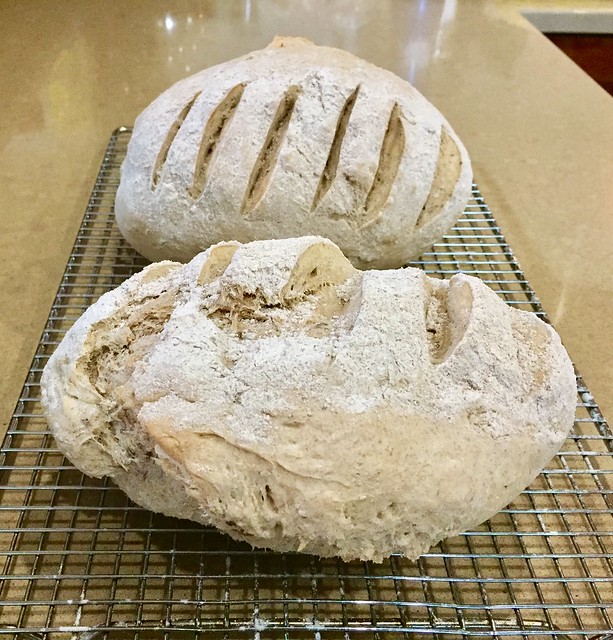
Ever have one of those days where it doesn’t seem to matter what you do, what you’re working on refuses to turn out quite right? Well, I had one of those days the other day. I made German beer Bread from page 19 of World Breads: From Pain de Campagne to Paratha (Paul Gayler, 2006), which I have made (and adored) many times before and, well…

It turned out ugly. I know I didn’t have a loaf pan to bake it in at the in-laws’ cottage, but I didn’t expect it to turn out so unappealing-looking. I mean, the marbled pesto bread turned out just fine. Maybe this kind of bread really needs a mould to keep it from going so weird. Maybe I used too much flour, or the day was too damp. I don’t know. But I have to say that this is the most unattractive bread that I’ve ever baked.

It still smelled heavenly, and it tasted great slathered in butter and served alongside smoked salmon and sautéed veggies for dinner. Looks aren’t everything, after all. If I had to choose between food that looks good or tastes good, I’d take taste any day of the week. But if I’m going to put that much effort into something, I’d also like it to look at least a little appetizing!

Cottage Bread

While at the cottage, I decided that I should make the bread that everybody would be eating. I started off with a few loaves of crusty white breadmaker bread (yes, I brought the breadmaker to the cottage, we weren’t roughing it by any means). Then I got tired of that and decided to whip up some marbled pesto bread from page 142 of Bread Machine: How to Prepare and Bake the Perfect Loaf (Jennie Shapter, 2002).

I made this bread a little while back and it was an instant hit, so I had to bake it again. This time I cut back the salt on the topping from 2 tsp to 1/2 tsp, which produced a flavour I much preferred. I also didn’t have an appropriately-sized loaf pan at the cottage, so I had to improvise and use a large roasting pan, which the loaf sat inside with room to spare, never touching the sides. This is how I ended up with a more “cottage loaf” look. It still cooked through properly and tasted great, which is what really matters.

The filling I used this time was nasturtium-leaf pesto, which isn’t quite as oily as garlic scape pesto, and has a slightly peppery kick. It was a different flavoring, but very tasty.

As a treat, I whipped up some banana chocolate chip bread while the pesto bread was rising. I just added a bag of semi-sweet chocolate chips to the banana bread cockaigne recipe from the Joy of Cooking app. I baked it in a silicone bundt pan that belongs to the cottage, and though I wasn’t terribly happy with the heat distribution in the pan, it still turned out rather tasty. The kids are it up as fast as I’d let them.

Clean-Out-the-Fridge Food

A coworker of a friend had a rhubarb plant that was trying to take over the world, so my friend was nice enough to claim the excess stalks for me and then meet up with me so I could get them. Since I knew I wasn’t going to have the chance to use up all of the rhubarb before it went bad, I washed it, chopped it, and divvied it up into portions for the freezer. However, I did set a bit of it aside so that I could make up another batch of rhubarb muffins (125 Best Quick Bread Recipes by Donna Washburn & Heather Butt (2002), page 22).

These muffins are a real hit around my house, and most of the batch of twelve was gone before the end of the day. I didn’t have any oranges or orange juice around the house (and I didn’t want to go out), so I omitted the orange zest and juice from the recipe. Instead I put 3 Tbsp lemon juice and 3 Tbsp sugar into a measuring cup, then added enough water to bring the level up to 2/3 cup. This gave me the proper amount of liquid, but with a bit of acidity and sweetness. The recipe is also for a loaf instead of muffins, but I just greased my muffin tin and filled the twelve sections with the batter, and baked it at the recommended temperature for about 25 minutes. Despite all of the changes, this recipe turned out really well!

Then it was time to make dinner. Once again, I didn’t want to hit the grocery store, so it ended up being a “use up the food in the fridge” kind of day. I thawed some chicken broth that I had made previously, chopped up some leftover chicken and peeled some carrots, then brought that all together to become chicken noodle soup. I even had a chance to use up some of my excess Canadian Eh? Shapes Pasta. I served the soup alongside tabbouleh (the Joy of Cooking (2006 edition), page 362), which was made with parsley and mint from my garden. The bread was day-old improvised white bread which has a whole story of its own behind it, but that tale will have to be told another day. All in all, I was very satisfied with this clean-out-the-fridge meal!

Bread Machine Baking

I’ve been taking the opportunity to play with my bread machine over the last little while, and not only because there have been some stinking hot days (30°C (86°F) with a humidex of 40°C (104°F) this past Sunday) where I don’t feel like baking in the oven. I’ve picked up a few more books about maximizing the potential of a breadmaker, and I think that the new knowledge I’ve gained, and the new recipes, are really making a difference in the results I’m getting.

For this bread I used the Golden Pumpkin Bread recipe on page 167 of Bread Machine: How to Prepare and Bake the Perfect Loaf by Jennie Shapter (2002), omitting the pumpkin seeds. The nearly-fluorescent orange colour was created by using the homemade pumpkin puree that I canned last fall. Some of the pumpkins that I cooked up after Halloween were white-skinned (probably Casper pumpkins), and their flesh was a more brilliant orange than the usual orange-skinned pumpkins you get around here. I also bought a variety of pumpkin that had skin that was a deep reddish orange, with a very intensely-orange flesh. The resulting bread was lovely and moist while still being light, with a slight tang of pumpkin that goes well with hearty dishes like casseroles and soups.

This loaf, although it doesn’t look spectacularly interesting, but it had a lovely, subtly-sweet flavour. It was based on the Apple Butter Bread recipe found on page 172 of The Complete Guide to Bread Machine Baking from Better Homes and Gardens (1999). To take advantage of my recent batch of strawberry-rhubarb butter (which I will share the recipe for soon), I used that instead of apple butter, and omitted the apple pie spice/allspice. This bread isn’t as moist as the pumpkin bread, but is more moist than your average white or brown bread. As per the cookbook’s suggestion, I have tried it with honey for breakfast, which was absolutely divine. I haven’t tried it as part of a grilled cheese sandwich with cheddar cheese due to my issues with dairy, but I predict that the flavour combination would be amazing.

Last but not least, my favourite bread machine experiment so far has been Marbled Pesto Bread from page 142 of Bread Machine: How to Prepare and Bake the Perfect Loaf. For this bread I used the Roadapple Ranch garlic scape pesto that I wrote about previously. The bread recipe required using the machine’s dough cycle, which means that the bread is then baked in the oven. It’s the economical version of using a stand mixer for bread dough, really, except that it also proofs the dough. The dough is rolled up kind of like a jelly roll, but with pesto instead of jelly. The final results were delicious! My husband has not stopped raving about this bread since I made it — and I’m pretty sure he ate most of the loaf. We didn’t serve this bread with anything; it was perfectly good all on its own, even without butter. I’m definitely making this one again once the days cool down a bit so I don’t roast myself by using the oven.

Breadmaker

Yesterday was a hot one, and today is predicted to be much akin to it, with the addition of thunderstorms. That’s par for the course in the summer in Ottawa: first we get a stiflingly hot, humid day, followed by an impressive deluge and light show, often in the evening of the same day.

Of course, I had run out of bread, but I didn’t want to fire up the oven on such a hot day. I would like to continue making my own throughout the summer, so I dug out my breadmaker, which I’d never used before. Over the winter I purchased a Black & Decker All-In-One Deluxe Horizontal Breadmaker at Value Village for $9.99. There were (and always are) a few on the shelf, so I picked the one that showed the least wear and tear. I also Googled to make sure I could get a user manual.


100% Whole Wheat Bread in the breadmaker.

We didn’t have air conditioning when I was growing up, and one of the best lessons that my parents taught me was to keep the house cool, cook outside whenever possible. The most obvious example of this is barbecuing or grilling, but most countertop appliances work perfectly well outdoors. Breadmakers, toaster ovens, even toasters or kettles fit the bill, and it’s especially convenient to use them if you have a deck/patio or a balcony. They’re not intended for outdoor use, so you have to be very sure that they never get wet and are set on a surface that can’t be damaged by heat, like a concrete step or a glass-top table. If you’re uncomfortable leaving them out in the open, they can be left under a parking shelter or in a garage. Also, you have to make sure that any plugs or extension cords are up to the challenge (I recommend heavy-duty appliance extension cords just in case, you don’t want to start a fire).

So I made a loaf of 100% Whole Wheat Bread (page 24 in the user manual) in the breadmaker, and it turned out deliciously! It was really easy, and although I kind of missed kneading the bread and I don’t like the inflexibility of the recipes that go along with mechanization. But the results were delicious, and I can see why people will set breadmakers on timers so they have fresh bread first thing in the morning. Since I’m used to oven loaves, the bread looked kind of misshapen to me, much too tall and thin. The looks didn’t mar the flavour at all, though. My family devoured the entire loaf in a day (granted, we had grilled cheese sandwiches for dinner). I will have to make another loaf asap.