Restaurante Sobrino de Botín

When I was in Madrid last month, one of the places I knew I had to visit was the Restaurante Sobrino de Botín (Botín’s Nephew’s Restaurant). This restaurant, which is very close to Plaza Mayor, is featured on Atlas Obscura, which is where I first learned of it. However, it’s in a lot of guidebooks and can be found on many websites because it has been recognized by Guinness World Records as the oldest restaurant in the world still in operation. A certificate in the front window from Guinness reads, “The oldest restaurant in the world is Restaurante Botín, in Calle Cuchilleros, Madrid, Spain, which opened in 1725 and has been operating ever since; it even retains the original 18th century firewood oven. It is currently run by the González family.”
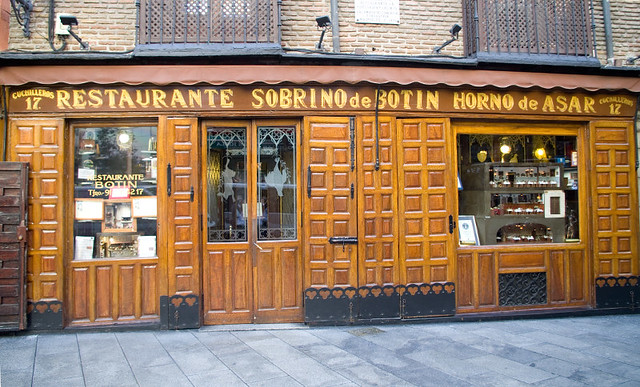
The restaurant is in what used to be an inn built in the 1500’s; it originally only took up the main floor, but now occupies all four floors. The current exterior dates back to a renovation in the 1800’s, when the large windows were added. Originally they displayed cakes and pastries, but now they showcase photos and articles on the left, and a miniature model of the interior of the restaurant on the right.

The large door to the right of the main entrance is carved with the year 1725, and it was installed at the time of the restoration that transformed the main floor into a restaurant. It would originally have been called an inn, then a tavern, under the name Casa Botín, because at first the proprietors were forbidden by law to sell the food, only to cook it for customers. Eventually the laws changed and they began to provide food as well as prepare it; the restaurant was passed down to Candido Remis, the Botín’s nephew, which is when the name changed (“sobrino” means “nephew”).

The miniatures in the window showcase all four floors, but for some reason I didn’t take a picture of the top one (which was showcased off to one side of the window).

The basement, with its vaulted brick ceilings, used to be the wine cellar.

The ground level is the original restaurant.

The second floor used to be lodgings (I believe the proprietors lived there), but has since been expanded.

On the sidewalk just out front of the building (you can see it roughly at the center bottom of the first photo) is a plaque installed by the City of Madrid. These plaques don’t stand out, but they’re out front of a lot of the city’s culturally important locations.

When my husband and I went for dinner, we were seated on the second floor. It was outside of the main tourist season and we arrived relatively early by Spanish dinner standards, around 8:00pm, so we didn’t end up needing a reservation. Even so, the restaurant was doing a very brisk business and table turnover was steady.

Given the mixed reviews that this place has received for its food (since the recognition by Guinness, a lot of people claim it’s just a tourist trap), I was quite happy with the food. The bread was fresh and tasty, with a crisp, flaky crust, and soft insides.

Since we had to be budget-conscious, we skipped appetizers and went straight for the main meal. It’s probably a good thing we did, because it was really filling! I had the suckling pig roasted in the restaurant’s original wood-fired ovens, served with boiled potatoes. It was plain but delicious, with the crackling skin being the most delectable part. The pork is a traditional regional dish and the pig itself was brought in from Segovia, where we were actually going the next day, and where I also had suckling pig. If I’d realized that these events were going to happen two days in a row I would probably have switched my dinner order in Segovia itself, but we had to decide weeks in advance what we were eating because it was a large group and a tour meal. The restaurant in Segovia was fantastic, and I’d say that the suckling pig at the two locations was comparable.

We declined dessert so that we could take a walk around the area around the main square to find ourselves a separate place for coffee and sweets. I had a lovely meal at the oldest restaurant in the world, and I can see why it has been in business for so long!

Shrove Tuesday

I meant to write this post on Wednesday about Tuesday, but unfortunately I was in a minor car accident — a fender bender, really — which, while not severe in any shape or form, did eat away at my day. (Before you ask: I seem to be fine, the car is now in the shop but likely doesn’t require any major repairs, and no it wasn’t my fault (I was rear-ended while stopped in a right-hand turning lane, waiting for a gap in traffic so I could pull out).) So now I’m writing my posts all out of order, but this post will be backdated to Tuesday, which is when I actually made the pancakes.

I’ve written about Shrove Tuesday, also known as Pancake Tuesday before, since it was a yearly tradition in my family growing up. In all of the hustle and bustle with travel (and my remaining jet lag) this year I’d almost forgotten about it, but somebody’s post on Facebook reminded me just in time. Not that pancakes for supper are limited to one day a year, mind. Some days I just feel like pancakes.

This year I went with Basic Pancakes from the Joy of Cooking (Rombauer & Becker, 2006 edition); I’m not sure what page of the hard copy book, though, since this time I used the app (super-convenient, that thing). However, I discovered too late to go to the shops that I was low on eggs and completely out of butter, so I substituted half a mashed banana for an egg and canola oil for the butter. My substitutions seemed to work just fine since these pancakes were very fluffy and mighty tasty! I topped them with a fresh fruit salad of Granny Smith apples, dragon fruit, strawberries and more bananas, along with lots of maple syrup. And, as is pretty much a constant request in this family, I served bacon on the side.

Royal Palace of Madrid

Like many tourists, one of my first stops during my visit to Spain was the Royal Palace of Madrid (“Palacio Real de Madrid” in Spanish). I actually visited twice on consecutive days, because I underestimated how long it would take to properly appreciate all of the exhibits and I wanted to give this beautiful complex the attention it deserved.

The Royal Palace is located right in the middle of the old city; buildings that are commercial on the ground floor and apartments (or sometimes hotels) above are separated only by a road and the public parks such as the Plaza de Oriente and Jardines de Sabatini. This means that you can get a good look at the palace even from outside of the gates. It’s possible to look right inside the Plaza de Armeria (the main courtyard) from the publicly-accessible area between the Catedral de la Almudena and the palace. The throne room is on the second floor right above the central doors, and looks over the courtyard and at the cathedral.

This is the statue of Charles III at the base of the grand staircase.

And this is the grand staircase from above, with a statue of Charles IV at the center. It is, quite simply, awe-inspiring in its grandeur.

On ceiling above the grand staircase (and, indeed, most of the ceilings inside the palace) is a fresco. As this is probably the biggest single room that I saw, I’d venture to guess that it’s also the largest fresco. It is by Corrado Giaquinto and depicts Religion Protected by Spain (although I have to admit I had to look that up after the fact, I was so gobsmacked by the palace that I forgot less-consequential things like artists and titles).

After this, though, I have very few photos of the palace, since there were only a few areas where photos were allowed. Suffice it to say that it is an exercise in opulence and incredible attention to detail. Also on the palace grounds is the armory, which contains fantastic examples of full plate armour (for men, children, and horses) alongside swords, crossbows, and other weapons. Most of the items on display belonged to royalty or upper nobility, so they are beautifully detailed as well. Of course I wasn’t allowed to take photos in there either.

One place that photography was allowed was an extra to the basic tour that I just had to go see: the royal kitchens. They are absolutely huge, which makes sense because they once played host to hundreds of people working at hot, sweaty, tiring jobs that eventually produced all of the food that royalty and nobility at the palace ate. Above is a selection of the kinds of copper and glass molds that were in use.

A wooden work table with the more delicate tools for preparing and decorating the foods prepared in the molds.

The station for washing vegetables.

The pastry station with its marble counter top for keeping the pastry dough cool (much as we still use marble rolling pins or rolling pins filled with cold water for the same purpose today — it keeps the lard or butter from melting, which makes the dough flaky).

Prep table in the room with the main ovens and stoves. The big rack in the background holds all of the different kinds of spits for roasting above the massive fireplace.

The stoves used wood as fuel and the smoke was vented through pipes that ran under the floor, which kept them from having to have overhead chimneys. I’m not sure how they managed to get the chimneys to draw correctly; apparently it was quite the feat of engineering. Notice the high ceilings for air flow; the kitchens were in the basement and the windows that light it and allow for air circulation are at ground level.

Here you can see another of the massive cast-iron stove/ovens, with the fireplace for spit-roasting in the background.

Back when these kitchens were in use, they were often written about by visitors who were impressed by how much work it took to feed the upper classes in the manner to which they were accustomed. They also wrote about how the kitchens ran like a well-oiled machine, or they compared it to a military operation. I personally have a hard time imagining the monumental task it must have been to make these kitchens anything but absolute chaos. My hat is off to the generations of people who worked here.

St. James Restaurante Juan Bravo

I am very happy to be able to say that I just spent ten days in Madrid, Spain! I prefer to write about trips after the fact because it’s generally not a good idea to announce to the world that your house is empty while you’re out of town. But I returned last night, jet-lagged as all get out, and now it’s time to write all about it.

Due to the jet lag I think I’m going to keep this one fairly short and sweet, and I’ll tell you a bit about the fancy group dinner that we had at Saint James Restaurante Juan Bravo. I believe that our hosts wanted us to get a chance to try some good, traditional Spanish food, which is the specialty of this restaurant. Most of us had paella, which is a slow-cooked, savoury rice dish with many variations. Above is Valencian paella, which includes chicken, rabbit, vegetables and snails.

These Norway lobsters (which are much smaller and more delicate than the American lobsters I’m familiar with from our East Coast) and prawns came on the side of a paella that also included chicken, vegetables, mussels and squid.

The crowning glory, at least for me, was the paella with Galician lobster, which is what my husband and I had. This serving was for at least four people (all of the paellas had to be ordered in portion sizes for two people or more), but I could have eaten all of that delicious lobster all by myself. The rice was also amazing, but it paled in comparison to the seafood. It was obvious to me that all of the dishes were prepared with care and pride, and the depth of flavour is where this showed the most.

This was the one and only time I tried paella in Spain, but it was absolutely delicious, so I hope that it was a good representation of the dish. It definitely makes me want to learn how to make it myself, especially since Spanish restaurants are few and far between around here. I think I’d have to keep the ingredients for homemade versions a little more simple, though; eating like kings while on vacation is definitely different than what we can afford to have every day at home. Maybe I should just keep an eye out for a sale on lobster…

Sansotei Ramen

Over time, I hope to try every ramen restaurant in Ottawa. What with ramen becoming more popular, this process has become more difficult, but I think I’ll manage! Recently I had the chance to check out the Sansotei Ramen location at 1537 Merivale Rd.

A few things you should know before I even talk about the food: they’re closed Mondays, they don’t take reservations, and they’re really popular right now due to positive reviews in the paper. The last two factors mean that even if you arrive shortly after opening for dinner, as we did, there’s going to be a wait. The line only gets longer as you progress further in to the dinner hour, with people squashed into the tiny vestibule awaiting their turn, and then a line going out the outer door and down the sidewalk. Although turnover was fairly quick (ramen is generally supposed to be a quick meal), the entrance looked like the above the entire time we were there — although to be fair, it was a Saturday.

Now to the food. I tried the tonkotsu ramen black (i.e. pork bone broth with black garlic oil) with chashu pork, which is one of my favourite dishes. It’s also one of the more complicated ones to make, so I find that it’s a pretty good test of a restaurant. I was very happy with my soup! The broth was rich without being too fatty, and bursting with flavour. The pork was melt-in-your-mouth. The noodles had just the right amount of chewiness. I have to admit that my favourite ramen place in Ottawa is still Koichi Ramen (formerly Ginza Ramen) in Chinatown, but Sansotei is definitely giving them a run for their money. I would definitely recommend this restaurant; it’s well worth the wait in line.

Quick & Easy

I needed a quick and easy dinner recently, something that didn’t take a lot of prep because it was a busy weeknight and I was already running around like a chicken with my head cut off.  So I threw some sticky rice in the instant pot, steamed some spinach in the microwave, and fried up a couple of eggs per person.

I topped the steamed spinach with a sprinkle of furikake (which is one of my favourite easy ways to liven up some dull vegetables, by the way), and it was done!  It wasn’t anything fancy, but it was healthy, fast, and cheap.  I’d estimate that it was less than $2.00 per serving — and it could have been much cheaper if I’d gone with the less pricey basmati rice instead of sticky rice.  Sticky rice is probably the most expensive kind of rice available at the grocery stores around here, although I’m sure there are other, more expensive kinds available in specialty stores.

Instant Pot Ground Beef Stroganoff

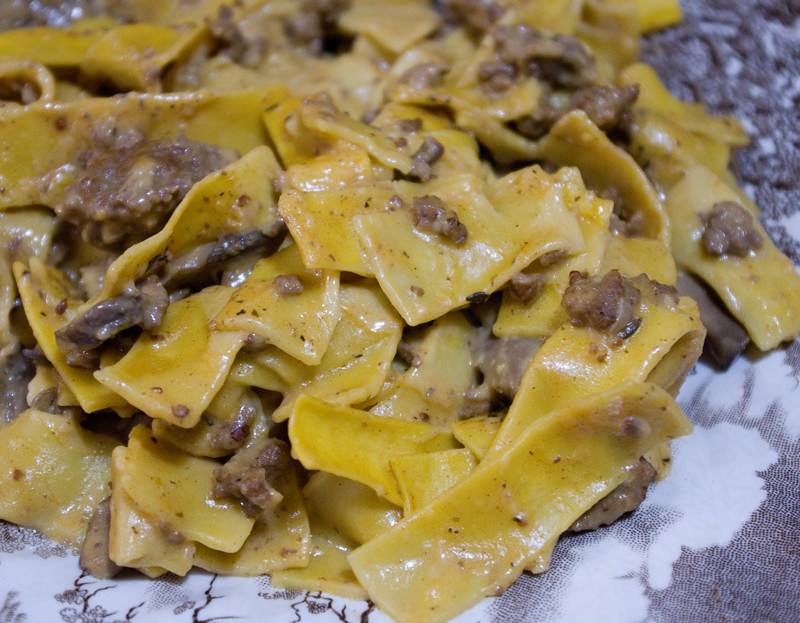
I was perusing my cookbooks the other day for a quick meal that wouldn’t require a lengthy trip to a grocery store, and I decided on Ground Beef Stroganoff from The Ultimate Instant Pot Cookbook (Coco Morante, 2018). It’s very different than the stroganoff that I was taught to make way back when (I learned so long ago that I honest can’t remember), but it was still quite nice. The only alteration was that I made the dish using lactose-free sour cream instead of regular sour cream.

I really liked that this was truly a one-pot meal; the sweating of the onions and garlic, the browning of the meat, and the cooking of the noodles are all done in the Instant Pot. This is the kind of situation where the saute function really shines. And I really liked that the short pressure cooking time was just long enough to get the prep mess cleaned up and the table set. What a great meal for a busy weeknight!

All-You-Can-Eat Sushi

One of the things that I really like about birthdays is that it usually means going out for dinner. When it’s a large group of people like it was for the dual birthdays this past weekend, that usually means a kind of place where everyone can find at least one thing that they like — which often means a buffet or all-you-can-eat kind of place. This year my friends chose 168 Sushi Buffet. We’ve eaten there for a number of other celebrations, and it’s usually pretty good food. I mean, it’s not fancy, no bones about it, but it gives everyone a chance to try a little bit of everything, and I really like that.

As a bonus, this meal gave me the chance to try out the little ring light that I had purchased during my visit to the US in the fall. Restaurant lighting is notoriously bad (it’s generally kept low for “ambience” — and often to conceal a multitude of flaws), and it’s not like you can set up a tripod in the close quarters between tables. One of my friends was nice enough to act as my light stand, though, so I think I captured a few decent pics. Above we have a group order of sashimi.

Shrimp tempura.

Rolled sushi (dragon rolls I think).

And seafood udon soup.

Every other dish went by me so quickly and was picked clean so fast that I didn’t have a chance to get pictures! I mean, it’s not like I wasn’t involved in that process or something, but I found it funny.

So, would I recommend this restaurant, and others in this style? Most definitely! Don’t go in expecting something high-end, but you will get your fill of good food. It’s also extremely popular! There was a long line from the time we arrived to the moment we left.

A Taste of Summer

Over the weekend two of my friends celebrated their birthdays together — the same two friends that I baked birthday pies for around this time last year. I asked them if they would like pies as gifts again this year, and they seemed to think that this was a marvelous idea! One of my friends even requested the same type of lemon meringue pie as last year, since it went over so well.

I don’t think the meringue was as fluffy this time, but I was much happier with the level of browning on the top — which I think can be accounted for by the oven, which we replaced in the meantime. I find that while it does have its own challenges (it runs pretty consistently 50 degrees F hot), it provides a much more even heat overall.


Photo by Karen Turnbull.

Sadly, the meringue topping got a little bit mangled in transit, but I’m assured that it still tasted fine! Once again, I used half of a crust recipe from page 73 of The All-New Purity Cook Book (Elizabeth Driver, 2001), the lemon meringue filling from page 687 of the Joy of Cooking (Rombauer & Becker, 2006 edition), and Soft Meringue Topping #1 on page 798 of the Joy of Cooking.

My other friend requested a change-up from last year with a fruit crumble instead of a pie. He really wanted rhubarb, and he was lucky that I still had some left over in the freezer from last summer’s harvest, because it’s well out of season around here. I mixed the rhubarb with some strawberries and green apples for added flavour and texture, and I did add a cup of sugar to the fruit because rhubarb is so very tart. To make this dish I used the Apple or Fruit Crisp recipe on page 392 of the Joy of Cooking. The final product kind of looked a mess, but I find that most crumbles do! I got to taste a bit of this one and I was quite happy with how it turned out as well. It was like a little bit of summer stuck smack dab in the cold and snow of February.

Valentine’s Day Baking

Yesterday was Valentine’s Day, and while we’re not terribly into big romantic gestures in our household, the kids really do love celebrating this holiday at school. Everyone ends up with a little mailbox full of Valentines, and some sweets to bring home, and often parents send in some nice snacks for the kids to munch on throughout the day. So of course I had to get the girls to help me with some baking to bring along to class.

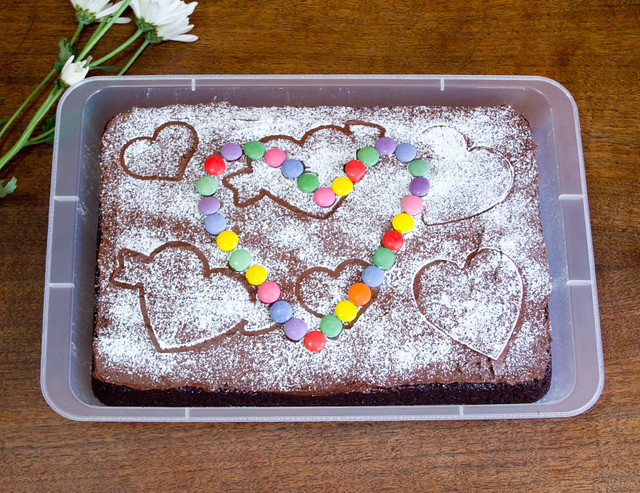
At Thing 1’s insistence, I made a chocolate sheet cake with chocolate icing for her class. Since she loved her Triforce Cake so much, I used the same recipe: Amelia Bedelia’s Sheet Cake, found at the back of the story book Amelia Bedelia Bakes Off (Herman Parish, 2010), or online via Desktop Cookbook. This time, though, I actually made buttercream icing from scratch — my very first time trying it! I used the Joy of Cooking (Rombauer & Becker, 2006 edition) recipe for Chocolate Buttercream found on page 793. Honestly, the icing was more difficult to make than the cake, but it turned out so well! I used really dark chocolate and my munchkin appreciated it. She isn’t actually a big fan of the thick layers of super-sweet icing that are commonly found on commercial cakes, and to be honest, neither am I. I decorated the icing with a dusting of icing sugar over some heart-shaped cookie cutters, and then I removed the cutters to lay down a heart made of Smarties. I know it wasn’t symmetrical, but the kiddos didn’t seem to care.

Thing 2, however, really wanted to make mini banana muffins for her class. I went back to the trusty recipe in the Joy of Cooking and we together we made the Banana Bread Cockaigne on page 628. There’s a lot of teaching that goes along with baking with a child of that age, especially since they haven’t started learning fractions yet! Even so, this recipe is very forgiving (if you read my blog regularly, you’ve probably noticed that it’s a favourite), and it turned out really well. There were only three left over after she shared them with her friends, and those were promptly snatched up by her grandparents. Not that I begrudge them, because if they didn’t eat them, I would.

I hope you all had a lovely Valentine’s Day and were spoiled with some of your own favourite treats!