Super Rapid Italian Herb Bread

I have been testing out the recipes for my breadmaker recently, because I want to move on from recipes in the instruction manual to the cookbook Canada’s Best Bread Machine Baking Recipes (Donna Washburn & Heather Butt, 1999) that I picked up for a song second-hand. I have a Black & Decker All-In-One Deluxe Horizontal Breadmaker, and I feel it needs to be put through its paces before I start experimenting. To that end, I tried out the recipe for Super-Rapid Basic White bread that can be found on page 21 of the manual.

Physically, it turned out well; it was shaped properly, and it smelled great. However, I wasn’t terribly satisfied with the texture. I found this bread to be very dense, with few pockets created by air bubbles. I think that this is because of the super rapid bake function, which makes a loaf of bread in just over an hour (the regular loaves take about four hours). It just didn’t give the bread the chance to rise and get fluffy like a longer rising period will do. I will have to make a few more of the super rapid bake recipes to see if my theory is correct.

That being said, the bread was definitely edible. It reminded me of the cheap white bread loaves that are available at the grocery store, albeit with more flavour from the herbs. It toasted up nicely and went well in sandwiches and alongside sunny-side-up eggs.

I discovered that the denseness of the bread made for particularly good French toast. It soaked in the eggs without falling apart, which made it much easier to cook up than a lighter loaf. The herbs in the bread also went surprisingly well with butter and syrup, probably because it was only lightly flavoured. I think I would make this recipe again, but only if I had an end dish in mind in which to use the bread, not to eat it on its own. I have a feeling it would also make a lovely grilled cheese.

Pumpkin Pancakes

I have a tendency to clip interesting recipes out of magazines, file them away in a recipe box, and then forget that they are there. Yet somehow recently when I thawed some homemade pumpkin puree for a pie that I didn’t end up making, I actually remembered that I had a recipe in my stash that might be useful. I thought I’d taken this recipe from an old Food & Drink, but a quick Google showed that it was actually from the October 2004 edition of Martha Stewart Living. The recipe was for Pumpkin Pancakes, and although heaven knows it probably wasn’t also available online back when it was first published, it is there now.

My pancakes weren’t Martha Stewart perfect, of course, but they did taste awfully good. They were light and fluffy and delicious, and the pumpkin and spice flavours were subtle enough that they went well with most sweet toppings. The pancakes were simple enough to make, with just a few additional ingredients added to a basic recipe. I’ll definitely be making this dish again — and perhaps with practice my pancakes will be a bit more symmetrical.

Building A Garden

As part of my commitment to growing at least some of my own food (because heaven knows I can’t grow enough food to feed a family of four on the amount of land we own), I’ve planted a vegetable garden in my back yard. It’s been a bit of an exercise in trial and error, because I never had a successful garden of any kind before. Until the last few years, I didn’t have the land — but I also didn’t have enough interest. I can’t pinpoint a particular event that changed my point of view, but I think it has been a gradual thing. That being said, my house didn’t come with a conveniently prepared garden plot, so it ended up being being both a mental and physical commitment to working outdoors.

I scoured my old photos for a picture of my old deck, but I hated it so much that it’s not in very many of them. The deck came with the house, and it was very poorly built — and then they painted it with interior paint, which of course didn’t last and led to it rotting out even quicker than it would have in the first place. However, we couldn’t afford to replace the deck right away, so we kept it as long as possible. The plan is to put in a small patio by the patio door sometime in the next year or two beside the garden, since what’s currently there is clay — otherwise known as very slippery mud when it rains.

However, after last year’s spring thaw, my husband and I started stepping through rotten boards on the old deck. That was the last straw for me, so I started taking the old deck apart. It was worse than I thought; the deck had been directly attached to the house wall and siding had been removed to do so. This meant that there was rot that had to be removed, new boards put in, and new siding put up. Also, the basement window under the deck had never been finished properly on the outside.

It was great to get all the boards out, but then I had to take out all of the concrete supports, which I could barely lift and definitely couldn’t carry. I ended up using a trolley to do the lifting and lugging. I also had to remove a huge random chunk of concrete that had been hidden under the deck. It was almost three feet long and a foot and a half wide, and weighed more than I did. That was a fun exercise of digging and lever use to get it out of the ground. Not only that, but it served no purpose that I could see, since there were no holes in the top where something had once been mounted.

Then I fixed up the wall of the house, and my husband helped me clear the sod where I wanted the garden to be. It was ridiculously difficult to get even the small amount of sod out that I needed for the size of garden I wanted. The seed had been planted directly in the local clay, and that stuff, when dry, is really, really hard.

I lugged in probably 2,000 liters of soil for the garden all by hand. Otherwise, nothing would grow in my garden except weeds. The soil is so poor out here. I also added a copious quantity of sheep manure compost.

I added a plastic border around the garden and planted it for the season.

With regular watering (last year was a dry summer), the garden grew really well.

I mean, it grew REALLY, really well. (I’m in the photo for scale.)

Then of course came the harvest, and then winter… By spring, the snow had collapsed my garden border, and the spring rains (which were pretty severe here, even where there was no flooding) started washing out my garden soil. Ambitious weeds started taking root before the planting season began.

Last week I built a cedar border around the garden to hold the soil.

Last year my root veggies were short and stubby, and started poking above the surface of the garden instead of growing down because they were thwarted by the hard clay under the garden soil. So this week I lugged in another 1,500L of garden soil to build up the garden, as well as another 350L of sheep manure fertilizer.

Then I planted the garden. It’s been rainy enough that I haven’t had to water it myself yet. I hope that we don’t get so much rain this year that it destroys crops. Although the way things are going right now, that is a distinct possibility. I have my fingers crossed.

Blossoms

Now that I live in a house with a proper yard, I’ve decided to try to grow some of my own food. I don’t think it saves me any money (especially the first few years, with all the set-up and trial and error), but I am proud of the food that I grow, and I know it’s as fresh as can be. I’ve never been one for taking care of purely ornamental plants, but I wish I’d started at least with basic herb pots years earlier — those things are very difficult to kill, and the fresh flavour is unparalleled.

One of the things I’m cultivating, since I do have the room and I do like shade, is fruit trees. Until a few days ago they were all in bloom, hopefully meaning that I’ll have a decent fruit yield this year. I know that flowers don’t mean that I’ll necessarily get any edible fruit, but without blossoms I definitely won’t get anything.


Pear tree.

The first tree to bloom was my pear tree, which I planted only three years ago — and this was the first time there were any flowers! It’s what I like to call my “mutant tree”, because it’s actually four kinds of pear grafted onto a single tree (it used to be five, but one branch died). Only two of the four main branches bloomed this year, but who knows if the maturity rate of all of the kinds of pears is the same? The rest of the branches are still alive, at any rate. I didn’t do the right kind of research before I planted this tree, because the blossoms do not smell very nice — which is apparently pretty common. Ah well, they don’t flower for very long, and it will be a number of years before there are enough blossoms to perfume the air; the tree is still shorter than me. The odor also isn’t very intense, since right now I have to stick my nose almost touching to smell anything at all.


Plum tree.

I was thrilled that my plum tree flowered as well; I only planted it early last year, and it didn’t flower then — and then Japanese beetles ate all of the leaves. I honestly didn’t think the poor tree would survive the winter. We shall see if the beetles return this year! They’re not quite in season yet. I would be happy if I never saw another one, to be honest. They are persistent pests that can decimate a garden, although the only plant they were interested in that I planted last year was my plum tree.


Apple tree.

The tree that I was least surprised to see flower this year was my apple tree. It came with the house, and it was probably planted about thirty years ago, when the neighborhood was new. I’m not entirely sure what kind of apple tree it is; the fruit is yellow-green when ripe, and ripens late into September, much later than a lot of the farmed apples around here. This indicates to me that it’s some kind of wild apple crossbreed (there are lots of those), or possibly a (or partly a) Russian Antonovka tree. It also seems to flower only every second year, and this is a boom year.


Apple tree.

This tree was very unhealthy when we first moved in. There were lots of dead branches, the apples all had apple scab… But I’ve trimmed back the dead wood, and (hopefully) taken care of the root of the apple scab. Last time this tree bloomed, it produced hundreds of pounds of fruit. It’s even healthier now, so I expect the yield will be even greater — especially if the sheer number of flowers is any indication.

Quinoa Bread Recipe

At the suggestion of a friend of mine, I bought some red quinoa a while back included a small portion in a fruit salad. Well, I discovered very quickly that I don’t like it with fruit; actually, despite all of the hype and how healthy it is, I don’t care for it much at all. Use it instead of rice! Add it to your salads! Yuck, yuck, yuck. But I still had most of a bag of quinoa to use up, and I would be darned if I was just going to compost it, so I decided that I’d try making quinoa bread. And it ended up being delicious! Not just to me, either. My kids ask for seconds and my husband, who generally loathes quinoa with the fire of a thousand dying suns, actually likes it. So even if you’re not a fan of this ancient grain, I suggest that you try this bread — and don’t write off all baked goods containing quinoa (like I almost did) until you try them.

This is a heavier bread, with a density a little closer to a banana or pumpkin bread than a traditional white or whole wheat loaf. The flip side of the heaviness — mostly caused by the water in the grains — is that this bread stays moist and tender inside for quite a long time. Even when stale, it doesn’t get hard like a crusty bread can, and can still be quite good toasted or in a grilled cheese sandwich.


This loaf was made in a 9.5″ x 5.5″ loaf pan, which is why it is so low and wide.

Quinoa Bread
Yields 3 loaves

In a large pot, bring to a boil:
500mL water
1 Tbsp canola oil
1 tsp salt
To the boiling liquid, add:
1 cup red quinoa*
Bring back to a boil. Turn heat down to low and cook for 20 to 25 minutes, uncovered. When cooked, the quinoa will become transparent and a white ring will appear in the ancient grain. Remove from heat, drain, and allow to cool.
In a large bowl, mix together:
2 1/2 cups all-purpose whole wheat flour
1 1/2 tsp salt
14g (2 packages) quick rise instant yeast
Stir in:
2 1/2 cups warm water
Once contents of bowl are mostly smooth (it doesn’t have to be perfect), add the cooked, cooled quinoa. Stir until mixed.
Gradually add:
4 cups all-purpose unbleached white flour

Depending on how much water the quinoa absorbs when cooking, slightly more or less white flour will be required. The dough should be soft and the slightest bit sticky, but should not flow like a batter.

Turn out dough onto a lightly floured surface and knead by hand for about 10 minutes, dusting kneading surface, hands, and dough lightly when necessary to prevent sticking.

Oil a large mixing bowl. Form the dough into a ball and place it in the bowl. Cover the bowl with a clean, damp tea towel. Place the bowl in a warm, dry area with no drafts. Allow the dough to rise until double, about 1 1/2 to 2 hours.

Punch down the dough. Grease three 8.5″x4.5″ loaf tins. Divide the dough into two equal-sized portions. Cover the pans with a clean, damp tea towel and allow to rise again until double, about 1 1/2 to 2 hours.

Preheat oven to 400ºF (205ºC). Bake loaves for 10 minutes. Turn heat down to 350ºF (177ºC) and bake for about 20 to 25 minutes more. Check to see if the bread is done by removing a loaf from the pan and tapping it on the bottom. When cooked through, it should make a hollow sound. Remove all loaves from the pans immediately and place them on a wire cooling rack.

Slice and serve immediately, or wrap in a clean plastic bag once loaves are cool; they will last about five days before going stale.

*Any colour quinoa may be used, but red quinoa makes the most attractive visual contrast in the loaf.

The Great Glebe Garage Sale 2017: Fabulous Finds

I found all kinds of neat things at the Great Glebe Garage Sale this past Saturday, although I did try to exercise some restraint and didn’t fill up the entire trunk. Although I did see someone walking past who had purchased a modern spinning wheel, and if I’d found it first it would totally have come home with me. Ah, well. It’s probably best for my budget.

– Miniature T.A.R.D.I.S. from Doctor Who (about the size of a Christmas ornament) with a working LED light on top, $1.00

I was actually pleasantly surprised to find a number of Doctor Who merchandise, which, since it is imported, can be pretty pricey around here.

– Small T.A.R.D.I.S. and Dalek silicone molds, which can be used for baking, chocolate or ice cubes. $2.00

– Aluminum T.A.R.D.I.S. lunch box, $5.00

– Girl Guide doll (an older version of the ones found here), $2.00. I was especially happy to come across this doll because my girls already have dolls in Sparks and Brownie uniforms, and my eldest will be starting Guides this year.

Of course, no day spent rummaging through garage sales comes without a stack of books.

The Secret Order of the Gumm Street Girls by Elise Primavera (2008), free (for Thing 1)
Candy Apple: Confessions of a Bitter Secret Santa by Lara Bergen (2008), free (for Thing 1)
The Canadian Harvest Cookbook by Jen Sayers & James Darcy (2008 edition), $0.50
The Divvies Bakery Cookbook: No Nuts, No Eggs, No Dairy, Just Delicious! by Lori Sandler (2010), free
Around the World Cookbook: More Than 50 International Recipes for Children by Abigail Johnson Dodge (2008), free
Dungeons & Dragons Monster Manual Core Rulebook III, (2000), $10.00 (for a friend who had been searching for a copy)
Monstrous Manual for Advanced Dungeons & Dragons 2nd Edition, (1993), $10.00 (for a friend who had been searching for a copy)

– Air Zone Punisher Gatling Blaster, $5.00

This was my only purchase that was too large to photograph in my light box, since the gun is almost a meter long. Please ignore the dandelions in the lawn. I didn’t test it to see if it works at the sale as it requires batteries, and I still haven’t, to be honest. I plan to use it as a costume prop, so it doesn’t really matter if it fires. I thought it might be fun to paint it up as a junior version of Sasha, the gun the Heavy uses in Team Fortress 2.

– Pentax MZ-7 35mm camera with a 28mm to 300mm zoom lens, $60.00

This was my most expensive purchase, but also the one I am happiest with. The camera itself is a side bonus; the lens works on my Pentax K-30, which is currently my main camera. My longest lens previously was 200mm, so this is a fantastic find for me.

– Kodak Brownie 8mm film camera, $10.00

This last one is the purchase I am most happy with. I have always wanted a camera like this, not to use (can you even buy 8mm film anymore?), but because I am a bit of an old home movie nut. My maternal grandfather shot his home movies on a camera like this. This camera will happily be added to my collection. I think I need to build a shelf to exhibit them all.

The Great Glebe Garage Sale 2017

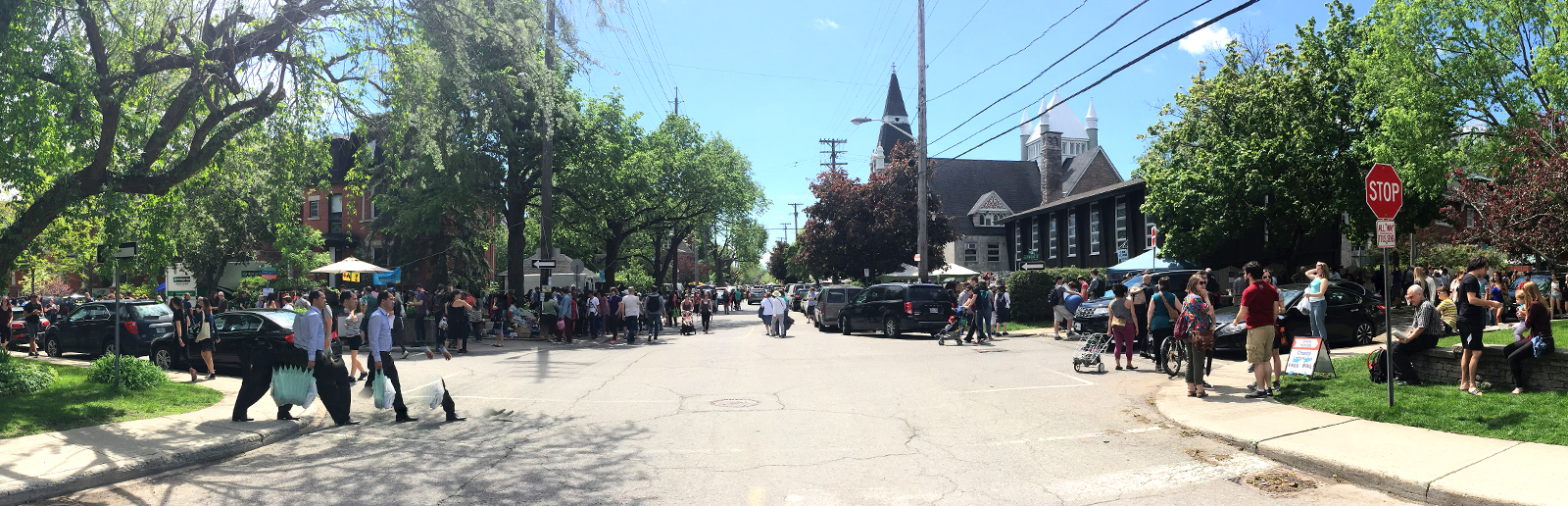
The Great Glebe Garage Sale is a Big Deal in Ottawa. A community garage sale may not seem like an exceptional event, but it is huge and densely packed with buyers and sellers alike. The roads are thronged with people, strollers, bicycles, and parked cars. Driving in the area — which is usually a fairly quiet residential area — is inadvisable; if you’re going to park in the area, plan to show up at the crack of dawn to get a spot. Even people who don’t go to garage sales as a general rule will make a day of hitting this one.


Panorama taken to give an idea of the crowds; click to enlarge. Please ignore how some people are visually chopped up, as everyone was moving and my camera objected. Taken from just north of Glebe Ave. and Lyon St. South.


I found somebody selling everything including the kitchen sink.

For those unfamiliar with the area, the Glebe is one of the older and wealthier areas of downtown Ottawa. It is bordered by the Queensway (a.k.a. the Trans-Canada Highway) to the north, the Rideau Canal to the east and south, and Bronson Avenue to the west. The residential streets are lined with huge hundred-year-old houses, and are shaded by equally-old trees.


I spotted this CCM GT-101 bicycle in a hodgepodge of bikes in front of the Glebe Collegiate. I think it would have fit right in in Stranger Things — it even still had its headlamp. Except that CCM is a Canadian company, and Stranger Things is set in Indiana, I guess.


Bargain hunters on Glebe Ave.

The Glebe Community Association schedules and runs the Sale, which has been held on the fourth Saturday in May, rain or shine, since 1986. Sellers are expected to donate a portion the day’s proceeds to the Ottawa Food Bank. The goal for this year was to raise $12,000, which is in addition to all of the other fundraising events that take advantage of the crowds. For example, every year I have attended there has been a scout troupe selling hot dogs and cold drinks in front of St. James United Church, and they do a brisk business. Some groups pool all their resources and run a larger sale from inside a community center or church, although some such fundraisers are held in volunteers’ driveways and front yards.


This was the thing that I wanted the most at the entire garage sale, but at an asking price of $175 it was much too dear for my budget, especially since I didn’t need to use it for anything, I just liked it. It’s an M-S-A Chemox Oxygen Breathing Apparatus — a rebreather (probably for firefighting), most likely from the 1950’s.


Both sides of this driveway were lined with golf bags; there were literally so many that I couldn’t get far enough away to get them all in one shot.

I have been attending the Great Glebe Garage Sale for at least fifteen years now, and my success in finding things to buy has been variable. Some years I don’t find a darned thing; other years I have to walk back to my car (usually parked outside the Glebe but within relatively easy walking distance) four or five times to drop things off because my bag(s) have become too heavy. But I find it fun to go whether or not I discover any treasures. Half of the thrill is of the hunt, but there’s also a lot of fun to be had people-watching (spotted a man carrying a live parrot on his shoulder this year), listening to music (there seems to be a busker or a DJ set up on every block), and eating (every fundraiser going is selling food on the street, alongside every style of food truck in town).


A whole pig being spit-roasted for pork sandwiches to be sold at lunch. It smelled divine.


The crowds on Third Ave.

If you’ve never been to the Great Glebe Garage Sale, and you’re in town on the fourth Saturday in May, I highly recommend that you go. Especially if you’re into anything that can be difficult to find — you might just get lucky!

Ottawa ComicCon Day 3: Pro Photos

Day 3 of Ottawa ComicCon (Sunday) I went as a femme version of the Joker from Batman. This was my easiest costume of the weekend, since I assembled the pieces instead of making them. I bought the ugly purple ladies’ suit years ago at Value Village for about $10; I’m pretty sure it was originally a mother-of-the-bride dress from the 1980’s. It was too small for me at the time, but the outfit just screamed “Joker” to me, and I hoped that one day I’d fit into it. (Now it’s actually a little bit big.) I bought the wig at Audrey’s Costume Castle and it was the last one of its kind that they had in stock, so I don’t know the make or model. The striped hose were from an American Mcgee’s Alice costume I’d done years before, and the shoes were just ones I’d had in the closet. The bow and flower were all from Michaels. I thought final look would be more Jack Nicholson’s Joker than anything else, but in the end I think I looked more like the 1960’s Cesar Romero Joker. At any rate, I don’t think anyone was confused as to who I was supposed to be.

(All photos in this post by Richard Dufault Photography, also known as Open Shutter Photography.)

Ottawa ComicCon Day 2: Pro Photos

Day 2 of Ottawa ComicCon (Saturday) I went as Death from the Terry Pratchett Discworld novels. In these novels, Death is an anthropomorphic personification that is generally regarded as a male skeleton, with glowing blue eye sockets, in black robes, who is about seven feet tall. By making a frame that sat on my shoulders, my Death was actually closer to eight feet tall, and would be even taller if someone bigger than me were to wear the costume. It only just fits under average ceilings. The belt at Death’s “waist” is actually in my armpits. It’s hard to get an idea of scale without anything in these photos to compare it to. This costume is almost more of a puppet than anything else.

(All photos in this post by Richard Dufault Photography, also known as Open Shutter Photography.)


Discworld Death loves cats.


The arms of the costume are articulated and can be manipulated from inside. The hands, however, are stuck in one position.


Death with Jiji from Kiki’s Delivery Service.


My mother as Death of Rats.

My mother went along with me and made a costume for Death of Rats, another Discworld character. This character is also known as The Grim Squeaker, and is really more of a small aspect of Death given physical form in the book Reaper Man. As per Wikipedia, “Death of Rats resembles a rodentine skeleton walking on its hind legs, wearing a black robe, and carrying a tiny scythe”.


Unfortunately the Death of Rats’ cowl kept falling down, and we didn’t notice until after the photo shoot.

Slow Cooker Clam Chowder Recipe with Dairy-Free Options

I’m taking a break today from ComicCon recap to post a recipe that a few people have asked for: my slow cooker clam chowder. I developed this recipe for two reasons: 1) I love dairy, but it doesn’t love me back, so if I want clam chowder I have to make it for myself with a dairy substitute, and 2) I had packages of frozen clams in my freezer that I’d bought on sale and I had no idea what I wanted to do with them. I Googled for ideas, and for the most part the consensus seemed to be that frozen clams are gross and tough, so don’t buy them in the first place. Well, in the past I’ve learned that simmering tough cuts of meat in liquid for a really long time can make just about anything palatable, and that technique works well with cheap frozen clams. As a bonus, all of the ingredients can be prepped the night before, and then most of them are thrown into the slow cooker as you get ready for work. This chowder really only needs attention in the last hour or so, and even then not much.

A note regarding dietary requirements: I make my clam chowder dairy-free using almond milk, and nobody can tell the difference. If you’re allergic to nuts, try soy milk or rice milk instead. If you prefer dairy, use 2% milk. Also, clam chowder can’t really be made vegetarian or vegan — all you’d be left with is potato soup (which can be good, but is no longer clam chowder). However, if you don’t eat pork, turkey bacon may be substituted, although it will change the flavour somewhat.


Slow cooker clam chowder, served here with microwave oatmeal wheat bread and corn on the cob.

Slow Cooker Clam Chowder (Dairy-Free)
Serves 8-10
Total cooking time: 8 hours

Thaw as per package directions:
2 packages of frozen clams (340g each)
In a frying pan, cook until crispy:
1 package reduced-salt bacon (375g package)
Place cooked bacon on a plate that is covered with a few pieces of paper towel; dab the bacon lightly to remove excess grease.
In the frying pan, reserve:
1 Tbsp bacon grease
Discard any additional bacon grease. In pan in which the bacon was cooked, in reserved grease, fry gently until soft and lightly browned:
2 yellow onions (approx 175g)
While onions are frying, chop into bite-sized pieces:
bacon cooked in previous steps
2 cups celery (approx 225g)
Peel and chop into bite-sized pieces:
6 cups white-fleshed potatoes (approx 1100g)
Peel and mince:
1 clove garlic
When onions are done cooking, add them and all previous ingredients to slow cooker. In addition, add:
6 bottles clam juice (236mL each)
1 tsp salt
1 tsp fresh thyme*
1/2 tsp pepper
1 Tbsp dried parsley
Cook in slow cooker for 7hrs on high, until potatoes are tender**.
In a large measuring cup or mixing bowl, whisk together:
4 cups almond OR soy OR rice OR 2% milk
4 Tbsp corn starch
Stir in the milk and corn starch into the mixture in the slow cooker. Cook until it reaches the desired thickness, about 1 additional hour.
I serve this soup immediately and freeze the leftovers; it also refrigerates well. If you are planning on serving this at a gathering, it can be prepared in advance and reheated immediately prior to serving.

*1/2 tsp dried thyme may be substituted for fresh.
**If you have an older slow cooker, you may need to adjust cooking times, as older slow cookers (pre-1980 or so) do not get as hot. If you’ve cooked it for the required time and the potatoes still aren’t tender, the recipe may be finished on the stove, being careful not to boil or scald the liquid.