Oven-Baked Oatmeal Wheat Bread Recipe

Out of sheer curiosity, back in May I tried out the recipe for Microwave Oatmeal Wheat Bread (page 128, Basic Microwaving by Barbara Methven, 1978). The loaf ended up having a heavy, hard, and, chewy without actually being crunchy. It wasn’t horrible, but I didn’t see myself ever cooking it in the microwave again.

I did promise myself that eventually I’d try to recreate this dish in the oven, and this week I finally got around to it. As I had suspected, the issue with the texture had nothing to do with the ingredients and everything to do with the cooking method. When I prepared this loaf the standard way for an oven, it was still dense — but that is to be expected when you use ingredients like whole wheat flour, oatmeal, and molasses. However, it was not chewy at all; it was lighter in the middle with a thin, crisp crust. The dark flavour of the bread went well with roast meats, deli meats, and cheeses — or just on its own with butter.

Without further ado, here’s how I made this bread in the oven:

Oven-Baked Oatmeal Wheat Bread
Yields one loaf

In a large mixing bowl, stir together:
1 cup whole wheat flour
1/2 cup rolled oats (not instant)
1 package (7g) quick-rise instant yeast
1 tsp salt
1 Tbsp sugar
Add to dry ingredients:
1 cup warm water
1/3 cup cooking molasses*
1/4 cup lard, melted
Stir wet ingredients into dry ingredients until they are evenly mixed. Gradually mix in:
1 1/2 to 2 cups all-purpose flour
After the majority of the flour is added, transfer the dough to a floured surface and start kneading. Gradually knead in the remainder of the flour. If the dough starts to become difficult to knead, stop adding flour. When flour is fully incorporated, dough should be smooth and elastic, but not sticky. If dough is sticky, add all-purpose flour 1 Tbsp at a time until stickiness abates.

Knead for an additional five minutes, until dough is smooth. Oil a large mixing bowl. Form the dough into a ball and place it in the bowl. Cover the bowl with a clean, damp tea towel. Place the bowl in a warm, dry area with no drafts. Allow the dough to rise until double, about 1 1/2 to 2 hours.

Punch down the dough. Grease a cookie sheet. Shape the dough into a ball, then flatten it into a thick, circular loaf. Put the dough on the center of the greased pan. Cover the pan with a clean, damp tea towel and allow to rise again until double, about 1 1/2 hours.

Preheat your oven to 375ºF (190ºC). Bake loaf for 15 minutes. Turn heat down to 350ºF (177ºC) and bake for about 15-20 minutes more. Check to see if the bread is done by removing it from the cookie sheet and tapping it on the bottom. When cooked through, it should make a hollow sound. Remove the bread from the pan immediately and place it on a wire cooling rack. Slice and serve immediately, or allow to cool thoroughly before wrapping in plastic to be eaten later.

*Fancy molasses may be substituted for cooking molasses, but if you do so, omit the sugar.

Shoyu Ramen

As I have said before, I am a huge fan of ramen. Not the instant stuff (although in a pinch, that stuff’s not half bad), but the fresh kind with real toppings. I fell in love with it in Japan, and I get out to Ginza Ramen whenever I can. But ever since my husband’s birthday dinner, now that I’ve learned how to make the good stuff at home, I probably eat it way more than I should. Not that my family minds, they’re just as big into it as I am.

I started off by using up the Shoyu base (page 8 of Simply Ramen by Amy Kimoto-Kahn (2016)). The recipe is also available for free on the author’s website at easypeasyjapanesey.com. I have since made a couple of batches of this broth and I still love how easy it is to make and how packed with flavour the broth turns out. If you’re like me and you like making things that you can just throw in the slow cooker for eleven hours, then you’ll love this recipe. I also like that this recipe makes up enough broth for eight or so servings, so I can freeze the excess for an easy meal later on.

As with many of my noodle soups, the toppings were less a pre-planned dish and more whatever we had in the fridge/freezer at the time. I included soft-boiled eggs, garlic shrimp, masago (capelin roe), and mussels cooked in white wine and garlic butter. The mussels were the kind that come in a vacuum-pack with the sauce and are meant to be cooked in the microwave or by dumping the whole pack in a pot of boiling water. I’m fully aware that this isn’t terribly classy, but it was delicious.

My second shoyu ramen was topped with soft-boiled eggs and garlic shrimp; these two ingredients are pretty common in the food I prepare because there are almost always eggs in the fridge and shrimp in the freezer. This time I also included baby bok choy and squares of nori (dried seaweed sheets).

I topped my third ramen with soft-boiled eggs, carrots, bok choy, and teriyaki chicken breast. I had never thought to combine teriyaki and ramen until I went to Umi Sushi Express in the food court of Rideau Center a while back, and I was pleasantly surprised when I ordered this dish. I mean, Umi Sushi is still fast food, and it’s nothing compared to the fantastic variety of ramen available in Japan, but it’s probably the best thing in the food court. Now if I can only find out what kind of hot sauce they used.

Blender Salsa

The other day I brought Thing 1 and Thing 2 out to the garden and enlisted their help to find all of the ripe tomatoes. Between us, we picked 10lbs of tomatoes, which seems like a lot for the size of garden that I have, but in the end that only yielded…

…Five 500mL jars of canned salsa, with a bit left over for immediate consumption. It’s always a bit disappointing to see how much ingredients can shrink down when you cook them, especially when you grew said ingredients yourself. However, this time I was much happier with the taste of the end result than I was with my last batch. This time I used the Blender Salsa recipe found on page 92 of Preserving by the Pint: Quick Seasonal Canning for Small Spaces (Marisa McClellan, 2014). Like most salsas, this preserve is both vegan and vegetarian. It’s a really easy recipe, which appeals to me. I liked that it used lime juice and citric acid to increase the acidity, instead of using vinegar. I also liked that the recipe was free of added sugar, which is healthier anyway, but sugar’s unnecessary for flavour when cooking with cherry tomatoes. I did have to boil down the salsa a bit to obtain the desired consistency, but I’m beginning to think that that’s just a consequence of using predominantly cherry tomatoes. I will definitely be using this recipe again.

First Day of School

The first day of school for the public school board in Ontario is always the day after Labour Day, which this year ends up being today. My girls are back to school, and although part of me is sighing in relief that they’ll be in someone else’s care for a couple of hours every day, I know the house will also seem echoingly empty without them around. I think I’ll learn to live with it, though.


Thing 1 and Thing 2’s lunches for the first day of school.

School-provided lunches really aren’t a thing around here; heck, the school doesn’t even have a cafeteria. Everyone brown bags it, although some kids do get a special lunch delivered by the “Lunch Lady” once or twice a week, which has never really seemed like value for money to me. Most of the year my girls pack their own lunches the night before, and they have almost since they started to go to school. I tried to pack Thing 1’s lunches for her starting in Junior Kindergarten, but too often more than half of the food came back home – although her teachers reported that she was complaining of hunger. Once Thing 1 made her own lunch, a lot less of the food came back home, and the complaints became rare. I had to help her out a lot at first, but by the time Thing 2 started school, she wanted to make her own lunch to be just like Thing 1. I’m not saying that it’s not a struggle sometimes. What should be a short and simple process can take ages when the kids do it themselves. Sometimes they are more interested in doing just about anything else and getting them to make their lunches can be a seemingly endless argument. But in the end, I think that the independence is important, and that it’s a good thing that my children learn basic food handling and prep early on. My husband and I are always nearby to make sure that they make healthy choices — and to ensure that they don’t accidentally bring anything with tree nuts or peanuts to school.


Thing 2’s lunch.

However, on the first day of school, for a special treat, I like to pack their lunches for them. I made up some fresh whole wheat bread using the Nan’s Pan Rolls recipe, and I also threw together some Blueberry Bran Muffins. The bread I used to make Hungarian salami sandwiches with mayonnaise (even though I prefer mustard myself). Each girl also got Goldfish, strawberries, vanilla yogurt, and string cheese. I packed Thing 2 a container of sliced English cucumber, while Thing 1 prefers an apple.

Am I the only one who finds those “school lunches in other countries” videos and articles interesting? I don’t know if you could consider this to be a typical Canadian lunch, though. I remember being very interested in my classmates’ lunches when I went to school because they were all so different. Some of them contained Wonder Bread sandwiches with peanut butter and jam or bologna and mayonnaise; others ate crusty French bread, sharp cheese, and cherry tomatoes; others always contained a thermos of soup and a travel package of crackers; others had warm dishes of rice and curry and spice. Some kids ate the same thing religiously, others had an entirely different daily menu. I think our household was somewhat between those extremes, with recurring favourites alongside seasonal and leftover dinner fare.


Thing 1 and Thing 2’s school bags, packed and ready to go.

At any rate, my kids’ lunches and supplies were ready the night before. New-ish outdoor shoes were set by the front door, brand new sneakers were in their backpacks, packages of markers and pencil crayons and duotangs and paper filled up the rest of their bags. Their lunches and water bottles were in the fridge, waiting to be grabbed on the way to the door. Hopefully all of this preparation will set a positive tone for the rest of the year. Will they like their new teachers? Will they get along with their classmates? Will they enjoy the new challenges that their schooling puts in front of them? Who knows? There’s really nothing I can do to influence most of that. But lunch, though, lunch I can do. And no matter how the first day turns out, it always goes better on a full stomach.

Healthy Veggie Tomato Sauce Recipe

Back in February I made a massive batch of Kerryann’s hidden vegetable pasta sauce, most of which I stuck in the freezer and thawed periodically to make spaghetti, lasagna, and pizza. We ran out near the start of the summer, at which point I decided to try to perfect my own tomato sauce recipe.

Don’t get me wrong, I adored the flavour of Kerryann’s, but I never got over the weird brownish-green that my attempts at the recipe ended up. I think that my previous suspicious were correct and that’s just because the proportions of fruits and vegetables are different here in Canada than they are in Britain, from whence the recipe originates.


Right now my little garden is yielding about 6lbs of tomatoes (mostly cherry tomatoes) every four or five days, so I need to keep up with the harvest.

For example, Kerryann’s recipe calls for eggplants (or rather, aubergines), among other ingredients. In my local grocery store, which does not specialize in particular kinds of produce, I was able to find four kinds of eggplant, all of which are extremely different sizes. So what is considered a “medium aubergine” in Britain? The video helps narrow the criteria down a bit, but I think that the produce here is just bigger. (I know that our leeks are freaking enormous.) Canada is a country that is very driven by agriculture, after all.


Top left — Indian eggplant (max 3″ long); top right — Thai eggplant (max 2″ long); bottom left — Chinese eggplant (about 12″ long); bottom right — American/globe eggplant (14″+ long, very wide at one end)

There were some other problems with importing this recipe. I’ve never found tomato puree in tubes here, although canned tomato paste is commonplace. I’m not sure if substituting the latter for the former would effect the colour or flavour, as I can’t get my hands on the kind in tubes to compare. I also had a hard time finding sieved tomatoes (passata), although it’s possible to find cans with tomatoes that have been crushed, small cut, diced, diced with herbs, left whole, stewed, or preserved without added salt.

So I’ve made my own tomato sauce recipe with added vegetables. I’ve measured everything out by weight, which should mean that this recipe will come out more or less the same no matter how big your local vegetables grow. I’ve left out the leeks and the celery, as well as peeled the eggplant and the zucchini, which should correct the colour of the sauce. Last but not least, I run my sauce through a blender after it is all cooked so that it is all the same consistency, which is perfect for sneaking veggies into the diets of picky eaters (a lot of people have problems with textures more than they do with flavours).


Tomato sauce simmering on the stove.

Healthy Veggie Tomato Sauce
Yields about 5Kg (11lbs), or about 22 cups sauce

In deep, heavy-bottomed skillet or frying pan, preheat:
4 Tbsp olive oil
Add to pan:
225g yellow onion, diced
8 cloves garlic, chopped fine
Cook on medium heat until onions have started to turn clear. Do not brown.
Add to the pan:
550g cremini mushrooms, sliced
400g zucchini*, peeled & chopped
400g globe eggplant, peeled & chopped
400g orange carrots, peeled & diced
Cover and cook on medium heat until carrots are softened. Stir often to avoid browning.
While this mixture is cooking, prepare tomatoes. If using cherry tomatoes, cut each one in half. If using larger tomatoes, remove the piths and quarter them.
Pour cooked mixture into a deep pot, such as a stock pot. A heavy-bottomed pot is best, but if one isn’t available, any large pot will do. If a thinner-bottomed pot is used, it will have to be stirred more frequently to prevent sticking & scorching.
To the pot, add:
1L low-sodium chicken or vegetable broth
2.75Kg fresh tomatoes, cut as per above instructions
2 cans tomato paste, 156mL each
8 Tbsp fresh oregano (or 2 Tbsp dried oregano)
3 tsp salt
1 tsp ground bay leaves
2 Tbsp sugar
Slowly bring mixture up to a boil, then turn the burner down until it is just simmering. Stir frequently to prevent scorching. Sauce is cooked once all of the ingredients are soft, the last of which should be the tomato skins.
Turn off the heat under the pot. Carefully ladle the hot sauce mixture into a blender to at most 3/4 full, put the lid on the blender, put a towel over the lid, and blend until smooth. Be careful, as the mixture is very hot! Pour the blended sauce into a large bowl or pot, then repeat until all of the sauce is blended.
At this point the sauce may be completely done, or it may be a little bit too liquid, depending on the juiciness of the tomatoes used. If the sauce is watery, return it to the deep pot and simmer gently until it has reached the preferred consistency, stirring often.

*Yellow zucchini is preferred to contribute to the colour of the sauce, but green zucchini will taste the same if that is what’s available.


Tomato sauce with ground beef over penne.

Healthy veggie tomato sauce can be served as-is over pasta; spaghetti is most commonly used, although in our house we prefer penne. If you use vegetable broth instead of chicken broth when you make the sauce, this results in a vegetarian/vegan dish. However, I like to freeze it in dinner-sized portions, then thaw it while I fry up and drain a 500g package of lean ground beef, turkey, meatballs, or sausage. I stir the sauce in with the meat and simmer together while the pasta boils for an easy weeknight dinner. This tomato sauce is also great for making homemade lasagna, pizza, or Sloppy Joes.


Tomato sauce with ground beef over penne, sprinkled with Parmesan cheese.

Mom’s Potato Salad Recipe

Back when I started writing this blog, I set a personal goal to record the recipes that I had grown up with. I didn’t want my descendants to encounter the same issues that I’d had when my grandmother passed away and took her knowledge of family favourites with her.


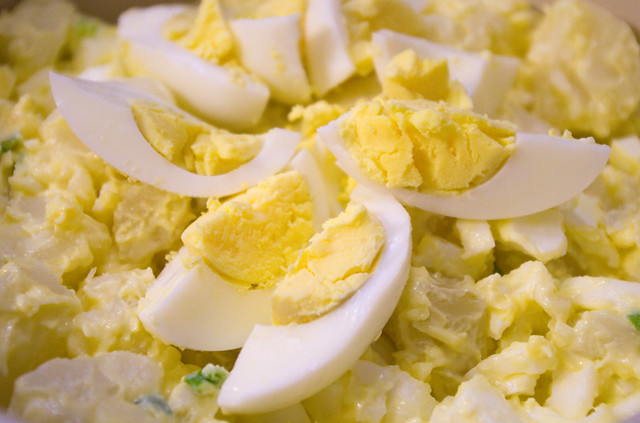
Mom’s basic potato salad.

To this end, I asked my mother the other day for her potato salad recipe so that I could post in online (it’s one of my favourite summer dishes). Much to my dismay, she explained to me that she had no real recipe and added ingredients until it “looked right”. After telling me this, she laughed a bit, because she used to get frustrated with my Nan and her approach of “a little bit of this, a touch of that” dishes that were downright impossible for her to recreate.


Mom’s basic potato salad.

So Mom and I set aside some time at the cottage this summer to measure all her ingredients and record everything that she did to make her potato salad. This one of her most often-requested potluck or barbecue dinner dishes, and indeed, it got rave reviews when I made her recipe for the most recent potluck. As a bonus, it is both simple and a great make-ahead dish. Actually, it’s easier to prepare the ingredients a day ahead, then combine them into the final dish on the day it will be served. It takes the pressure off of hosting when you know that at least one dish is ready and waiting in the fridge.


Mom’s potato salad made fancier by leaving the potato skins on and including bacon bits.

Mom’s Potato Salad
Makes about 7 cups of salad

You will need:
6 cups potatoes (any variety) cut into bite-sized pieces
This recipe works well with both older and new potatoes. With older potatoes, peel before cutting. With new, thin-skinned potatoes, wash them and leave the skins on before cutting.
Place the potatoes into a large pot and cover with water. Boil potatoes until they are soft enough to be pierced by a fork, but not yet mushy. Drain and refrigerate in a covered container until cool (this can be done overnight).
While the potatoes are cooking, hard-boil:
6 large or extra-large eggs
Place eggs into cold water until they are cool to the touch. If assembling the salad the next day, the eggs can be left in their shells in the fridge overnight.
Place the cooled potatoes into a large mixing bowl. Peel the eggs. Cut up 4 of the 6 eggs into bite-sized pieces (usually eighths or smaller), setting the two most aesthetically pleasing eggs aside as topping.
To the potatoes and eggs add:
1 cup mayonnaise*
1 tsp table salt
1 tsp yellow mustard
3 Tbsp finely chopped green onion or chives
Optionally, you may add:
(375g package of low-salt bacon, cooked and chopped into bits)**
Mix well until all ingredients are evenly coated.
Scoop the salad into a serving dish, or simply serve in the mixing bowl for informal gatherings. Optionally, you may lightly sprinkle over the salad for looks:
(a dash of paprika)
Cut into quarters the 2 eggs you set aside. Arrange the eggs at the center of the salad in a sunburst pattern.
Serve.
This recipe may easily be multiplied in order to serve a larger number of people.


Mom’s fancy potato salad.

*Regular, olive oil, reduced-fat, or reduced-fat olive oil mayonnaise are all acceptable. However, do NOT use salad dressing or Miracle Whip, the flavour is all wrong in this dish.

**If you add reduced-salt bacon, halve the amount of salt in the recipe. I prefer the reduced-salt kind, but if you have to use regular bacon, don’t add any salt at all.

Potluck Dinner

Last night I attended a potluck dinner held in honour of a members of my husband’s extended family visiting all the way from Germany. For the occasion, my in-laws rented the party room in their friends’ posh apartment building, which was the fanciest location in which I have ever attended a potluck. However, the view of the Rideau River and Rivierain Park were gorgeous coming up onto sunset. (I’m assuming the views of downtown at sunrise would be equally spectacular, but at by evening the sun was too much in our eyes to appreciate it.)

Given that the guests of honour were international, I went all out and cooked up a storm of dishes to bring along. I wanted them to get a taste of the favourite Canadian dishes that I grew up with.

On the far left is the fancy version of my mother’s potato salad (recipe here). At the center is maple pecan butter tarts, using the recipe found on page 234 of The Canadian Living Cookbook (Carol Ferguson, 1987). Despite these being one of my absolute favourite desserts ever, this was my first time ever baking them. I think they turned out rather well, although the filling did overflow the crust a little bit. Lastly, I made up a batch of my Nan’s Pan Rolls.

I always worry that my cooking won’t hit the right note with the guests at a party, but this time every last bit of food I brought was consumed. I actually should have made a double batch of the potato salad, because a number of people came back for seconds and were audibly disappointed when there was none left. I got quite a few compliments on the rolls and tarts, too, but I think the potato salad was the biggest hit. The German grandmother hunted me down and made sure to make it clear, in her few words of English and copious hand gestures, that she absolutely loved it. I couldn’t be more pleased.

Blueberry Bran Muffins Recipe

Recently I came across a copy of The United Churches in Canada: Let’s Break Bread Together — the September 1988 version, though, not the current one. I love cookbooks that are comprised of favourite recipes contributed by members of the organization. I mean, where else can you find quality recipes like this one:

Jokes aside, I have learned how to make some really great dishes from books like these. I have also contributed to a few; off the top of my head I know some of my recipes have ended up in books published by my high school, the local chapter of the Girl Guides of Canada, and my kids’ preschool. Not only are these cookbooks great fundraisers, they’re also a nice way to bring the community together by introducing neighbours to the flavours and dishes that are important to them.

All that being said, these cookbooks are not written — and as importantly, are not edited by — professionals. These days it’s not as bad, what with spell check and the ability to digitally track changes when a document is being sent around for review. But you have to be very, very careful to fully read a recipe from start to finish with pre-2000 cookbooks. Well, I mean, you should probably do that anyway with any recipe, but at least in professional cookbooks they’ll generally include all of the ingredients in the ingredient list, and a general expectation of yield, and have fairly clear instructions.

I’ll use the blueberry bran muffins recipe on page 86 of Let’s Break Bread Together as an example. It specified All-Bran Cereal — but what kind? Right now, in Canada, there’s All-Bran Flakes, All-Bran Buds, All-Bran Multigrain Crunch, and All-Bran Granola. Now, I understand that in some cases with older recipes, there was only one variety of an ingredient even though now the company may have branched out. In this case, though, a quick search of the Internet reveals that in the mid-’80’s there was the equivalent of Flakes and Buds, so it should have been specified.

Also, the blueberries in the muffins, which were so clearly stated in the title, were not in the ingredient list. Instead, the kind and quantity of berry were buried in the baking instructions. As you can see from the recipe above, the formatting of this books is such that the ingredients are supposed to be in bold and indented from the rest of the text; they are most often found at the start of the recipe as well. It can be really confusing when ingredients are not where you expect them to be.

Now, please don’t think I’m angry about all this. I’m really not. This book was put together by volunteers (in this case, the United Church in Meadowood, Winnipeg, Manitoba) in their free time before the general use of the home computer. However, what it does for me is it makes me aware of how important precise instructions are to the ease of success of a recipe. It definitely makes me want to give another go-over of the recipes I’ve written, that’s for sure. And if anyone else uses one of my recipes and notices something that should be changed, please let me know so I can fix it!

Here is my version of the blueberry bran muffins recipe, updated for accuracy and to make it a little bit healthier. I have tried out the changes and it resulted in the delectable muffins seen pictured above.

Blueberry Bran Muffins
Makes 16 muffins

In a large mixing bowl, beat:
2 large eggs
Mix in:
1 cup 2% milk*
1/2 cup unsweetened applesauce
1 cup All-Bran Buds
Let stand 15 minutes for Buds to hydrate.
Preheat oven to 400°F (175°C).
In a separate mixing bowl, combine:
2 cups all-purpose white flour
1 cup white sugar
4 tsp baking powder
1 tsp salt
Add dry ingredients to wet ingredients, stirring until blended.
Fold into batter:
2 cups fresh blueberries**
Spoon batter into greased muffin tins 3/4 full. Bake 15-18 minutes, until done. You will be able to tell that the muffins are done when the tops turn golden-brown and a toothpick or wooden skewer inserted at the center point comes out clean.
Cool the muffins for 5 minutes in the pan, until the tops are just cool enough to touch. Gently, with your fingertips, spin each muffin a quarter turn in the pan. This will dislodge the muffin from the pan and help keep it from sticking. Remove the muffins from the pan and finish cooling them on a wire rack. Once cool, they may be stored in a container for about five days. However, they are best eaten as fresh as possible.

*Alternately, a milk substitute such as almond milk or soy milk may be used. If you do so, reduce the volume of milk substitute by 1 Tbsp, and add 1 Tbsp light vegetable oil such as sunflower or canola.
**Alternately, you may use frozen blueberries. However, before using they should be thawed and the excess liquid drained.

Birthday Dinner

Yesterday was my husband’s birthday, and the tradition at our house is that you get to eat whatever you want (within reason) on your birthday. This often involves going out to a restaurant, but this year my husband asked me to make his dinner instead. His choice of dinner necessitated a special trip to T&T Supermarket for ingredients, which was, as usual, an event in itself. Every time we go, we have a meal in the cafeteria, and then the kids have to check out all of the samples and go watch the live fish and seafood in their tanks. We also have to peruse the produce and packaged goods sections for food we’ve never tried before, and for ingredients for new recipes we’d like to try. There is no such thing as a quick trip to T&T with my family.

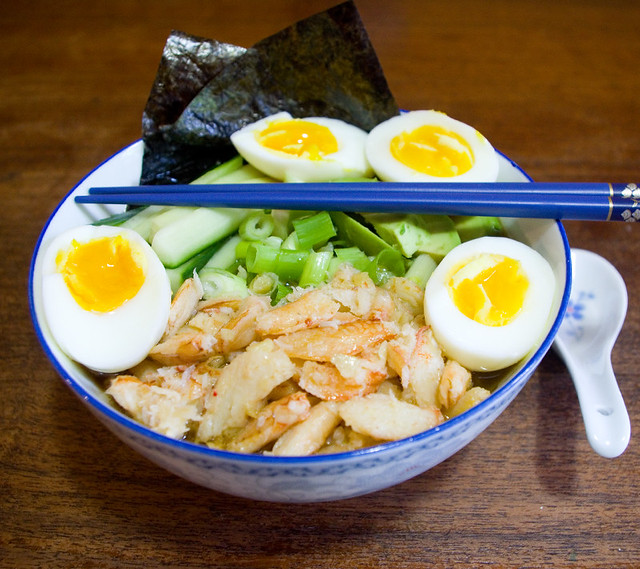
The main meal that my husband requested was California Ramen from page 86 of Simply Ramen (Amy Kimoto-Khan of easypeasyjapanesey.com, 2016). My copy of the book was actually a birthday gift to me from my husband a few months back, and I feel this may have been a not-so-subtle hint on his part. This dish is based California roll sushi, with toppings of avocado, cucumber, and crab. The recipe recommends fresh Dungeness crab, but I had never cooked live crab before, and I have to admit that I chickened out and used frozen crab instead. I distributed one package of frozen crab meat out around our family of four, but I admit that I probably could have used half as much crab and been just as happy. I also ended up using soft-boiled eggs instead of the marinated half-cooked eggs recommended, mostly because I misread the directions and didn’t realize they had to start marinading two days before the dish was to be made. Whoops.

The standout flavour of this dish, though, was the shoyu base broth. I’d never made it before, but it was both delicious and very simple. It packed a huge amount of flavour and tasty aroma into what I would have thought is just another slow-cooker broth. The recipe calls for dashi granules and soy sauce (both of which are high in sodium) and salt, but I had to take into account my family’s tastes. I left the salt out, and I am glad I did. The broth was just fine without it. In addition to the broth, I ended up with a lovely cooked chicken and melt-in-your-mouth oxtail (both of which are supposed to be discarded after being strained out of the base), so that’s two meals in one, really. All in all, it was a 10/10 recipe, and I will definitely make it again after I use up the leftovers that I froze! Now I want to try all of the bases in this book, especially the tonkotsu — my absolute favourite when I go to a ramen restaurant.

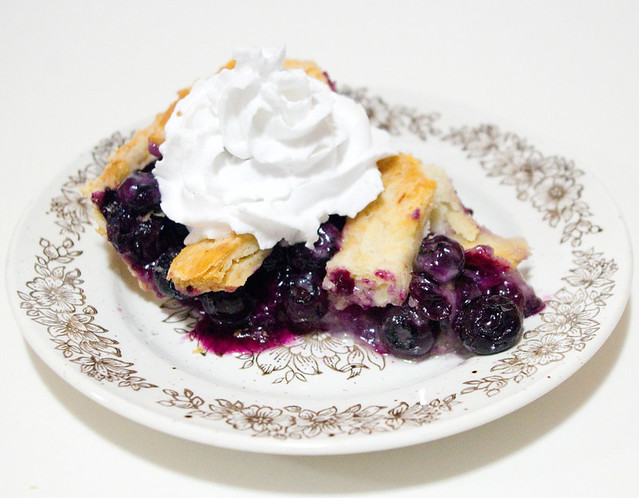
Of course, no birthday in our house is complete without dessert, and as my husband is not a big fan of sweet dishes, I made him up a fresh reduced-sugar blueberry pie. I cut down the sugar from the recipe by a third, but the blueberries were so sweet by themselves that I could probably have reduced it by a half or more. Once again, I used the Purity Pastry crust from page 73 of the Purity Cookbook (2001 edition), and the fresh fruit pie filling formula on page 228 of The Canadian Living Cookbook by Carol Ferguson (1987). I made a latticework crust, which turned out pretty well considering that a) it was only my second time making one, and b) Thing 2 somehow managed to step on the edge of uncooked pie while I was showing it to her, and I had to totally reassemble it. If you’re pondering the logistics of that, be aware that there was a stool involved so she could see what I was working on at the counter, and that the pie’s innards all fell out onto a clean baking sheet.

As many of my pies do, the blueberry one did not stand up well to a serving knife… It kind of crumbled and fell apart. I figure that’s not so bad because that means that the crust is nice and flaky. And yes, I did keep thinking of The Frantics’ A Piece of Pie while I was making this dessert. “Great big blueberries!”

Campfire

The formula for a perfect night at the cottage is as follows:

One small campfire, plus:

Jumbo sparklers lit in the campfire, plus:

Perfectly toasted marshmallows on green sticks, plus:

S’mores!

(For those not in the know, that’s a toasted marshmallow and a square of chocolate sandwiched between graham crackers, called “s’mores” because you always want “some more”.)