Canning Pears

A while back, a friend of mine brought me a box of cooking pears from his neighbour’s tree, which was producing an overabundance. Not too long after that, he brought me a second box full. I’m told that these boxes of fruit kept appearing in front of his house under not-so-mysterious circumstances; apparently that neighbour was getting really tired of being beaned in the head by falling fruit. This week I finally had the chance to tackle this mass of pears. I’ve been cooking with them for over a month, but my rate of attrition was much too slow, and some of the fruit was starting to turn.

First I made a double batch of Cinnamon-Scented Parsnip Pear Jam, from page 407 of Preserving: The Canning and Freezing Guide for All Seasons by Pat Crocker (2011). As interesting as this combination appeared at first glance, I found the final result much too sweet; it uses twice as much sugar as fruit by volume, which is a very high ratio even by jam standards. It would still be nice on Dad’s Biscuits, fresh bread, or toast, but I guess I was hoping for more of a flavour punch given my success with this book’s carrot jam. However, I do agree with the book’s assessment that this jam, when mixed with a bit of orange juice, would probably make a lovely glaze in which roasted root veggies could be tossed.
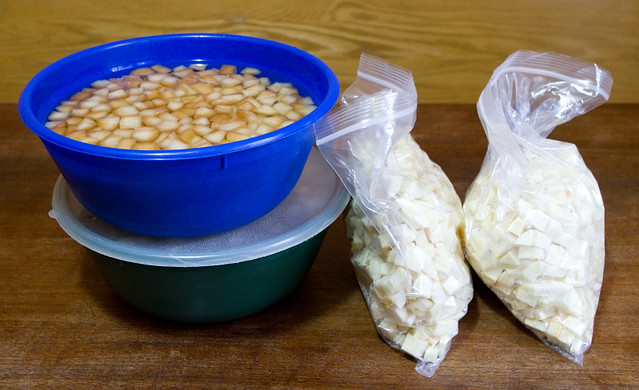
I well and truly overestimated how much fruit & veg to prepare to make this recipe, even doubled; I honestly thought I’d be able to get at least a quadruple batch in, but with all of that sugar, my pots just weren’t big enough. So I had a whole bunch of peeled, cut up pears (left) and parsnips (right) after this attempt.

The parsnips became part of our dinner last night, roasted in the oven with a sprinkle of salt, pepper, rosemary, and olive oil. I served them with baked pork chops coated in dried onion soup mix, which is a dish from my childhood that I’ve been making a lot lately once I was reminded of it. It’s just so easy! I probably have enough parsnips left for another three dinners like this one, but I think that would get old fast. I’ll need to research another recipe.

For my next recipe, I took a chance and tried peeling my ginger with a spoon, which is a kitchen hack I’ve seen floating around the Web for a while. I was quite satisfied with how this worked, actually. Not all cooking hacks are worth your time, but I found that this was honestly easier than a veggie peeler or a knife, and it wasted much less of the root.

The next step was to break out the candy/deep fry thermometer and bring the next jam up to the jelling point. (As an aside, am I the only one who feels like they need a shield as their jam/jelly gets thicker and it starts spitting huge globs of boiling-hot sugar and juice out of the pot?) This time I made Spiced Pear Jam with Pineapple found on page 935 of the Joy of Cooking (2006 edition, Rombauer & Becker), or on the app.
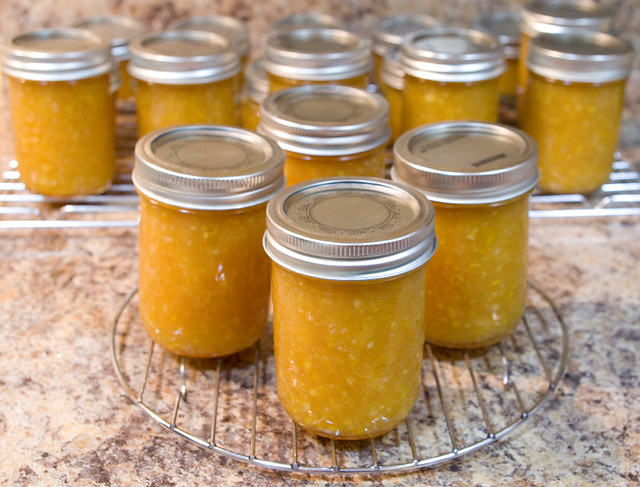
I was much happier with this jam than the previous one. I could definitely taste the fruit, and it wasn’t too sweet (it has a much lower sugar-to-fruit ratio). I have to admit that I couldn’t really taste the pineapple; the citrus note is definitely the strongest part of this jam, which isn’t necessarily a bad thing, although it does end up tasting more like a marmalade.

I probably still have enough chopped pears to make one more batch of jam. What kind should I make? I still haven’t decided. I have a lovely old recipe for pears poached in red wine and then canned, but that’s really intended for whole pears. These cooking pears needed to be chopped up to remove imperfections, so they’re sadly not really suitable to such a dish.

Steak Ramen

Last night I was searching for something to make for dinner, something that wouldn’t require a special trip to the grocery store. I did finally go get groceries on Monday, so now both the freezer and the fridge are full and I figure that I shouldn’t have to go out again every day for ingredients. At my husband’s request, since he’s fighting off a cold, I decided to make soup.

In the freezer I had some beef broth made with garlic and wild mushrooms, which I thawed as the base for the soup. I boiled up some ramen noodles and topped them with steamed spinach, carrot matchsticks, and soft-boiled eggs. The crowning glory of this particular dish was the steak. It didn’t brown up as nicely as I’d like, to my dismay, but it was very tender. To enhance the flavour, I used a marinade from page 65 of Simply Ramen by Amy Kimoto-Kahn (2016). Now, technically the recipe was for Kobe Beef Tsukemen, but I’ll be 100% honest and tell you that there’s no way I can afford Kobe beef. Instead, I thought I’d just use the marinade on a (much) cheaper steak. The marinade contains lemon juice, soy sauce, sake, and mirin (sweet rice wine), which combined is somewhat salty-sweet with an acidic punch to start breaking down the meat. Also, as per the recipe, I fried up the steak in melted beef suet instead of oil, which I think helped to enhance the flavour. Once I removed the meat from the pan, I added the juices to the soup broth to add extra punch. I was very satisfied with how it all turned out, especially since it made a lower-quality cut of beef quite palatable. Even if I never get the chance to cook Kobe beef, I think that I will definitely revisit this recipe in the future when I have all of the other ingredients on hand to try the dish in full.

Winter is Coming

Although I am much better, my kids are still fighting their colds. Last night I decided to go the more traditional route, dinner-wise, in an attempt to help them get well. I don’t know that it actually helped, but it didn’t hurt at any rate, and it was pretty tasty.

I made up a batch of chicken noodle soup based roughly on the recipe on page 125 of the Joy of Cooking (2006 edition, Rombauer & Becker). I added carrots and rosemary mostly because it’s what I happened to have around the house. I served the soup alongside fresh-baked Poppy Seed Loaf (page 138, Bread Machine: How to Prepare and Bake the Perfect Loaf (Jennie Shapter, 2002)) with avocado slices on top. Unlike me, the rest of the family ate their bread with butter and scooped the avocado out of the skins directly with a little bit of salad dressing on top.

Last night ended up involving a lot more food prep than just supper, though. The forecast called for the temperature to drop precipitously overnight to a low of -10°C (14°F) with a windchill of -20°C (-4°F). I had left a few frost-hardy plants in the garden after the main harvest, but I knew that cold this intense would kill them. So I had to bring in two good-sized bunches of celery, which I washed and trimmed the leaves off of, then put in a jug of water in the fridge for use over the next week or so.

I had a whole mess of Swiss chard to bring in — believe it or not, this was all from only two bunches!

I washed it all, then chopped the stems into bite-sized pieces, which I bagged to freeze in single-use packages over the winter in soups, stews, stir-fries and casseroles. The leaves don’t freeze nearly so well, so they’re still drying off in my sink while I figure out what to do with that much chard. A friend suggested a soup, but I don’t have a recipe yet.

My uncarved Halloween pumpkins had to come inside; freezing isn’t terribly hard on them as a general rule, especially if you’re just going to cook them, but a frozen-solid gourd is really difficult to prepare. Heck, it would take an axe or a sledgehammer just to get through it!

I also brought in the last of my summer herbs so they didn’t get frostbitten (along with half a case of Coke that I’d been cooling outdoors since the Halloween party; cool fall temperatures mean that the outdoors makes a great refrigerator for non-perishables). There are two pots of lavender, one of mint, one of rosemary, and one of parsley. Some of them I will eventually dry, others I will preserve (I have an interesting recipe for parsley jelly I want to try). They’d survive just fine in the house all winter, but the pots are quite large and take up my whole patio window. I think I will just plant new herbs in the spring and not deal with the hassle.

Squash & Pear Casserole Recipe

For Thanksgiving dinner, my mom made a lovely squash casserole as part of the main meal. (You can see it on the bottom right hand side of the table in the last picture in the post linked above.) It was so good that I asked her to share the recipe with me.


My stab at this delicious casserole.

Mom sent me the link to The Spruce’s Butternut Squash and Apple Casserole With Crumb Topping recipe, but then she sent me a list of the changes she’d made that turned it into a significantly different dish.

Last night I tried Mom’s version, which has pears instead of apples (’cause that was what she had on hand), and includes walnuts for crunch (the best part of the dish in my opinion). The topping stays pretty much the same, but it really wasn’t very crumby. The photo in the Spruce recipe was obviously taken before the dish was baked. Rather, as the butter melts it carries the spices and sugar to ingredients at the bottom of the casserole. This doesn’t make it any less tasty (I’d venture to say that it actually enhances the flavour), but I’d hesitate to call it a “crumb”.


Squash & Pear Casserole served with pork chops with an onion soup mix glaze.

Squash & Pear Casserole
Serves 4-6

Preheat the oven to 350°F (177°C).
Peel, remove guts and seeds, and cut into bite-sized pieces:
2 1/2 lbs butternut squash (approx. 1 medium)*
Core and cut into bite-sized pieces:
3 green pears
Place squash and pear pieces in a casserole dish that fits these ingredients with a bit of room to spare. Stir to mix.
Sprinkle over the mixture:
1/2 cup chopped walnuts**
In a separate bowl, mix together:
1/2 cup brown sugar
1 Tbsp all-purpose flour
1 tsp salt
1/4 tsp cinnamon
1/4 tsp nutmeg
To the sugar and spice mixture add:
1/4 cup chilled butter***
Using two knives or a pastry knife, cut the butter into the sugar and spice mixture until the pieces of butter are a roughly even size, about the size of a pea.
Sprinkle butter and spice mixture over the contents of the casserole dish.
Bake, covered, for 50 to 60 minutes****, or until the squash is easily pierced with a fork.
Serve using a slotted spoon so that the cooking juices are left behind in the casserole dish.

*This casserole would work equally well with squash of a similar texture such as acorn squash or pumpkin.
**Chopped pecans may be substituted for chopped walnuts.
***Margarine may be substituted to make this dish vegan/vegetarian. However, the margarine has to be the kind that is hard when cold, or it will not cut into the sugar & spice mixture properly.
****This dish may be prepped ahead of time, refrigerated overnight, and then baked just prior to serving. If the dish is still cold from the refrigerator, allow for an additional 15 to 20 minutes of cooking time.

Harvest Garden Bread Recipe

Last week Thing 1 and I tried our hands at making Confetti Bread (page 67 of The Complete Guide to Bread Machine Baking from Better Homes and Gardens (1999)). While in general I really like this book and I have found its recipes to be quite reliable, this loaf did not turn out as planned. It looked like this:


Failed Confetti Bread

The poor, sad thing just didn’t rise. The loaf was much too dense and wasn’t even baked the whole way through. The cookbook even warns that you might have to add additional flour to the dough after the first knead (which I did), and it still fell flat. I think that this is because a bread machine recipe just can’t predict the moisture content of the vegetables, and bread machines need very precise measurements because they just can’t compensate for change on the fly.

However, the loaf smelled absolutely delicious when it was baking, and the flavour of the bread backed up that smell. Well, except for the red pepper part, but that’s probably just my preference (I’m not a real fan of sweet peppers). I was inspired to try to create a similar loaf by hand to get all of those flavours that I liked, but I wanted it to be a nice fluffy loaf with a crisp crust. As a bonus, this recipe includes both zucchini and carrots, which many gardeners have an overabundance of this time of year. (If you don’t garden, these veggies are also cheap in stores in the fall.) I was very happy with the result.


Successful Harvest Garden Bread

So here’s the recipe:

Harvest Garden Bread
Yields one loaf

Line two small bowls with paper towel or clean dish towels.
Grate separately:
3/4 cups carrots
2/3 cups zucchini
Place the carrots into one bowl and the zucchini into the other. Leave them in the bowls so that the towels absorb excess moisture while you perform the next steps.
In a large bowl, mix together:
1 cup warm water
2 Tbsp olive oil
1 egg yolk
1/4 cup finely sliced green onions OR chives
In another large bowl, mix together:
4 cups all-purpose white flour
1 1/2 tsp white sugar
1 tsp salt
3/4 tsp dried thyme OR 2 1/4 tsp minced fresh thyme
2 tsp quick-rise instant yeast
Squeeze the zucchini and the carrots in their towels to remove excess moisture. Add the vegetables to the bowl containing the liquids and stir.
Gradually mix the dry ingredients into the wet ingredients. When mixture becomes too difficult to stir with a spoon, turn it out onto a lightly floured surface and continue to incorporate the ingredients by kneading.

Once all ingredients have been kneaded in, the dough may be too moist, sticking to both your hands and the kneading surface. If so, you may need to gradually add:
up to 1/2 cup all-purpose white flour
This additional flour will compensate for the moisture of your vegetables. If the dough is still too sticky once the additional flour has been kneaded in, continue to add flour one tablespoonful at a time until the desired consistency is reached.

Oil a large mixing bowl. Form the dough into a ball and place it in the bowl. Cover the bowl with a clean, damp tea towel. Place the bowl in a warm, dry area with no drafts. Allow the dough to rise until double, about 2 hours.

Punch down the dough. Grease a 9.5″ X 5.5″ loaf pan. (A slightly smaller loaf pan may be used, but you will end up with a more mushroom-shaped loaf.) Shape the dough into a loaf to fit the bottom of the pan. Cover the pan with a clean, damp tea towel and allow to rise again until double, about 1 hour.

Preheat your oven to 400ºF (204ºC).
While oven is preheating, mix together:
1 egg white
1 Tbsp cold water
Brush the top of the dough evenly with the egg & water mixture to create a glaze.
Bake loaf for 30 to 40 minutes, until top of loaf is lightly browned and the loaf sounds hollow when removed from the pan and tapped on the bottom.

If you try out this recipe, I’d love it if you’d leave a comment and let me know what you think! And if you make any changes or if you find any errors, I’d love to know that too.

Harvest

Even though the days have been lovely, it is now the beginning of October, so the nights are getting colder and there is often the threat of frost. This means it’s time to bring in the harvest. I dug up about half of my garden last week, and it wasn’t all mutant carrots!

Please excuse the long grass. My plants were hanging over the sides of the wooden garden border, so I figured I should pull them all up before mowing.

I picked the last of the hot peppers and dug up the few shallots that survived the season. For some reason, most of my shallots didn’t sprout this year. I will freeze the hot peppers with the intention of making hot sauce at a later date.

I tried growing lemongrass this year, which was very pretty but didn’t yield a huge amount of edible parts. It’s supposedly a perennial, but the root ball may not survive the harsh Canadian winter. We shall see if it sprouts in the spring.

I’m still harvesting ripe cherry tomatoes, much to my surprise. Last week’s heat wave meant that the plants haven’t started to die down as much as usual by this time of year.

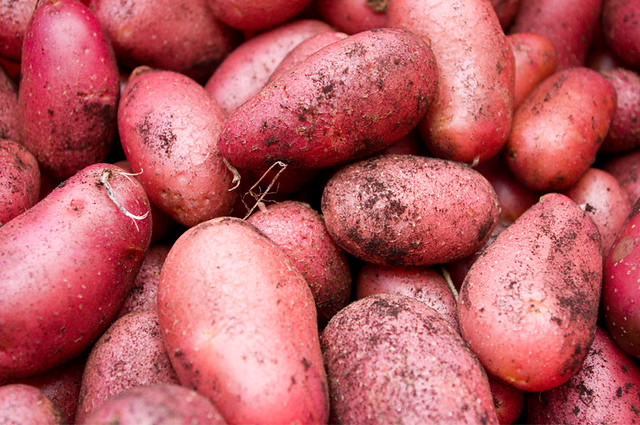
I had a total yield of about 30lbs of Prince of Orange potatoes. These potatoes are apparently a pretty new breed. They have reddish skins and a dark yellow interior (actually pretty close to my Creampak carrots when cooked). They also have a stronger flavour than traditional white-fleshed potatoes, which I really like. I may plant these again next year, or may be I’ll alternate with Violet Queens, which have purple skins and flesh. I figure hey, if I’m going to grow it myself, why be satisfied with the few varieties that are available at the average grocery store?

Carrots

I love both cooking with and eating carrots, so I’ve been planting them in my garden for a couple of years. I haven’t had great success, though. Last year, one of my carrots looked like this:

(That’s a dime for size reference.)

So when I planted my carrots this year, I didn’t have any great expectations. Instead of growing them from seeds like I’d tried in previous years, I bought pre-started seedlings from Laporte Gardens. I hoped I’d get a few decent-sized carrots and probably some finger-sized ones as well. Little did I know that I was growing MONSTERS.


Thing 1 helping me harvest the carrots.

I left lots of space between each planted seedling (so I never had to thin them), made sure they got lots of water (not a problem this year) and that they weren’t being eaten alive by pests or crowded out by weeds. I also fertilized the entire garden with sheep manure compost early in the spring. And that was all I did. I’d learned the hard way that you really just have to leave root vegetables alone for as long as possible so that they develop fully. Um… Mission accomplished, I guess?

(Yes, I know now that I probably should have re-buried the carrots as they began to poke out of the ground so they didn’t discolor, but I didn’t know that back when it mattered. My carrots have never before grown so large.)

So yeah, that’s Thing 1 holding up one of the carrots/carrot clusters that she pulled up for me. It’s almost as big as her head.

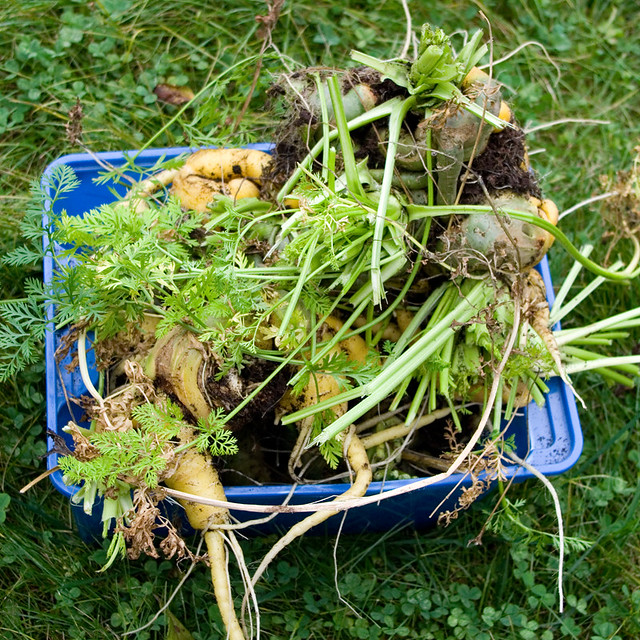
Instead of the roots growing long and straight, they looped back upon themselves multiple times, creating gnarled, mutant bunches. Even in the spots where there was only one top, the roots looked like this.

These are creampak carrots, by the way. They’re supposed to be yellow instead of the more common orange.

All in all, my small planting of carrots yielded a root harvest that overfills a 11″ x 15″ x 7¾” IKEA GLES box.

Washed and untangled, the carrots looked more like the vegetables I’m used to. The photo above is of only one of the root balls. I kept giggling as I washed and separated, since it all seemed so absurd to me. This is honestly the funniest plant I have ever grown… And I have grown some weird-looking plants.

Thing 1 washed and cut up some of the smaller bits, then harvested a few cherry tomatoes from the garden to make her own carrot and tomato salad. I was very proud of her for taking the initiative to make a dish out of the food she’d helped harvest. She insisted that I photograph her creation and put it on “the blog”.

I included part of the harvest in yesterday’s dinner, which was steamed carrots, whipped potatoes (which are Prince of Orange potatoes and almost the same colour as the Creampak carrots when cooked), and maple & cinnamon sausages. After spending the afternoon in the garden, the whole family cleaned their plates.

Onion Soup Pork Chops & Baked Panko Zucchini Sticks

In an attempt to use up the zucchini I received this weekend, I made another round of Baked Panko Zucchini Sticks for dinner last night. Enough for my entire family only uses up about a quarter of one of those giant summer squash. Of all of the recipes that I have for zucchini, this one uses the most in one go. It may end up being a contest to see which gives out first, my supply of zucchini or my kids’ ability to consume it. To be fair, the girls were really happy to see the zucchini on their plates last night, and that’s two suppers in a row where I didn’t have to fight with them to get them to eat their vegetables.

However, the real star of dinner wasn’t the zucchini sticks, although my kids may argue otherwise. The best part to me was the pork chops that I baked as the entree. I found these 1″ thick slabs of pork on sale for less than the cheap cuts, so I stocked up and planned on a few for dinner. I greased a broiler pan, lay the chops flat on top, and then covered them with a thick coating of dry onion soup mix. Then I baked them at 275°F (135°C) for about two hours. They were a very fatty cut, but the low, slow bake made them moist, tender, and not too greasy. Honestly, they couldn’t have been much easier. Now, if only I’d planned a meal cooked entirely in the oven for a day that wasn’t 30°C (86°F).

I was inspired to cook the meat this way after reading The I Hate To Cook Book (Peg Bracken, 1960). On page 12, the author writes about Sweep Steak, which is “[s]o-called because a couple of seasons ago this recipe swept the country“. Basically, it’s beef coated with dry onion soup mix and roasted in the oven.

Now, this cookbook predates me, but I distinctly remember dry onion soup mix being a staple of the kitchen when I was growing up. It was used to coat steak, to bread pork chops and chicken, and to season meatloaf. In our house, it was most commonly mixed with sour cream to become chip dip — which is referred to as Classic California Dip on page 84 of The I Hate To Cook Book, so I guess this combination predates me as well. I remember doing groceries with my parents and there was a whole assortment of dried soups along an aisle. But when I went to pick up some mix for this dish, the dried soups took up only part of one tiny shelf, most of which was taken up by Cup-A-Soup. There are probably a hundred or more types of canned and tetra-packed soup, not to mention the refrigerated stuff in the deli section, but apparently the dried kind is no longer popular. I guess that’s to be expected with the popularity of fresh ingredients being back on the rise. I certainly hadn’t bought any dried soup mix in years. Still, it came as quite a surprise to me to see the selection so limited.

Autumn Produce & Baked Panko Zucchini Sticks Recipe

A friend came by this past weekend to hang out and chat, and also to gift me with some of the excessive produce from his family’s garden. Apparently zucchini has really liked this year’s rainy summer, and tomatoes weren’t far behind in the production department.


Zucchinis and tomatoes in cardboard boxes from my friend’s garden; tomatoes and cherry tomatoes from my garden in the green bowls.

I didn’t try to grow zucchinis this year, but my tomatoes are ripening up nicely as well, so I ended up with much more fresh garden produce this weekend than we could eat before it went bad. So I’ve found myself spending the majority of the last few days in the kitchen, cooking as much of these fruits and veggies as I can.

Since my freezer is getting pretty full so I wanted something shelf-stable, and my husband (the main salsa consumer in our house) really likes the Blender Salsa from page 92 of Preserving by the Pint: Quick Seasonal Canning for Small Spaces (Marisa McClellan, 2014), making another big batch was a no-brainer. Once my hubby had snacked on some of the lovely cherry tomatoes, I cooked up the remainder into about four liters of salsa. That’s not nearly enough to get us through the winter, but there are still more tomatoes on the vine to ripen, after all.

I baked a loaf of Chocolate Zucchini Bread (page 104 of 125 Best Quick Bread Recipes by Donna Washburn & Heather Butt (2002)). This is a heavy, rich bread that is satisfying either as a dessert or as a snack. I opted for semi-sweet mini chocolate chips, which makes this dish almost bitter, since it doesn’t include all that much added sugar. You can also use dark chocolate chips for an even deeper flavour, or switch it up with butterscotch, raspberry, or white chocolate chips. I was a little worried about the texture that the grated zucchini might have created, so I used the same technique as when I rebaked the chocolate fudge zucchini cookies and precooked the zucchini, then ran it through the blender. This added a bit of extra moisture to the bread, so I omitted the vegetable oil entirely. I was quite happy with how it turned out, both in flavour and in texture.

For dinner yesterday I also made baked chicken with my usual sprinkling of parsley, sage, rosemary, thyme, garlic powder, summer savoury, and salt as topping. As a side I made baked zucchini sticks, which my kids couldn’t get enough of, so I think I’ll be making them a few more times until I use up all of this zucchini (there’s still lots left). Instead of the more common (around here) seasoned bread crumbs, I went with panko, which is a much lighter style of Japanese bread crumb. I also baked the sticks instead of the more traditional deep-frying, for health reasons and because I just don’t particularly enjoy deep-frying. Here’s the very simple recipe that I used:

Baked Panko Zucchini Sticks
Serves 4 as a side dish

Preheat oven to 425°F (220°C).
Wash and slice into thick sticks, leaving peel on:
400g zucchini
In a small mixing bowl, beat:
1 large egg
In a second small mixing bowl, combine:
3/4 cup panko
1/4 tsp salt
1/8 tsp black pepper
1/4 tsp garlic powder
4 Tbsp Kraft 100% Parmesan grated cheese*
Grease a cookie sheet lightly with olive oil or cooking spray.
Dry the zucchini on paper towel, then dip it into the egg until coated, then into the panko mixture until coated. Place the coated zucchini sticks in a single layer on the greased cookie sheet. Sticks will cook most evenly and be most crunchy if they are not touching.
Bake the zucchini sticks for 15-20 minutes, or until topping is golden brown.
Serve plain, or with ranch dressing or marinara sauce as a dipping sauce.

*Parmesan cheese may be omitted, but if so, double the amount of salt.

Healthy Veggie Tomato Sauce Recipe

Back in February I made a massive batch of Kerryann’s hidden vegetable pasta sauce, most of which I stuck in the freezer and thawed periodically to make spaghetti, lasagna, and pizza. We ran out near the start of the summer, at which point I decided to try to perfect my own tomato sauce recipe.

Don’t get me wrong, I adored the flavour of Kerryann’s, but I never got over the weird brownish-green that my attempts at the recipe ended up. I think that my previous suspicious were correct and that’s just because the proportions of fruits and vegetables are different here in Canada than they are in Britain, from whence the recipe originates.


Right now my little garden is yielding about 6lbs of tomatoes (mostly cherry tomatoes) every four or five days, so I need to keep up with the harvest.

For example, Kerryann’s recipe calls for eggplants (or rather, aubergines), among other ingredients. In my local grocery store, which does not specialize in particular kinds of produce, I was able to find four kinds of eggplant, all of which are extremely different sizes. So what is considered a “medium aubergine” in Britain? The video helps narrow the criteria down a bit, but I think that the produce here is just bigger. (I know that our leeks are freaking enormous.) Canada is a country that is very driven by agriculture, after all.


Top left — Indian eggplant (max 3″ long); top right — Thai eggplant (max 2″ long); bottom left — Chinese eggplant (about 12″ long); bottom right — American/globe eggplant (14″+ long, very wide at one end)

There were some other problems with importing this recipe. I’ve never found tomato puree in tubes here, although canned tomato paste is commonplace. I’m not sure if substituting the latter for the former would effect the colour or flavour, as I can’t get my hands on the kind in tubes to compare. I also had a hard time finding sieved tomatoes (passata), although it’s possible to find cans with tomatoes that have been crushed, small cut, diced, diced with herbs, left whole, stewed, or preserved without added salt.

So I’ve made my own tomato sauce recipe with added vegetables. I’ve measured everything out by weight, which should mean that this recipe will come out more or less the same no matter how big your local vegetables grow. I’ve left out the leeks and the celery, as well as peeled the eggplant and the zucchini, which should correct the colour of the sauce. Last but not least, I run my sauce through a blender after it is all cooked so that it is all the same consistency, which is perfect for sneaking veggies into the diets of picky eaters (a lot of people have problems with textures more than they do with flavours).


Tomato sauce simmering on the stove.

Healthy Veggie Tomato Sauce
Yields about 5Kg (11lbs), or about 22 cups sauce

In deep, heavy-bottomed skillet or frying pan, preheat:
4 Tbsp olive oil
Add to pan:
225g yellow onion, diced
8 cloves garlic, chopped fine
Cook on medium heat until onions have started to turn clear. Do not brown.
Add to the pan:
550g cremini mushrooms, sliced
400g zucchini*, peeled & chopped
400g globe eggplant, peeled & chopped
400g orange carrots, peeled & diced
Cover and cook on medium heat until carrots are softened. Stir often to avoid browning.
While this mixture is cooking, prepare tomatoes. If using cherry tomatoes, cut each one in half. If using larger tomatoes, remove the piths and quarter them.
Pour cooked mixture into a deep pot, such as a stock pot. A heavy-bottomed pot is best, but if one isn’t available, any large pot will do. If a thinner-bottomed pot is used, it will have to be stirred more frequently to prevent sticking & scorching.
To the pot, add:
1L low-sodium chicken or vegetable broth
2.75Kg fresh tomatoes, cut as per above instructions
2 cans tomato paste, 156mL each
8 Tbsp fresh oregano (or 2 Tbsp dried oregano)
3 tsp salt
1 tsp ground bay leaves
2 Tbsp sugar
Slowly bring mixture up to a boil, then turn the burner down until it is just simmering. Stir frequently to prevent scorching. Sauce is cooked once all of the ingredients are soft, the last of which should be the tomato skins.
Turn off the heat under the pot. Carefully ladle the hot sauce mixture into a blender to at most 3/4 full, put the lid on the blender, put a towel over the lid, and blend until smooth. Be careful, as the mixture is very hot! Pour the blended sauce into a large bowl or pot, then repeat until all of the sauce is blended.
At this point the sauce may be completely done, or it may be a little bit too liquid, depending on the juiciness of the tomatoes used. If the sauce is watery, return it to the deep pot and simmer gently until it has reached the preferred consistency, stirring often.

*Yellow zucchini is preferred to contribute to the colour of the sauce, but green zucchini will taste the same if that is what’s available.


Tomato sauce with ground beef over penne.

Healthy veggie tomato sauce can be served as-is over pasta; spaghetti is most commonly used, although in our house we prefer penne. If you use vegetable broth instead of chicken broth when you make the sauce, this results in a vegetarian/vegan dish. However, I like to freeze it in dinner-sized portions, then thaw it while I fry up and drain a 500g package of lean ground beef, turkey, meatballs, or sausage. I stir the sauce in with the meat and simmer together while the pasta boils for an easy weeknight dinner. This tomato sauce is also great for making homemade lasagna, pizza, or Sloppy Joes.


Tomato sauce with ground beef over penne, sprinkled with Parmesan cheese.