Cloths

I’ve been laid up a bit lately, and I had to do something with my hands before I lost my mind. To that end, I picked up a bunch of Bernat Handicrafter Cotton Yarn in a variety of colours so that I could make some cloths. I love to make these to give away at Christmas; I figure that while they’re not terribly fancy, they’re a very practical gift — and you can never have too many.

I started with Bella Coco’s How To Crochet the Waffle Stitch tutorial. I cast on 34 stitches and worked the waffle pattern from there. I used, top to bottom in the photo above, Lemon Swirl Ombre, Poppy Ombre, Pale Yellow, and then Poppy Ombre again. I haven’t crocheted for years, but I found the tutorial laid everything out very clearly. The waffle pattern makes a nice, scrubby texture in this yarn that will be great for cleaning dishes.

I also knit some cloths using the free pattern on the back of the yarn ball band that’s also available for free online: the Brick Stitch Dishcloth. I’d never done this pattern before either, but I loved how it turned out. Now that the leaves are starting to change, I thought it would be fun to make some cloths in Halloween colours. They’ll probably be Christmas gifts too, but many of my friends would prefer these combinations anyway. I used Black Licorice with (from top to bottom) Hot Green, Hot Orange, Hot Purple, and Red.

Onion Soup Pork Chops & Baked Panko Zucchini Sticks

In an attempt to use up the zucchini I received this weekend, I made another round of Baked Panko Zucchini Sticks for dinner last night. Enough for my entire family only uses up about a quarter of one of those giant summer squash. Of all of the recipes that I have for zucchini, this one uses the most in one go. It may end up being a contest to see which gives out first, my supply of zucchini or my kids’ ability to consume it. To be fair, the girls were really happy to see the zucchini on their plates last night, and that’s two suppers in a row where I didn’t have to fight with them to get them to eat their vegetables.

However, the real star of dinner wasn’t the zucchini sticks, although my kids may argue otherwise. The best part to me was the pork chops that I baked as the entree. I found these 1″ thick slabs of pork on sale for less than the cheap cuts, so I stocked up and planned on a few for dinner. I greased a broiler pan, lay the chops flat on top, and then covered them with a thick coating of dry onion soup mix. Then I baked them at 275°F (135°C) for about two hours. They were a very fatty cut, but the low, slow bake made them moist, tender, and not too greasy. Honestly, they couldn’t have been much easier. Now, if only I’d planned a meal cooked entirely in the oven for a day that wasn’t 30°C (86°F).

I was inspired to cook the meat this way after reading The I Hate To Cook Book (Peg Bracken, 1960). On page 12, the author writes about Sweep Steak, which is “[s]o-called because a couple of seasons ago this recipe swept the country“. Basically, it’s beef coated with dry onion soup mix and roasted in the oven.

Now, this cookbook predates me, but I distinctly remember dry onion soup mix being a staple of the kitchen when I was growing up. It was used to coat steak, to bread pork chops and chicken, and to season meatloaf. In our house, it was most commonly mixed with sour cream to become chip dip — which is referred to as Classic California Dip on page 84 of The I Hate To Cook Book, so I guess this combination predates me as well. I remember doing groceries with my parents and there was a whole assortment of dried soups along an aisle. But when I went to pick up some mix for this dish, the dried soups took up only part of one tiny shelf, most of which was taken up by Cup-A-Soup. There are probably a hundred or more types of canned and tetra-packed soup, not to mention the refrigerated stuff in the deli section, but apparently the dried kind is no longer popular. I guess that’s to be expected with the popularity of fresh ingredients being back on the rise. I certainly hadn’t bought any dried soup mix in years. Still, it came as quite a surprise to me to see the selection so limited.

Autumn Produce & Baked Panko Zucchini Sticks Recipe

A friend came by this past weekend to hang out and chat, and also to gift me with some of the excessive produce from his family’s garden. Apparently zucchini has really liked this year’s rainy summer, and tomatoes weren’t far behind in the production department.


Zucchinis and tomatoes in cardboard boxes from my friend’s garden; tomatoes and cherry tomatoes from my garden in the green bowls.

I didn’t try to grow zucchinis this year, but my tomatoes are ripening up nicely as well, so I ended up with much more fresh garden produce this weekend than we could eat before it went bad. So I’ve found myself spending the majority of the last few days in the kitchen, cooking as much of these fruits and veggies as I can.

Since my freezer is getting pretty full so I wanted something shelf-stable, and my husband (the main salsa consumer in our house) really likes the Blender Salsa from page 92 of Preserving by the Pint: Quick Seasonal Canning for Small Spaces (Marisa McClellan, 2014), making another big batch was a no-brainer. Once my hubby had snacked on some of the lovely cherry tomatoes, I cooked up the remainder into about four liters of salsa. That’s not nearly enough to get us through the winter, but there are still more tomatoes on the vine to ripen, after all.

I baked a loaf of Chocolate Zucchini Bread (page 104 of 125 Best Quick Bread Recipes by Donna Washburn & Heather Butt (2002)). This is a heavy, rich bread that is satisfying either as a dessert or as a snack. I opted for semi-sweet mini chocolate chips, which makes this dish almost bitter, since it doesn’t include all that much added sugar. You can also use dark chocolate chips for an even deeper flavour, or switch it up with butterscotch, raspberry, or white chocolate chips. I was a little worried about the texture that the grated zucchini might have created, so I used the same technique as when I rebaked the chocolate fudge zucchini cookies and precooked the zucchini, then ran it through the blender. This added a bit of extra moisture to the bread, so I omitted the vegetable oil entirely. I was quite happy with how it turned out, both in flavour and in texture.

For dinner yesterday I also made baked chicken with my usual sprinkling of parsley, sage, rosemary, thyme, garlic powder, summer savoury, and salt as topping. As a side I made baked zucchini sticks, which my kids couldn’t get enough of, so I think I’ll be making them a few more times until I use up all of this zucchini (there’s still lots left). Instead of the more common (around here) seasoned bread crumbs, I went with panko, which is a much lighter style of Japanese bread crumb. I also baked the sticks instead of the more traditional deep-frying, for health reasons and because I just don’t particularly enjoy deep-frying. Here’s the very simple recipe that I used:

Baked Panko Zucchini Sticks
Serves 4 as a side dish

Preheat oven to 425°F (220°C).
Wash and slice into thick sticks, leaving peel on:
400g zucchini
In a small mixing bowl, beat:
1 large egg
In a second small mixing bowl, combine:
3/4 cup panko
1/4 tsp salt
1/8 tsp black pepper
1/4 tsp garlic powder
4 Tbsp Kraft 100% Parmesan grated cheese*
Grease a cookie sheet lightly with olive oil or cooking spray.
Dry the zucchini on paper towel, then dip it into the egg until coated, then into the panko mixture until coated. Place the coated zucchini sticks in a single layer on the greased cookie sheet. Sticks will cook most evenly and be most crunchy if they are not touching.
Bake the zucchini sticks for 15-20 minutes, or until topping is golden brown.
Serve plain, or with ranch dressing or marinara sauce as a dipping sauce.

*Parmesan cheese may be omitted, but if so, double the amount of salt.

Salmon Puff

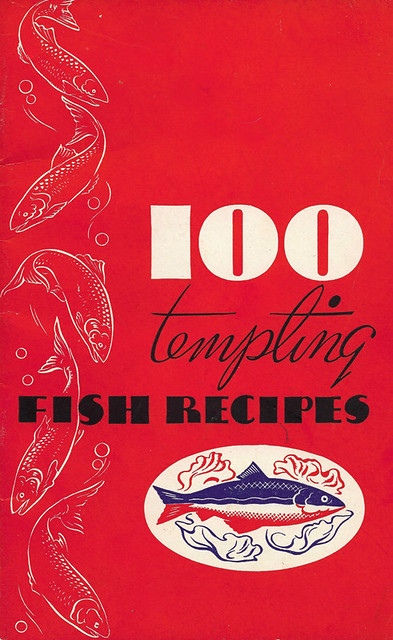
Keeping with this week’s rather unintentional theme of preparing dishes from old cookbooks, last night I tried a dish from 100 Tempting Fish Recipes. This book (well, at 56 pages, it’s more of a pamphlet) was issued by the Department of Fisheries (Ottawa, Canada) in 1939, although I have a 1949 reprint. It’s well out of print now and I haven’t found any copies for sale on the Web, but a digital copy is available online at Early Canadiana Online if you have a membership (which I do not). The site does have a free 18-page preview.

You can get a general idea of the age of this book just by the typography. Another dead giveaway of its age are the sometimes-vague cooking directions. For example, the recipe that I used was the Salmon Puff on page 23, and the baking directions were “Place in a buttered casserole, dot with butter and bake in a moderate oven until brown.” The term “moderate oven” is used a lot in this book and could, I think, denote a number of temperature settings. The timing is also vague; these days, you’d get an instruction along the lines of “Bake in an oven preheated to 350° until brown, about 20 to 30 minutes.” Not that older recipes can’t be precise, but newer ones generally give much more detail. I think that part of this is because the authors expected the reader to have a background of knowledge that would make what the author meant obvious. It’s probably also due to the fact that publication costs went down over time, so it was possible to be wordier (and include photographs of the final product) when every word didn’t carry as much financial weight at printing time. Heck, even between in my 1949 copy 100 Tempting Fish Recipes and the 1960 The I Hate To Cook Book by Peg Bracken (which is still in print), there’s a notable shift toward more precise instructions. The author actually bemoans this in the introduction:

…[T]hey’re always telling you what any chucklehead would know. “Place dough in pan to rise and cover with a clean cloth,” they say. What did they think you’d cover it with?

This terrible explicitness also leads them to say, “Pour mixture into 2 1/2 qt. saucepan.” Well, when you hate to cook, you’ve no idea what size your saucepans are, except big, middle-sized, and little. Indeed, the less attention called to your cooking equipment the better. You buy the minimum, grudgingly, and you use it till it falls apart.

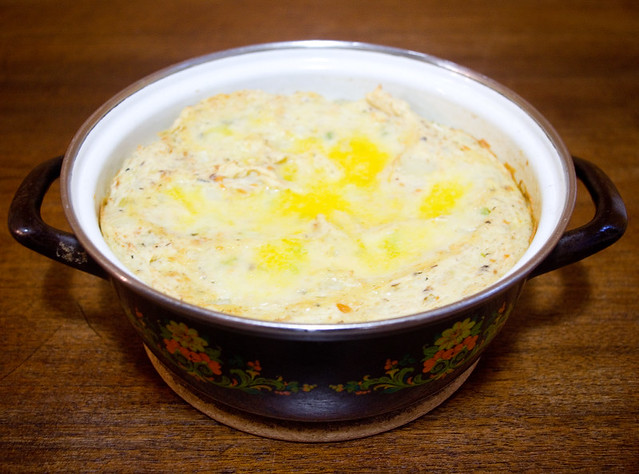
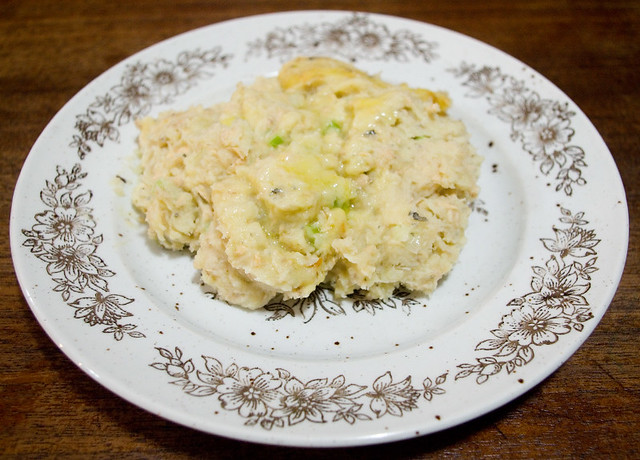
Back to yesterday’s recipe. It’s what I would consider to be a “pantry casserole”, i.e. a dinner that, with a reasonably-stocked Canadian pantry and fridge, one is likely to have all of the ingredients already at home. The salmon, which would normally be the ingredient most easily spoiled, is canned. You’d think that with a pound of salmon in there, the dish would at least have a bit of a pink tinge, but potatoes make up the bulk and leach it of all colour. I think that this is a good metaphor for the dish overall, actually. It’s just very… Beige. Not great, not bad; edible, but uninspired. Even a sprinkling of paprika as garnish would liven it up a little. Peg Bracken has great things to say about garnish on page 15 of The I Hate to Cook Book:

The reason for these little garnishes is that even though you hate to cook, you don’t always want this fact to show, as it so often does with a plateful of nude food. So you put light things on dark things (like Parmesan on spinach) and dark things on light things (like parsley on sole) and sprinkle paprika on practically everything within reach. Sometimes you end up with a dinner in which everything seems to be sprinkled with something, which gives a certain earnest look to the whole performance, but it still shows you’re trying.

(Seriously, though, I highly recommend this book, even if you hate to cook. Especially if you hate to cook. It’s a fun read.)

The salmon puff would have benefited greatly from a side of steamed vegetables or a salad, both to enhance the presentation and the nutritional values. Surprisingly, I think I may use this recipe again in the future specifically because it is an easy pantry casserole. Heaven knows some winter days I just don’t want to brave the roads for more exciting ingredients. Also, it would be a great way to use up leftover mashed potatoes. I mean, everyone in my family ate their dinner, nobody complained, and some even had seconds. Nobody had anything great to say about the dish, but when it comes to feeding kids, a lack of complaints is pretty high praise.

Honey Curry Chicken

Sometimes the food that I make can take hours, even days, to prepare. Other times I have to make a rushed meal between activities. This dinner was definitely one of the latter.

I made the Honey Curry Chicken from page 126 of The United Churches in Canada: Let’s Break Bread Together (September 1988 edition). The flavour of the final dish reminded me of nothing so much as dipping McDonald’s chicken nuggets into honey, which is incredibly low-brow but recalls happy childhood memories. At least this is nominally healthier, since the chicken isn’t breaded and there are actually vegetables!

The honey curry sauce is very quick to make and can be as mild or as spicy as suits your tastes, depending on the kind of curry powder that you choose to use. I used Irresistibles Mild Curry powder which adds flavour but absolutely no heat, which is exactly what I’m looking for when cooking for my children or my parents. (My husband and I prefer more spice.) Instead of baking the chicken in the oven, as the recipe called for, I went the quicker route of chopping it small and frying it in its own juices on the stove top. I didn’t use raisins in the sauce (they were optional anyway and didn’t really seem to go). As the recipe dictated, I served it over fluffy rice (Suraj Basmati). I served it with peas as we didn’t have any beans, and no toasted slivered almonds as a topping since we didn’t have any of those either. Despite all of the changes, it turned out absolutely lovely and I will definitely make this dish again.

Oven-Baked Oatmeal Wheat Bread Recipe

Out of sheer curiosity, back in May I tried out the recipe for Microwave Oatmeal Wheat Bread (page 128, Basic Microwaving by Barbara Methven, 1978). The loaf ended up having a heavy, hard, and, chewy without actually being crunchy. It wasn’t horrible, but I didn’t see myself ever cooking it in the microwave again.

I did promise myself that eventually I’d try to recreate this dish in the oven, and this week I finally got around to it. As I had suspected, the issue with the texture had nothing to do with the ingredients and everything to do with the cooking method. When I prepared this loaf the standard way for an oven, it was still dense — but that is to be expected when you use ingredients like whole wheat flour, oatmeal, and molasses. However, it was not chewy at all; it was lighter in the middle with a thin, crisp crust. The dark flavour of the bread went well with roast meats, deli meats, and cheeses — or just on its own with butter.

Without further ado, here’s how I made this bread in the oven:

Oven-Baked Oatmeal Wheat Bread
Yields one loaf

In a large mixing bowl, stir together:
1 cup whole wheat flour
1/2 cup rolled oats (not instant)
1 package (7g) quick-rise instant yeast
1 tsp salt
1 Tbsp sugar
Add to dry ingredients:
1 cup warm water
1/3 cup cooking molasses*
1/4 cup lard, melted
Stir wet ingredients into dry ingredients until they are evenly mixed. Gradually mix in:
1 1/2 to 2 cups all-purpose flour
After the majority of the flour is added, transfer the dough to a floured surface and start kneading. Gradually knead in the remainder of the flour. If the dough starts to become difficult to knead, stop adding flour. When flour is fully incorporated, dough should be smooth and elastic, but not sticky. If dough is sticky, add all-purpose flour 1 Tbsp at a time until stickiness abates.

Knead for an additional five minutes, until dough is smooth. Oil a large mixing bowl. Form the dough into a ball and place it in the bowl. Cover the bowl with a clean, damp tea towel. Place the bowl in a warm, dry area with no drafts. Allow the dough to rise until double, about 1 1/2 to 2 hours.

Punch down the dough. Grease a cookie sheet. Shape the dough into a ball, then flatten it into a thick, circular loaf. Put the dough on the center of the greased pan. Cover the pan with a clean, damp tea towel and allow to rise again until double, about 1 1/2 hours.

Preheat your oven to 375ºF (190ºC). Bake loaf for 15 minutes. Turn heat down to 350ºF (177ºC) and bake for about 15-20 minutes more. Check to see if the bread is done by removing it from the cookie sheet and tapping it on the bottom. When cooked through, it should make a hollow sound. Remove the bread from the pan immediately and place it on a wire cooling rack. Slice and serve immediately, or allow to cool thoroughly before wrapping in plastic to be eaten later.

*Fancy molasses may be substituted for cooking molasses, but if you do so, omit the sugar.

Shoyu Ramen

As I have said before, I am a huge fan of ramen. Not the instant stuff (although in a pinch, that stuff’s not half bad), but the fresh kind with real toppings. I fell in love with it in Japan, and I get out to Ginza Ramen whenever I can. But ever since my husband’s birthday dinner, now that I’ve learned how to make the good stuff at home, I probably eat it way more than I should. Not that my family minds, they’re just as big into it as I am.

I started off by using up the Shoyu base (page 8 of Simply Ramen by Amy Kimoto-Kahn (2016)). The recipe is also available for free on the author’s website at easypeasyjapanesey.com. I have since made a couple of batches of this broth and I still love how easy it is to make and how packed with flavour the broth turns out. If you’re like me and you like making things that you can just throw in the slow cooker for eleven hours, then you’ll love this recipe. I also like that this recipe makes up enough broth for eight or so servings, so I can freeze the excess for an easy meal later on.

As with many of my noodle soups, the toppings were less a pre-planned dish and more whatever we had in the fridge/freezer at the time. I included soft-boiled eggs, garlic shrimp, masago (capelin roe), and mussels cooked in white wine and garlic butter. The mussels were the kind that come in a vacuum-pack with the sauce and are meant to be cooked in the microwave or by dumping the whole pack in a pot of boiling water. I’m fully aware that this isn’t terribly classy, but it was delicious.

My second shoyu ramen was topped with soft-boiled eggs and garlic shrimp; these two ingredients are pretty common in the food I prepare because there are almost always eggs in the fridge and shrimp in the freezer. This time I also included baby bok choy and squares of nori (dried seaweed sheets).

I topped my third ramen with soft-boiled eggs, carrots, bok choy, and teriyaki chicken breast. I had never thought to combine teriyaki and ramen until I went to Umi Sushi Express in the food court of Rideau Center a while back, and I was pleasantly surprised when I ordered this dish. I mean, Umi Sushi is still fast food, and it’s nothing compared to the fantastic variety of ramen available in Japan, but it’s probably the best thing in the food court. Now if I can only find out what kind of hot sauce they used.

Blender Salsa

The other day I brought Thing 1 and Thing 2 out to the garden and enlisted their help to find all of the ripe tomatoes. Between us, we picked 10lbs of tomatoes, which seems like a lot for the size of garden that I have, but in the end that only yielded…

…Five 500mL jars of canned salsa, with a bit left over for immediate consumption. It’s always a bit disappointing to see how much ingredients can shrink down when you cook them, especially when you grew said ingredients yourself. However, this time I was much happier with the taste of the end result than I was with my last batch. This time I used the Blender Salsa recipe found on page 92 of Preserving by the Pint: Quick Seasonal Canning for Small Spaces (Marisa McClellan, 2014). Like most salsas, this preserve is both vegan and vegetarian. It’s a really easy recipe, which appeals to me. I liked that it used lime juice and citric acid to increase the acidity, instead of using vinegar. I also liked that the recipe was free of added sugar, which is healthier anyway, but sugar’s unnecessary for flavour when cooking with cherry tomatoes. I did have to boil down the salsa a bit to obtain the desired consistency, but I’m beginning to think that that’s just a consequence of using predominantly cherry tomatoes. I will definitely be using this recipe again.

First Day of School

The first day of school for the public school board in Ontario is always the day after Labour Day, which this year ends up being today. My girls are back to school, and although part of me is sighing in relief that they’ll be in someone else’s care for a couple of hours every day, I know the house will also seem echoingly empty without them around. I think I’ll learn to live with it, though.


Thing 1 and Thing 2’s lunches for the first day of school.

School-provided lunches really aren’t a thing around here; heck, the school doesn’t even have a cafeteria. Everyone brown bags it, although some kids do get a special lunch delivered by the “Lunch Lady” once or twice a week, which has never really seemed like value for money to me. Most of the year my girls pack their own lunches the night before, and they have almost since they started to go to school. I tried to pack Thing 1’s lunches for her starting in Junior Kindergarten, but too often more than half of the food came back home – although her teachers reported that she was complaining of hunger. Once Thing 1 made her own lunch, a lot less of the food came back home, and the complaints became rare. I had to help her out a lot at first, but by the time Thing 2 started school, she wanted to make her own lunch to be just like Thing 1. I’m not saying that it’s not a struggle sometimes. What should be a short and simple process can take ages when the kids do it themselves. Sometimes they are more interested in doing just about anything else and getting them to make their lunches can be a seemingly endless argument. But in the end, I think that the independence is important, and that it’s a good thing that my children learn basic food handling and prep early on. My husband and I are always nearby to make sure that they make healthy choices — and to ensure that they don’t accidentally bring anything with tree nuts or peanuts to school.


Thing 2’s lunch.

However, on the first day of school, for a special treat, I like to pack their lunches for them. I made up some fresh whole wheat bread using the Nan’s Pan Rolls recipe, and I also threw together some Blueberry Bran Muffins. The bread I used to make Hungarian salami sandwiches with mayonnaise (even though I prefer mustard myself). Each girl also got Goldfish, strawberries, vanilla yogurt, and string cheese. I packed Thing 2 a container of sliced English cucumber, while Thing 1 prefers an apple.

Am I the only one who finds those “school lunches in other countries” videos and articles interesting? I don’t know if you could consider this to be a typical Canadian lunch, though. I remember being very interested in my classmates’ lunches when I went to school because they were all so different. Some of them contained Wonder Bread sandwiches with peanut butter and jam or bologna and mayonnaise; others ate crusty French bread, sharp cheese, and cherry tomatoes; others always contained a thermos of soup and a travel package of crackers; others had warm dishes of rice and curry and spice. Some kids ate the same thing religiously, others had an entirely different daily menu. I think our household was somewhat between those extremes, with recurring favourites alongside seasonal and leftover dinner fare.


Thing 1 and Thing 2’s school bags, packed and ready to go.

At any rate, my kids’ lunches and supplies were ready the night before. New-ish outdoor shoes were set by the front door, brand new sneakers were in their backpacks, packages of markers and pencil crayons and duotangs and paper filled up the rest of their bags. Their lunches and water bottles were in the fridge, waiting to be grabbed on the way to the door. Hopefully all of this preparation will set a positive tone for the rest of the year. Will they like their new teachers? Will they get along with their classmates? Will they enjoy the new challenges that their schooling puts in front of them? Who knows? There’s really nothing I can do to influence most of that. But lunch, though, lunch I can do. And no matter how the first day turns out, it always goes better on a full stomach.

Healthy Veggie Tomato Sauce Recipe

Back in February I made a massive batch of Kerryann’s hidden vegetable pasta sauce, most of which I stuck in the freezer and thawed periodically to make spaghetti, lasagna, and pizza. We ran out near the start of the summer, at which point I decided to try to perfect my own tomato sauce recipe.

Don’t get me wrong, I adored the flavour of Kerryann’s, but I never got over the weird brownish-green that my attempts at the recipe ended up. I think that my previous suspicious were correct and that’s just because the proportions of fruits and vegetables are different here in Canada than they are in Britain, from whence the recipe originates.


Right now my little garden is yielding about 6lbs of tomatoes (mostly cherry tomatoes) every four or five days, so I need to keep up with the harvest.

For example, Kerryann’s recipe calls for eggplants (or rather, aubergines), among other ingredients. In my local grocery store, which does not specialize in particular kinds of produce, I was able to find four kinds of eggplant, all of which are extremely different sizes. So what is considered a “medium aubergine” in Britain? The video helps narrow the criteria down a bit, but I think that the produce here is just bigger. (I know that our leeks are freaking enormous.) Canada is a country that is very driven by agriculture, after all.


Top left — Indian eggplant (max 3″ long); top right — Thai eggplant (max 2″ long); bottom left — Chinese eggplant (about 12″ long); bottom right — American/globe eggplant (14″+ long, very wide at one end)

There were some other problems with importing this recipe. I’ve never found tomato puree in tubes here, although canned tomato paste is commonplace. I’m not sure if substituting the latter for the former would effect the colour or flavour, as I can’t get my hands on the kind in tubes to compare. I also had a hard time finding sieved tomatoes (passata), although it’s possible to find cans with tomatoes that have been crushed, small cut, diced, diced with herbs, left whole, stewed, or preserved without added salt.

So I’ve made my own tomato sauce recipe with added vegetables. I’ve measured everything out by weight, which should mean that this recipe will come out more or less the same no matter how big your local vegetables grow. I’ve left out the leeks and the celery, as well as peeled the eggplant and the zucchini, which should correct the colour of the sauce. Last but not least, I run my sauce through a blender after it is all cooked so that it is all the same consistency, which is perfect for sneaking veggies into the diets of picky eaters (a lot of people have problems with textures more than they do with flavours).


Tomato sauce simmering on the stove.

Healthy Veggie Tomato Sauce
Yields about 5Kg (11lbs), or about 22 cups sauce

In deep, heavy-bottomed skillet or frying pan, preheat:
4 Tbsp olive oil
Add to pan:
225g yellow onion, diced
8 cloves garlic, chopped fine
Cook on medium heat until onions have started to turn clear. Do not brown.
Add to the pan:
550g cremini mushrooms, sliced
400g zucchini*, peeled & chopped
400g globe eggplant, peeled & chopped
400g orange carrots, peeled & diced
Cover and cook on medium heat until carrots are softened. Stir often to avoid browning.
While this mixture is cooking, prepare tomatoes. If using cherry tomatoes, cut each one in half. If using larger tomatoes, remove the piths and quarter them.
Pour cooked mixture into a deep pot, such as a stock pot. A heavy-bottomed pot is best, but if one isn’t available, any large pot will do. If a thinner-bottomed pot is used, it will have to be stirred more frequently to prevent sticking & scorching.
To the pot, add:
1L low-sodium chicken or vegetable broth
2.75Kg fresh tomatoes, cut as per above instructions
2 cans tomato paste, 156mL each
8 Tbsp fresh oregano (or 2 Tbsp dried oregano)
3 tsp salt
1 tsp ground bay leaves
2 Tbsp sugar
Slowly bring mixture up to a boil, then turn the burner down until it is just simmering. Stir frequently to prevent scorching. Sauce is cooked once all of the ingredients are soft, the last of which should be the tomato skins.
Turn off the heat under the pot. Carefully ladle the hot sauce mixture into a blender to at most 3/4 full, put the lid on the blender, put a towel over the lid, and blend until smooth. Be careful, as the mixture is very hot! Pour the blended sauce into a large bowl or pot, then repeat until all of the sauce is blended.
At this point the sauce may be completely done, or it may be a little bit too liquid, depending on the juiciness of the tomatoes used. If the sauce is watery, return it to the deep pot and simmer gently until it has reached the preferred consistency, stirring often.

*Yellow zucchini is preferred to contribute to the colour of the sauce, but green zucchini will taste the same if that is what’s available.


Tomato sauce with ground beef over penne.

Healthy veggie tomato sauce can be served as-is over pasta; spaghetti is most commonly used, although in our house we prefer penne. If you use vegetable broth instead of chicken broth when you make the sauce, this results in a vegetarian/vegan dish. However, I like to freeze it in dinner-sized portions, then thaw it while I fry up and drain a 500g package of lean ground beef, turkey, meatballs, or sausage. I stir the sauce in with the meat and simmer together while the pasta boils for an easy weeknight dinner. This tomato sauce is also great for making homemade lasagna, pizza, or Sloppy Joes.


Tomato sauce with ground beef over penne, sprinkled with Parmesan cheese.