Easter Celebrations

Our family’s Easter celebrations can happen any time over the long weekend, to coordinate with peoples’ schedules. Barring illness (we’ve had a couple of spring bugs work their way through our family over Easter, so those years nobody much cared about chocolate), though, the Easter Bunny visits after the kids go to bed on Easter Eve, so that there are gifts for the children to find first thing on Easter Sunday.

In our family, the Easter Bunny hides chocolate eggs around the main level of the house, but Easter baskets are put together by Mom and Dad. Although it may look like a lot of stuff, it’s generally dollar-store or thrift-store finds (except for the Skip-It-like toys this year). The downside is that sometimes the gifts aren’t of the highest quality, like the Crazy Eggs (Eights) deck from the dollar store that was entirely spades… Hmm, manufacturer’s flaw much? The toy I thought was the coolest was the Sew Science kits, which provided the materials and instructions for the kids to make their own sewn circuits that really light up. Super cool! I think the kids were most enthused about the K’Nex kits, though.

This year Hubby and I got little Easter baskets as well, although this isn’t always the case. Hubby’s basket was filled with his favourites: Farm Boy fresh jujubes, Twizzlers Nibs, Ferrero Rocher chocolates, and Sweet Tarts. I got a big bag of Whopper Robin Eggs, sock yarn, and a cute Peeps lunch box.

Easter afternoon is basically time for everyone to eat chocolate, the kids to play with their new toys, and the adults to prep for dinner. I baked an apple pie using the crust from page 73 of The All-New Purity Cook Book (Elizabeth Driver, 2001), as usual, and the filling from page 678 of the Joy of Cooking (Rombauer & Becker, 2006 edition).

I was actually excited to be able to use my new-to-me Tupperware 12″ Pie Taker for the first time in order to bring the pie to my parents’ place. I was so happy to find this because I usually transport my pies in Ziploc bags, but the top of the bags have a bad habit of getting stuck to the top of the pie. The Tupperware worked much better!

I made hot cross buns again this year (page 37, Baking Bread: Recipes From Around the World for the Complete Home Baker by Audrey Ellison (1995)). I think they turned out much better than last year’s, but I’d forgotten that last year I burned the first batch cooking them at the recommended temperature for the recommended time. I almost made the same mistake again! Luckily, I got them out just in time. I think they should take 12 minutes to bake, max (instead of the recommended 15 to 20 minutes in the book). This year I also used the glaze after baking, and boy was it sweet and sticky! The kids seemed to like it, though.

Mom put on her traditional turkey spread for our family of four, my parents, and their good friends Mrs. and Mr. B. (I guess the more traditional roast would be lamb, but Mom doesn’t like it and since she’s the cook, what she says goes. Mom gave us all the choice between pork and turkey, and we chose turkey.) It was delicious! It included roast turkey, stuffing, mashed potatoes, squash casserole with walnuts, Brussels sprouts, gravy, and… Oh, what am I missing?

That’s right, everybody’s favourite part: Dad’s famous Yorkshire pudding! Dad only used to make this for roast beef meals, and then he’d only make a single batch. In the last few years we’ve managed to persuade him that any roast meat with gravy needs to be paired with Yorkshire pudding, and that a double batch in the bare minimum quantity. They never, ever go to waste.

Of course, my mom set the table with seasonally-appropriate cloth napkins and adorable napkin rings.

I wanted to say thanks again to Mom and Dad for hosting such a delicious meal! And I hope that you all had a lovely Easter — or, for those who don’t celebrate the holiday, a fantastic long weekend!
Tie Dyed Pillow Cases

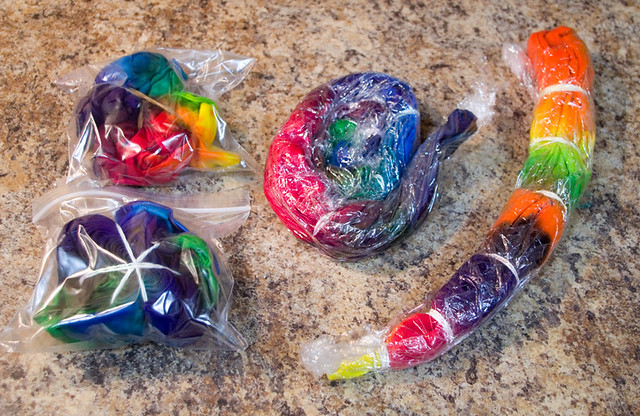
Tie dyeing with the kids is really something that I prefer to do in the summer when I can throw the kids outside in their bathing suits (which are synthetic and don’t absorb dye) to minimize the mess indoors. This time of year, with temperatures hovering around freezing and snow still covering the ground, that’s not exactly an option. Instead, the girls worked in their bathing suits and socks (warm feet are important) in the kitchen, over the metal sink, and we hoped for the best.

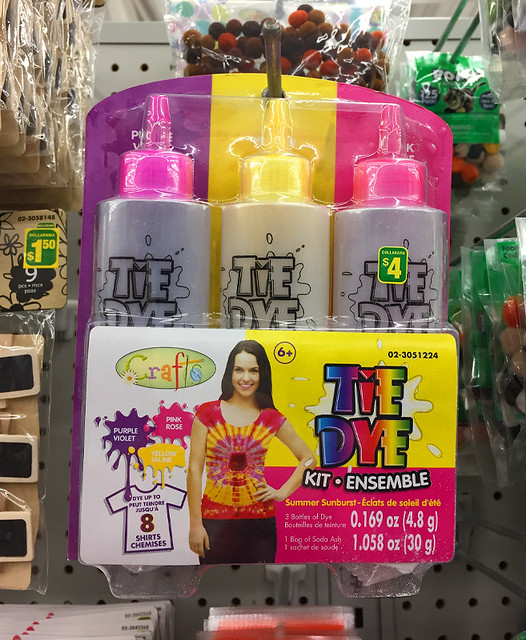
In the spirit of keeping things as cheap as possible, we used fabric we already had — four old, plain cotton pillow cases. We also bought the dye at the dollar store. So far, this are the cheapest kits I’ve found locally, with even Walmart’s selection starting at about $11.00 for a two-colour Tulip-brand kit that only makes three items. For six colours, you’re looking at upwards of $25.00. At Dollarama, they sell their own Crafts brand three-colour kits for $4.00 apiece, and we bought two in different colours. But would these kits work as well as the more expensive ones we’d tried?

When it comes to the supplies included in the kit, I found that they were more or less the same as other brands. They contained everything we needed except the water and the plastic to wrap the fabric as it sat, which is standard. Slightly higher quality gloves would have been appreciated, since they did leak and now the kids have splotches on their hands in places, but that seems to be standard too (just like the ones that come with hair dye). The instructions were clear and concise, and even had a brief photo tutorial for how to make different kinds of designs. We used the spiral (left) and bullseye (center and right) techniques on the kids’ pillowcases. (If you need more information about how to tie dye there are a million sites out there, but the Tulip site has some great tutorials that will work with any brand of dye.)

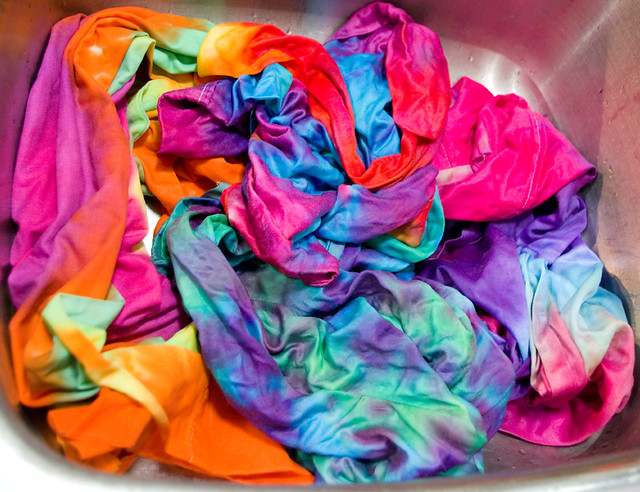
The kit did contain soda ash, which is necessary to pre-treat the fabric to retain vibrant colours. However, the directions did say that the dyes could be used without pre-treatment, but they would come out more pastel. I let the kids choose between waiting a bit longer to dye so they could have bright colours, or to do it right away and have lighter colours, and not surprisingly they chose to go with the route that required the least amount of patience. Despite the dire warnings of the packaging and articles online, after the first rinse the colours remained vibrant (above).

After a run through the washer and dryer, the colours did fade a bit, and I expect that they will continue to do so throughout their lifetime, but I remain happy with the final product. The kids are thrilled (according to Thing 1, the pillow cases are “Awesome!”), and since the project was for them, I say it was a success. (Bottom left and top right were done in the spiral techniques, top left and bottom right were done using bullseye — more techniques here.)

I will say one thing, though: each package of three colours claims that it contains enough dye for up to eight T-shirts. I guess that could technically be true, if you were to use very small shirts, and if you didn’t want a lot of colour saturation or variation in your design. Two packs, for us, did four very saturated single-bed-sized pillow cases (which I would say are about the same size as a small adult T-shirt), with enough left over to do maybe one more. That’s five items out of two packs of dye, when it claims we could make sixteen items. So keep that in mind when you decide how many items to prep. Even so, that’s five items in six colours for $8.00, compared to Walmart’s three items in two colours for $11.00, so Dollarama remains the cheapest place in town to buy supplies for tie dye crafts.

Fairy Light Lamp Tutorial

It’s March Break, so I’m trying to keep the kids entertained without plopping them in front of screens the entire time. We’re going to try to do a craft a day, and I thought I’d share what we did and how we did it so that others can use these same techniques this week (or any time, really).

The first craft we did was a fairy light lamp. There’s no wiring required, and for safety’s sake all of the lights are LED and the power source is battery-powered. We’ve all seen a string of lights in a jar, but I thought we needed to do something to take it up a notch. If you’re working with younger children, some of these steps will need adult supervision. The end result should be an ornamental lamp or night light that the kids can be proud of! As a bonus, all of the materials can be obtained at the local dollar store, or can be made of recycled materials for free.

Since there are a few ways to do this craft, be sure to read all of the instructions first, to keep from having to re-do steps!

Fairy Light Lamp

Materials:
– small sturdy cardboard box with lid
– Mason jar or recycled jar with lid
– paint
– string of 20 battery-powered LED lights (or two strings of 10)
– batteries to power the LED lights
– diffusing fabric
– small piece of card or paper (optional)
– stickers

Supplies Needed:
– pencil
– craft knife
– duct tape
– paint brush(es)
– heavy-duty scissors
– drill (if using a jar with a one-piece lid)

1. Unscrew the lid from the jar. I used a 1L Mason jar because that’s what fit best with my box, but it’s a very subjective judgement. I also liked the look of a round box, but square or rectangular is fine too. Just make sure it’s the kind of box that has a lid. Don’t worry about a colour or pattern on the box, since it will be covered later. If you want to use a wooden box, that can work too, but you’ll need heavier-duty tools to proceed with the next steps.

2. Trace the opening of the jar onto the lid of your box.

3. Using a craft knife, cut a hole along the line that you have traced. Make sure not to use the knife on a surface that you don’t want damaged, since it will make marks on whatever’s underneath the lid!
4. Make sure that the jar fits into the hole as shown. If the fit is too tight, trim off edges of the hole with the craft knife.

5. Use a few pieces of duct tape (any colour) to reinforce the cardboard around the hole on the inside of the box.

6. Paint the outside of the box. My kids chose a base coat of their favourite colour, then two coats of glitter paint in different colours. We used acrylic paint, since it is more permanent and covers better than kids’ craft paint. Because of this, we covered our table in craft paper first to protect it — and if you look at the paper under the box, you can see why.

Other options to painting include decoupage, stickers, and wrapping the box in pretty paper. No matter what method you choose, make sure that the top and bottom are done separately, since you’ll need to be able to get into the box.

7. Put the batteries into the battery pack of the light string(s). Stuff the diffusing fabric and strings of light into the jar, leaving the battery packs and some cord outside of the jar. I used a cheap tulle (a lightweight, very fine, stiff netting as my diffusing fabric, which is available at most craft stores, fabric stores, and dollar stores in the craft section. A good place to look for this kind of thing is in the Christmas clearance section. You can use a plain colour or one with a glitter pattern. Whatever you choose, the point of the fabric is to make the light from the LEDs softer, hide the cords, and keep it all in place. Arrange the fabric and lights until they are in a position that you find satisfactory. I found that it helped to do so in low lighting so I could see how the light would shine through.

8. Using the heavy-duty scissors, cut a wide slot into the flat part of the Mason jar lid. If you are using a recycled jar with a one-piece lid, using a drill make hole large enough to easily pass the light string through.

9. Cut small strips of duct tape (any colour) and use them to cover the sharp edges of the hole in the lid. This will keep little fingers and the wires from the lights from getting cut.

10. Cover the inside of the lid with a piece of coordinating-coloured duct tape. If you don’t have any, a piece of card or colour in a coordinating colour will also work.

11. Thread the light strings through the hole. If you’re using a piece of card/paper, that should be between the lid and the jar. If you’re using a one-piece lid, you should do this step before you fill the jar with the lights and fabric.

12. Using a piece of duct tape in a coordinating colour, cover most of the hole. If you’re using the card/paper layer, this tape can be any colour. This step is unnecessary if you’re using a one-piece lid.

13. Assemble the parts in the following order:

– jar
– box lid
– card/paper (optional)
– Mason jar lid, then Mason jar band OR one-piece lid

14. Put the battery packs into the bottom of the box, then flip the jar and box lid over on top of the box bottom. To turn the lights off and on, just reach inside the box and flip the switch(es). If you like your lights simple, this can be the end of this craft. My kids wanted a bit more fun, though!

15. My girls really wanted to decorate their lanterns with 3D butterfly stickers, so that’s what we did. Honestly, any kind of sticker would work, although shiny ones (especially the faux-jewel kind) would reflect the light better.

My girls made a lantern each in their favourite colours. You may notice that the jars are slightly different because they’re from different manufacturers. The kids didn’t notice, though.

The lanterns look especially nice in the dark, and they throw interestingly-patterned shadows on the wall.

I promised Thing 2 that I would post a picture of her orange and gold lantern all by itself, since I’d done so many of Thing 1’s blue and silver one already.

So there you go! I hope that your kids enjoy making these fairy light lanterns as much as mine did!

Grilled Cheese

Our household is currently in the grip of a nasty gastro bug; Thing 1’s illness started promptly at 6:00am on Friday morning, and Thing 2 woke up at 4:30am Monday morning to begin her turn. I’ll spare you all the nasty details, but nobody in our house is really thinking about cooking or thrifting or crafting at the moment. Right now we’re all just trying to take care of each other and/or minimize the effects of the bug. So here’s a picture of a meal we made up last week:

That’s a grilled cheese (lactose-free for me) and avocado sandwich, served with a salad of romaine lettuce and baby spinach and a choice of dressings. The bread is a Farmhouse Loaf that Thing 1 made in the bread machine; the recipe is on page 72 of Bread Machine: How to Prepare and Bake the Perfect Loaf (Jennie Shapter (2002)).

Hopefully we’ll be able to return to your regularly scheduled programming quickly.

First Barbecue of the Year

Around the start of March, the weather begins to get warmer, but it’s still below freezing most nights and we’ll likely get a few more good snowfalls in. The weather has been quite mild recently, and is predicted to remain so for a while. We’ve managed to avoid Winter Storm Riley, which is hitting south and east of here. Canadian winters being what they are, we’d be prepared for the kind of snow that Europe is getting right now, but that weather system is much too far away. Instead, what we’re getting right now is the first hint of spring.

The photo above is a really old one of Thing 1 at the start of March, playing in the back yard while we cooked dinner on the barbecue. I love it because it shows the weird accommodations we have to make for the weather this time of year. (I also love it because I think Thing 1 is adorable, but I am somewhat biased.) It takes quite a while of above-zero temperatures for all of the snow to melt, and after that for the ground to thaw enough so that the water doesn’t just sit on the surface in a coating of mud and puddles. But it’s warm enough out that anything with good sun — or that sticks out of the snow covering — gets well dried out, and for the most part we get away with lighter clothing because it seems so much warmer than the frigid winter was. If you have kids in school, you send them in all bundled up for the morning temperatures (which are often below freezing), and they come home in the afternoon with 99% of their outerwear in hand or in their backpacks because it’s just much too warm. I’m pretty sure that this time of year is when the most stuff gets turned in to the school lost-and-found, to be honest.

One of the perks of this time of year is that our barbecues can be started up again, since they stick out of the ground a fair way and aren’t in areas prone to drifts. Technically, they can be used year-round, but we would have to dig them out after every snowfall, and missing just a bit of ice means that the covers end up frozen to the ground until the next big thaw. Actually, the gas barbecue’s cover is still quite encased in ice, but the cover for the Black Olive (an insulated wood pellet grill) is shorter and hence could be freed sooner. This device was handed down to us at the end of last fall, so we never really got the chance to test it out. Yesterday, my husband fired it up for the first time this year and we had our first hamburgers of the season — a sure sign that spring will soon be here. I had my burger with lactose-free cheese, mayonnaise, mustard, avocado, and lettuce. And dill pickles, of course.

A Year Gone By

The one-year anniversary of this blog (blogiversary?) slipped by on February 13th without me really noticing it. Sitting down at the computer to write a blog post before I shut down my computer and crawl into bed has become a part of my daily routine. It has given me a chance to reflect on the things I’ve worked on or that have interested me. On a more practical note, blogging has allowed me to keep track of what I’ve done, where I got the recipe/instructions/pattern, and how it turned out — and in a searchable format. I can’t count the number of times I’ve grabbed my phone and used the search function on this blog as a quick memory aid.


Kirkland Asian Beef Noodle Soup kit with added soft-boiled eggs. It looks reasonably appetizing, but it tastes powdery and somehow more artificial than an instant ramen packet. Thumbs down from me.

Have I learned anything over the last year? Well, I’ve expanded my cooking skills considerably. I no longer rely on the same repertoire of a few reliable recipes day in and day out. I mean, of course I still have some that I go back to over and over again, but that’s interspersed with trying new things. And trying new things has started to help me get over the fear of failure when learning. One of the great things about cooking is that even if you mess it up, it’s only one meal. It may seem like a big deal at the time, especially for the more difficult dishes, but in the grand scheme of things it’s not so bad. The important thing is that I learn from my failures.


Homemade chicken noodle soup with half an avocado filled with ranch dressing, and a Dad’s Biscuit. I may have added a few too many noodles to the soup this time, but it tasted fine.

I’m also enjoying how blogging has pushed me to try new foods and new techniques — and that, by extension, has influenced how my children experience the culinary world. So long as it’s not burned to a crisp, my husband will eat just about anything so long as he doesn’t have to cook it. (That’s not to say that he doesn’t have his preferences, but he’ll still eat stuff he’s not fond of.) But my kids, though, are more resistant to culinary change. They’re not super-picky eaters (and boy, have I heard stories about kids like that), but they tend to complain when a food isn’t one of their favourites. I think that exposing them to new foods so often now has taught them that just because a food is new, that doesn’t mean they won’t like it. There’s still resistance there, but not at the same level as this time last year. And I have to say it’s heartwarming when I overhear my kids brag to their friends about my cooking — and then try to persuade their friends to try something new.


A quick dinner of fried rice using whatever leftovers were in the fridge. Ingredients included roast chicken, roast beef, red onion, green onion, potatoes, corn, peas, mushrooms, garlic, and eggs, cooked together with a bit of soy sauce and miso broth. Tasty.

Where do I want to go from here? Well, I have a whole list of dishes I want to try, and a stack of new cookbooks from Christmas that I’ve barely cracked. My friends bought me a copy of The Sioux Chef’s Indigenous Kitchen by Sean Sherman (2017), and I am highly intrigued. I also want to dive into How To Cook Indian by Sanjeev Kapoor (2011), which my husband bought me. Although these books are from completely different cultures and corners of the globe, they do share a commonality in that I’ll have to learn where to source some of the ingredients that are less common around here (or common, but only seasonally). I also want to improve my breadmaking skills, and learn to make rum balls and pavlovas.


Fresh fruit tarts made from crust leftover after making full-sized pies. The filling is basically a peeled, chopped apple, strawberries, and blueberries, with a bit of white and brown sugar and a dash of cinnamon.

Mostly, I just want to keep learning. There is so much out there to try! I want to push my personal boundaries when it comes to cooking, and try new techniques when it comes to handicrafts, and start my own small business when it comes to thrifting. I want to challenge myself. I want to expand. I want to grow. And I want to keep writing about it.

Pancake Tuesday

Mardi Gras isn’t really a thing around here, although I’d love to head down to New Orleans some day to celebrate it. However, my family does have British history, and hence strong cultural ties to the Anglican church. As such, when I was growing up we honoured Shrove Tuesday, which immediately precedes Ash Wednesday (the first day of Lent) — although perhaps “honoured” is stretching things a bit. We never sought out the church in order to obtain absolution for our sins on Shrove Tuesday, and we didn’t give up certain foods for Lent. What we did do was make a point of serving pancakes on Pancake Tuesday. As you can see, the celebration for us, such as it is, was much more secular than religious. It’s kind of like how many people celebrate Christmas without ever going to church.

I’ve decided to keep the tradition alive with my children by cooking pancakes for dinner every year on this day (when I remember). It’s not like this is the only time we have pancakes, after all. This year I served it covered in a mound of freshly-prepared fruit salad that included green grapes, blueberries, honeycrisp apples, oranges, bananas, and strawberries. As winter drags on, these pops of colour and flavour are welcome additions to our diet. That being said, every single one of these items is an import (except maybe the apples, which store well), so the fruit commands a premium price.

I used my Spiced Pancake Recipe for the pancakes themselves, since they’ve become quite a hit in my household of late. There were all kinds of sweet toppings available: whipped cream and non-dairy whipped cream substitute, black currant syrup, elderberry syrup, maple syrup, caramel syrup, and icing sugar. I had mine with elderberry syrup and non-dairy whipped cream substitute. It was delicious! I made a bit extra for the kids to reheat in the morning for breakfast, too, which makes our morning that much easier — and tastier.

Toad in the Hole

I’ve been wanting to try to make toad in the hole for ages. I have vague memories of my Nan serving it, or at least something similar, although I couldn’t remember the name… I Googled “pigs in a blanket” and “bubble and squeak” before I finally figured out what the name was of the dish that I remembered. Basically, toad in the hole is sausages baked in Yorkshire pudding batter — with regional and temporal variations, of course. Although the photos I’ve found online use thick sausages for the most part, I distinctly remember the version from my childhood containing smaller breakfast sausages, so that’s what I was determined to make.

The first time I tried it, I wasn’t very happy with the results. I used the Yorkshire pudding recipe from the Joy of Cooking (page 637, 2006 edition, Rombauer & Becker), which was recommended by my father. I doubled the recipe and doubled the size of the pan, which I thought would work just fine, but the sausages were just too small to compensate for all that batter. Also, although the edges of the casserole rose and puffed up quite nicely, it didn’t cook evenly through the center, leaving it a stodgy mess. I mean, the texture was firm enough to be edible, but it wasn’t very appetizing.

I tried to learn from my mistakes the second time around. This time I whipped up only a single batch of the batter, which greatly improved the ratio of batter to meat, at least for sausages this small. I cooked it all in a pan that was half the size, which allowed it to rise more thoroughly. Also, I used a metal pan instead of a glass one, which I find in general allows for a crispier edge to baked dishes.

I was really happy with how it turned out. The pudding rose beautifully, so fluffy in the middle that in many spots it was completely hollow. The crust was nice and crisp without being hard. The sausages were perfectly done. Now, if only I’d remembered to grease the pan, since to serve it I almost had to destroy it. You’d think I’d know better by now.

I served my toad in the hole with a side Ceasar salad and some sliced avocado, which my Nan would never have done (she’d have paired it with boiled or baked veggies). But I thought we needed some fresh greens with a main dish that doesn’t contain a single vegetable. The family ate it all up and asked me to make it again soon, which tells me that it was a success.

Christmas Gifts

I received some absolutely lovely Christmas gifts this year from friends, family, and Santa Claus. Some of the gifts would likely be of interest to other crafty- and foodie-types. My brother gave me one of those fantastic crocheted knight helmet hats and the previously-mentioned Jamie Oliver 5 Ingredients Quick & Easy Food cookbook (Jamie Oliver, 2017). My husband gave me a copy of How to Cook Indian by Sanjeev Kapoor (2011). Santa brought me some lovely worsted-weight variegated yarn, which I am currently turning into a hat. My parents bought me a funny (and very accurate) Procrasti-knitter T-shirt from White Owl Crochet.

But I do have a weakness for handmade items that combine practicality with beauty, and this year my parents picked out some absolutely lovely pieces for me. The first is a pair of wine tumbler/tea bowls from Greig Pottery. The one on the right is patterned with lupins, which is a flower that I first fell in love with on a trip to Newfoundland with my mom about eight years back. In shape and size, these vessels remind me of Japanese teacups, although they are intended for both hot and cold beverages (so far as I know, you’d never have a cold beverage in this kind of cup in Japan). They fit comfortably in my hand and the little indents — one on either side — are perfectly placed for my thumb and forefinger. As a bonus, they’re both microwave and dishwasher safe. I can’t wait to use them, possibly for some rum and eggnog before the season is over.

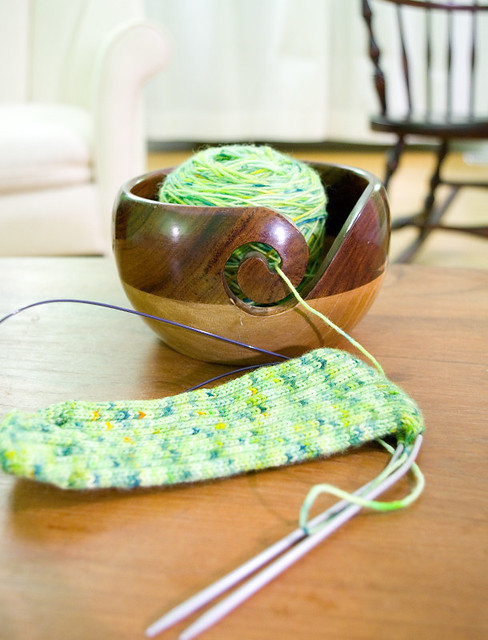
Mom and Dad also gave me this gorgeous two-tone rosewood & mango wood yarn bowl from Knitpicks. They actually gave me two hand-potted yarn bowls (in different sizes, for different-sized balls of yarn) last year for Christmas, but my kids managed to smash both of them on the same day. Needless to say, I was not amused, as the bowls sat on the table in the living room where the kids aren’t supposed to be playing in the first place. I was very vocal (possibly too vocal) about how much I missed the old bowls, so Mom actually hopped onto the Internet and ordered me a new one — one that, it should be noted, should be much more difficult to smash. Touch wood. I love the glassy-smooth finish of the wood; when I got the bowl, I couldn’t stop running my hands over it. I was especially proud of my mother for ordering it for me, since she had never before shopped online on her own, usually getting my brother or I to order things for her. I don’t see an Amazon Prime account in her future, but I like that Mom is now able to put aside her worries about online shopping, at least for items that she can’t get in town.

I want to take this opportunity to say a sincere thank-you for all of my gifts this holiday season. Although, as Garfield points out in the Christmas special that we watch every year, it’s not the giving, it’s not the getting, it’s the loving.

Christmas Breakfast

Christmas breakfast was a big thing at my house when I was a kid. Mom and Dad pulled out all of the stops and bought all kinds of awesome food that we pretty much never had any other time of the year. I associated these foods so strongly with the holidays that it came as a great revelation to me when I moved out that I could buy Havarti cheese with dill or caraway seeds, or Babybel miniature cheeses, or Stoned Wheat Thins all year long.

We’ve been hosting Christmas breakfast at our house since the year that Thing 1 was born. Given that she would have needed to be fed and then probably put down for a nap sometime during the festivities, it just made sense for us to stay home and have the rest of my family come to us. Breakfast is generally served buffet-style, so that everyone can have a little bit of everything and then head over to the Christmas tree to open gifts, often while still munching.

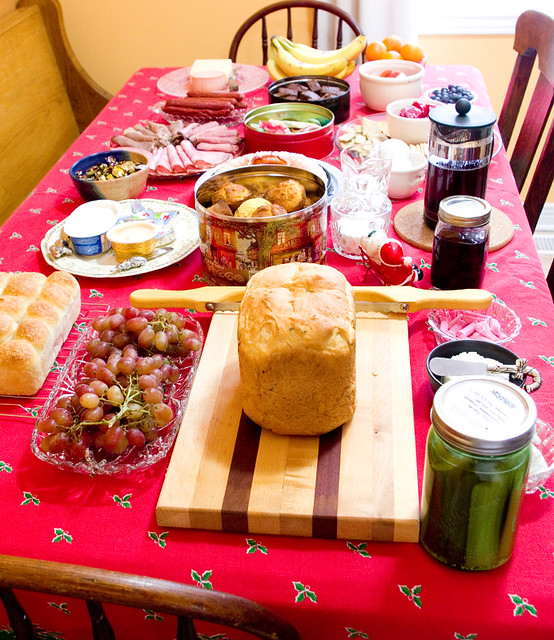
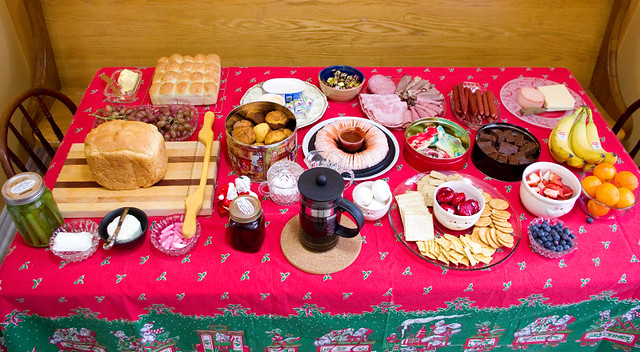
This year I served (working roughly from left to right):

Nan’s pan rolls* with butter
– red grapes
– rosemary bread from the bread machine**
– homemade dill pickles
– Chevrai Original Goat Cheese
– Garlic & Fine Herbs Boursin cheese
Chicken Bones
– Daiya Plain Cream Cheeze Style Spread
– Crème Oka cheese
– Laughing Cow cheese
– my husband’s homemade cornmeal muffins
– homemade pickled beets
– coffee & tea with sugar & milk
– chocolate toffees
– meat platter with Hungarian salami, Montreal smoked meat, roast beef, and Black Forest ham
– shrimp ring with cocktail sauce
– Christmas Cookie Monster’s Shape Cookies (made, for the most part, by Thing 1 and Thing 2)
– cold hard-boiled eggs
– Babybel miniature cheeses
– cracker plate with Stoned Wheat Thins, Ritz, Vegetable Thins, and Rosemary & Olive Oil Triscuits
– pepperettes (all-beef by my hubby’s preference and European style for mine)
– Oka and Havarti cheeses
Fudgy Pumpkin Brownies (this time with no coffee)
– bananas
– strawberries
– clementines
– blueberries

In case you’re worried, no, the seven of us did not eat this all in one sitting. This much could have easily fed twice that amount of people, with food to spare! The point of this kind of meal (which only happens once a year) is that everyone can have as much as they like, and then it all gets packed away to become lunches and dinners for the next week or so. There were still a few leftovers as of New Year’s Day, but that was of the kind of thing that takes forever to go bad, like crackers. Some of it will probably even make its way into the kids’ lunches in the new year.

*I discovered that these rolls can be left to do their second rise overnight in the refrigerator, and then just popped into the oven to serve fresh-baked for breakfast. If you’re going to do so, make sure that the pan you use is metal and not glass, as it takes the glass longer to heat up and can make the bottom of the rolls take a little too long to cook. Also, if the top is browning but the bottom isn’t quite done yet, cover the top of the rolls with aluminum foil to prevent them going from “browned” to “burnt”.

**Classic White Bread, found on page 24 of Betty Crocker’s Best Bread Machine Cookbook (1999) — but with half the sugar, olive oil instead of margarine, and about 1/4 cup fresh chopped rosemary added.