Fairy Light Lamp Tutorial

It’s March Break, so I’m trying to keep the kids entertained without plopping them in front of screens the entire time. We’re going to try to do a craft a day, and I thought I’d share what we did and how we did it so that others can use these same techniques this week (or any time, really).

The first craft we did was a fairy light lamp. There’s no wiring required, and for safety’s sake all of the lights are LED and the power source is battery-powered. We’ve all seen a string of lights in a jar, but I thought we needed to do something to take it up a notch. If you’re working with younger children, some of these steps will need adult supervision. The end result should be an ornamental lamp or night light that the kids can be proud of! As a bonus, all of the materials can be obtained at the local dollar store, or can be made of recycled materials for free.

Since there are a few ways to do this craft, be sure to read all of the instructions first, to keep from having to re-do steps!

Fairy Light Lamp

Materials:
– small sturdy cardboard box with lid
– Mason jar or recycled jar with lid
– paint
– string of 20 battery-powered LED lights (or two strings of 10)
– batteries to power the LED lights
– diffusing fabric
– small piece of card or paper (optional)
– stickers

Supplies Needed:
– pencil
– craft knife
– duct tape
– paint brush(es)
– heavy-duty scissors
– drill (if using a jar with a one-piece lid)

1. Unscrew the lid from the jar. I used a 1L Mason jar because that’s what fit best with my box, but it’s a very subjective judgement. I also liked the look of a round box, but square or rectangular is fine too. Just make sure it’s the kind of box that has a lid. Don’t worry about a colour or pattern on the box, since it will be covered later. If you want to use a wooden box, that can work too, but you’ll need heavier-duty tools to proceed with the next steps.

2. Trace the opening of the jar onto the lid of your box.

3. Using a craft knife, cut a hole along the line that you have traced. Make sure not to use the knife on a surface that you don’t want damaged, since it will make marks on whatever’s underneath the lid!

4. Make sure that the jar fits into the hole as shown. If the fit is too tight, trim off edges of the hole with the craft knife.

5. Use a few pieces of duct tape (any colour) to reinforce the cardboard around the hole on the inside of the box.

6. Paint the outside of the box. My kids chose a base coat of their favourite colour, then two coats of glitter paint in different colours. We used acrylic paint, since it is more permanent and covers better than kids’ craft paint. Because of this, we covered our table in craft paper first to protect it — and if you look at the paper under the box, you can see why.

Other options to painting include decoupage, stickers, and wrapping the box in pretty paper. No matter what method you choose, make sure that the top and bottom are done separately, since you’ll need to be able to get into the box.

7. Put the batteries into the battery pack of the light string(s). Stuff the diffusing fabric and strings of light into the jar, leaving the battery packs and some cord outside of the jar. I used a cheap tulle (a lightweight, very fine, stiff netting as my diffusing fabric, which is available at most craft stores, fabric stores, and dollar stores in the craft section. A good place to look for this kind of thing is in the Christmas clearance section. You can use a plain colour or one with a glitter pattern. Whatever you choose, the point of the fabric is to make the light from the LEDs softer, hide the cords, and keep it all in place. Arrange the fabric and lights until they are in a position that you find satisfactory. I found that it helped to do so in low lighting so I could see how the light would shine through.

8. Using the heavy-duty scissors, cut a wide slot into the flat part of the Mason jar lid. If you are using a recycled jar with a one-piece lid, using a drill make hole large enough to easily pass the light string through.

9. Cut small strips of duct tape (any colour) and use them to cover the sharp edges of the hole in the lid. This will keep little fingers and the wires from the lights from getting cut.

10. Cover the inside of the lid with a piece of coordinating-coloured duct tape. If you don’t have any, a piece of card or colour in a coordinating colour will also work.

11. Thread the light strings through the hole. If you’re using a piece of card/paper, that should be between the lid and the jar. If you’re using a one-piece lid, you should do this step before you fill the jar with the lights and fabric.

12. Using a piece of duct tape in a coordinating colour, cover most of the hole. If you’re using the card/paper layer, this tape can be any colour. This step is unnecessary if you’re using a one-piece lid.

13. Assemble the parts in the following order:

– jar
– box lid
– card/paper (optional)
– Mason jar lid, then Mason jar band OR one-piece lid

14. Put the battery packs into the bottom of the box, then flip the jar and box lid over on top of the box bottom. To turn the lights off and on, just reach inside the box and flip the switch(es). If you like your lights simple, this can be the end of this craft. My kids wanted a bit more fun, though!

15. My girls really wanted to decorate their lanterns with 3D butterfly stickers, so that’s what we did. Honestly, any kind of sticker would work, although shiny ones (especially the faux-jewel kind) would reflect the light better.

My girls made a lantern each in their favourite colours. You may notice that the jars are slightly different because they’re from different manufacturers. The kids didn’t notice, though.

The lanterns look especially nice in the dark, and they throw interestingly-patterned shadows on the wall.

I promised Thing 2 that I would post a picture of her orange and gold lantern all by itself, since I’d done so many of Thing 1’s blue and silver one already.

So there you go! I hope that your kids enjoy making these fairy light lanterns as much as mine did!
Vintage Tupperware

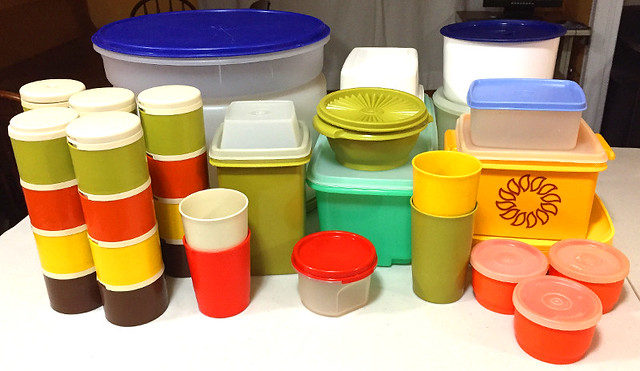
As I write this I am fighting symptoms and hoping to heck that I’m not coming down with whatever the kids had, so I thought I’d just make a quick post about my recent awesome thrifting find. I managed to come into a whole lot of vintage Tupperware:

Okay, some of it is more modern than vintage, and the Pick A Deli (the olive green tall, rectangular container) is missing the lifter/strainer bit, but it was a really awesome find. I was especially happy with the colourful 1970’s stacking spice containers on the left, although the parts of the 1980’s picnic set with the yellow plates with and the stackable container with the orange sunburst were a close second. I’ve only started collecting this stuff recently, and I didn’t realize until I started how much a part of my childhood these containers were.

Lemongrass Atsuete Chicken

Last night everyone was finally well enough to actually eat again; nobody had much of an appetite, but at least some solids were staying down. So I decided not to make anything too difficult and used a marinade I’d impulse-bought at Walmart a while back: Pulo Lemongrass Atsuete Marinade. This brand claims to be inspired by the 7000 islands of the Philippines, but since I honestly wouldn’t be able to pick Filipino food out of a lineup, I couldn’t tell you how authentic it is. But I thought I’d give it a go anyway.

I was pleasantly surprised by the marinade! It was light but flavourful; the fresh zing of the lemongrass really shone through. I used it to marinade eight chicken thighs, which was all we needed, but there was enough marinade there for twice as much. (Next time I’ll only use half a bottle.) I baked the chicken in the oven, while on the stove I cooked up some macaroni that I served with a quick cheater sauce of cream of mushroom soup, lactose-free cheddar, a sprinkle of garlic powder, and frozen corn. Since it was such a mild sauce, it went really well with the strong flavour of the chicken. I also brought out a side salad of spinach and romaine lettuce, with a choice of dressings.

National Cereal Day

Yet another day of taking care of sick kiddos… It doesn’t leave much time (or inclination) to cook. Luckily, we had lots of bits and bobs from previous dinners in the fridge that needed to be eaten anyway, so yesterday became Leftover Night. Lunch, however, was a bit of a wash, so I just had a bowl of cereal.

Social media reminded me that today is National Cereal Day in the US, although it doesn’t even make the ,a href=”https://en.wikipedia.org/wiki/List_of_food_days”>list of food days on Wikipedia. According to that list, yesterday was actually National Crown Roast of Pork Day, which was way more complicated than I was up to trying. It occurs to me that if I planned our menu based on the national food days, we’d have quite the variety of diet, and I’d have the inspiration to try a whole bunch of new things.

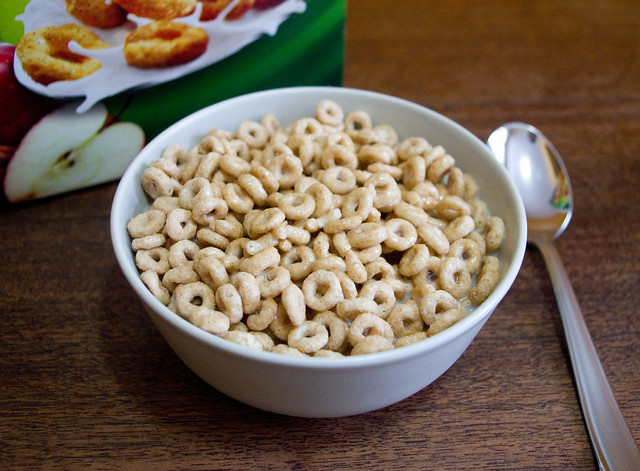
Anyways, I ate a bowl of Apple Cinnamon Cheerios, which have been my favourite cereal since I was a kid. My parents wouldn’t let us get sugary cereals on a regular basis, so when we did get a box it was a real treat. This was pretty much the only sugary breakfast we ever had, except sometimes for those miniature boxes of cereal when we were camping/cottaging. I used to eat healthier cereal almost every day, but I slowly fell out of the habit as I became more sensitive to dairy (I don’t like my cereal dry). Now I eat it with almond milk, but I’ve come to prefer a hot breakfast or at least some toast in the morning. We always have cereal around, though, since the kids eat it all the time. Following my parents’ lead, I also only allow sugary cereal as the occasional treat. Much to my surprise, my kids don’t even like Apple Cinnamon Cheerios, so I don’t even have to share them!

Grilled Cheese

Our household is currently in the grip of a nasty gastro bug; Thing 1’s illness started promptly at 6:00am on Friday morning, and Thing 2 woke up at 4:30am Monday morning to begin her turn. I’ll spare you all the nasty details, but nobody in our house is really thinking about cooking or thrifting or crafting at the moment. Right now we’re all just trying to take care of each other and/or minimize the effects of the bug. So here’s a picture of a meal we made up last week:

That’s a grilled cheese (lactose-free for me) and avocado sandwich, served with a salad of romaine lettuce and baby spinach and a choice of dressings. The bread is a Farmhouse Loaf that Thing 1 made in the bread machine; the recipe is on page 72 of Bread Machine: How to Prepare and Bake the Perfect Loaf (Jennie Shapter (2002)).

Hopefully we’ll be able to return to your regularly scheduled programming quickly.

First Barbecue of the Year

Around the start of March, the weather begins to get warmer, but it’s still below freezing most nights and we’ll likely get a few more good snowfalls in. The weather has been quite mild recently, and is predicted to remain so for a while. We’ve managed to avoid Winter Storm Riley, which is hitting south and east of here. Canadian winters being what they are, we’d be prepared for the kind of snow that Europe is getting right now, but that weather system is much too far away. Instead, what we’re getting right now is the first hint of spring.

The photo above is a really old one of Thing 1 at the start of March, playing in the back yard while we cooked dinner on the barbecue. I love it because it shows the weird accommodations we have to make for the weather this time of year. (I also love it because I think Thing 1 is adorable, but I am somewhat biased.) It takes quite a while of above-zero temperatures for all of the snow to melt, and after that for the ground to thaw enough so that the water doesn’t just sit on the surface in a coating of mud and puddles. But it’s warm enough out that anything with good sun — or that sticks out of the snow covering — gets well dried out, and for the most part we get away with lighter clothing because it seems so much warmer than the frigid winter was. If you have kids in school, you send them in all bundled up for the morning temperatures (which are often below freezing), and they come home in the afternoon with 99% of their outerwear in hand or in their backpacks because it’s just much too warm. I’m pretty sure that this time of year is when the most stuff gets turned in to the school lost-and-found, to be honest.

One of the perks of this time of year is that our barbecues can be started up again, since they stick out of the ground a fair way and aren’t in areas prone to drifts. Technically, they can be used year-round, but we would have to dig them out after every snowfall, and missing just a bit of ice means that the covers end up frozen to the ground until the next big thaw. Actually, the gas barbecue’s cover is still quite encased in ice, but the cover for the Black Olive (an insulated wood pellet grill) is shorter and hence could be freed sooner. This device was handed down to us at the end of last fall, so we never really got the chance to test it out. Yesterday, my husband fired it up for the first time this year and we had our first hamburgers of the season — a sure sign that spring will soon be here. I had my burger with lactose-free cheese, mayonnaise, mustard, avocado, and lettuce. And dill pickles, of course.

Beef Stroganoff Recipe

I’ve been making beef stroganoff for fifteen years or so, but I hadn’t had any since a consultation with a dietician who suggested that I may be lactose intolerant. It’s been about a year since I started avoiding lactose, and my gut is much happier for it. I’m not touting this as something that everyone should try, since I know that there are a whole lot of people that tolerate lactose just fine — but sadly, I’m no longer one of them.

Lately I’ve been quite happy to discover that, in addition to the vegetarian/vegan options to milk that are out there, a few dairy companies have started to sell lactose-free versions of their products. I’ve found PC lactose-free old and marble cheddars in my local grocery store, and, for the first time just this week, Gay Lea’s lactose-free sour cream. As soon as I saw the sour cream on the shelf, I knew that I had to make some stroganoff this week.

Now, I’m not vouching for the authenticity of my stroganoff or anything. I can’t even remember where I first learned how to make it; it certainly wasn’t from someone who taught me in person. My version is the combination of a number of recipes over the years that have created what I’d consider to be a good meal for when you have a little bit of time to cook, but you still have other plans for the evening. It’s full of mushrooms and onions, but I recommend serving it with steamed veggies or a side salad to round it out. At the very least, this will add a splash of colour, since stroganoff is such a beige dish!

Beef Stroganoff
Serves 4-6 adults

In a large, deep frying pan, heat at medium-high:
2 Tbsp canola or sunflower oil
Into the heated oil, place:
1 yellow onion, chopped (about 120g before peeling & chopping)
Cook the onion gently until slightly browned, then add:
1 package of cremini mushrooms (227g)*
Cook until mushrooms begin to soften, then add:
450g steak or chopped roast chopped into bite-sized pieces with the fat trimmed off
Stir it all together, then sprinkle over the mixture:
1 tsp garlic powder
1 1/2 tsp nutmeg
1/4 tsp salt
Cook until the meat is browned on the outside and medium (pink, but not bloody) in the middle. While the meat is cooking, cook according to package directions:
2 cups of dried pasta
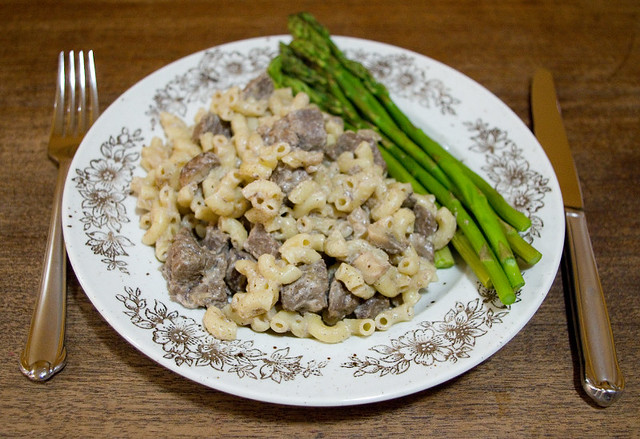
Traditionally stroganoff is made with broad egg noodles, but in our house we usually use penne. Rotini, fusilli, farfalle, and even elbow macaroni (pictured) also work well. Once the pasta is cooked, drain it and set it aside.
Once the meat is cooked, add to the pan:
1 cup sour cream (14% or greater) (regular or lactose-free)
Optionally, you can add:
1/4 cup cream cheese (optional)**
Stir the sour cream and cheese in until they are evenly distributed and have created a sauce; the sauce will have picked up some of the browning and spice and will have turned a nice light brown.
Add the drained pasta to the pan, and stir it all together until coated. Serve!

*You can add more mushrooms (up to double as much if you like), but this is the amount that my family prefers.
**I used to make my stroganoff with cream cheese every time, since I find it’s much creamier this way, but I have yet to find a lactose-free version. So for now I make it without.

Cleaning Up a Tiny Cast Iron Pan

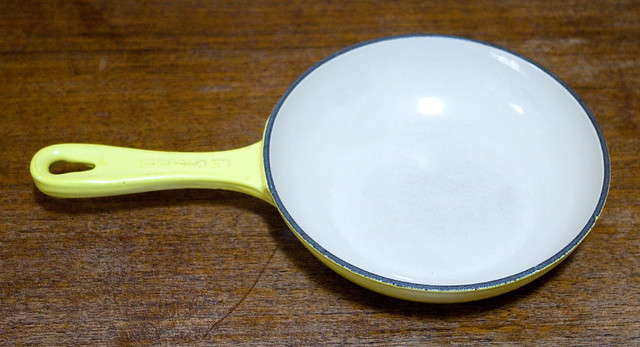
Not too long after I got the cast iron Nomar braiser, I found over the course of my thrifting a lovely little cast iron enameled pan. It’s only about 6.5″ (16.5cm) across, so I guess it’s individual-sized for frying. But a very popular baking trend at the moment is to bake and serve cakes and breads in cast iron pans, and this little pan would make a lovely serving for two for that kind of dish.

The inside doesn’t look half bad! There’s only a few scratches on the shiny enamel. And a bit of a squint at the handle reveals that it’s actually a Le Creuset, which means top-of-the-line workmanship. They don’t currently sell a pan this small, but one that’s about twice the size is $210.00, which does give an idea of how much it would have cost when new.

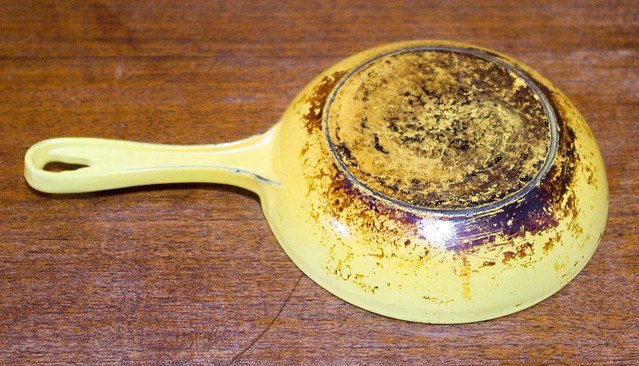
The bottom of the pan, however, needed some TLC. Luckily it’s not as bad as last time.

I used the baking-powder-and-lemon-juice paste technique again, and it worked a treat. It didn’t make too much of a difference to the inside…

But now the outside looks lovely too! There are a few scratches that can’t be removed, but all of the gunk is gone. And this time, it only took one application of the paste and a good scrub, instead of a couple days of soaking and scrubbing. Works for me!

Chicken Katsudon

Thirteen years ago, I went to Japan for a month-long visit. For most of that time, I was with my friend Michelle, who is a childhood friend from Canada who was teaching there. Together we traveled by train from Saga in the southwest along the coast to Tokyo over the course of three weeks, stopping many times along the way. One of our stops was to visit a young woman named Ayako Koyama and her family. Ayako had stayed with me back in high school as part of an exchange program; she’d also come to visit me as an adult about a year before. On this trip, I had the opportunity to meet her family and to get to know the home and the region where she had grown up.


Ayako, Mrs. Koyama, Mr. Koyama, Ayako’s grandfather, Ayako’s grandmother, and Michelle. Ayako’s brother must have been at work that night.

One evening, Ayako’s mother brought Michelle and I into her kitchen to teach us how to make katsu for dinner. I honestly can’t remember if it was chicken (torikatsu) or pork (tonkatsu) that we breaded and deep-fried, but I do remember the process! I was rummaging through my old photos yesterday and realized that I actually had a photo of us all eating the dinner we’d made (above). It was a lot of fun, although it’s always awkward to cook in someone else’s kitchen — even when there isn’t a language barrier! It remains one of my fondest memories of visiting with Ayako and her family. My one regret is that I wasn’t really into cooking at the time, so I didn’t take the opportunity to learn more from a Japanese home cook firsthand. Such a valuable resource wasted! I guess I’ll just have to go back to Japan someday and learn more.

These memories resurfaced recently when I saw a show on the Food Network that had a segment on some restaurant that makes a chicken katsu burger. I really had developed a liking for it in Japan (you can see one of the commercial meals that I had that included it in my Noodle Soup entry). It’s a real comfort food. Suddenly, I was craving chicken katsudon again. Although I’d made the meat part before and could pretty much remember how to do it without help, I had to Google for how to make the eggs correctly, since they’re not simply scrambled eggs. I used the Chicken Katsudon recipe from Just One Cookbook, and in an attempt to make it a little bit healthier I made Baked Katsudon instead of fried. I was pretty happy with how it turned out, although I know where I made some mistakes. I was running out of time at the end (I had to get the kids fed and out the door to Guiding), so I skipped cooking the chicken in the egg mixture and instead just put it on top, which made it a little bit dry. I think I cooked the egg a bit too long; when I had it in Japan it was just a little bit runny, more like a sauce than a scrambled egg. I also didn’t have any parsley, which would really have made it pop a bit more visually. Also, although I did manage to make up some miso soup, I ran out of time to make a salad, and a meal like this really needs some kind of veggie, even if it’s just a quick pickle. But given that it’s been thirteen years since I’ve attempted this dish, I don’t think it turned out too badly. It did get positive reviews from the family just how it was, so I am encouraged enough to try it again.

Chicken Wings & Salad

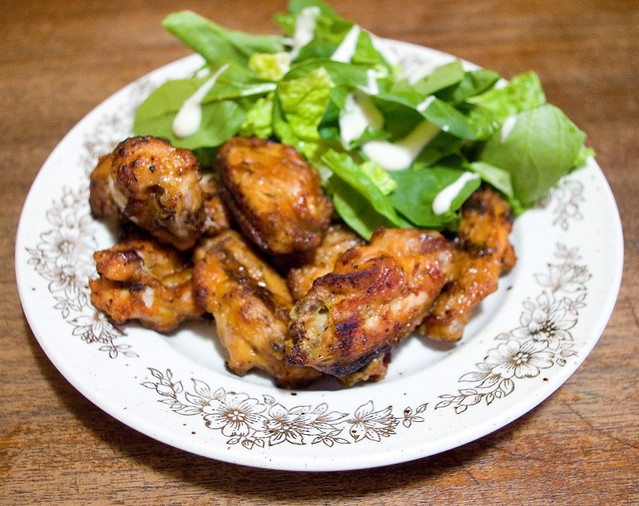
Last night’s dinner was a simple one: baked, precooked frozen chicken wings from Costco, and a simple salad of romaine lettuce and baby spinach. The wings were Sun Chef Fully Cooked — Fire Grilled Roasted Chicken Wings with two sauces.

I’d never tried these specific wings before, and they were… Okay. I mean, they weren’t fantastic, but they weren’t bad either. Passable, I guess the word would be. There are better pre-made chicken wings out there, though, even at Costco. There are seasoned, uncooked ones sold in the refrigerated meat section that have much better flavour. I think next time that’s what I’ll buy if I want to have an easy chicken wing meal.