Steak and Bannock

We’ve been having some real problems with power outages in our area lately. It seems like whenever we have a storm or a particularly hot day, the part of the grid that I live in goes down, often for hours. It’s particularly frustrating because a few streets over, who have infrastructure that was put in at the same time as where I live, there won’t even be a glitch.

Such was the case last night when I came home from a grocery run with the kiddos after school. There was a thunder and lightning storm, but there were no issues at the store, so I didn’t think anything of it. Lo and behold, when I returned home we had no power, and apparently we hadn’t for at least an hour. Well, that changed my dinner plans drastically! I’d been planning on making pasta with homemade pesto, but without a burner upon which to boil the water, that was out. (Honestly, I’m starting to think that our next barbecue should be the kind with a burner on the side, since this happens so often.) So I rummaged through the day’s purchases and found something that could easily be cooked on the gas barbecue (I couldn’t use the wood pellet one since the auger is electrically driven).

Luckily I’d picked up a pack of steaks that I’d planned to marinade for the next day’s meal. There was a really good special, and the inch-thick steaks were cheaper by the pound than medium ground beef. So I threw them on the grill with a dusting of Montreal steak spice, and cooked them low and slow (about 300 to 320F) for about an hour, so they’d be done all the way through without burning.

But what to do for a side dish? I had no bread made; I was out of potatoes and corn; rice and pasta were right out because I couldn’t use the stove. But suddenly my Girl Guide training popped into my head: what about bannock? Granted, we’d always made bannock by twisting the dough around a stick and cooking it over the campfire, but traditionally it was made on a griddle or a flat stone. A cast iron pan on a gas barbecue isn’t that much different, right?

It turns out that I was absolutely correct! A perfectly decent bannock can be made this way, and honestly it’s not very difficult. I used the recipe I’d learned years ago from The Golden Book of Camping and Camp Crafts (1959), which was my father’s book before me and was one of my favourite resources for techniques as a Girl Guide. (This recipe just so happens to be vegan/vegetarian so long as you use a vegetable oil such as canola oil as your fat, which I admit wasn’t a huge factor when pairing with steak, but it would have been useful if I’d had a vegan guest.) I preheated my grill to 325F, since I was cooking the steak in there anyway. I basically treated the bannock like a big, slow pancake: cook for 10min or so with the lid closed, open the lid and flip the dough, and then close the lid to cook for another 10min or so. I stayed outside with the bannock and checked on it often because I really wasn’t sure how long it would take — except when it started to rain again. The heat wasn’t terribly consistent, especially with the rain cooling the whole thing down at one point, but it still turned out quite well. Basically, it was just a giant biscuit that I didn’t have to run the oven to make — which makes me think I’ll be making it on future hot days where I don’t want to have to cook indoors.

The steak was done to perfection, by the way. It was melt-in-your mouth. Not too shabby for an improvised meal cooked without electricity!

Last Visit to the Cottage for the Summer

(I’ve been sick this past week, so I haven’t been up to writing much. Not only that but we’ve had a bunch of power outages, which has forced me to be away from my computer and even cut me off mid-try! So now I’m trying to fill in the gaps of the past week’s posts. So if you’re wondering why you’re just seeing stuff now from earlier in the week, especially if you follow via email or Facebook, well, that’s why!)

This past week I was lucky enough to spend a last few days of summer vacation at the cottage that my parents are renting. We did take a day trip while we were there (which I will write about at a later date), but the rest of the time was spent relaxing.

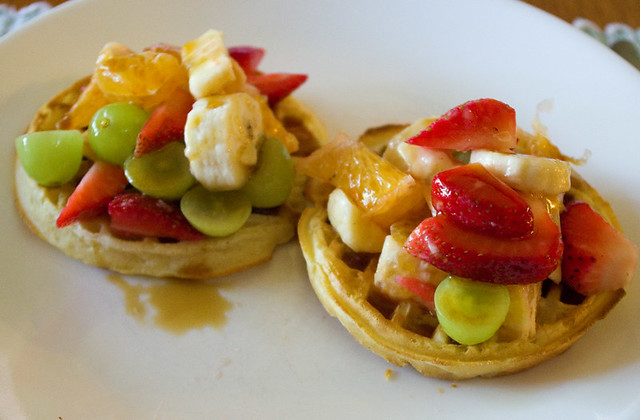
Thing 1 and Thing 2 discovered the joys of toaster waffles. I honestly don’t think I’d ever bought them for them before. I tried to make mine just a little more healthy by adding fruit salad (oranges, bananas, grapes, and strawberries). But I may have negated that healthiness by slathering it in maple syrup.

The weather was beautiful and sunny, with only a few fluffy clouds in the sky. Despite the lovely sun, it wasn’t terribly warm, so we didn’t really feel like swimming.

I spent most of my free time relaxing on the Adirondack chairs by the lake.

The kids, on the other hand, buzzed around like mayflies, alternating between crafting in the cottage and fishing with Gramps. Gramps caught a decent-sized perch and a rock bass, while Thing 2 caught two rock bass.

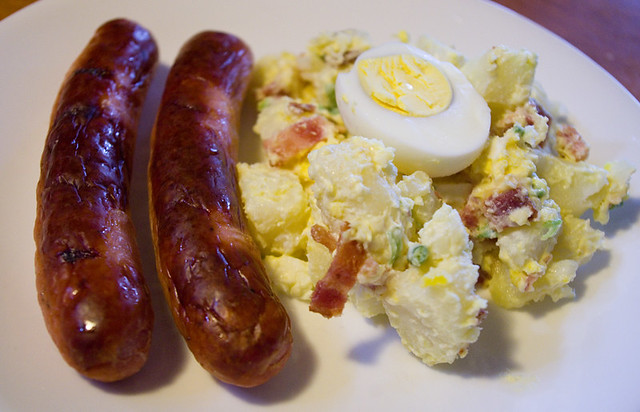
Dinner was baked sausages (bangers, I think), and Mom’s famous potato salad with bacon.

What a lovely way to end this summer’s lazy days at the cottage!

Garlicky Pasta Primavera

Last night I was inspired by Delish to make their Bowtie Primavera recipe. It was originally posted back in 2016, but the video popped up again on my Facebook feed, and, well, I had lots of cherry tomatoes that needed eating, so I figured it was timely.

This dish features a lovely rainbow of vegetables: asparagus, zucchini, cherry tomatoes, and mushrooms. I find it funny that it’s advertised as a “spring pasta” because really the only spring part is the asparagus; the zucchini, cherry tomatoes, and most mushrooms are late summer/early fall produce. I actually couldn’t find fresh asparagus at the grocery store right now and so had to use frozen, but that works just fine cooked in a sauce anyway.

My cherry tomatoes were really juicy and released a lot of that juice when cooking, so I found that 1 cup of reserved pasta water was excessive. I ended up having to boil down the sauce in order for it not to be, well, soup. Additionally, I used lactose-free sour cream, which I don’t think make a huge difference to the consistency but it did mean that I could actually eat it. (I would assume that, to make this dish vegan, a cream cheese substitute could be used effectively.) I also didn’t garnish with chopped basil because, to be completely honest, I forgot to buy any.

All that being said, I was really happy with the end result. This dish was creamy but not cloying, came together quickly (although not as quickly as the recipe indicated), and was both healthy and tasty. I will definitely be making it again.

First Salsa of the Year

After experimenting last year with different salsas, my husband (the main consumer of salsa in our household) determined that he liked the Blender Salsa the best. The recipe for this easy salsa can be found on page 92 of Preserving by the Pint: Quick Seasonal Canning for Small Spaces (Marisa McClellan, 2014).

As with last year, I had to boil the salsa down a bit as it was quite watery to begin with, which is a result of using cherry tomatoes from my garden instead of the Roma tomatoes that are recommended. This ends up making it taste a little bit more like tomato sauce than true salsa, but my husband doesn’t seem to mind. Good thing, too, since I’m not about to peel and core literally hundreds of tiny tomatoes for a few liters of salsa. It’s just not worth it.

My final result for this round of canning was nine 500mL jars of blender salsa. As the tomatoes ripen I realize that there will definitely be more — as requested by my family. I’m also hoping to make up some Healthy Veggie Tomato Sauce with the produce from my garden, and also some extras from a friend’s garden, since I’m told that they ended up with way more tomatoes than they plan to use this year. Bonus for me!

Bean Sprout

At the start of the month, husbeast and I took the kiddos to the Canada Agriculture and Food Museum. It was a hot, lazy Saturday and we had a hard time getting everyone moving, so we arrived late and didn’t get to spend too much time there before it closed for the day. However, we did get a chance to watch a presentation in the Soil Lab about bees and the role that they play in the life cycle of a plant.

The girls were enthralled as they learned about the life cycle of bees and why they are so important to agriculture. At the end of the presentation, each child was given a bean that they wrapped in a cotton ball, watered with an eyedropper, and placed in a tiny plastic bag. The bags were tied on string loosely around each child’s neck, creating a necklace of sorts.

My children, like so many, have an on-again, off-again love of gardening. They love planting, and watching things sprout, and harvest time, and even weeding, if you can believe it. What they lack is the patience and upkeep that goes between each of these steps. Over the years, they’ve forgotten about many plants which have then died, or have ended up being taken care of by me. So I didn’t have high hopes for these beans. In point of fact, Thing 2 completely forgot about hers and has no idea where it ended up; we’re not even sure it made it home. However, much to my surprise, Thing 1 fed her bean a few drops of water every day and kept it in a cool, dark place for about two weeks. Her attention was rewarded, when seemingly overnight it sprouted! (I suspect that it may have been left to its own design for a couple of days, because it grew right out of the bag before she noticed — but no harm done.)

Thing 1 triumphantly presented me with her baby plant and requested that it be given a proper pot and some soil. I am happy to report that it is doing well and is visibly growing every day. Thing 1 couldn’t be more pleased. I don’t know how much of the museum lecture she will remember in the end, but I’m very happy that she learned the lesson that a bit of work and some patience can have very positive results. If that’s the only lesson she ever learns from gardening in general, then I count it as a win.

Dill Pickles: From Garden to Jar

This year, I grew my own cucumbers out in the garden for the very first time. (Okay, I tried to grow lemon cucumbers a few years ago, but I only ever yielded the one gourd.) Given this year’s high yield after it finally started to rain at the start of August, I thought that I should preserve some of my crop by turning it into pickles.

A friend of mine had already used up an entire container of Bernardin Dill Pickle Mix‘s worth of pickles, and she wasn’t terribly interested in making more even though her cucumber vines were still yielding fruit. So she gifted me with all the extra cukes she had that were currently ripe, and I combined them with my harvest to date. It filled one entire crisper in my fridge.

Sliced up, all those cucumbers yielded two big Pyrex bowls full.

I filled my biggest stock pot and my pressure canner (which works perfectly well as a huge stock pot if I don’t lock the lid) with water, and I washed all the jars and rings and lids while I waited for the water to boil. With that much water, it takes quite a while. Then, while the jars and tools were sterilizing in the boiling water, I prepared the vinegar and spice mixture. Then I packed the cucumber slices into the jars, added the vinegar mixture, wiped the rims, put on the lids and rims, and processed the jars.

All in all, the pile of cucumbers yielded nine 1L jars. They all sealed properly and didn’t need to be re-processed, thank goodness. It’ll take a good six weeks or more before the pickles are ready to eat, since the longer they sit in the vinegar mixture, the better they taste. They should be ready for Christmas, at least! Or even Thanksgiving.

Glazed Lemon Loaf

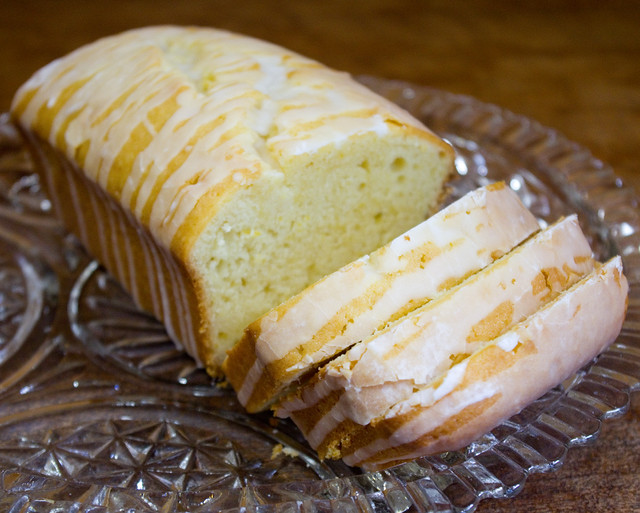
I don’t know why, but I’ve been craving glazed lemon loaf lately. I think it may be because one of my favourite coffee shops has it in the pastry case every once and a while, and I do sometimes succumb to temptation. When I was grocery shopping with the family the other day, I thought that I might pick one up, but they were nowhere to be found! So I Googled a recipe, bought a lemon, and baked a loaf myself — despite the fact that I usually try not to turn on the oven in this heat.

I’m happy to report that it turned out exactly as I had hoped! Moist (but not doughy) in the center, with just a little tang of lemon in the glaze… Perfect. I found the Glazed Lemon Pound Cake Loaf recipe on Seasons & Suppers: The Summer Edition. The writeup for the recipe stresses that it must be made just so, with butter and eggs at room temperature, sour cream removed from the fridge fifteen minutes before adding, and a very specific order of operations. Given that I’ve never made lemon loaf before (lemon poppyseed yes, straight up lemon no), I figured that I should follow the directions as written — at least the first time. Okay, well, I did have to make one small modification to adjust for my dairy issues, and used lactose-free sour cream instead of regular. But it still turned out great!

I think that the only beef I have with this absolutely delicious recipe is that it’s called a pound cake. What I’ve always been taught is that a pound cake calls for a pound each of flour, butter, and sugar. A quick Googling tells me that this translates to approximately 3 1/3 cups all-purpose flour, 2 cups butter, and 2 cups granulated sugar… Which isn’t even close to the proportions in this recipe. I mean, it gets a little bit closer if you halve it so that it’s simply equal weights, but even so, to me, that’s not really a pound cake. Not that this has anything to do with the quality of the recipe itself, mind you. The methodology was correct, and the end results were delicious! And I will definitely make this recipe again. I guess I’m being just a bit pedantic.

Guinness Pulled Pork

Because I think that trying new things is important, and because I don’t think there’s such thing as ever truly perfecting a dish, I decided to try a new recipe for pulled pork the other day. On freebie day, someone had left a box of books on the side of the road, and one of the ones in there was Cooking With Beer: Quick & Easy from Publications International Ltd. (2010). One of the ingredients in the recipe was stout – there weren’t any brands mentioned (probably due to trademark or copyright issues), but whenever anyone thinks “stout” around here, one of the first beers to come to mind is “Guinness”. So that’s what I used.

Given that it was a beer-based recipe, I also used Bulls-Eye Guinness Barbecue Sauce (recently bought on sale for $0.99 a bottle), and I served it on my bread machine beer bread (you can find the recipe in yesterday’s post). I thought that this would be the perfect combination.

Sadly, I wasn’t terribly thrilled with this pulled pork recipe. It had a nice flavour, but you didn’t really taste even the slightest tang of beer. Also, the sauce didn’t thicken very much; it was more like pulled pork soup than a proper sauce. And, in my case, it took way longer to cook than planned. I mean, the meat was cooked through by the specified time, but it definitely wasn’t soft enough to shred. Now, that might have been the fault of my oven, but overall the recipe just wasn’t up to my (admittedly high) hopes. All that being said, though, everyone ate their fair share, because there’s only so wrong you can go with pulled pulled pork on fresh bread.

Bread Machine Beer Bread Recipe

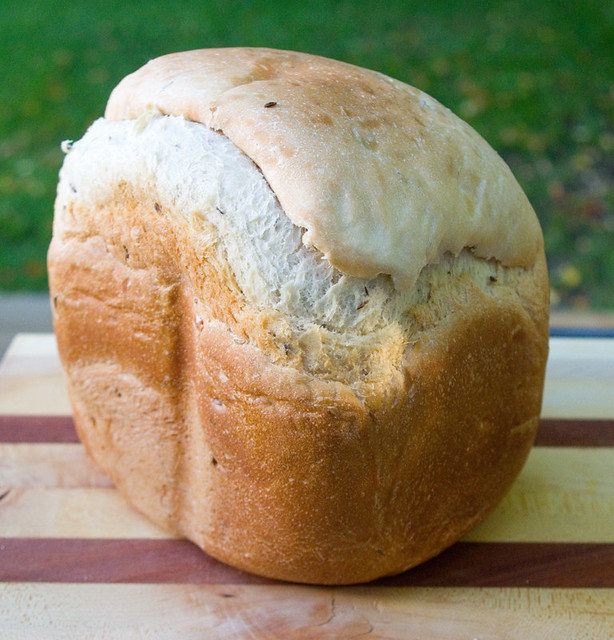
I think I’ve finally gotten the beer bread recipe to the point that I feel it’s good enough to share! This bread is customizable based on what kind of beer you choose to use. For this bread I chose to use Lost Craft’s India Pale Ale, which is a nice, light beer with only a 4% alcohol content. But feel free to choose the beer that you like best! A stout will make a much darker, richer bread, while a crisp, light beer will have a much less pronounced taste. You could even use a non-alcoholic beer. Additionally, you can choose to omit the caraway seeds, which do have a strong flavour of their own, so that the beer shines through.

The beer that you choose to use changes what it goes well with. It’s a light fluffy bread no matter the beer, so if you’re going to spread something on top, it’s best to toast it first. With a light ale and caraway seeds, I like it paired with a sharp cheese, deli meats, and/or a touch of mustard. Without the caraway, I have served it with eggs and toast for breakfast, and received quite a few compliments.

Bread Machine Beer Bread
Yields one 2lb loaf

A note about bread machines:
Every bread machine comes with an instruction booklet (most of which are also generally available online) that will specify the order that ingredients should be added. Mine says that liquids should be added first, then flour, then yeast. When preparing this recipe, the instructions for your specific bread machine should take first priority, so if your manual says to add the ingredients in a different order, do so.

Into the bread machine pan, pour:
1 ½ cups India pale ale
2 Tbsp olive oil
Over the liquids, pour evenly:
4 cups flour
Into one corner of the pan spoon:
1 Tbsp sugar
Into the other corner of the pan, spoon:
2 tsp salt
Make a divot at the center of the flour. Into the divot, put:
2 tsp yeast
Over the top of all of the ingredients, sprinkle:
3 tsp caraway seeds

Set the bread machine to the basic/normal/white setting, with a light or medium crust to your preference. Press start. Running this cycle should take about three to four hours, depending on your machine.

It’s as simple as that!

Birthday Dinner Woes

Yesterday was my husband’s birthday, so at his request I cooked him a special birthday dinner. I’d say that overall it was a learning experience.

The dinner itself was one of his favourites: chicken thighs marinaded in Pataks Tandoori Curry Paste and coconut milk, cooked on the smoker grill (which is finally fixed). Despite appearances, it wasn’t actually burned, although it was definitely overcooked. Now that it’s running properly, the grill heats up better and faster than before, and I failed to take that into account. As sides I toasted some garlic naan bread on the barbecue, and we also had steamed butternut squash with butter and salt. I know I’ve prepared this meal better in the past, but it was still tasty.

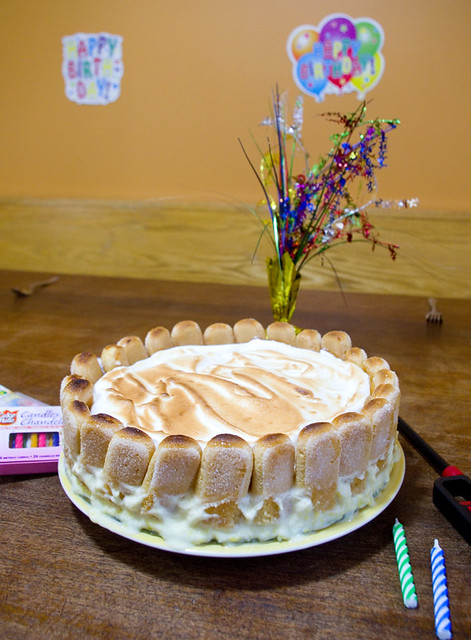
The difficult part — and the greatest learning experience — of my husband’s birthday dinner was actually the dessert: a frozen lemon torte. We’d had this dish at a barbecue hosted by my husband’s boss a couple of months ago, and we both really liked it. Sadly, I could only have a mouthful, as it was filled with whipping cream. As we were leaving the party I requested the recipe from my husband’s boss’ wife, and she made sure to send along a copy a few days later. Sadly, I have no idea what recipe book it comes from, since she just sent me a photocopy of the one page.

The challenge for me was making this dish without the use of cow’s milk. I was sure that I should be able to make it with coconut milk instead; internet research indicated that it is possible to make an imitation whipped cream from coconut milk. Strike 1 against me was that the milk hadn’t separated after I’d placed the can in the fridge overnight; most instructions for whipping the cream call for using only the solids from the can. I’m not sure if it’s a canning/processing technique or an added ingredient, but my coconut milk didn’t separate. Further Googling told me that I could probably make whipped cream even with non-separated coconut milk, but I would have to whip it longer (15+ minutes), use a thickening additive, and it would still only form soft peaks. Well, mine didn’t even get that thick. I whipped it with a hand mixer for almost half an hour and just got slightly fluffier milk. By this time it was almost two in the morning and I was exhausted, so I combined all of my ingredients, threw the pan in the freezer, and hoped for the best.

I was really worried about removing the springform pan after dinner, which is why I took photos in advance just in case it all fell apart without support. It wasn’t quite that bad, but it did get mushy really quickly. I’d say that the lemon layer, which was supposed to have a mousse-like texture, was a lot more like ice cream. I mean, that wasn’t bad overall, but it wasn’t what I was hoping for. Also, the lady finger bottom crust, which should have been held down by the mousse, actually floated to the top of the too-liquid lemon mix, and then froze that way. After adding the meringue on top, the cookies ended up being more of a central layer than a crust.

In the end, the torte ended up being more of an ice cream cake with a meringue topping — but at least I could eat it! I really want to have a go at this recipe again, with less of a time limit and more than one brand of coconut milk to try whipping. Actually, I noticed on a grocery store trip today that there is a brand that sells full-fat coconut cream, so that may be the next thing I try. If I ever get the non-dairy version working to my satisfaction, I will post the recipe, I promise!