Mystery Plants

Victoria Day long weekend (more commonly known as May Two-Four) is this coming weekend, which is usually the time when most people in this neck of the woods start plating their garden for summer. Mine isn’t quite ready to be planted yet. The one along the fence line needs cleaning out, added soil, and sheep manure fertilizer; the one near the house may be partially dug up so as to do some work on the foundation. Even if that wasn’t the case, I’ll be at Russell Flea all day Saturday and I’m hoping to hit the Rockland Community Garage Sale on Monday. (Yes, Monday — apparently they hold it on the holiday Monday every year.) So I wouldn’t have much time to garden this weekend in any case. I’ll try to get as much possible done next week instead.

Since I wasn’t sure how much of my garden I was going to be able to plant this year, I didn’t bother starting plants indoors for a change. Once I know how many I’ll need, I’ll just buy seedlings from a local nursery. However, I do have a few items sunning themselves on my window shelves. One of the gifts that I got from Thing 2 for Mother’s Day this year was a cute little bee plant pot made from a recycled aluminum can. When I received it, it was filled with soil and, I was assured, a few seeds.

And the seeds have sprouted! I am probably way too excited about this, but plant gifts from children often aren’t in the best shape by the time they arrive home, so their survival was not assured. I have no idea what kind of plant this will end up being, so I don’t know how much to water it or if it’s a sun or shade plant, so… Fingers crossed?

(And yes, I know that my photo is kind of hazy, like a femme fatale in an old film noir movie. I’m not sure if the lens/mirrors need cleaning or if there is something wrong with my camera/lens since I kind of dropped it on Saturday at the con. I have to give it a good once-over; I’m really hoping it’s just dirty!)

Earth Day

Yesterday I spent most of Earth Day on my bicycle, which I think is appropriate. It was less because it was Earth Day and more because the weather was finally nice (you’d never know we had an ice storm a week before), and I love to cycle.

I cycled with my mother along the Rideau River and the Rideau Canal, taking a break in the middle of the ride for a lovely bite to eat in the Glebe. A good deal of maintenance had been done since the ice storm, so most of the big branches had been pulled off of paths and roads, but the large numbers of smaller sticks and twigs sometimes made it dicey going. Every so often we’d find an area with constant shade, and we’d have to be careful of the ice hidden there. The water was really high on the river (although definitely not as bad as last year’s major flooding), so some of the bike paths that run alongside were a little dicey and sometimes inaccessible. Amusingly, when we traveled alongside the canal we realized that it has yet to be raised back to navigation level and was almost dry at the bottom — the water level is controlled by a series of dams and weirs, and it’s only partially filled in the winter to create ice for the skateway.

While the plants have yet to green up, the bugs were starting to reemerge (I learned that gnats stick to sunscreen) and we saw a plethora of birds. Although there were worries that the robins would starve in the late freezing weather, we did see quite a few of them. Also in large numbers were pigeons, gulls, and Canada geese; although we didn’t see many of them, we did hear songbirds singing in the trees. We even spotted the odd pigeon in the photo above, which caught our eyes because the pigeons around here generally have colouring more like this.

Honestly, it wasn’t the prettiest day. Despite the clear blue sky and the sun shining down, this isn’t the most beautiful time of year to be a tourist. If you wanted to film/photograph something with a post-apocalyptic vibe, this is the time to do it. Just wait a few weeks, though, and it will be beautiful again!

I did do a couple of things that are kind of stereotypically Canadian today, now that it’s warmed up a bit. First, I took my outdoor Christmas lights down. If you live in warmer climes that probably seems quite late, but although I turned mine off on January 1st, by then they were frozen to the ground and under a thick layer of ice and snow. Only now had things melted back enough that I could actually take them down!

Also, today I shoveled the lawn. That probably sounds ridiculous to anyone who doesn’t live where there’s a great deal of snow, so let me explain. At the end of the winter, you’re always left with a few drifts that are the last to melt, usually in areas that don’t get much sun or where you pile snow when you shovel your driveway or paths clear. Well, I have a few spots like that, and I’ve learned over the years that if I want them to melt (and hence dry out) a little faster, I can throw the top layers of snow into the parts of the yard that actually get regular sun. I know it’ll all melt eventually if I just leave it, but by this point in the year I’m impatient for the change of seasons. It probably only takes a couple of days less to melt the snow if I shovel it, but it makes me feel better, gosh darn it!

For our Earth Day dinner, my husband cooked us up some steak and zucchini on the wood pellet grill, which I served with some nice homemade bread. We had actually intended to have hamburgers, but I think everyone else in town had the same idea and we couldn’t find buns for love nor money. I think anyone who could do so fired up the barbecue and cooked outside, if only as an excuse to do something out in the lovely weather. I mean, it went up to 16°C (61°F) for the first time since around October, so I really don’t blame them. Ah well, our dinner was probably healthier than burgers anyway — and it was delicious!

Easter Celebrations

Our family’s Easter celebrations can happen any time over the long weekend, to coordinate with peoples’ schedules. Barring illness (we’ve had a couple of spring bugs work their way through our family over Easter, so those years nobody much cared about chocolate), though, the Easter Bunny visits after the kids go to bed on Easter Eve, so that there are gifts for the children to find first thing on Easter Sunday.

In our family, the Easter Bunny hides chocolate eggs around the main level of the house, but Easter baskets are put together by Mom and Dad. Although it may look like a lot of stuff, it’s generally dollar-store or thrift-store finds (except for the Skip-It-like toys this year). The downside is that sometimes the gifts aren’t of the highest quality, like the Crazy Eggs (Eights) deck from the dollar store that was entirely spades… Hmm, manufacturer’s flaw much? The toy I thought was the coolest was the Sew Science kits, which provided the materials and instructions for the kids to make their own sewn circuits that really light up. Super cool! I think the kids were most enthused about the K’Nex kits, though.

This year Hubby and I got little Easter baskets as well, although this isn’t always the case. Hubby’s basket was filled with his favourites: Farm Boy fresh jujubes, Twizzlers Nibs, Ferrero Rocher chocolates, and Sweet Tarts. I got a big bag of Whopper Robin Eggs, sock yarn, and a cute Peeps lunch box.

Easter afternoon is basically time for everyone to eat chocolate, the kids to play with their new toys, and the adults to prep for dinner. I baked an apple pie using the crust from page 73 of The All-New Purity Cook Book (Elizabeth Driver, 2001), as usual, and the filling from page 678 of the Joy of Cooking (Rombauer & Becker, 2006 edition).

I was actually excited to be able to use my new-to-me Tupperware 12″ Pie Taker for the first time in order to bring the pie to my parents’ place. I was so happy to find this because I usually transport my pies in Ziploc bags, but the top of the bags have a bad habit of getting stuck to the top of the pie. The Tupperware worked much better!

I made hot cross buns again this year (page 37, Baking Bread: Recipes From Around the World for the Complete Home Baker by Audrey Ellison (1995)). I think they turned out much better than last year’s, but I’d forgotten that last year I burned the first batch cooking them at the recommended temperature for the recommended time. I almost made the same mistake again! Luckily, I got them out just in time. I think they should take 12 minutes to bake, max (instead of the recommended 15 to 20 minutes in the book). This year I also used the glaze after baking, and boy was it sweet and sticky! The kids seemed to like it, though.

Mom put on her traditional turkey spread for our family of four, my parents, and their good friends Mrs. and Mr. B. (I guess the more traditional roast would be lamb, but Mom doesn’t like it and since she’s the cook, what she says goes. Mom gave us all the choice between pork and turkey, and we chose turkey.) It was delicious! It included roast turkey, stuffing, mashed potatoes, squash casserole with walnuts, Brussels sprouts, gravy, and… Oh, what am I missing?

That’s right, everybody’s favourite part: Dad’s famous Yorkshire pudding! Dad only used to make this for roast beef meals, and then he’d only make a single batch. In the last few years we’ve managed to persuade him that any roast meat with gravy needs to be paired with Yorkshire pudding, and that a double batch in the bare minimum quantity. They never, ever go to waste.

Of course, my mom set the table with seasonally-appropriate cloth napkins and adorable napkin rings.

I wanted to say thanks again to Mom and Dad for hosting such a delicious meal! And I hope that you all had a lovely Easter — or, for those who don’t celebrate the holiday, a fantastic long weekend!

Happy Easter!

I hope that everyone is having a safe and happy Easter long weekend. It hasn’t been terribly spring-like here yet, with lots of snow still on the ground, but a least we have had lots of chocolate to compensate!

(Those are Whopper Robin Eggs, by the way. The most addictive Easter chocolates known to man, in my personal opinion.)

Happy Easter!

Seasonal School Snacks

I mentioned in my last post that since it’s in season, I wanted to do more cooking with maple syrup over the next little while. Well, after reading a book about kids learning to cook, Thing 1 has been bugging me to make fruit leather with her. Since fruit leather is just pureed fruit that has been dried, I figured why not? Also, it’s a great way to use up an overabundance of fresh fruit (not really a problem here in the spring) or the fruit that you’d forgotten about in the freezer (more of an issue of mine right now).

My parents actually used to make fruit leather and dried fruit for my brother and I when we were kids. This was the era of the Fruit Roll-Up, but my brother’s sensitivity to corn (and hence corn syrup) made most versions of this store-bought snack inadvisable. Actually, the dehydrator that I’m using now is exactly the same one we used when I was a kid; my parents let me have it when they realized they hadn’t used it since my brother and I moved out.

The instructions for the dehydrator recommend that if you’re going to use a sweetener when making fruit leather, you should “use corn syrup, honey or fruit juice instead of granulated sugar which tends to crystallize”. We’ve discovered that maple syrup actually makes a great, all-natural sweetener for fruit leather that does not crystallize — and it adds a lovely flavour as well.

As an aside, if you don’t have a dehydrator, you can make fruit leather in the oven by drying it out at 200°F (93°C) for eight hours or so… But a dehydrator is a much smaller machine and uses a lot less electricity, so if you’re going to make fruit leather often, I’d recommend buying a purpose-built machine.

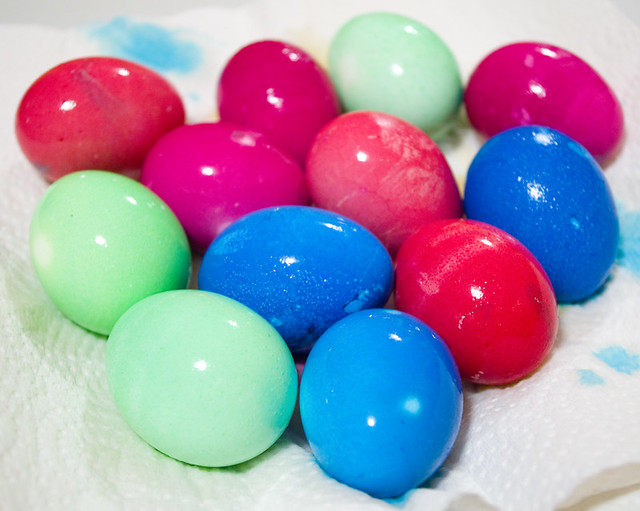
This is also the week leading up to Easter, which in our family means at the very minimum it’s time to dye some eggs! The kids like to take hard-boiled eggs to school in their lunches, so I made up a dozen for the week.

I used food colouring to dye the eggs vibrant, food-safe colours. There are all kinds of kits out there for dyeing and decorating Easter eggs, but a lot of them aren’t intended for consumption afterwards, so I like to stick with food colouring. The kids may decorate more eggs over the long weekend, though, and those will probably be with paint and glitter. They might be old enough to blow out the eggs to create permanent ornaments this year. Well, I know that Thing 1 is, but Thing 2 is not always as gentle as her big sister… And empty eggshells are mighty easy to smash.

The nice thing about blowing out eggs for decorating is that you can save the yolks and whites and make lovely scrambled eggs, or breakfast burritos, or tamagoyaki (either by itself or in sushi), or egg drop soup. This way, no part of the egg would be wasted. I have to admit, wasting food is a pet peeve of mine. Sometimes it can’t be avoided, but all efforts should be made not to, you know?

Saint Patrick’s Day Thrifting

This past Saturday I spent the day with a good friend of mine down in the Glebe. We started with a Saint Patrick’s Day lunch at Patty’s Pub, where we had great food and conversation while we listened to the live band playing Irish folk music. Then we headed out to 613flea (a great urban flea market) just up the road in the Aberdeen Pavilion in Lansdowne Park. When we finished there, we browsed the Ottawa Antique Market, and then we rounded out our day by perusing a second-hand charity shop. I know it’s not the kind of thing that everyone’s into (heaven knows my husband has no interest whatsoever), but my friend and I had a fabulous time!

Of course, I did return home with a few treasures. I think my favourite one of the bunch is a copy of the 1889 (seventieth edition) printing of the 1877 volume The Home Cook Book, which was compiled by the Ladies of Toronto and Chief Cities and Towns in Canada as a fundraiser for the Sick Kids Hospital. From what I understand, this is the very first Canadian cookbook that was compiled by an organization to be sold in order to raise funds. It’s such a common thing to do these days (especially as it gets easier and easier to self-publish inexpensively) that most of us who like to cook have at least one of these in our collection — and have probably contributed to a few.

I’m really looking forward to diving into this book and trying to recreate some of the recipes. It’s going to be interesting, because the instructions are sparse and often vague as so many old cookbooks often are, since they assume a great deal of previous experience on the part of the reader. The book also refers to culinary techniques, measurements, and ingredients we don’t use any more. I mean, what is a quiet oven? Or a quick oven? Do we even grow Spitzenberg or Greening apples any more in Canada? When they talk about currants, do they mean dried or fresh? How much does a wineglass hold? Or a teacup? I’m going to be doing a lot of Googling, I tell you.

Now, I love the feel and smell of old books, but this is the digital age after all and the book is well out of copyright. It was actually archived online by the University of Toronto and the Toronto Public Library; you can check it out in all its glory here. Or if you’re like me and you don’t want your old books contaminated by kitchen spatter, when you’re cooking you can always pull up the digital version on your phone or tablet.

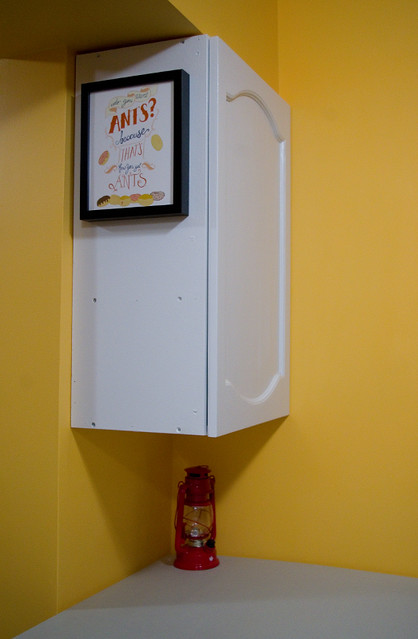
The fantastic old cookbook wasn’t my only find, though! I picked up an 8×10″ print of Carabara Designs‘ hand-lettered print of the “Do you want ants?” quote from the TV show Archer. I am constantly amazed by my kids’ capability to utterly destroy the kitchen with two pieces of toast, so I’ve been thinking this a lot lately.

The print has pride of place on the side of the cupboard above the kitchen counter peninsula, hopefully where the kids will see it. But kids being kids, they probably won’t even notice. Ah, well. I think it’s perfect, and it even matches the paint job. Now all I need is a coordinating print to go underneath.

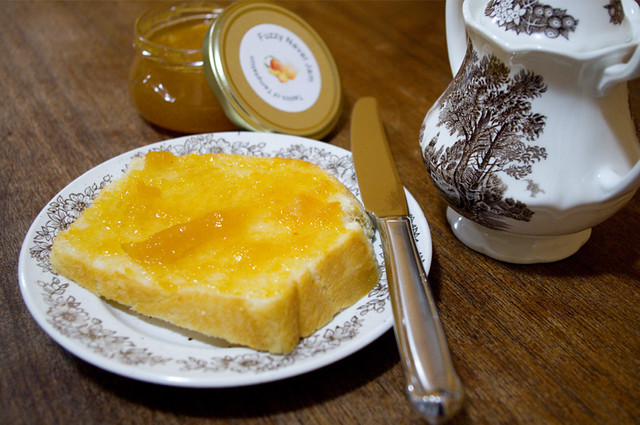
Last but not least, I picked up some Fuzzy Navel Jam from Tastes of Temptation. This jam tastes just like summer, which is exactly what I need right about now. Honestly, I liked everything they had on offer, but this was the one that made me smile the most. Spread on a piece of fresh homemade bread, it makes a divine snack with a cup of tea!

Teacup Pin Cushion Tutorial

My kids are learning to sew, so I thought that it was time that they had pincushions of their own. I’ve seen teacup pin cushions around at flea markets and craft fairs, so I thought we’d make a go of whipping up some of our own. They’re really easy and right up the kids’ alwy, patience-wise.

Teacup Pin Cushion

Materials:
– 1 teacup (saucer optional)
– 1 square of cotton or cotton-blend fabric, about 3X as wide as the teacup’s top
– polyester fiberfill
– thread

Supplies Needed:
– fabric scissors
– needle
– hot glue gun & glue
– pins

1. It all starts with a teacup — but none of Grandma’s fine china! We bought ours for about $2.00 at a local charity thrift shoppe. If you’re not into tea, a coffee or espresso cup works well, or an egg cup, or even a sake glass. We even made one using a miniature terracotta pot (picked up for about $0.75 at a gardening supply store). Basically, it has to be an opaque container that you like the looks of that’s about the size of an old teacup, or smaller. You will also need to pick out a piece of coordinating fabric that’s about three times as wide as the mouth of your vessel.

1.B. OPTIONAL STEP: If you’re very crafty, you can embroider a design on your fabric at this stage.

2. Using a pair of fabric scissors, cut your fabric into a circle about three times as wide as the opening of your teacup. It doesn’t have to be perfect, since this end will be hidden inside the bottom of the cup where nobody will ever see it.

3. Using a running stitch, stitch around the outside edge of the circle, about 1cm from the edge. Use a sturdy thread, but don’t worry about the colour, since this will be hidden as well. Tie a knot at each end of the thread, but do not stitch that knot into the fabric.

4. Making sure that the fabric is inside-right, pull the thread taut to gather the fabric, but do not tie a knot. This will make a little pouch.

5. Stuff the pouch firmly with fiberfill.

6. Draw the thread as taut as possible and tie it off securely. This will create a small cushion.

7. Stuff the cushion into the teacup, making sure that the end with the stitching and the gathering is at the bottom of the cup.

8. Affix the cushion inside the cup using hot glue. I found that I got the neatest results by pushing the fabric down below the edge of the cup, and then running a bead of hot glue quickly about 0.5cm lower than the edge of the cup. Then I carefully released pressure on the cushion until it sat at the height I wanted, holding it in place while the glue dried. Otherwise, the cushion kept trying to puff much too far out of the cup.

9.B. OPTIONAL STEP: Using hot glue or by sewing, decorate the pin cushion. You can add a border of ribbon or trim around the edge of the cup to conceal the glue. Buttons, lace, small pompoms, googly eyes, felt cutouts, silk flowers… If you’re so inclined, this is a great time to be creative.

And that’s really all there is to it!

As for our last March Break craft, Thing 2 went with a more contemporary look.

Whereas I made mine in a little flower pot. I created the floral element by sticking sewing pins through little fabric flowers bought in a confetti-like pack from the dollar store.

And Thing 1 used the fabric flowers slightly differently, pinning them into place with her pincushion’s pins.

String Art Tutorial

I’ve been wanting to try this craft with my girls for a while; it is a great way to learn how to use a hammer and nails! I never did this as a child, but my little brother did, and his string art masterpiece hung in his room for years. The nice thing about this craft is that you can make it simple or complicated, depending on the skill level of the people doing it. We went with really simple, perfect for a busy day’s work!

String Art

Materials:
– 1 piece of 1/2″to 3/4″ thick wood, approx 12″ by 12″ (pine preferred)
– 1 colour of acrylic paint
– 20 (or so) 1″ long common framing nails
– scraps of thin yarn or string
– sawtooth picture hanger & screws

Supplies Needed:
– fine-grain sandpaper
– paintbrush
– hammer
– wooden clothes pin
– screwdriver

1. We started with a 12″ by 12″ piece of 1/2″ pine shelving left over from an old project. Pine is inexpensive and easy to hammer nails into. Such a small piece can be often be found inexpensively (or free) off-cut from a home improvement store. If you’re not handy with a saw, most reno stores will cut wood to size if you ask.

2. Using fine-grain sandpaper, give the piece of wood a quick once-over to remove any splinters.

3. You can leave the wood unfinished (in fact, a lot of string art is done on gorgeous, rustic barn board), but my girls opted to paint theirs. Two coats of crafting acrylic turned Thing 2’s board an eye-searing pink, while Thing 1 chose a more muted lavender. Don’t forget to cover your work surfaces with paper or plastic if you care at all if it gets stained! (Graffito from the kids is optional.)

4. Nail in the nails in the pattern of your choice. My kids went for an abstract creation of their own design. However, any number of designs and shapes can be downloaded off of the Internet, printed out, and then taped onto the top of the wood. You can then nail along the edges of the design, and rip the paper away when you’re done. Alternately, you can freehand a design in pencil and then paint over the marks before you add the string.

Since the kids hadn’t done much hammering with full-sized hammers before, we used wooden clothes pins to hold the nails upright while they got them started. This keeps their fingers away from the hammer, at least until they have a little bit more precision! (It stunned Thing 1 that I could hold a nail while hammering without smashing my fingers.)

Thing 1 went with a free-form design.

Thing 2 went with a more geometric plan.

5. Tie a few knots around one of the nails, and then go to town wrapping the string around the nails!

6. If you’re planning on hanging the string art on the wall, using a screwdriver, attach a sawtooth picture hanger with screws to the top back of the piece. Alternately, it can be propped on shelf, or held up by a mini easel.

Tie Dyed Pillow Cases

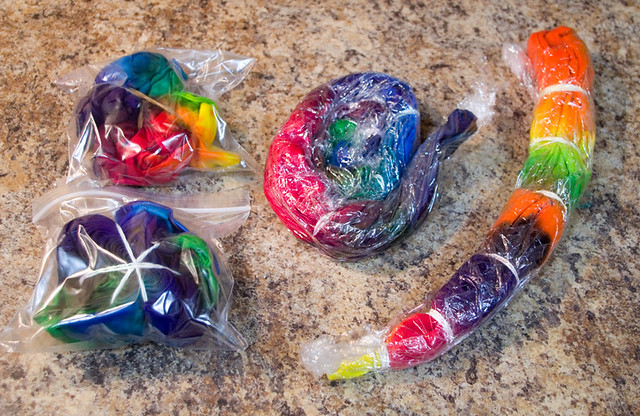
Tie dyeing with the kids is really something that I prefer to do in the summer when I can throw the kids outside in their bathing suits (which are synthetic and don’t absorb dye) to minimize the mess indoors. This time of year, with temperatures hovering around freezing and snow still covering the ground, that’s not exactly an option. Instead, the girls worked in their bathing suits and socks (warm feet are important) in the kitchen, over the metal sink, and we hoped for the best.

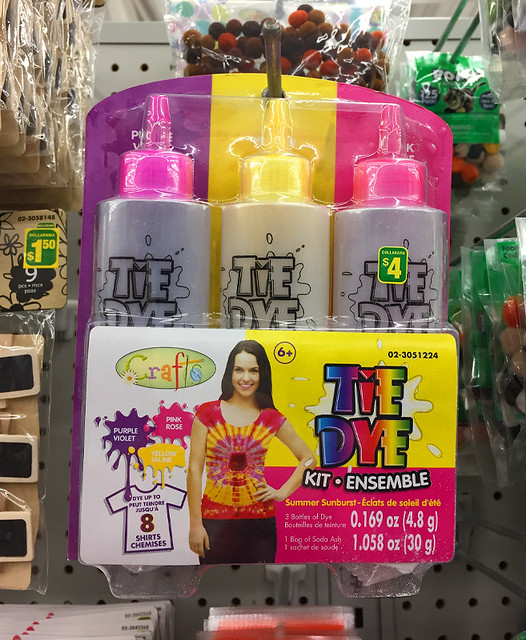
In the spirit of keeping things as cheap as possible, we used fabric we already had — four old, plain cotton pillow cases. We also bought the dye at the dollar store. So far, this are the cheapest kits I’ve found locally, with even Walmart’s selection starting at about $11.00 for a two-colour Tulip-brand kit that only makes three items. For six colours, you’re looking at upwards of $25.00. At Dollarama, they sell their own Crafts brand three-colour kits for $4.00 apiece, and we bought two in different colours. But would these kits work as well as the more expensive ones we’d tried?

When it comes to the supplies included in the kit, I found that they were more or less the same as other brands. They contained everything we needed except the water and the plastic to wrap the fabric as it sat, which is standard. Slightly higher quality gloves would have been appreciated, since they did leak and now the kids have splotches on their hands in places, but that seems to be standard too (just like the ones that come with hair dye). The instructions were clear and concise, and even had a brief photo tutorial for how to make different kinds of designs. We used the spiral (left) and bullseye (center and right) techniques on the kids’ pillowcases. (If you need more information about how to tie dye there are a million sites out there, but the Tulip site has some great tutorials that will work with any brand of dye.)

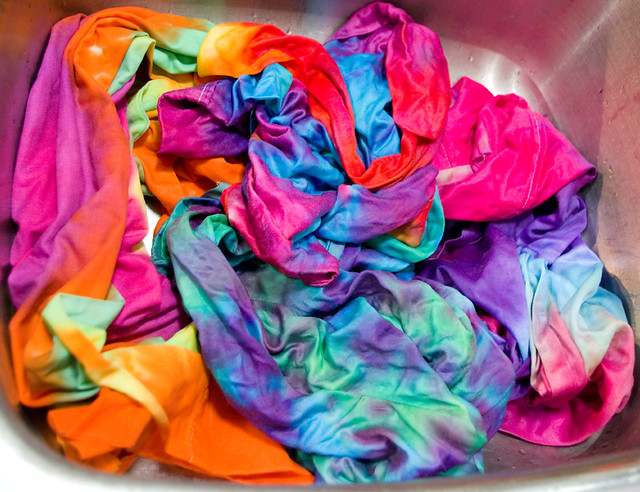
The kit did contain soda ash, which is necessary to pre-treat the fabric to retain vibrant colours. However, the directions did say that the dyes could be used without pre-treatment, but they would come out more pastel. I let the kids choose between waiting a bit longer to dye so they could have bright colours, or to do it right away and have lighter colours, and not surprisingly they chose to go with the route that required the least amount of patience. Despite the dire warnings of the packaging and articles online, after the first rinse the colours remained vibrant (above).

After a run through the washer and dryer, the colours did fade a bit, and I expect that they will continue to do so throughout their lifetime, but I remain happy with the final product. The kids are thrilled (according to Thing 1, the pillow cases are “Awesome!”), and since the project was for them, I say it was a success. (Bottom left and top right were done in the spiral techniques, top left and bottom right were done using bullseye — more techniques here.)

I will say one thing, though: each package of three colours claims that it contains enough dye for up to eight T-shirts. I guess that could technically be true, if you were to use very small shirts, and if you didn’t want a lot of colour saturation or variation in your design. Two packs, for us, did four very saturated single-bed-sized pillow cases (which I would say are about the same size as a small adult T-shirt), with enough left over to do maybe one more. That’s five items out of two packs of dye, when it claims we could make sixteen items. So keep that in mind when you decide how many items to prep. Even so, that’s five items in six colours for $8.00, compared to Walmart’s three items in two colours for $11.00, so Dollarama remains the cheapest place in town to buy supplies for tie dye crafts.

Fairy Light Lamp Tutorial

It’s March Break, so I’m trying to keep the kids entertained without plopping them in front of screens the entire time. We’re going to try to do a craft a day, and I thought I’d share what we did and how we did it so that others can use these same techniques this week (or any time, really).

The first craft we did was a fairy light lamp. There’s no wiring required, and for safety’s sake all of the lights are LED and the power source is battery-powered. We’ve all seen a string of lights in a jar, but I thought we needed to do something to take it up a notch. If you’re working with younger children, some of these steps will need adult supervision. The end result should be an ornamental lamp or night light that the kids can be proud of! As a bonus, all of the materials can be obtained at the local dollar store, or can be made of recycled materials for free.

Since there are a few ways to do this craft, be sure to read all of the instructions first, to keep from having to re-do steps!

Fairy Light Lamp

Materials:
– small sturdy cardboard box with lid
– Mason jar or recycled jar with lid
– paint
– string of 20 battery-powered LED lights (or two strings of 10)
– batteries to power the LED lights
– diffusing fabric
– small piece of card or paper (optional)
– stickers

Supplies Needed:
– pencil
– craft knife
– duct tape
– paint brush(es)
– heavy-duty scissors
– drill (if using a jar with a one-piece lid)

1. Unscrew the lid from the jar. I used a 1L Mason jar because that’s what fit best with my box, but it’s a very subjective judgement. I also liked the look of a round box, but square or rectangular is fine too. Just make sure it’s the kind of box that has a lid. Don’t worry about a colour or pattern on the box, since it will be covered later. If you want to use a wooden box, that can work too, but you’ll need heavier-duty tools to proceed with the next steps.

2. Trace the opening of the jar onto the lid of your box.

3. Using a craft knife, cut a hole along the line that you have traced. Make sure not to use the knife on a surface that you don’t want damaged, since it will make marks on whatever’s underneath the lid!

4. Make sure that the jar fits into the hole as shown. If the fit is too tight, trim off edges of the hole with the craft knife.

5. Use a few pieces of duct tape (any colour) to reinforce the cardboard around the hole on the inside of the box.

6. Paint the outside of the box. My kids chose a base coat of their favourite colour, then two coats of glitter paint in different colours. We used acrylic paint, since it is more permanent and covers better than kids’ craft paint. Because of this, we covered our table in craft paper first to protect it — and if you look at the paper under the box, you can see why.

Other options to painting include decoupage, stickers, and wrapping the box in pretty paper. No matter what method you choose, make sure that the top and bottom are done separately, since you’ll need to be able to get into the box.

7. Put the batteries into the battery pack of the light string(s). Stuff the diffusing fabric and strings of light into the jar, leaving the battery packs and some cord outside of the jar. I used a cheap tulle (a lightweight, very fine, stiff netting as my diffusing fabric, which is available at most craft stores, fabric stores, and dollar stores in the craft section. A good place to look for this kind of thing is in the Christmas clearance section. You can use a plain colour or one with a glitter pattern. Whatever you choose, the point of the fabric is to make the light from the LEDs softer, hide the cords, and keep it all in place. Arrange the fabric and lights until they are in a position that you find satisfactory. I found that it helped to do so in low lighting so I could see how the light would shine through.

8. Using the heavy-duty scissors, cut a wide slot into the flat part of the Mason jar lid. If you are using a recycled jar with a one-piece lid, using a drill make hole large enough to easily pass the light string through.

9. Cut small strips of duct tape (any colour) and use them to cover the sharp edges of the hole in the lid. This will keep little fingers and the wires from the lights from getting cut.

10. Cover the inside of the lid with a piece of coordinating-coloured duct tape. If you don’t have any, a piece of card or colour in a coordinating colour will also work.

11. Thread the light strings through the hole. If you’re using a piece of card/paper, that should be between the lid and the jar. If you’re using a one-piece lid, you should do this step before you fill the jar with the lights and fabric.

12. Using a piece of duct tape in a coordinating colour, cover most of the hole. If you’re using the card/paper layer, this tape can be any colour. This step is unnecessary if you’re using a one-piece lid.

13. Assemble the parts in the following order:

– jar
– box lid
– card/paper (optional)
– Mason jar lid, then Mason jar band OR one-piece lid

14. Put the battery packs into the bottom of the box, then flip the jar and box lid over on top of the box bottom. To turn the lights off and on, just reach inside the box and flip the switch(es). If you like your lights simple, this can be the end of this craft. My kids wanted a bit more fun, though!

15. My girls really wanted to decorate their lanterns with 3D butterfly stickers, so that’s what we did. Honestly, any kind of sticker would work, although shiny ones (especially the faux-jewel kind) would reflect the light better.

My girls made a lantern each in their favourite colours. You may notice that the jars are slightly different because they’re from different manufacturers. The kids didn’t notice, though.

The lanterns look especially nice in the dark, and they throw interestingly-patterned shadows on the wall.

I promised Thing 2 that I would post a picture of her orange and gold lantern all by itself, since I’d done so many of Thing 1’s blue and silver one already.

So there you go! I hope that your kids enjoy making these fairy light lanterns as much as mine did!