Instant Pot Duck à l’Orange

A few weeks ago I purchased some duck at the grocery store, since it was actually cheaper than chicken for a change. (That doesn’t happen very often around here.) I hadn’t cooked duck before, and I’d only eaten it a few times before, mostly in a very thick, sweet orange sauce at a Chinese buffet. I had been warned that it was both gamy and greasy, though, so I though it would be a good idea to cook it in some kind of sauce instead of doing a basic oven roast. I settled on the Easy Duck à l’Orange from the Instant Pot Holiday Cookbook.

The whole process was made more difficult right away because I had a whole bird, not just four duck thigh quarters. I’ve only taken a bird apart a few times before, so it was very awkward and slow going, even after looking up tutorials online. I think it’s just something for which practice makes perfect. But one way or another the duck had to be broken down into smaller pieces, since otherwise it wouldn’t fit in the Instant Pot.

As for the final result, I was quite satisfied with the recipe, which cooked the duck thoroughly and with a lovely sauce. However, I think that when it comes to personal preference, I’m just not a duck gal. It was just too greasy for me. I think I might like it better on a rotisserie or in a dish that calls for no skin, though, since that would make the final dish less fatty.

As a bonus, I roasted the bones in the oven and made bone broth in the slow cooker, which I cooled and skimmed the fat off of before I froze it. I look forward to some duck broth soup in the future.

Tuna Steak

A while back I picked up a four-pack of frozen tuna steaks at Food Basics for about $10.00, which is a really reasonable price around here. Now, I know that frozen fish can be hit or miss, but around here a lot of the stuff you find at the fish counter is previously frozen anyway (it’s usually noted only in the tiniest of print), so I figured I’d give it a shot. I followed Jamie Oliver’s tutorial for How to Cook Tuna Steak, which I’ve had great success with before. I figured it would be a good idea to keep the methodology the same if I wanted to test a different product, only changing the one variable and all that. See, teachers, I did learn something in science class!

I am happy to report that it turned out really well! I’d say it was easily as good as the tuna steaks I’ve previously bought from the fish counter. Now, the stuff from the counter probably doesn’t compare favorably to fresh, but unless I want to spend an exorbitant sum to get stuff flown in from the ocean, it’s probably the best I’m going to get. After all, we are landlocked here — the closest ocean (the Atlantic) is almost 500km away! (And that’s if you go to Maine — it’s more than double that to stay in Canada.)

The rub on the tuna is salt, pepper, coriander seeds, and fennel seeds, all ground together with a mortar and pestle. I served the fish over sticky rice, along with garlic shrimp, steamed asparagus, and steamed edamame. Overall it was a lovely, fresh-tasting dinner, and I look forward to having it again.

Lactose-Free Pizza

A friend of mine who also has to avoid lactose told me that she’d found a great new product from President’s Choice: Lactose-Free Pizza Mozzarella Shredded Cheese (and they also have a cheddar blend). I was able to find it at a nearby store, too! Then the other day a different friend reminded me that I could use my bread machine to make pizza dough, so I figured that the world was conspiring to have me make some pizza.

Since I’d already tried the Betty Crocker pizza dough recipe, I thought I’d try something different to compare it to. This time I went with the dough from Tomato and Prosciutto Pizza on page 108 of Bread Machine: How to Prepare and Bake the Perfect Loaf (Jennie Shapter, 2002), and I think I like this one better. It’s more of a thick crust and it definitely makes a greater quantity. I’d run out of homemade sauce, so I picked up a jar of Classico Traditional Pizza Sauce, which I had also never tried before and ended up quite liking. Not only did it taste much better than the canned kinds, it also was enough for two pizzas with some left over. I topped the pizza with bacon and ground beef, at Thing 1’s request. And I really liked how it all turned out! I was especially impressed with the lactose-free mozzarella, which remained gooey and stringy even as it cooled. I find that a lot of lactose-free cheeses melt just fine, but they start turning a disturbing plastic-like consistency very quickly. But not this one! This is definitely a dish I’m going to be making again, especially since my pizza dough tossing technique needs a lot of practice.

It Has Begun!

Today is the vernal equinox and first day of spring, which is encouraging for those of us who like to garden despite the fact that it still looks like winter outside. However, it has been peeking above freezing off and on for the last week, and things are finally starting to melt a bit. While my driveway is still a skating rink, I can finally see a bit of the back deck close to the house.

I find myself rather envious of the people further south (or back in Madrid) where spring flowers are already pushing out of the ground and fruit blossoms are covering the trees. Ah well, our time will soon come!

With the seasonal change comes the reminder that Ottawa ComicCon is only 50 days away — and I have to get cracking on costumes! Yesterday I popped out to purchase some fabric, although I haven’t found all of what I will need yet. (Today it’s all in the washer being pre-shrunk.) The purple and white fabric will mostly become Vio from The Legend of Zelda: Four Swords Adventures for Thing 1. I also need to purchase fabric for our other family costumes: Thing 2’s Sheik from The Legend of Zelda: Ocarina of Time and my Ganondorf from The Legend of Zelda: The Wind Waker. For group costumes on the weekend I also need to make a R.O.U.S. costume from The Princess Bride (I’m hoping to find a kigurumi pattern that I can modify) and a 1950’s version of Marrow from the X-Men comics. Over the weekend I also plan on wearing my Men in Tights costume again, which is the only one I don’t have to make this year. So that’s a total of five costumes I still have to sew, but at least there are no big builds this year?

English Muffins Take 2

My husband has been bugging me to make homemade English muffins again since I last made them about a year ago. But my new stove meant that I didn’t have the griddle attachment anymore, and I hadn’t bought a stand-alone version in the meantime. I also hadn’t found a local source for proper silicone English muffin rings, which is what I thought would have really helped create a better muffin than last time.

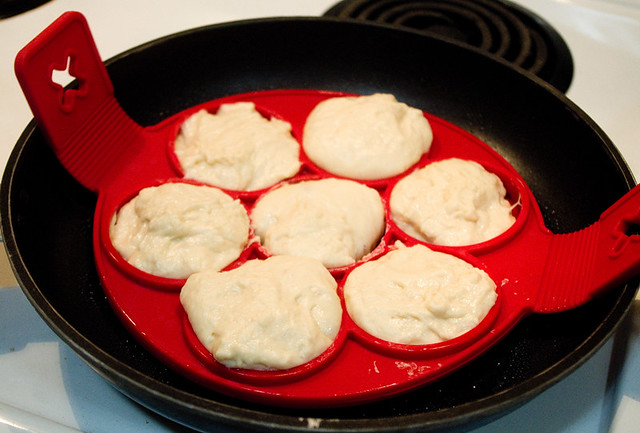
However, I had found a Flippin’ Fantastic pancake maker at a thrift store, so after a good wash I thought I’d give it a try instead. I discovered that if you want perfectly-round English muffins, this really isn’t the right tool. It’s great when they’re first starting out, but the rings need to be deeper, so once they started to rise they ended up being irregularly-shaped anyway. Not only that, but despite a good coating of non-stick spray, the batter stuck really badly to the silicone, making for a messy clean-up.

I also tried to use the flipper for the eggs that were going to go in the muffin sandwiches, and that was an unmitigated disaster. Eggs are a lot more liquid than English muffin batter, and they just leaked out the bottom of the flipper to create a single, solid mass of egg that I then had to break up with a spatula. Online reviews point out that this exactly the same thing that happens with pancake batter, so I don’t think that this product works as advertised. What a shame.

All that being said, the flavour and texture of the English muffins themselves was great despite the flipper not working out. I used Alton Brown’s English Muffin Recipe, which turned out lighter than my other attempt. I discovered that while this mixture is too liquid to mold like a bun, it can just be spooned out onto a pan without rings at all. The resulting muffins will be lopsided, but they will taste just as good! This time I served the muffins as sandwiches with bacon, egg, and cheddar cheese (lactose-free for me), with slices of navel oranges on the side. It was a hit!

Salmon Cheese Tamagoyaki & Rice

This past Saturday I had what seemed like a houseful of people over for dinner. Okay, there were seven people in comparison to our normal four, not exactly a party, but still more than usual. I didn’t have anything taken out of the freezer, I decided to make everyone tamagoyaki on rice. Ever since I got my Japanese omelet pan for Christmas, they’ve become a go-to meal when I want something relatively simple and healthy.

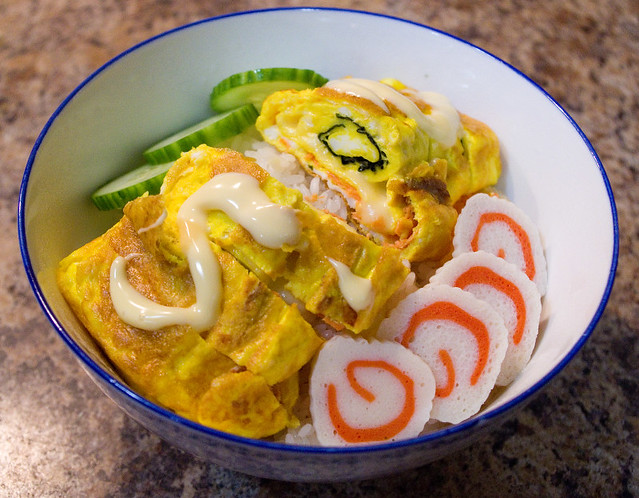
This time I had smoked salmon in the fridge, so I added ingredients between each layer of egg: nori, cheese, and smoked salmon. The kind of salmon that I had automatically comes sliced in very thin, flexible sheets, so it’s perfect for this kind of thing. I really liked this addition and I think I will do it again in the future! I served the omelets with slices of naruto fish cake and cucumbers on the side, and a squirt of Japanese mayonnaise on top (if the diners wanted these additions).

Should I do this again, though, I’ll have to plan at least a little bit better. I didn’t make enough rice the first time so I had to make a second batch, and I realized that I was short of eggs about halfway through and had to send my brother-in-law out to get some. And if I’m planning on making this many tamagoyaki in a row again, I’m definitely going to have to pick up a second pan!

Spool-Knit Headband Tutorial

I loved to spool knit (also known as corking) as a kid. I would make yards and yards of multicolored I-cord, but I never quite knew what to do with it after that. So I thought I’d figure out a way to use some spool knitting in a useful way — and only a short length of it, too, so that little ones with not much patience could still make something fun.

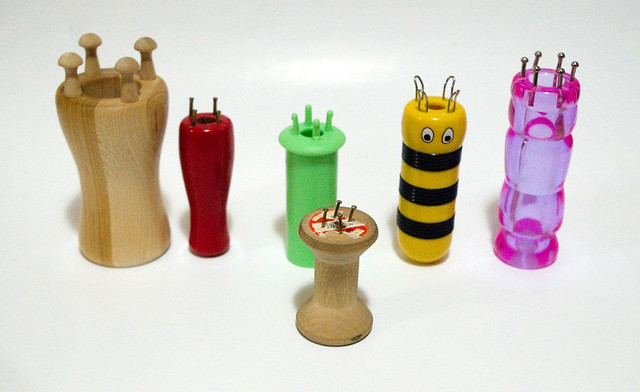
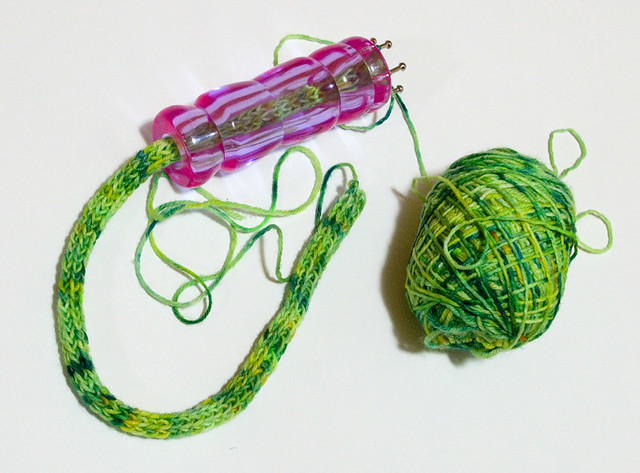
For this craft you will need a spool knitter or knitting spool, which is also known as a french knitter, a knitting dolly, a knitting mushroom, or a small knitting loom. There are probably terms I’ve never heard of as well, but they’re all the same tool! You can buy one commercially; they’re often found at thrift stores as kids tire of them, and sometimes at dollar stores in the craft section. Walmart even carries a few kinds if you don’t have a craft store in your area. But you can always make your own as I did with the one in the front, which is just four nails in an old wooden spool. The one that I’ve chosen to use for this craft is the pink one on the far right, which has six points instead of the more common four, just because I’ll be using a thin sock yarn. But you can use whatever kind you have handy!

Spool-Knit Headband

Materials:

– yarn
– narrow flat elastic
– two shades of green felt
– green thread to match felt

Supplies Needed:

– knitting spool
– crochet hook or spool knitting hook
– scissors
– small needle for sewing
– darning needle
– pencil or marker

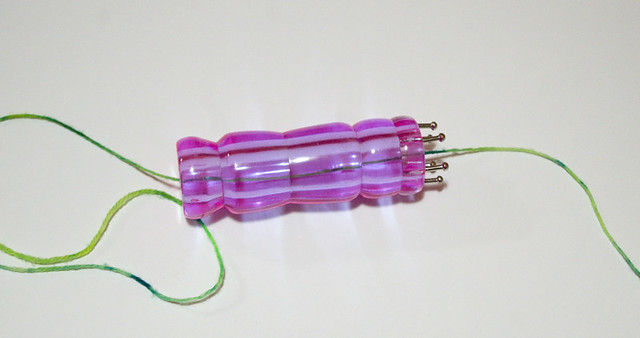
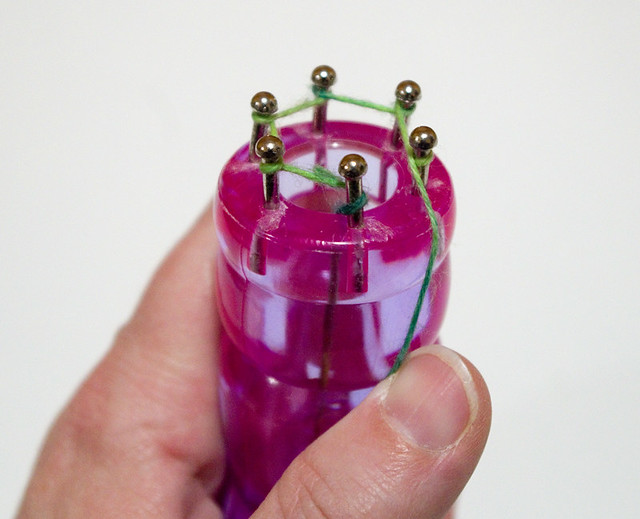
1. Thread your yarn through the knitting spool, leaving a tail of approximately 6″ dangling. The ball of yarn should end up at the end of the tool with the pegs.

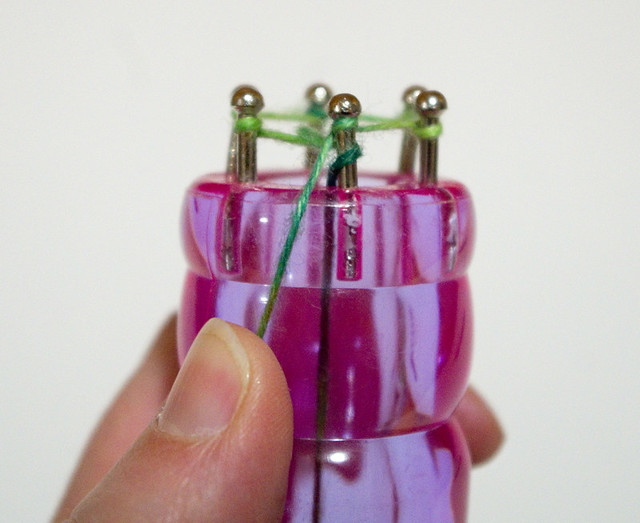
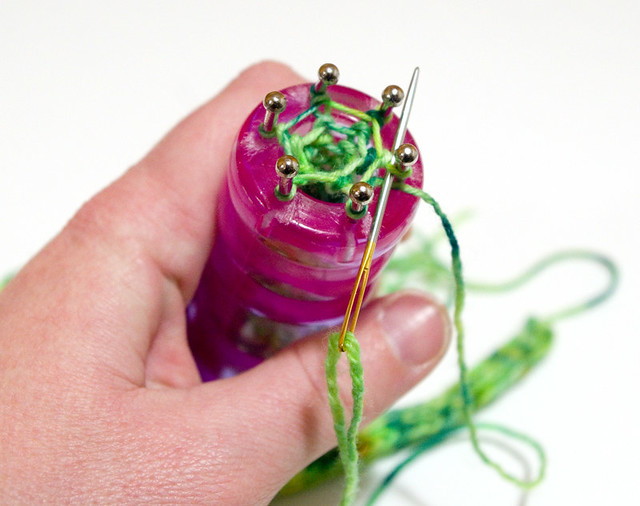
2. Keeping the yarn taut, wrap the yarn counter-clockwise once around your starting peg (all of the pegs are identical, just choose one to start from). Spin the knitting spool counter-clockwise in your hand until the next empty peg is directly in front of you, then wrap the yarn counter-clockwise once around that peg. Continue in this manner until all of the pegs are wrapped.

3. Wrap the starting peg a second time.

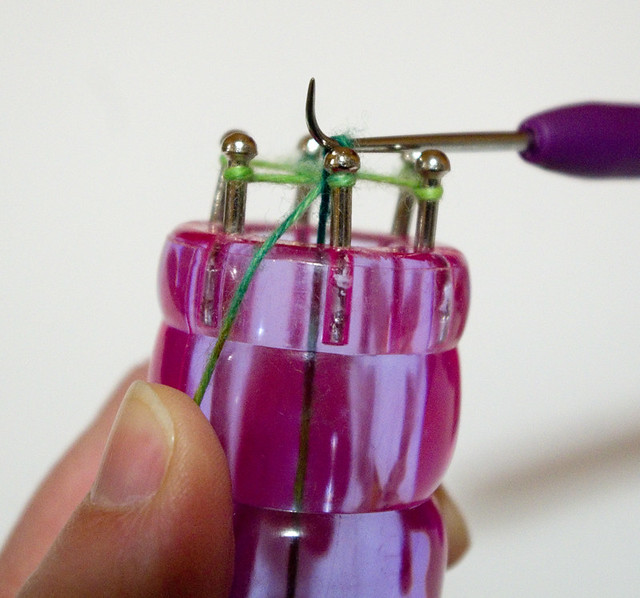
4. Using your hook, flip the first wrap over the second. Give the tail a gentle tug to set the loop.

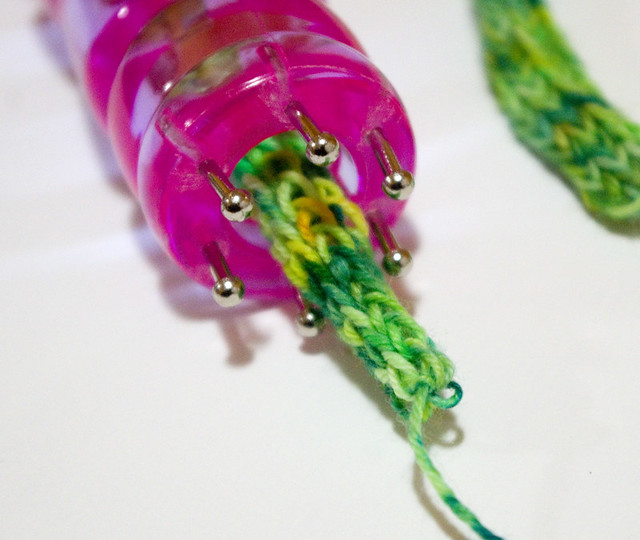
5. Continuing to move counter-clockwise, wrap each peg, flip the oldest wrap over the newest, and then give the tail a gentle tug. This will create a long spiral of spool knitting.

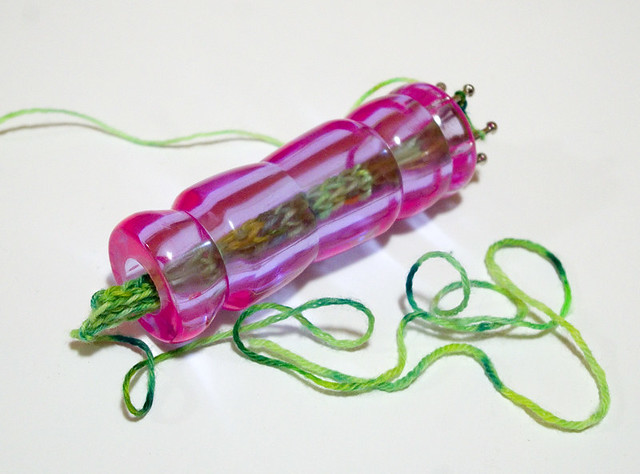
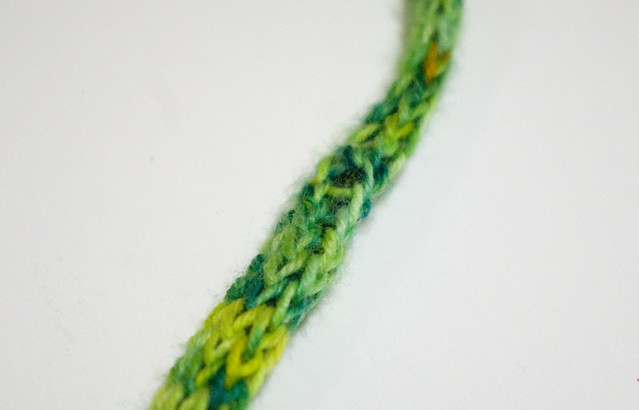
6. Continue in this method until the I-cord you have created is as long as the circumference of the head of the person who will be wearing the headband. Make sure that the measurement is taken without stretching the knitting.

7. Cut the yarn about 6″ away from the peg end of the spool knitting. Thread the end of the yarn through the darning needle. Moving counter-clockwise from the last stitch, use the darning needle to thread the yarn through each loop.

8. Pull the loops off of the pegs, then pull the yarn taut. Tie the yarn securely so that the knitting will not unravel.

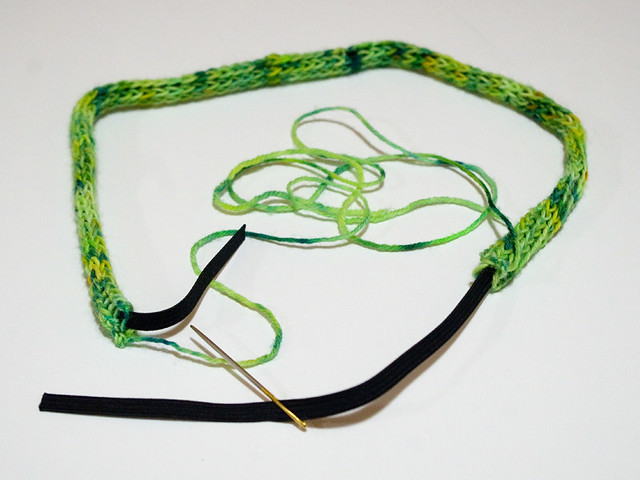
9. Remove the I-cord from the knitting spool. Thread the elastic through the darning needle. Use the darning needle to pull the elastic through the center of the “tube” of the I-cord.

10. Push the I-cord back on the elastic to create a clear working area. Cut the elastic to the circumference of the intended head. Overlap the elastic about 1cm and, keeping it flat, stitch the ends together.

11. Pull the I-cord back so that it covers all of the elastic. Tie the two tails of yarn together tightly, then pass them both through the darning needle and use them to roughly stitch the two ends of the I-cord together.

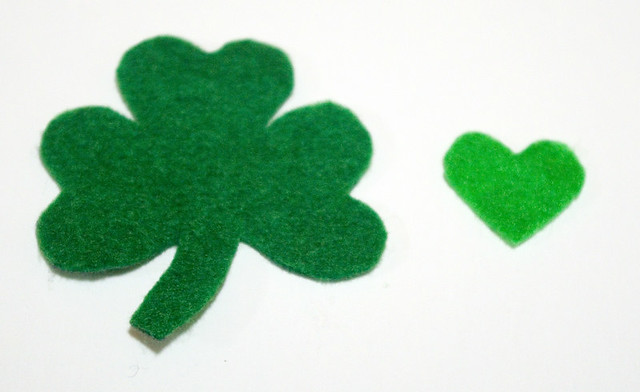
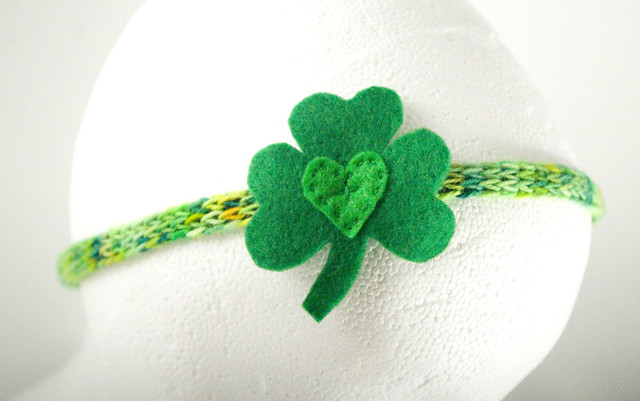
12. Use a pencil or marker to sketch a shamrock and a small heart out of two different shades of felt. Cut the designs out with scissors.

<img src="https://farm8.staticflickr.com/7856/46685216214_0aff433758_z.jpg" width="640" height="544"

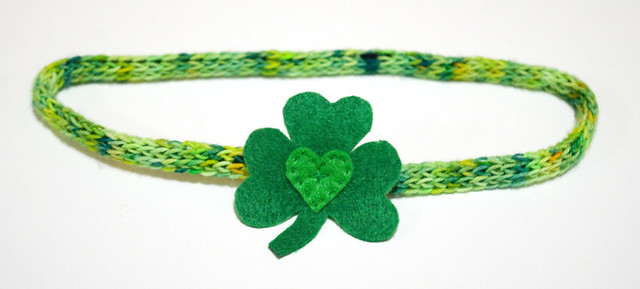
13. Making sure that the non-marked side remains up, stitch the heart to the top of the shamrock.

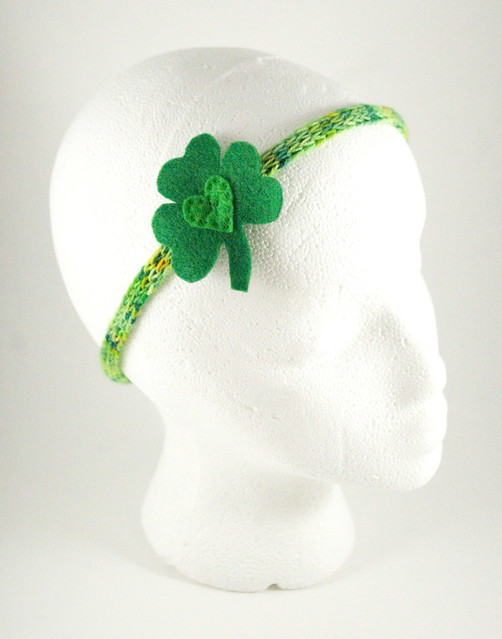
14. Stitch the shamrock over the area on the headband where the two ends of I-cord were joined.

That’s all there is to it! Of course, any colour of yarn and any felt design can be used. I just thought that it would be nice to have something in the theme of Saint Patrick’s Day given that it was coming up on the weekend. But red, white, and pink with a heart design would be lovely for Valentine’s Day; red, white, and green for Christmas; you could make it in the colours of your favorite sports team or even Hogwarts House. Be creative!

Strawberry Pi Pie Cat Toy Tutorial

March Break didn’t really turn out as planned. A tickle in my throat at the flea market on Saturday turned into a full-blown chest cold by Sunday; Monday through Thursday I spent most of my time between decongestant doses with a hot barley bag over my face to decrease the pressure in my sinuses. The rest of the family didn’t fare much better, with my husband missing work and the only reason the kids didn’t miss school being that it was already a holiday. All of our plans for outings and most of the fun things to do at home went straight down the toilet.

However, I had made myself a promise of one thing I was going to do over the break: find a rescue kitty who would fit well into our home. This was not a spontaneous decision, since my husband finally agreed that it was time for a new cat since Christmas (our previous cats passed away of extreme old age over ten years ago). But we also knew that we were going to be in Madrid in February, and we didn’t think it was fair to adopt a cat and then go away for ten days just as it was settling in.

So over the March Break I visited the Humane Society as well as many of their Pet Adoption Locations. While I think I petted and cuddled every cat who was willing (which is honestly a nice way to spend your time anyway), it wasn’t until right before closing on Wednesday night that I found Fizzgig (originally named Violet).

Fizzgig is a female 9-month old brown tabby with green eyes who is very curious about the world around her. She is a little bit shy, but deals well with our boisterous, noisy family.

So, in honour of the new member of our household, I thought that a cat toy craft was in order. Since March 14th is Pi Day, a pie-shaped toy seemed particularly fitting! If you don’t have a cat who would have any use for this toy, it also makes fun play food for a child.

Strawberry Pi Pie Cat Toy

Materials:

– 1 sheet of tan felt
– coordinating tan thread
– red embroidery thread
– polyester stuffing
– OPTIONAL: dried catnip

Supplies Needed:

– sewing needle
– scissors
– circular item (to trace)
– pencil

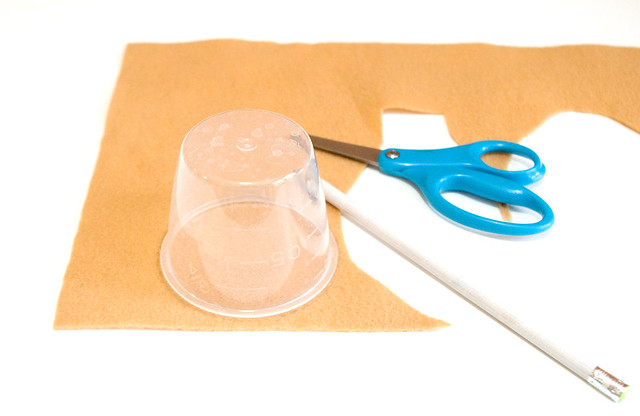
1. Using a circular glass or container about 7cm in diameter, trace a circle on your felt.

2. Cut out the circle and a strip of felt about 2cm wide. The strip should be an inch or two longer than the circumference of the circle. The easiest way to determine the circumference without math is to wrap the felt around the bottom of the glass/container you used to to make the circle.

3. Using coordinating thread, whip stitch the long edge of the strip of fabric to the circumference of the circle.

4. Overlap the ends of the long strip, and then trim off the excess so that they only overlap by about half a centimeter. Whip stitch along the exterior edge to join the strip into a circle.

5. Using your stitched portions as a guide, draw a rough circle about 1cm larger all the way around than the original base. Cut it out.

6. Turn the circle over so that the marked pieces are on the bottom. Draw the symbol for Pi π in pencil at the center of the “top crust” you just cut out.

7. Using red embroidery thread and your favourite stitch (I am a fan of the split stitch, which is #3 in this article), embroider over the pencil markings you have made for the Pi symbol.

8. Using a large whip stitch (which will result in the fabric bunching around the edge to create the “crimped edge” of the top crust), sew the top crust to the rest of the pie. When the crust is about 3/4 of the way attached, stuff the pie with polyester stuffing and, if you so choose, a little bit of dried catnip. Then finish stitching the pie closed.

Your strawberry pi pie cat toy should be ready to go! We didn’t use catnip for ours, but Fizzgig likes it just the same. Her favourite thing to do is bat it down the stairs and then go chase after it. I tried to get a picture of her playing with it, but this was the best that I could do — she’s basically just a motion blur at this age!

Plastic Lace Bracelets Tutorial

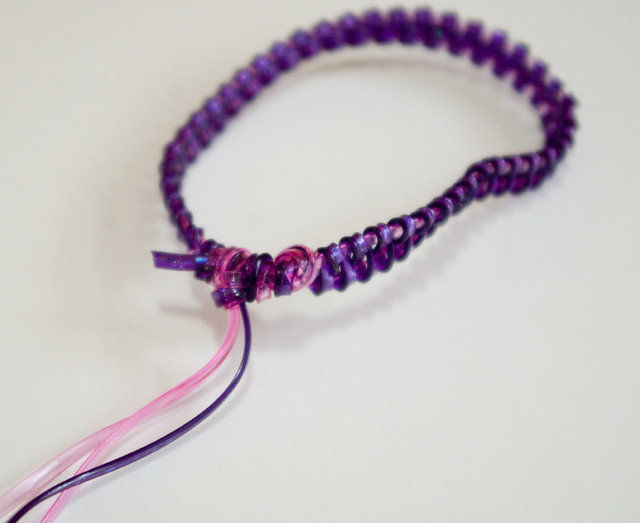
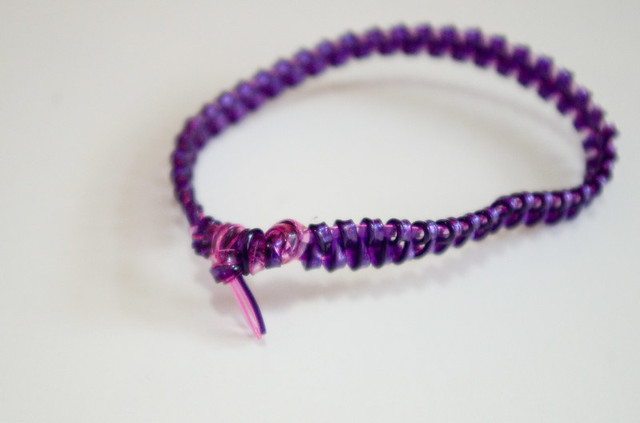
I used to make plastic lace bracelets (and zipper pulls, and all kinds of little geegaws) in the schoolyard with my friends when I was a kid. I learned how from my friends, but I’m not sure where they learned; perhaps the older kids passed it along to the younger ones. This is the simplest style was what we called a “zipper” bracelet, just because it kind of looked like a zipper when it was done. These days, I’ve seen this technique applied to paracord bracelets, which seem to be a recent trend in this kind of craft.

Plastic Lace Bracelets

Materials:

– plastic lace

Supplies Needed:

– scissors

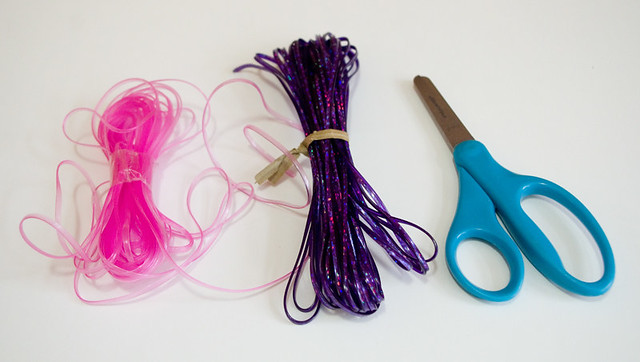
1. Pick your supplies. I generally find it’s easier with two different colours of lace because it’s easier to keep track of which one’s which, but it’s up to you. Cut a piece of your base coloured lace twice as long as the intended bracelet length, plus about 5″.

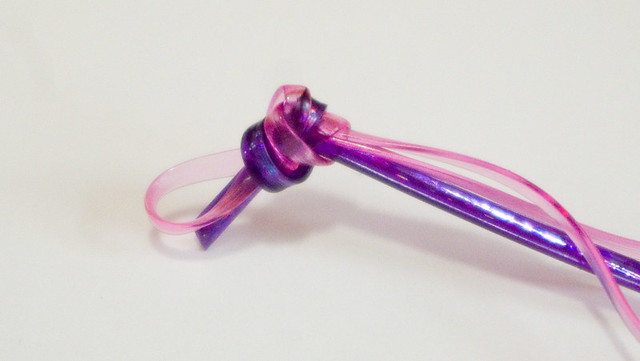
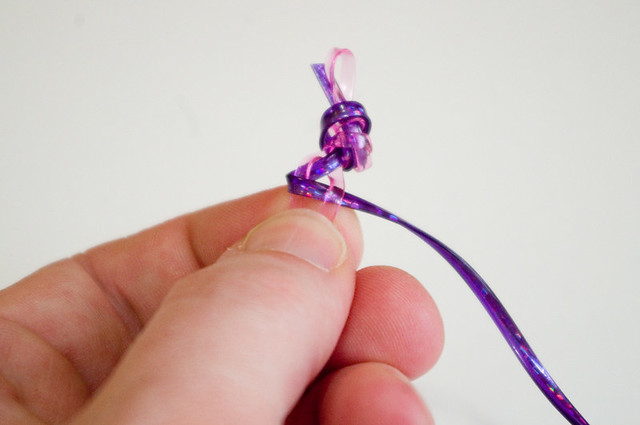
2. Fold the base colour lace in half, and then pair it with the accent colour of lace (don’t bother to cut this one yet). Tie a knot to attach the laces together.

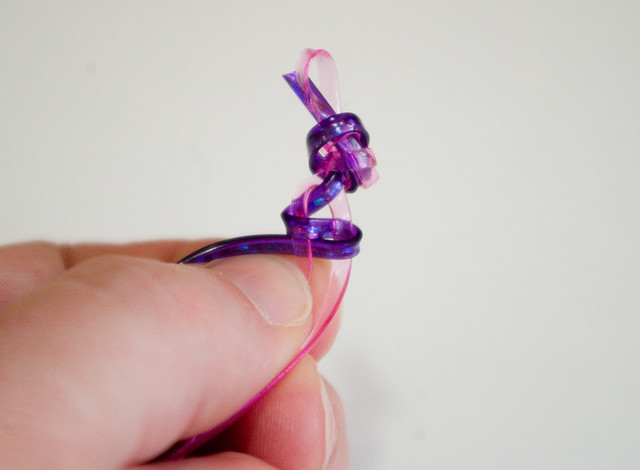
3. Wrap the accent colour lace around the left base lace, then bring it down the middle.

4. Keeping the laces flat and taut, wrap the accent colour around the right base lace, then bring it down the middle.

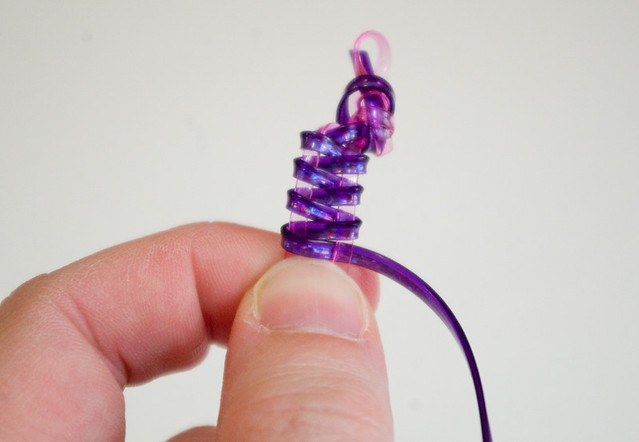
5. Repeat steps 3 and 4, being sure to press firmly up on the lacing from the bottom as you go, to prevent gaps. Keep repeating these steps until the bracelet is as long as desired.

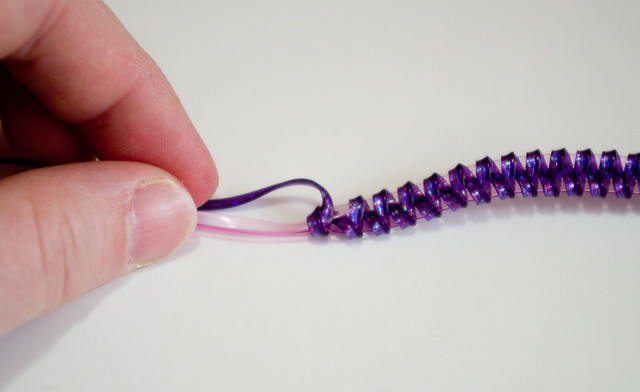
6. Using the accent colour, tie a knot around the base colour laces to keep the lacing from coming out.

7. Thread the leftover lace through the loop created in step 2, and tie both ends of the bracelet together.

8. Trim the excess lace.

9. Wear it!

Yarn Dolls Tutorial

Yarn dolls are something that I used to make all the time as a kid; once again, I believe I learned how to make them in Girl Guides. I realized that I hadn’t made any with my own children yet when Thing 1 came home from Guides the other night with the beginnings of her own yarn doll in the works. Thing 2 hadn’t had a chance to make them yet, so I thought I’d dig out my solid-colour yarns left over from previous projects and let them get at creating.

If you’re not the kind of person who’d have yarn scraps around the house, don’t despair! There are lots of very cheap yarns available, even from the dollar store. But before you head there I might recommend hitting the local thrift shop. There you can usually find orphaned balls of yarn for a fraction of the price of buying new, and it keeps a previously-loved item from going to a landfill.

Yarn Dolls

Materials:

– yarn
– OPTIONAL: googly eyes, beads, buttons, scrap fabric, etc.

Supplies Needed:

– book, binder, folder, or piece of stiff cardboard
– scissors
– OPTIONAL: glue, needle, thread

1. Get your yarn, book, and a pair of scissors. I chose a stack of file folders for 8″x10″ pages because they were about the right size for the size of doll that I wanted to make. However, you can really use any size of book or even a piece of cardboard. Since it’s just going to hold the yarn, you don’t have to worry about damaging it.
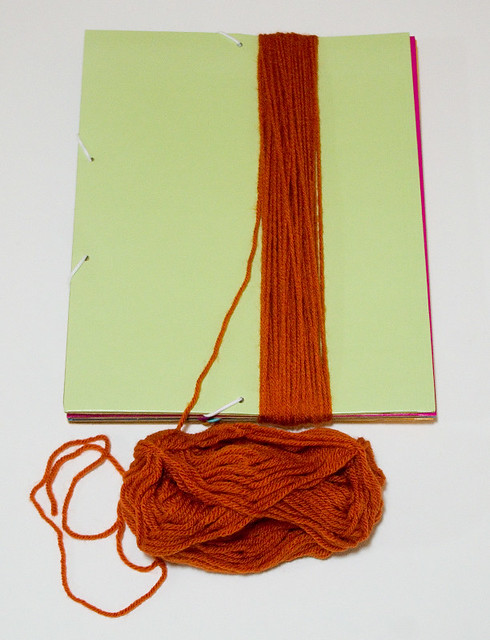
2. Wrap the yarn around the book until you have created a thick hank. How much yarn you use depends entirely on how big you want the doll to be and what size of book you use. Feel free to experiment! There really isn’t any “right way” to do it. Then cut the yarn off of the ball.
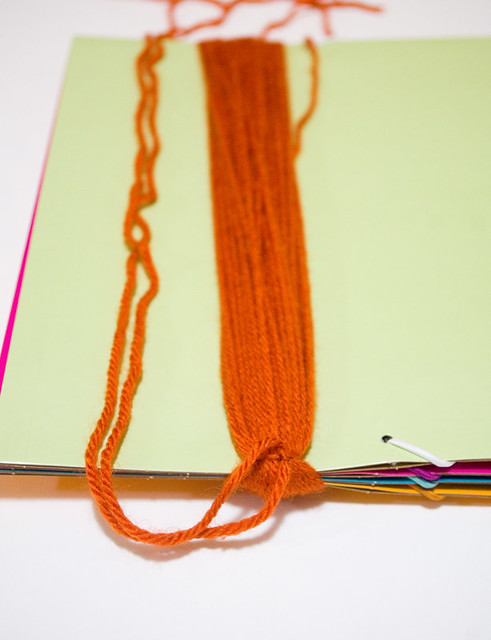
3. Cut a piece of yarn that is a little bit more than twice as long as the book. Thread the piece of yarn under the hank and tie it tightly with a double knot.

4. Slide the hank off of the book. Pass the piece of yarn that you used in step 3 through the center of the hank again and tie another double knot for reinforcement. Turn the hank inside-out so that the knots are on the inside. Smooth the piece of yarn so that it is now part of the hank.

5. Cut another piece of yarn that is a little bit more than twice as long as the book. Wrap this yarn tightly around where you will want the neck of the doll to be, then tie it tightly with a double knot. Wrap the yarn around one more time and tie it again for reinforcement. Smooth the yarn into the hank.
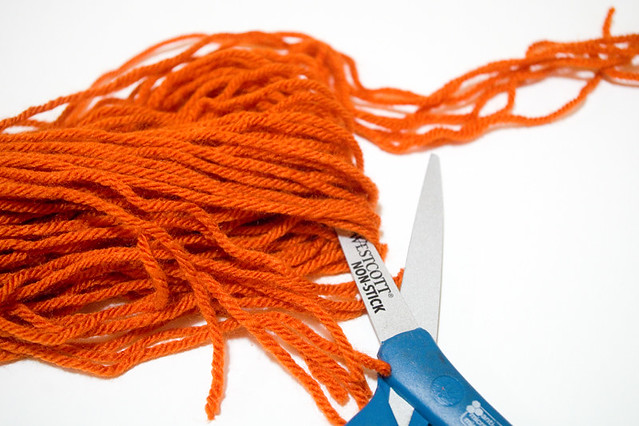
6. Holding the yarn taut, snip the loops at the bottom of the hank (opposite from the head you have created). Trim the excess yarn so that it is roughly the same length.

7. Separate roughly a third of the yarn to create the arms (1/6 of the yarn per arm). For thicker arms, separate a little bit more.

8. Cut another piece of yarn that is a little bit more than twice as long as the book. Tie that yarn to create the waist, using the same technique as at the neck.

9. Braid the arms, double-tying the wrists tightly with scraps of yarn. Divide the bottom of section of yarn in half and braid it to create the legs. Double-tie the yarn tightly around the ankles.

10. Trim off the excess yarn on the hands and feet.

At this point your yarn doll is technically done, but if you feel that it is too plain, that’s where the optional decorations come in! You can:

– add googly eyes or beads or buttons for eyes,
– tie on more yarn as hair,
– sew scrap fabric for clothing,
– tie on artificial butterfly or dragonfly wings to create fairies
– twist a pipe cleaner into a halo and tie on a big lace bow as “wings” to make an angel
– make tiny yarn dolls to hang from earrings or necklaces
– make small yarn dolls in festive colours to use as Christmas ornaments

Exercise your creativity!

There are a couple of basic variations on this kind of doll that are useful to know. The first is the “dress” version, which basically omits braiding the legs to create a skirt. You may note that the arms of this doll are tied instead of braided, which is a much quicker way to do it; this is great for younger children who may have limited patience or braiding skill. It should be noted that this version requires a shorter length of yarn (i.e. a smaller book) due to the lack of braiding.

Also, for a simple snowman, use white yarn and tie it all together at the bottom to create a “snowball” instead of legs.

A great Halloween version of a yarn doll stops at Step 6, and requires only the addition of googly eyes to become a ghost. This is probably the simplest version possible, which is perfect if you want to make a bunch of them and hang them as decorations.

Have fun!