Canning Pears

A while back, a friend of mine brought me a box of cooking pears from his neighbour’s tree, which was producing an overabundance. Not too long after that, he brought me a second box full. I’m told that these boxes of fruit kept appearing in front of his house under not-so-mysterious circumstances; apparently that neighbour was getting really tired of being beaned in the head by falling fruit. This week I finally had the chance to tackle this mass of pears. I’ve been cooking with them for over a month, but my rate of attrition was much too slow, and some of the fruit was starting to turn.

First I made a double batch of Cinnamon-Scented Parsnip Pear Jam, from page 407 of Preserving: The Canning and Freezing Guide for All Seasons by Pat Crocker (2011). As interesting as this combination appeared at first glance, I found the final result much too sweet; it uses twice as much sugar as fruit by volume, which is a very high ratio even by jam standards. It would still be nice on Dad’s Biscuits, fresh bread, or toast, but I guess I was hoping for more of a flavour punch given my success with this book’s carrot jam. However, I do agree with the book’s assessment that this jam, when mixed with a bit of orange juice, would probably make a lovely glaze in which roasted root veggies could be tossed.
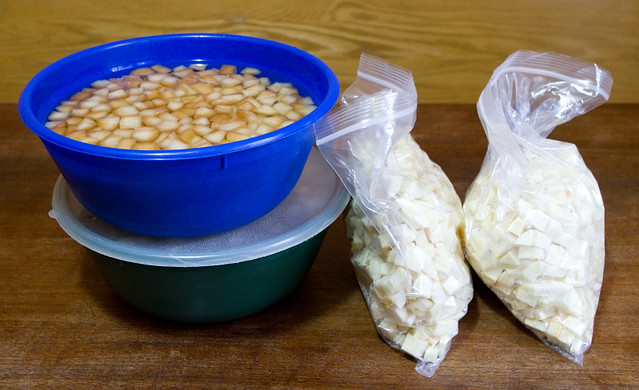
I well and truly overestimated how much fruit & veg to prepare to make this recipe, even doubled; I honestly thought I’d be able to get at least a quadruple batch in, but with all of that sugar, my pots just weren’t big enough. So I had a whole bunch of peeled, cut up pears (left) and parsnips (right) after this attempt.

The parsnips became part of our dinner last night, roasted in the oven with a sprinkle of salt, pepper, rosemary, and olive oil. I served them with baked pork chops coated in dried onion soup mix, which is a dish from my childhood that I’ve been making a lot lately once I was reminded of it. It’s just so easy! I probably have enough parsnips left for another three dinners like this one, but I think that would get old fast. I’ll need to research another recipe.

For my next recipe, I took a chance and tried peeling my ginger with a spoon, which is a kitchen hack I’ve seen floating around the Web for a while. I was quite satisfied with how this worked, actually. Not all cooking hacks are worth your time, but I found that this was honestly easier than a veggie peeler or a knife, and it wasted much less of the root.

The next step was to break out the candy/deep fry thermometer and bring the next jam up to the jelling point. (As an aside, am I the only one who feels like they need a shield as their jam/jelly gets thicker and it starts spitting huge globs of boiling-hot sugar and juice out of the pot?) This time I made Spiced Pear Jam with Pineapple found on page 935 of the Joy of Cooking (2006 edition, Rombauer & Becker), or on the app.
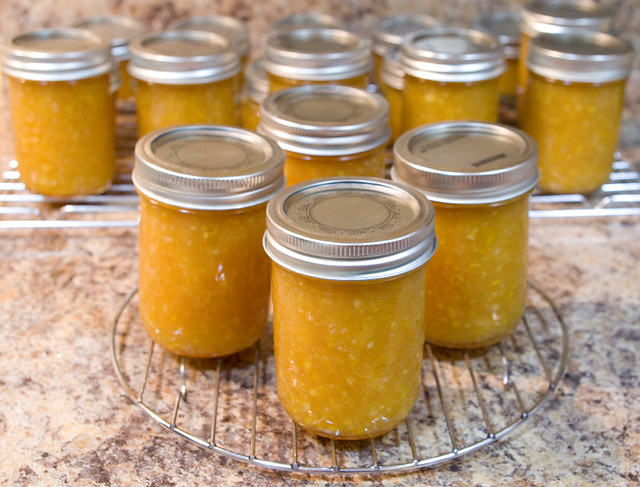
I was much happier with this jam than the previous one. I could definitely taste the fruit, and it wasn’t too sweet (it has a much lower sugar-to-fruit ratio). I have to admit that I couldn’t really taste the pineapple; the citrus note is definitely the strongest part of this jam, which isn’t necessarily a bad thing, although it does end up tasting more like a marmalade.

I probably still have enough chopped pears to make one more batch of jam. What kind should I make? I still haven’t decided. I have a lovely old recipe for pears poached in red wine and then canned, but that’s really intended for whole pears. These cooking pears needed to be chopped up to remove imperfections, so they’re sadly not really suitable to such a dish.


Steak Ramen

Last night I was searching for something to make for dinner, something that wouldn’t require a special trip to the grocery store. I did finally go get groceries on Monday, so now both the freezer and the fridge are full and I figure that I shouldn’t have to go out again every day for ingredients. At my husband’s request, since he’s fighting off a cold, I decided to make soup.

In the freezer I had some beef broth made with garlic and wild mushrooms, which I thawed as the base for the soup. I boiled up some ramen noodles and topped them with steamed spinach, carrot matchsticks, and soft-boiled eggs. The crowning glory of this particular dish was the steak. It didn’t brown up as nicely as I’d like, to my dismay, but it was very tender. To enhance the flavour, I used a marinade from page 65 of Simply Ramen by Amy Kimoto-Kahn (2016). Now, technically the recipe was for Kobe Beef Tsukemen, but I’ll be 100% honest and tell you that there’s no way I can afford Kobe beef. Instead, I thought I’d just use the marinade on a (much) cheaper steak. The marinade contains lemon juice, soy sauce, sake, and mirin (sweet rice wine), which combined is somewhat salty-sweet with an acidic punch to start breaking down the meat. Also, as per the recipe, I fried up the steak in melted beef suet instead of oil, which I think helped to enhance the flavour. Once I removed the meat from the pan, I added the juices to the soup broth to add extra punch. I was very satisfied with how it all turned out, especially since it made a lower-quality cut of beef quite palatable. Even if I never get the chance to cook Kobe beef, I think that I will definitely revisit this recipe in the future when I have all of the other ingredients on hand to try the dish in full.

Circular Bacon?

I’m trying my darndest to get the costume photos from this weekend edited, but it’s taking much longer than I had hoped, although I do acknowledge that this is mostly because I’m really picky. It would have been much too easy to just crop the photos to size. So it may be another day or two before I have it all done.

In the meantime, I did have to cook dinner last night, which had to be quick because I had to get the kids to extracurricular activities. Thing 2 requested bacon and eggs, which I thought was a perfectly acceptable solution. Earlier in the day I’d put some Milk Loaf (page 65, Bread Machine: How to Prepare and Bake the Perfect Loaf (Jennie Shapter (2002)) on to cook in my bread machine. I just microwaved some bacon (my preferred low-mess way to cook it), scooped out some honeydew melon, fried up some eggs, and buttered some fresh bread for a quick dinner.

You might note that the bacon in the above photo are shaped unusually. It’s not an illusion, the slices are actually more or less circular! They’re actually Presiden’t Choice Naturally Smoked Bacon Rounds, which are described as follows:

A real game changer when it comes to whipping up burgers, breakfast sandwiches and BLTs, bacon rounds make things so much easier. Cut from the pork belly, they’re everything you love about traditional bacon – only rolled prior to smoking and slicing. Not only are they the perfect fit for buns and English muffins, the edges curl up a little while cooking, creating a “cup” for toppings.

Well, my slices didn’t curl up on the edges, but maybe they do so when fried. I have to admit, I’ve never had any problem whatsoever fitting traditionally-sliced bacon into a sandwich or burger, so I think that these bacon rounds have been created to fix a problem that doesn’t really exist. I mean, if your bacon is too big for your bread, it can be broken if crispy or cut if soft. The rounds are more expensive than the same brand’s regularly-sliced bacon, too ($1.60/100g vs. $1.20/100g). I have a feeling that other shoppers agree, since I found my supply in the clearance section at the local grocery store and I haven’t seen them there since. I paid only $0.99 per package (so $0.26/100g if I did my math right), and at that price it was definitely worth it since the rounds taste exactly the same as regular bacon. Without another comparable sale, I can’t see myself buying these again though.

Clean Out Your Refrigerator Day

I’m still working away on that last-minute costume. I got so caught up in the process that I stayed up until almost 2:00am without even realizing it! I had absolutely no intention of staying up too late. When I get into problem-solving mode, I hate to stop when I’m on a roll. If I’d been super-frustrated, I would probably have stopped earlier (although there was a large seam that I “sewed” without realizing that the bobbin had run out).

I couldn’t find my meter stick, so I did end up using a wooden prop sword in order to trace a long, straight line on my fabric. My father pointed out afterward that I could have just called and borrowed his, but the sword was only a few feet away from where I was sewing, and it worked out fine!

November 15th is Clean Out Your Refrigerator Day, so I made a dinner entirely out of what I had around the house. This had nothing to do with the fact that I’ve been so engrossed in costume construction that I haven’t gone out to do groceries, I swear. I went with one of the simplest clean-out-the-fridge dishes: stir fry. I cooked up the veggies I had on hand (celery, zucchini, and frozen peas), scrambled in some egg, threw in some cooked rice and shrimp, and gave it all a good drizzle of sesame oil and soy sauce while I cooked it all together for a few minutes. My husband asked for seconds, which I figure means it wasn’t half bad.

After the kids went to bed, I wanted to treat myself to some banana bread, which is pretty much my favourite quick bread. I even had some bananas I’d frozen before they went bad that I needed to use up, so the timing was perfect. I’d seen a Tasty video for 6 Desserts To Make In Your Microwave, so I thought I’d give their individual microwave banana bread a shot. Sadly, as with the microwave oatmeal bread I made a while back, I was disappointed. The more I try it, the less I think that microwaves can be used for half-decent baking.

First of all, there was a recipe in the YouTube transcription of the recipe. If you watch the video, the ingredients include 3 Tbsp brown sugar and 1/2 tsp baking powder, but the recipe under the video calls for 3 Tbsp brown sugar and then another 1/2 tsp brown sugar, with no baking powder. Luckily I noticed that there was no rising agent before I started cooking, but by then I’d already added the extra 1/2 tsp brown sugar, too.

Once the banana bread was cooked, I found it to be largely tasteless. I found that interesting, because it contains basically the same ingredients as the more traditional banana bread in the Joy of Cooking; what really differentiates the two, other than size, is the cooking method. I think that because the Tasty version is made so quickly in the microwave, instead of cooking for an hour or more in the oven, it doesn’t have a chance to develop its flavour, which probably mostly comes from the crust. Microwave cooking, in general, doesn’t create proper crusts. Also, I found the consistency of the microwave banana bread to be less like a quick bread and more like a sponge or a pudding. I cooked it for an extra 30 seconds over the recommended time and tested it with a cake tester for doneness, so I know it was definitely cooked all the way through. Even so, the consistency was more like microwave scrambled eggs than like bread.

Of course, opinions may vary, and you may like banana bread made this way. I think that I will stick to baking in the oven from now on, except perhaps for the occasional experiment.

Tornado Potato

Last night, being a Sunday, dinner wasn’t a rushed affair between classes and extracurricular activities, which it definitely can be during the school week. I had the opportunity to try out a new recipe that I’d spotted on Tasty for tornado potatoes:

It looked pretty simple, and it actually was! (That isn’t guaranteed with tutorial videos, as they’re often made by people who are experts in their fields, who can make even the most difficult techniques seem simple because they have tonnes of practice at them.) I had a really hard time inserting the bamboo skewers into the potatoes, though — they kept snapping off, sometimes inside the potato! So I used metal barbecue skewers instead, which slid through the potatoes like butter.


Tornado potatoes served with a ground beef/lamb mix in mushroom soup gravy, steamed frozen peas, and steamed carrots.

I used Prince of Orange potatoes from my garden, which are a little harder than a russet, so I should have cooked them a little longer, but I will know that for next time. Overall, the taste was very nice, and everyone in the family liked them. Now that I have the kinks in the process ironed out, I can see eating tornado potatoes a lot in the future.

Winter is Coming

Although I am much better, my kids are still fighting their colds. Last night I decided to go the more traditional route, dinner-wise, in an attempt to help them get well. I don’t know that it actually helped, but it didn’t hurt at any rate, and it was pretty tasty.

I made up a batch of chicken noodle soup based roughly on the recipe on page 125 of the Joy of Cooking (2006 edition, Rombauer & Becker). I added carrots and rosemary mostly because it’s what I happened to have around the house. I served the soup alongside fresh-baked Poppy Seed Loaf (page 138, Bread Machine: How to Prepare and Bake the Perfect Loaf (Jennie Shapter, 2002)) with avocado slices on top. Unlike me, the rest of the family ate their bread with butter and scooped the avocado out of the skins directly with a little bit of salad dressing on top.

Last night ended up involving a lot more food prep than just supper, though. The forecast called for the temperature to drop precipitously overnight to a low of -10°C (14°F) with a windchill of -20°C (-4°F). I had left a few frost-hardy plants in the garden after the main harvest, but I knew that cold this intense would kill them. So I had to bring in two good-sized bunches of celery, which I washed and trimmed the leaves off of, then put in a jug of water in the fridge for use over the next week or so.

I had a whole mess of Swiss chard to bring in — believe it or not, this was all from only two bunches!

I washed it all, then chopped the stems into bite-sized pieces, which I bagged to freeze in single-use packages over the winter in soups, stews, stir-fries and casseroles. The leaves don’t freeze nearly so well, so they’re still drying off in my sink while I figure out what to do with that much chard. A friend suggested a soup, but I don’t have a recipe yet.

My uncarved Halloween pumpkins had to come inside; freezing isn’t terribly hard on them as a general rule, especially if you’re just going to cook them, but a frozen-solid gourd is really difficult to prepare. Heck, it would take an axe or a sledgehammer just to get through it!

I also brought in the last of my summer herbs so they didn’t get frostbitten (along with half a case of Coke that I’d been cooling outdoors since the Halloween party; cool fall temperatures mean that the outdoors makes a great refrigerator for non-perishables). There are two pots of lavender, one of mint, one of rosemary, and one of parsley. Some of them I will eventually dry, others I will preserve (I have an interesting recipe for parsley jelly I want to try). They’d survive just fine in the house all winter, but the pots are quite large and take up my whole patio window. I think I will just plant new herbs in the spring and not deal with the hassle.

Victorian Curry

I really enjoy trying recipes that are not only new to me, but ones that are actually quite old. My collection of vintage cookbooks is slowly growing, one thrift store, garage sale, and used book sale at a time. But that’s not the only place that historic recipes can be found. YouTube is a great resource, and I love to have it playing in the background while I’m cooking, giving me ideas for my next meal. That’s how I came across the English Heritage channel, and How to Make Curry — The Victorian Way.

If you visit the actual video on YouTube, the written recipe can be found in the video description.

Now, of course this is English curry from the 1800’s, not authentic Indian dish at all. The ingredients are ones that were possibly to obtain locally or ones that were fairly easy to import; this was generally a dish served to the burgeoning middle class at the time, and the most expensive imports just didn’t make it that far down the social ladder. However, an English soldier or merchant who’d had a chance to try authentic Indian food — and liked it — would probably like something like this dish when they returned home.

I tried making Victorian-style curry for dinner last night, and I’m happy to say that it went pretty well. The recipe breaks down the components of their curry powder, but not the quantities of each spice, so I had to make an educated guess. I put in:

7g turmeric
5g ground ginger
3g white pepper
3g ground cardamom
5g ground coriander
2g cayenne pepper

This ended up being a pretty hot curry, at least to my kids’ tastes (my husband and I actually enjoyed the burn). I think next time I make it I might halve the amount of cayenne pepper, or even quarter it — which may lead to some difficulties in measurement because my scale isn’t sensitive enough to read weight under a gram. Perhaps I need another, more precise scale?

I was pleasantly surprised by the combination of ingredients in this recipe. As the video suggests, I included two chopped shallots and three diced cloves of garlic, since unlike Lord and Lady Braybrooke, I like both. I thought that the five (five!) onions would make it taste too much of onions, but it really didn’t. I couldn’t taste the cucumber at all, though I suspect that it played a part in thickening the sauce (and adding vegetables to a recipe rarely makes it less healthy). The apple was a nice, sweet touch. I did appreciate that this dish is dairy-free without having to make any changes. I’ve found that many curries, at least the ones made in North America and Europe, use cream or coconut milk to thicken the sauce. I have no idea whatsoever if this is also true of authentic Indian dishes, but I’ve never claimed to be an expert on such things. Not having to alter the dish in this respect was a nice change.

I’m hoping to make up some mince pies and gingerbread the Victorian way for the upcoming holiday season. I also have yet to try anything from my English 18th Century Cookery book, so that’s up there on my list. I’m also looking forward to trying a few of the recipes from my recently-acquired The Tudor Kitchens Cookery Book: Hampton Court Palace book, which I found at a local thrift store. This book has both original and modern interpretations of recipes originally from 1485 to 1603, so it should be a little bit easier to follow than those from 18th Century.

Halloween Party Leftovers

After about a week of junk food and candy, I thought it was about time to start making some healthy food again. I needed (and still need) to use up some leftover food from the Halloween party on the weekend before it goes bad, so dinner planning for the last few days has been centered on that.

On Monday night I improvised some sushi bowls, which contained garlic shrimp (from my freezer), smoked salmon (leftover), lumpfish caviar (which I had meant to put on the deviled eggs and then completely forgot about), avocado slices, and steamed Swiss chard (from my garden) in a drizzle of teriyaki sauce. I was looking for a better way to serve Swiss chard that my kids might actually eat, and although this wasn’t horrible, I don’t think it was all that great either. I need to experiment more.

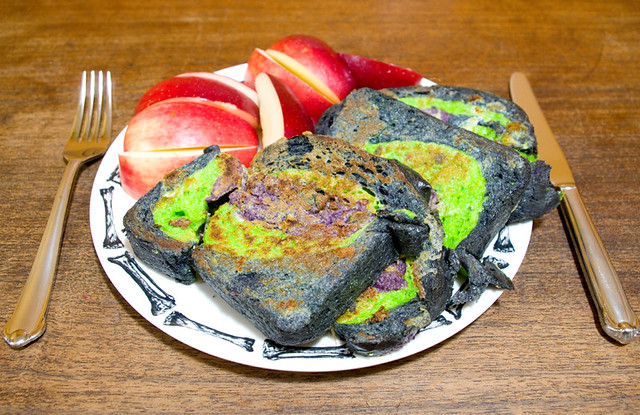
Last night’s dinner was French toast and apple slices. I think that French toast looks absolutely hilarious when it’s made with Voodoo Bread. I mean, it tasted just like normal Nan’s Pan Rolls bread dipped in eggs and fried, but the colours definitely made it much more fun. My kids are really into this “rainbow bread”, as they call it. Perhaps I could make it in different colours for other holidays, even if I can’t quite get it into the proper swirl.

Childhood Family Dinner

Yesterday I had a million and one things to do in order to prep for the party on Saturday, so I really needed to make a dinner that I could probably have cooked in my sleep. This was the kind of dinner that I had regularly as a kid and was one of the staples of how I learned how to cook, way back when. A few small things have changed here and there, but it basically tastes the same.

I baked chicken thighs that were sprinkled with powdered onion soup mix. When I was a kid, boned and skinned meat was way too expensive for everyday meals, so it would have been whole chicken legs (drumstick and thigh), bone-in, skin-on. I served it with whipped potatoes; as a kid, that would simply have been mashed, no fancy schmancy electronics like a hand mixer. The corn was exactly what I grew up with: boiled from frozen, generally in the microwave.

We ate all kinds of other food, of course. My mom used to hang out with a Lebanese couple, and they exchanged recipes and techniques, so Mom made great Lebanese food. We ate all kinds of pasta and roasts and fancy Sunday dinners. But when push came to shove and we had something going on on a weekday evening (and with both my brother and I in hockey and Guiding/Scouting, that was most evenings), this was our fast, easy, everybody-likes-it kind of meal. To me, this kind of dish is a comfort food, because it brings back fond memories of family togetherness. And as a bonus, now that I’m a parent myself, there’s nothing in a supper like this that I have to fight to get my kids to eat!

Oh, and if you think that my parents wouldn’t have served supper on a plate with a skull and bones on it, on top of a skeleton-print tablecloth, you probably haven’t met my parents. Trust me, if they’d had those things, they would have used them in a heartbeat.

Chichen & Roast Vegetables Curry for Family Guests

Last night I had family guests over for dinner. I find that my guests can be divided into two basic categories: formal and family. Formal visitors are generally people I don’t know very well and with whom I am still trying to make a good impression. When they visit, I stress that my house is not neat and tidy enough, that my decor is not fancy enough, that my food is not tasty enough, and that my children are too noisy (unless they bring their own children along, which mitigates this factor). I spend hours or days making everything as perfectly prepped as possible before they come over, and I still worry that it is not enough.

Family guests include actual family and friends that I’ve known for long enough that they might as well be family. They have seen me at my best and at my worst, and they know that for the most part I am somewhere in between these two extremes. They are the people that would I welcome into my home without advance notice; in fact, I welcome them to drop by any time. So while I may not have a three course meal prepped for them and my house will be cluttered with the day-to-day mess of living, we do end up seeing much more of each other. Formal visitors can transition into family guests over time. It’s part of the process of friendship to me.

Last night’s dinner was one for family guests. The people visiting me were my parents, with whom I have a very close relationship, and a friend of the family who is an honorary aunt. She’s in no way related to me by blood or marriage, but she’s actually closer to me than a number of my actual relatives. This woman has known me since the day I was born; actually, she posed as my mother’s sister in order to visit us in the maternity ward and actually met me before my grandparents did. She changed my diapers and rocked me to sleep when I was colicky as an infant. At six years old, I was literally the only child allowed at her wedding. The idea of being formal with her is kind of absurd.

The seven of us crowded around my kitchen table (which doesn’t seem small when it’s just the four of us, but I am quickly reminded of the true size of my dining area when we have guests). I served a hearty, healthy meal based predominantly on my Thai Coconut Curry recipe, but as usual I changed things up a bit. I didn’t have any bok choy, so that got left out. I traded shrimp for chopped chicken thighs, added chopped garlic, and I served it over rice instead of noodles. Most notably for the flavour, I didn’t use curry paste, I just sprinkled in mild curry powder to taste. My parents don’t have the taste for any spice whatsoever, so the mildest way to go was the best in this situation. So I guess it wasn’t really all that similar to the original recipe, but the technique I used was the same.

I served the curry with some bread machine Whole Wheat Bread (page 15, The Complete Guide to Bread Mahcine Baking, Better Homes and Gardens (1999)). We sat around the kitchen table, stuffed our faces, caught up with the things we’d done since we’d last met, and regaled each other with stories of days gone by. It was a lovely way to spend an evening.