Excellent Potato Bread Recipe

I finally had a chance to try out one of the recipes from the 1877 The Home Cook Book that I was so happy to find on Saint Patrick’s Day! It was a very interesting exercise to try to recreate such an old recipe. Here’s the original text:

EXCELLENT BREAD
Mrs. Geo. W. Pitkin.

Four potatoes mashed fine, four teaspoons of salt, two quarts of lukewarm milk, one-half cake compressed yeast dissolved in one-half cup of warm water, flour enough to make a pliable dough ; mould with hands well greased with lard ; place in pans, and when sufficiently light, it is ready for baking.

You’ll notice that it gives no cooking time or temperature, no approximate yield, no idea the volume of mashed potatoes, how big a cake of yeast measures (and what kind of yeast — the book gives multiple recipes for how to make your own), or how much flour to use. I’m really glad this wasn’t the first loaf of bread I’d ever made! Although I guess part of the point of these recipes is that they assume that all readers will have a certain breadth of knowledge base.

As it turns out, this recipe makes 4-5 loaves, depending on the size of your loaf pan. I honestly didn’t even have a bowl big enough to mix all of the ingredients, so I had to stir everything in shifts. It all turned out quite well, though, so I thought I’d share my interpretation of the recipe. Hopefully it’s a little more easily-repeatable than the original; I’ve also halved the quantities in my version for ease of cooking in a modern kitchen. The end result is a white bread that is still a little heavier and more filling, due to the potatoes. It also stays moist much longer than a straight white loaf.

Excellent Potato Bread
Yields 2 large loaves

In a small bowl, mix together:
2 packages (14g) quick-rise instant yeast
1/4 cup warm water
Wait for yeast to activate; if it foams up, it is good to use.
While waiting for yeast, peel and chop:
2 potatoes
Peeled, this should yield about 265g of uncooked potato.
Place potatoes in a stove-safe pot, cover with water, and bring to a boil. Reduce heat to a simmer and cook until the potatoes are easily pierced with a fork. Alternately, you can cook the potatoes in a microwave-safe casserole: place potatoes in the dish, cover with water, and cook on high until they can be easily pierced by a fork, about 12 minutes. No matter how you prepare the potatoes, drain them once cooked and mash them until they are no longer lumpy. Set aside to cool somewhat.
In a very large bowl, combine:
4 cups warm milk
2 tsp salt
Stir. Add the yeast mixture and the potatoes to the mixture, stir well.
While stirring with a sturdy wooden spoon, gradually add:
8 cups flour
As the end of adding the flour nears, the mixture may become too stiff to stir with a spoon. If it does, it can be stirred with floured hands in the bowl.

Flour a flat surface and hands generously. Turn the dough out of the bowl, scraping if necessary. Knead the bread for about 10 minutes, until it is springy. If the dough is too sticky on the hands or flat surface, add a bit more flour, but add it gradually and only add as much as absolutely necessary. The dough should be moist but not sticky.

Oil or use cooking spray on a large mixing bowl. Form the dough into a ball and place it in the bowl. Cover the bowl with a clean, damp tea towel. Place the bowl in a warm, dry area with no drafts. Allow the dough to rise until double, about 1 hour.

Grease two loaf pans. If you use smaller loaf pans (8.5″x4.5″), they will end up with a “mushroom top” loaf like the one pictured. If you use larger 9.5″x5.5″ pans, the bread will be a more uniform shape.
Divide the dough into two even portions, form each into a loaf shape and put each one into its own loaf pan. Cover with a damp towel and allow to rise again in a warm, draft-free area until double, about one hour.

Near the end of the rising time, preheat your oven to 350°F (175°F). Bake for about 30 minutes, checking often near the end of that time to make sure that they do not overcook. Verify that the bread is done by removing them from the pan and tapping them on the bottom. When cooked through, the loaf should make a hollow sound. Remove the loaves from the pans immediately and place them on a wire cooling rack.

As with all bread, this kind is best served immediately. To keep it at its freshest, slice it only when it is about to be eaten. This bread will keep for four or five days if wrapped in a clean plastic bag. Make sure it is wrapped up only after totally cool, or it will go soggy.

Chicken Pot Pie Noodles

Last night I wanted to try something new for dinner, but I didn’t want something that would take forever and a day to prepare. The perfect compromise was the Chicken Pot Pie Noodles recipe from Delish that came across my Facebook feed the other day.

It was as easy as promised, although it did take me a bit longer because I had to cook the chicken beforehand — but that was just a matter of throwing some chicken legs and thighs on a roasting pan, seasoning them, and putting them on a roasting pan at 350°F (175°C) for about 45 minutes. This recipe would be much faster if I had precooked chicken, and I think it would be a great way to use up leftovers. I had to make my version dairy-free, so I substituted margarine for butter and coconut milk for heavy cream. I’ve found in the past that these are good replacements, and they worked just as well as expected. There was a slight flavour of coconut to the sauce, which isn’t strongly spiced, but that didn’t bother me. Also, I used macaroni instead of egg noodles, just because that’s what I had in the pantry, and it worked just fine.

Would I make this recipe again? Most definitely! I think it’s a great addition to my weeknight repertoire.

Salt Dough Creations

A friend of mine bought me a copy of the Better Homes and Gardens Treasury of Christmas Crafts & Foods for Christmas, and leafing through the project ideas therein brought back many memories of the kinds of crafts that I did when I was growing up. One of the ones that stood out the most was the salt dough Christmas ornaments. Although I never made any in the patterns suggested by this book, I did make some simple ones through Brownies and Guides, and I had a lovely little girl in a red dress as part of my ornament collection until she eventually fell apart. I thought that my kids might enjoy playing with dough that becomes a permanent creation for a change. (If your kids would basically like to do the same exercise but come away with something that they can eat, I would highly recommend Cookie Monster’s Famous Cookie Dough instead.)


Rolling out the dough and cutting it out with cookie cutters and Play Doh cutters.

I did my due Googling, and I discovered that although the style of ornament that people make has changed a bit over the years (especially when it comes to the choice of colours used), the actual technique remains the same. Multiple books and many sources on the Net stick to the basic recipe of:

– 2 cups flour
– 1 cup salt
– 1 cup water

Which you then knead together to create a stiff dough. You then cut out/shape your designs and lay them on parchment paper on a cooking tray. Advanced creations can take a long time, a lot of skill, and a great attention to detail. However, when you’re making crafts with younger children, quick and easy cookie cut-outs are the name of the game! As a bonus, since the dough is so cheap to make and is 100% biodegradable, if the kids proclaim themselves done after having made very few cutouts, it’s not too big of a deal.

Salt Dough 2//embedr.flickr.com/assets/client-code.js

After shaping, you put the salt dough creations in the oven at 200°F (93°C) for… Well, that’s where directions vary. I think it all really depends on the thickness of the final pieces. I’ve seen it anywhere from two to eight hours, so I kind of guessed at three, which worked out okay. I think that what everyone agrees on is that you don’t want to bake or brown the dough, you just want to remove all the moisture.

Then the cut-outs need to be cooled on a cooling rack, which doesn’t take all that long, really, since they weren’t terribly hot in the first place. We left them overnight to hopefully remove the last of the moisture. It’s not like you have to worry about them going stale, after all.

Then it was time for paint! I have what seems like a million colours of acrylic and many different paint brushes, all from the dollar store. If you don’t have a stash of paint and want to keep costs low, stick with red, yellow, blue, black, and white. The kids can mix any colours they want with the primary ones, and it’s a good lesson in colour theory.

To be honest, my girls ran out of patience with the fiddly details, so the painting will have to be completed another day. Since I had to make dinner, I didn’t get a chance to finish painting the ones that I made either, so we’ll have to sit down and do them all together tomorrow. I really liked how the ones with the impressions turned out, though. The girls used rubber stamps, carved rolling pins, and even leaves of plants to create textures.

Of the ones that I painted, I am particularly happy some of the simplest: the Easter bunnies, made using a cookie cutter and a little ball of dough for the tails.

The next step is to seal salt dough, which I’d prefer to do with spray-on acrylic, so that will probably have to be done out in the garage once it warms up a bit. I’m told it can also be done with Mod Podge or PVA glue, both of which I own, but I’d like to test them first to see how badly they smudge. Then the ones with holes will become ornaments, and the ones without holes will have a magnet (also from the dollar store) glued on the back to become fridge magnets.

Tie Dyed Pillow Cases

Tie dyeing with the kids is really something that I prefer to do in the summer when I can throw the kids outside in their bathing suits (which are synthetic and don’t absorb dye) to minimize the mess indoors. This time of year, with temperatures hovering around freezing and snow still covering the ground, that’s not exactly an option. Instead, the girls worked in their bathing suits and socks (warm feet are important) in the kitchen, over the metal sink, and we hoped for the best.

In the spirit of keeping things as cheap as possible, we used fabric we already had — four old, plain cotton pillow cases. We also bought the dye at the dollar store. So far, this are the cheapest kits I’ve found locally, with even Walmart’s selection starting at about $11.00 for a two-colour Tulip-brand kit that only makes three items. For six colours, you’re looking at upwards of $25.00. At Dollarama, they sell their own Crafts brand three-colour kits for $4.00 apiece, and we bought two in different colours. But would these kits work as well as the more expensive ones we’d tried?

When it comes to the supplies included in the kit, I found that they were more or less the same as other brands. They contained everything we needed except the water and the plastic to wrap the fabric as it sat, which is standard. Slightly higher quality gloves would have been appreciated, since they did leak and now the kids have splotches on their hands in places, but that seems to be standard too (just like the ones that come with hair dye). The instructions were clear and concise, and even had a brief photo tutorial for how to make different kinds of designs. We used the spiral (left) and bullseye (center and right) techniques on the kids’ pillowcases. (If you need more information about how to tie dye there are a million sites out there, but the Tulip site has some great tutorials that will work with any brand of dye.)

The kit did contain soda ash, which is necessary to pre-treat the fabric to retain vibrant colours. However, the directions did say that the dyes could be used without pre-treatment, but they would come out more pastel. I let the kids choose between waiting a bit longer to dye so they could have bright colours, or to do it right away and have lighter colours, and not surprisingly they chose to go with the route that required the least amount of patience. Despite the dire warnings of the packaging and articles online, after the first rinse the colours remained vibrant (above).

After a run through the washer and dryer, the colours did fade a bit, and I expect that they will continue to do so throughout their lifetime, but I remain happy with the final product. The kids are thrilled (according to Thing 1, the pillow cases are “Awesome!”), and since the project was for them, I say it was a success. (Bottom left and top right were done in the spiral techniques, top left and bottom right were done using bullseye — more techniques here.)

I will say one thing, though: each package of three colours claims that it contains enough dye for up to eight T-shirts. I guess that could technically be true, if you were to use very small shirts, and if you didn’t want a lot of colour saturation or variation in your design. Two packs, for us, did four very saturated single-bed-sized pillow cases (which I would say are about the same size as a small adult T-shirt), with enough left over to do maybe one more. That’s five items out of two packs of dye, when it claims we could make sixteen items. So keep that in mind when you decide how many items to prep. Even so, that’s five items in six colours for $8.00, compared to Walmart’s three items in two colours for $11.00, so Dollarama remains the cheapest place in town to buy supplies for tie dye crafts.

First Barbecue of the Year

Around the start of March, the weather begins to get warmer, but it’s still below freezing most nights and we’ll likely get a few more good snowfalls in. The weather has been quite mild recently, and is predicted to remain so for a while. We’ve managed to avoid Winter Storm Riley, which is hitting south and east of here. Canadian winters being what they are, we’d be prepared for the kind of snow that Europe is getting right now, but that weather system is much too far away. Instead, what we’re getting right now is the first hint of spring.

The photo above is a really old one of Thing 1 at the start of March, playing in the back yard while we cooked dinner on the barbecue. I love it because it shows the weird accommodations we have to make for the weather this time of year. (I also love it because I think Thing 1 is adorable, but I am somewhat biased.) It takes quite a while of above-zero temperatures for all of the snow to melt, and after that for the ground to thaw enough so that the water doesn’t just sit on the surface in a coating of mud and puddles. But it’s warm enough out that anything with good sun — or that sticks out of the snow covering — gets well dried out, and for the most part we get away with lighter clothing because it seems so much warmer than the frigid winter was. If you have kids in school, you send them in all bundled up for the morning temperatures (which are often below freezing), and they come home in the afternoon with 99% of their outerwear in hand or in their backpacks because it’s just much too warm. I’m pretty sure that this time of year is when the most stuff gets turned in to the school lost-and-found, to be honest.

One of the perks of this time of year is that our barbecues can be started up again, since they stick out of the ground a fair way and aren’t in areas prone to drifts. Technically, they can be used year-round, but we would have to dig them out after every snowfall, and missing just a bit of ice means that the covers end up frozen to the ground until the next big thaw. Actually, the gas barbecue’s cover is still quite encased in ice, but the cover for the Black Olive (an insulated wood pellet grill) is shorter and hence could be freed sooner. This device was handed down to us at the end of last fall, so we never really got the chance to test it out. Yesterday, my husband fired it up for the first time this year and we had our first hamburgers of the season — a sure sign that spring will soon be here. I had my burger with lactose-free cheese, mayonnaise, mustard, avocado, and lettuce. And dill pickles, of course.

Beef Stroganoff Recipe

I’ve been making beef stroganoff for fifteen years or so, but I hadn’t had any since a consultation with a dietician who suggested that I may be lactose intolerant. It’s been about a year since I started avoiding lactose, and my gut is much happier for it. I’m not touting this as something that everyone should try, since I know that there are a whole lot of people that tolerate lactose just fine — but sadly, I’m no longer one of them.

Lately I’ve been quite happy to discover that, in addition to the vegetarian/vegan options to milk that are out there, a few dairy companies have started to sell lactose-free versions of their products. I’ve found PC lactose-free old and marble cheddars in my local grocery store, and, for the first time just this week, Gay Lea’s lactose-free sour cream. As soon as I saw the sour cream on the shelf, I knew that I had to make some stroganoff this week.

Now, I’m not vouching for the authenticity of my stroganoff or anything. I can’t even remember where I first learned how to make it; it certainly wasn’t from someone who taught me in person. My version is the combination of a number of recipes over the years that have created what I’d consider to be a good meal for when you have a little bit of time to cook, but you still have other plans for the evening. It’s full of mushrooms and onions, but I recommend serving it with steamed veggies or a side salad to round it out. At the very least, this will add a splash of colour, since stroganoff is such a beige dish!

Beef Stroganoff
Serves 4-6 adults

In a large, deep frying pan, heat at medium-high:
2 Tbsp canola or sunflower oil
Into the heated oil, place:
1 yellow onion, chopped (about 120g before peeling & chopping)
Cook the onion gently until slightly browned, then add:
1 package of cremini mushrooms (227g)*
Cook until mushrooms begin to soften, then add:
450g steak or chopped roast chopped into bite-sized pieces with the fat trimmed off
Stir it all together, then sprinkle over the mixture:
1 tsp garlic powder
1 1/2 tsp nutmeg
1/4 tsp salt
Cook until the meat is browned on the outside and medium (pink, but not bloody) in the middle. While the meat is cooking, cook according to package directions:
2 cups of dried pasta
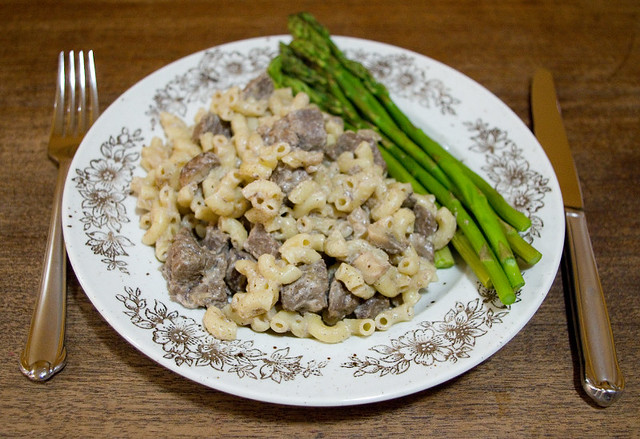
Traditionally stroganoff is made with broad egg noodles, but in our house we usually use penne. Rotini, fusilli, farfalle, and even elbow macaroni (pictured) also work well. Once the pasta is cooked, drain it and set it aside.
Once the meat is cooked, add to the pan:
1 cup sour cream (14% or greater) (regular or lactose-free)
Optionally, you can add:
1/4 cup cream cheese (optional)**
Stir the sour cream and cheese in until they are evenly distributed and have created a sauce; the sauce will have picked up some of the browning and spice and will have turned a nice light brown.
Add the drained pasta to the pan, and stir it all together until coated. Serve!

*You can add more mushrooms (up to double as much if you like), but this is the amount that my family prefers.
**I used to make my stroganoff with cream cheese every time, since I find it’s much creamier this way, but I have yet to find a lactose-free version. So for now I make it without.

A Year Gone By

The one-year anniversary of this blog (blogiversary?) slipped by on February 13th without me really noticing it. Sitting down at the computer to write a blog post before I shut down my computer and crawl into bed has become a part of my daily routine. It has given me a chance to reflect on the things I’ve worked on or that have interested me. On a more practical note, blogging has allowed me to keep track of what I’ve done, where I got the recipe/instructions/pattern, and how it turned out — and in a searchable format. I can’t count the number of times I’ve grabbed my phone and used the search function on this blog as a quick memory aid.


Kirkland Asian Beef Noodle Soup kit with added soft-boiled eggs. It looks reasonably appetizing, but it tastes powdery and somehow more artificial than an instant ramen packet. Thumbs down from me.

Have I learned anything over the last year? Well, I’ve expanded my cooking skills considerably. I no longer rely on the same repertoire of a few reliable recipes day in and day out. I mean, of course I still have some that I go back to over and over again, but that’s interspersed with trying new things. And trying new things has started to help me get over the fear of failure when learning. One of the great things about cooking is that even if you mess it up, it’s only one meal. It may seem like a big deal at the time, especially for the more difficult dishes, but in the grand scheme of things it’s not so bad. The important thing is that I learn from my failures.


Homemade chicken noodle soup with half an avocado filled with ranch dressing, and a Dad’s Biscuit. I may have added a few too many noodles to the soup this time, but it tasted fine.

I’m also enjoying how blogging has pushed me to try new foods and new techniques — and that, by extension, has influenced how my children experience the culinary world. So long as it’s not burned to a crisp, my husband will eat just about anything so long as he doesn’t have to cook it. (That’s not to say that he doesn’t have his preferences, but he’ll still eat stuff he’s not fond of.) But my kids, though, are more resistant to culinary change. They’re not super-picky eaters (and boy, have I heard stories about kids like that), but they tend to complain when a food isn’t one of their favourites. I think that exposing them to new foods so often now has taught them that just because a food is new, that doesn’t mean they won’t like it. There’s still resistance there, but not at the same level as this time last year. And I have to say it’s heartwarming when I overhear my kids brag to their friends about my cooking — and then try to persuade their friends to try something new.


A quick dinner of fried rice using whatever leftovers were in the fridge. Ingredients included roast chicken, roast beef, red onion, green onion, potatoes, corn, peas, mushrooms, garlic, and eggs, cooked together with a bit of soy sauce and miso broth. Tasty.

Where do I want to go from here? Well, I have a whole list of dishes I want to try, and a stack of new cookbooks from Christmas that I’ve barely cracked. My friends bought me a copy of The Sioux Chef’s Indigenous Kitchen by Sean Sherman (2017), and I am highly intrigued. I also want to dive into How To Cook Indian by Sanjeev Kapoor (2011), which my husband bought me. Although these books are from completely different cultures and corners of the globe, they do share a commonality in that I’ll have to learn where to source some of the ingredients that are less common around here (or common, but only seasonally). I also want to improve my breadmaking skills, and learn to make rum balls and pavlovas.


Fresh fruit tarts made from crust leftover after making full-sized pies. The filling is basically a peeled, chopped apple, strawberries, and blueberries, with a bit of white and brown sugar and a dash of cinnamon.

Mostly, I just want to keep learning. There is so much out there to try! I want to push my personal boundaries when it comes to cooking, and try new techniques when it comes to handicrafts, and start my own small business when it comes to thrifting. I want to challenge myself. I want to expand. I want to grow. And I want to keep writing about it.

Bread Machine Fluffy Herb Bread Recipe

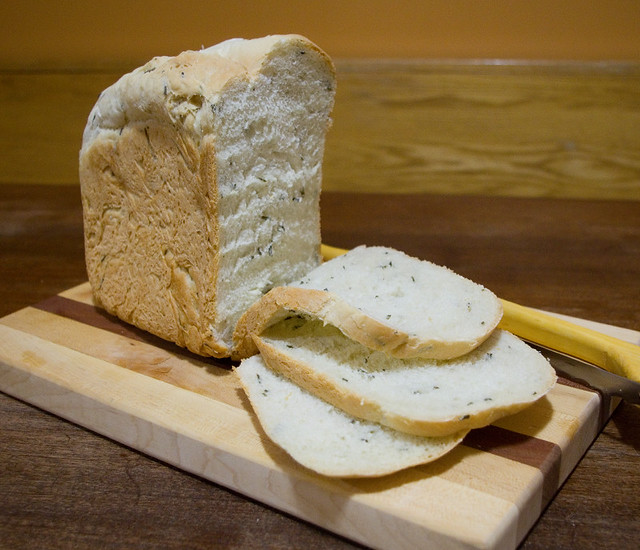
I’ve been meaning to post this recipe for a while, but I like to accompany my recipes with a picture, and my family keeps cutting into the loaves before I get a chance to take a photograph! This recipe is for a fluffy, high-rising loaf that stands up well on its own, but really shines when it is speckled generously with fresh or dried herbs. As a bonus, this bread is also dairy-free, nut-free, vegetarian, and can be made vegan with the proper sourcing of ingredients. Because of the herbs, it is a very savoury bread, and pairs well with eggs and meats — especially as toast with dipping eggs, and as sandwich bread for leftover roast or cold cuts.


A 2lb loaf made with rosemary.

Bread Machine Fluffy Herb Bread
Yields one loaf

A note about loaf size:
Quantities for a 1.5lb loaf are in bold, quantities for a 2lb loaf are in bold purple. However, this loaf is very light and fluffy — so it expands a lot. Use the settings for a 1.5lb loaf if your machine goes up to 2lbs; only make a 2lb loaf if your machine has the capacity to make a loaf that is 3lbs or greater.

A note about bread machines:
Every bread machine comes with an instruction booklet (most of which are also generally available online) that will specify the order that ingredients should be added. Mine says that liquids should be added first, then flour, then yeast. When preparing this recipe, the instructions for your specific bread machine should take first priority, so if your manual says to add the ingredients in a different order, do so.

Into the bread machine pan, pour:
1 1/4 cups (1 1/2 cups +3 Tbsp) water
2 Tbsp (2 Tbsp) olive oil
Over the liquids, sprinkle:
3 cups (4 cups) all-purpose flour*
Ensure that the flour covers the liquids entirely.
Into opposite corners of the pan, add:
1 Tbsp (1.5 Tbsp) sugar
1 1/2 tsp (2 tsp) salt
Create a well in the flour at the center of the bread pan, being sure not to go all the way down to the liquid. Into the well, add:
2 tsp (2 tsp) active dry yeast
Over the entire contents of the pan, sprinkle:
2 Tbsp (2 1/2 Tbsp) dried OR 4 Tbsp (5 Tbsp) chopped fresh herb of choice**

Set the bread machine to the basic/normal/white setting, with a light or medium crust to your preference. Press start. Running this cycle should take about four hours.

Remove the bread at the end of the baking cycle. Turn it out of the pan onto a wire rack to cool, making sure that the kneading paddle(s) are removed from the bread. Serve immediately (being careful to cut gently when it is warm), or when cool. Do not wrap the loaf or put it into a container until it is entirely cool, or it will become mushy.

* For a healthier loaf, substitute half of the all-purpose flour for whole-wheat flour. A whole wheat loaf will not rise as high, however.
**Suggestions: rosemary, dill, oregano, basil, chives, thyme, or sage.

Avocado Pasta Sauce: Second Try

Yesterday was another busy day, followed by a trip to Costco as soon as the girls got home. The trip took over two hours; I can never get out of that place in a reasonable amount of time! Luckily, Thing 1 and Thing 2 were very patient, which couldn’t possibly have anything whatsoever to do with the plethora of food samples that they were able to try. By the time I finished at the store and drove home, I had eaten significantly into the time that I usually use to prepare dinner. Something quick and easy was in order.

I have to say that the Avocado Pasta Sauce that I wrote about earlier this week is definitely a quick and easy dish. In the time that it takes to boil up the pasta (assuming you’re using dried — fresh stuff only takes a couple of minutes), the sauce is done. Since the sauce only requires prepping a few veggies and running them through a blender, it’s also very simple. This time I took my own advice and added a generous handful of fresh basil and cilantro to the mix, along with a bit more pasta water to thin it all out. I was much happier with the flavour this way — it wasn’t so plain! I sliced a few cherry tomatoes and tossed them in with the pasta and sauce as well for a bit of an acid zing. I also discovered that a generous shake of Parmesan cheese tops this dish nicely. (I’d suggest using a bit more salt and pepper if you’re going to forego the dairy.)

I served the avocado sauce on penne basically because it was the only wheat-based pasta that we had in the house (I didn’t think it would go terribly well on vermicelli or soba noodles). For the meat, I just carved up a rotisserie chicken that I’d picked up at Costco while I was there. It was a tasty and satisfying meal that was whipped up in the amount of time that it takes to boil some pasta. Not bad!

Ice Day

Yesterday was what we generally call a “snow day” around here, as in the winter weather was so terrible that school buses were cancelled and the kids stayed home from school. But it was really more of an “ice day”, since it had snowed the day before and then the temperature jumped up so we could have freezing rain coating that layer of snow, and then just plain old rain creating puddles on top of it all. It was a mess. It was definitely an ice storm, if not the ice storm.

With the kids home from school and it being too dangerous to really get out of the house (that being the whole reason for the bus cancellations in the first place), I found myself trying to wrangle two active children with increasingly high levels of cabin fever. The day was taken up with playing, crafting, snacking, NERF target practice, and video games. When the weather cleared up a bit, the girls went outside with their father to clear the driveway while I cooked supper (no mean feat after the plough had been by, leaving a burm of ice and slush between our house and the road).

On days like this, you really have to cook with whatever happens to be in the house. My pantry and freezer are well-stocked, and although it would likely take us weeks to even feel hungry feeding on those items alone, I was craving something a bit fresher. I Googled to find some recipes for pasta sauce that I could make without hitting the grocery store, and I found PureWow’s Spaghetti with Avocado Pasta Sauce. I thought that it would be ideal because it is a sauce with a creamy texture (which I adore), but without any actual dairy products.

I served the sauce over cooked spaghetti squash, with baked chicken legs (sprinkled with my usual garlic powder, sage, rosemary, thyme, summer savoury, and sea salt). I only realized after I took the picture exactly how unappetizing the sauce ended up looking, especially since I couldn’t toss it in the “noodles” without them falling apart. Ignoring the other gross things it could look like, the shine on the sauce makes it look like icing or a glaze, which it did not taste like at all. Flavour-wise, it was like eating guacamole, without the heat of peppers. Honestly, it was a little bit bland. I’d like to try this recipe again, but on actual pasta, with some fresh herbs thrown in (Googling has suggested basil and cilantro), and possibly some sliced cherry tomatoes.

At least dessert was a success! I heated a frozen apple pie from Mom’s birthday dinner (I always make two pies when I bake, one for the event and another to throw in the freezer for future use). When reheated from fully frozen, it usually takes about an hour in an oven at 350°F. I served the pie with a scoop of non-dairy vanilla “ice cream” for me and whipped cream for everyone else. There were no complaints on that score!