Avocado Pasta Sauce: Second Try

Yesterday was another busy day, followed by a trip to Costco as soon as the girls got home. The trip took over two hours; I can never get out of that place in a reasonable amount of time! Luckily, Thing 1 and Thing 2 were very patient, which couldn’t possibly have anything whatsoever to do with the plethora of food samples that they were able to try. By the time I finished at the store and drove home, I had eaten significantly into the time that I usually use to prepare dinner. Something quick and easy was in order.

I have to say that the Avocado Pasta Sauce that I wrote about earlier this week is definitely a quick and easy dish. In the time that it takes to boil up the pasta (assuming you’re using dried — fresh stuff only takes a couple of minutes), the sauce is done. Since the sauce only requires prepping a few veggies and running them through a blender, it’s also very simple. This time I took my own advice and added a generous handful of fresh basil and cilantro to the mix, along with a bit more pasta water to thin it all out. I was much happier with the flavour this way — it wasn’t so plain! I sliced a few cherry tomatoes and tossed them in with the pasta and sauce as well for a bit of an acid zing. I also discovered that a generous shake of Parmesan cheese tops this dish nicely. (I’d suggest using a bit more salt and pepper if you’re going to forego the dairy.)

I served the avocado sauce on penne basically because it was the only wheat-based pasta that we had in the house (I didn’t think it would go terribly well on vermicelli or soba noodles). For the meat, I just carved up a rotisserie chicken that I’d picked up at Costco while I was there. It was a tasty and satisfying meal that was whipped up in the amount of time that it takes to boil some pasta. Not bad!

New Toy

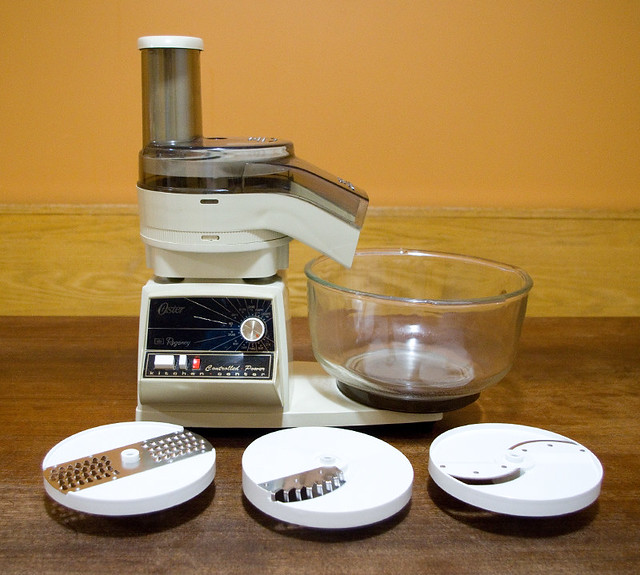
So I have a bit of thing for hunting for interesting vintage kitchen gear. Part of this is the love of the hunt, part of it is because I love the look of older pieces, and part of it is because I actually use a lot of these things and I just can’t afford to buy them new. And, let’s face it, the phrase “Reduce, Reuse, Recycle!” was beaten so thoroughly into my head as a child that I just can’t shake it free. My new toy is a case in point: a Oster Regency Kitchen Center, circa 1983.

Oster Kitchen Center Slicer Shredder Salad Maker
Kitchen Center with slicer/shredder/salad maker/French fry cutter attachment and four cutting discs (shredder, French fry cutter, thick slicer, and thin slicer).

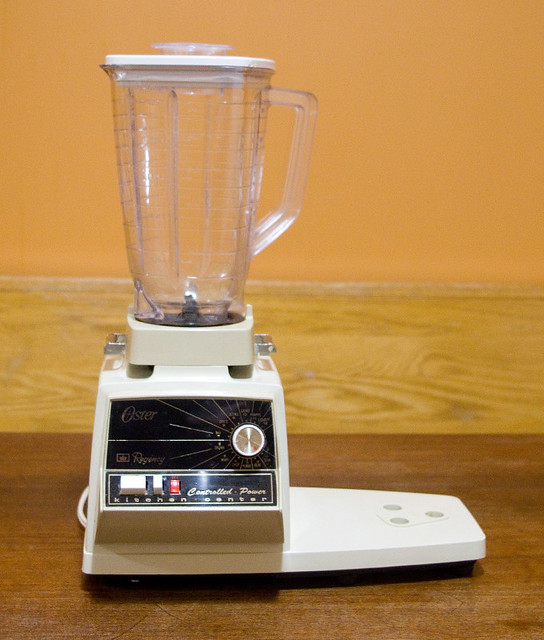
I adore the styling of the KitchenAid and Smeg stand mixers, but heaven knows that I can’t afford one. I do have a beautiful Dormeyer Princess mixer, but so far I only have the mixer attachment for it. My new-to-me Kitchen Center has slicer/shredder/salad maker/French fry cutter, mixer/doughmaker, and blender attachments. Actually, it originally came with a grinder as well, but that part went missing sometime in the last 35 years.


Kitchen Center with blender attachment.

Also missing: the mixing bowls! Well, two bowls that looked about right came with it, but it turns out that they weren’t the correct ones. I shopped around at my local thrift stores and found a total of four that work for about $20, which is reasonable when you consider they’d be about $70 on Amazon.

I was a little worried when I took the machine apart to clean it and realized that some of the gears are plastic. I have a bad habit of putting too much strain on my machines and stripping plastic gears. I’ve ruined a couple of blenders that way. Luckily, the gears for the blender attachment are all metal. We’ll see if the other attachments’ gears are durable enough to withstand my not-so-tender ministrations.


Kitchen Center with mixer/dough maker attachment.

I have to admit that the part I am most enthused about is the stand mixer/dough maker. So many recipes and instructional videos just call for you to use one. I mean sure, it’s possible to do it all by hand, but sometimes I just don’t want to put in all that effort. Also, it can sometimes be a bit tricky to translate directions (especially timing/consistency) from machine mixing to hand mixing.

Apparently there were a whole lot of other attachments that were additional, optional purchases. The one that interests me the most was the pasta accessory, which included five processing discs for thin or thic spaghetti, lasagne, rigatoni, and fettuccine. Unfortunately, it looks like it attached to the (missing) grinder. So I’ll be keeping an eye out for these pieces during my future thrifting expeditions. There may be homemade ramen in my future yet!

Ice Day

Yesterday was what we generally call a “snow day” around here, as in the winter weather was so terrible that school buses were cancelled and the kids stayed home from school. But it was really more of an “ice day”, since it had snowed the day before and then the temperature jumped up so we could have freezing rain coating that layer of snow, and then just plain old rain creating puddles on top of it all. It was a mess. It was definitely an ice storm, if not the ice storm.

With the kids home from school and it being too dangerous to really get out of the house (that being the whole reason for the bus cancellations in the first place), I found myself trying to wrangle two active children with increasingly high levels of cabin fever. The day was taken up with playing, crafting, snacking, NERF target practice, and video games. When the weather cleared up a bit, the girls went outside with their father to clear the driveway while I cooked supper (no mean feat after the plough had been by, leaving a burm of ice and slush between our house and the road).

On days like this, you really have to cook with whatever happens to be in the house. My pantry and freezer are well-stocked, and although it would likely take us weeks to even feel hungry feeding on those items alone, I was craving something a bit fresher. I Googled to find some recipes for pasta sauce that I could make without hitting the grocery store, and I found PureWow’s Spaghetti with Avocado Pasta Sauce. I thought that it would be ideal because it is a sauce with a creamy texture (which I adore), but without any actual dairy products.

I served the sauce over cooked spaghetti squash, with baked chicken legs (sprinkled with my usual garlic powder, sage, rosemary, thyme, summer savoury, and sea salt). I only realized after I took the picture exactly how unappetizing the sauce ended up looking, especially since I couldn’t toss it in the “noodles” without them falling apart. Ignoring the other gross things it could look like, the shine on the sauce makes it look like icing or a glaze, which it did not taste like at all. Flavour-wise, it was like eating guacamole, without the heat of peppers. Honestly, it was a little bit bland. I’d like to try this recipe again, but on actual pasta, with some fresh herbs thrown in (Googling has suggested basil and cilantro), and possibly some sliced cherry tomatoes.

At least dessert was a success! I heated a frozen apple pie from Mom’s birthday dinner (I always make two pies when I bake, one for the event and another to throw in the freezer for future use). When reheated from fully frozen, it usually takes about an hour in an oven at 350°F. I served the pie with a scoop of non-dairy vanilla “ice cream” for me and whipped cream for everyone else. There were no complaints on that score!

Frozen Ramen

I love fresh noodles. I am endlessly fascinated by videos like the ones about making thread-thin suo noodles or precisely-cut Chinese spinach noodles or seemingly-effortless hand-pulled noodles (emphasis on “seemingly”). In Japan, I was lucky enough to be able to try fresh ramen and, I think, udon, but there may have been a bit lost in translation.

Sadly, it’s hard to get fresh noodles of any style around here. There are a couple of specialty restaurants that make them, but for home use the closest I can get is refrigerated ones from the grocery store — and that’s only European styles. So until someone teaches me how to hand-pull noodles, or until I can afford an automatic pasta maker (or at the very least a hand-cranked pasta machine), I’m stuck with frozen or dried noodles.


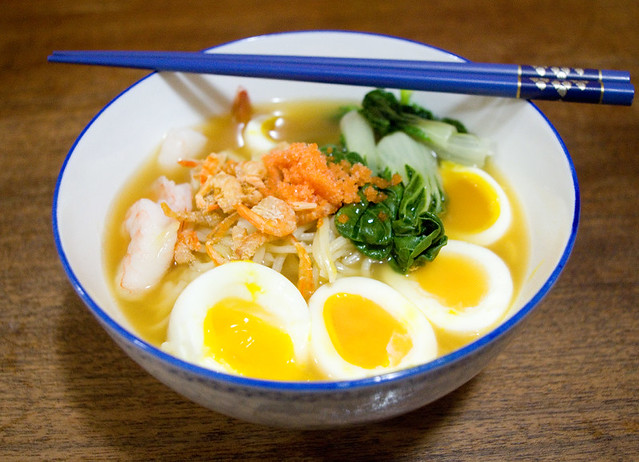
Frozen ramen that my husband prepared, topped with cooked shrimp, dried shrimp, baby bok choy, and soft-boiled eggs.

The consistency of dried noodles doesn’t seem to bother my husband. Sure, he likes freshly-made pasta on the few occasions that we do get it, but he doesn’t crave the chewiness and strength of well-made ramen or udon. When he cooks ramen for dinner (and he always uses either instant broth or my homemade broth from the freezer), the consistency of the noodles doesn’t even cross his mind.


Frozen ramen that my husband prepared, topped with cooked shrimp, sliced avocado, baby bok choy, and soft-boiled eggs.

That being said, he is willing to go along with my conviction that there are much better things out there. To that end, we’ve been trying out the other brands of ramen that are locally available, which admittedly aren’t very many. We started with dried noodles — not the ones in the instant noodle packets, but something very similar. The last two meals my husband made used Nissin Frozen Ramen Roodles in Artificial Pork Flavour. The noodles were a bit better than the dried kind, but not by much. The broth mix that went with the noodles actually had less flavour than the packets that come with instant noodles (and so far as I can tell they had just as much sodium). I think the lack of punch is funny considering that Nissin is the same company that makes our family’s preferred brand of instant noodle packet. If I have to eat a just-add-water soup, I prefer their Tonkotsu Artificial Pork Flavour with Black Garlic Oil.

So I guess this frozen ramen was overall a bit better than the dried kind, but only a bit. I have another variety in my freezer left to try, though, before I head back to T&T to see if they have any others.

As an aside, did anyone else use to eat dried ramen as a kid without cooking it first? It makes me cringe in retrospect, but we used to sprinkle the dried sauce packet over the top and eat it as is. I was reminded of this recently when I noticed that one of the local grocery stores had instant ramen on sale for 27¢ a packet, and I realized how happy this would have made me as a child, or as a broke college student for that matter. How my teeth survived unbroken I’ll never know.

Personal Pizza

I’ve been craving pizza lately, which is pretty much a no-no because of the issues that my digestive tract has with dairy. However, to my everlasting joy, I’ve discovered that I can eat lactose-free cheese so long as I don’t go overboard, since cheese is also quite greasy, especially when melted. Since none of the pizzerias around here carry lactose-free cheese as an option, I thought that a “make your own pizza” evening was in order.

It didn’t look spectacular because I put the toppings under the cheese, but it tasted great! I started with the dough from the Two-Cheese Pizza recipe on page 170 of Betty Crocker’s Best Bread Machine Cookbook (1999). This made enough for one 12″ pizza or four 4″ or so thin-crust-ish pizzas. (Next time I do this, I’m doubling the recipe.) You can’t actually cook pizzas in the bread machine, so I rolled out the dough into individual crusts and everyone topped their own. I used Healthy Veggie Tomato Sauce that I had in the freezer as the sauce, although I did simmer it a little to reduce it a little bit. I topped my pizza with ground beef and crumbled bacon, along with a few cremini mushroom slices. The rest of the family had theirs with more traditional mozzarella, but since cheddar was the only kind I could get lactose-free, I went with that.

I’ve tried Jamie Oliver’s Quick Family Pizza in the past, and although the kids liked it, one of the things I discovered about myself is that I’m not a big fan of the taste of self-rising flour. I think it’s just a little too salty for me. At any rate, I like the yeast dough a great deal more, and it’s just as easy as the quick bread version if I use the bread machine. So I think I’ll stick with this kind of dough for future pizza iterations.

Bacon-Wrapped Prime Rib

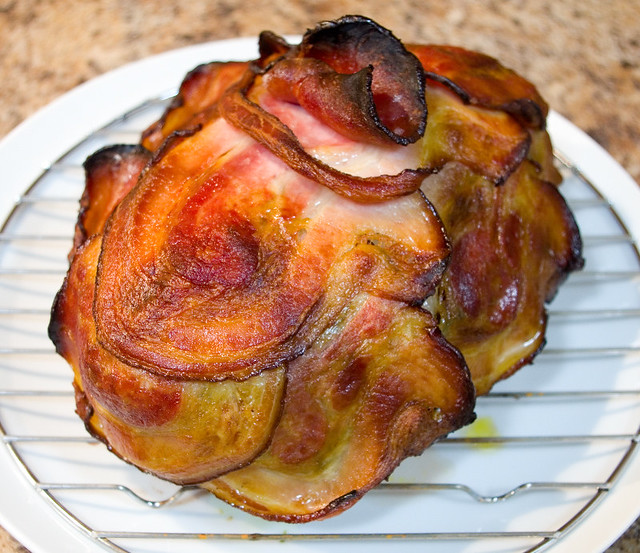
So Einfach Tasty (the German version of Tasty) got my attention again with their video for how to make Bacon-Wrapped Prime Rib (English version here), which looked so delicious that I just had to try it. Generally, I suck at roasts; they’re either completely tasteless, or dry, or both, no matter how many techniques I try to fix it. But I figured that with a combination of butter, spices, and bacon rubbed all over the outside of the roast, I shouldn’t have too many problems with this recipe. Also, I bought a meat thermometer. So that helped too.

I only made two changes to the recipe. The first was that I used the circular bacon that I had left over in the freezer, so I couldn’t exactly weave it. I ended up draping it over the roast instead, which worked just fine. The top piece curled up when cooking and singed a bit because it was nearer to the heating element, but I just removed it before serving.

<

The second was that I used an inferior cut of meat, and you can see this especially in the lines of gristle through the center of the slice. So long as I ate around these unpalatable pieces, it was just fine, though!

I really did like how this roast turned out. It was probably the best one I've made yet (although there really isn't much competition for that title). I served it with boiled baby potatoes and steamed carrots. The kids ate their servings and asked for seconds, but I'm pretty sure they would have been happier if I'd only served them bacon without the beef. I wish I'd had a chance to try the gravy, but unfortunately all of my drippings burned solid to the bottom of the pan, so I didn't get to use them. Ah, well.

Toad in the Hole

I’ve been wanting to try to make toad in the hole for ages. I have vague memories of my Nan serving it, or at least something similar, although I couldn’t remember the name… I Googled “pigs in a blanket” and “bubble and squeak” before I finally figured out what the name was of the dish that I remembered. Basically, toad in the hole is sausages baked in Yorkshire pudding batter — with regional and temporal variations, of course. Although the photos I’ve found online use thick sausages for the most part, I distinctly remember the version from my childhood containing smaller breakfast sausages, so that’s what I was determined to make.

The first time I tried it, I wasn’t very happy with the results. I used the Yorkshire pudding recipe from the Joy of Cooking (page 637, 2006 edition, Rombauer & Becker), which was recommended by my father. I doubled the recipe and doubled the size of the pan, which I thought would work just fine, but the sausages were just too small to compensate for all that batter. Also, although the edges of the casserole rose and puffed up quite nicely, it didn’t cook evenly through the center, leaving it a stodgy mess. I mean, the texture was firm enough to be edible, but it wasn’t very appetizing.

I tried to learn from my mistakes the second time around. This time I whipped up only a single batch of the batter, which greatly improved the ratio of batter to meat, at least for sausages this small. I cooked it all in a pan that was half the size, which allowed it to rise more thoroughly. Also, I used a metal pan instead of a glass one, which I find in general allows for a crispier edge to baked dishes.

I was really happy with how it turned out. The pudding rose beautifully, so fluffy in the middle that in many spots it was completely hollow. The crust was nice and crisp without being hard. The sausages were perfectly done. Now, if only I’d remembered to grease the pan, since to serve it I almost had to destroy it. You’d think I’d know better by now.

I served my toad in the hole with a side Ceasar salad and some sliced avocado, which my Nan would never have done (she’d have paired it with boiled or baked veggies). But I thought we needed some fresh greens with a main dish that doesn’t contain a single vegetable. The family ate it all up and asked me to make it again soon, which tells me that it was a success.

Asparagus, Eggs & French Dressing

I’ve really been enjoying trying out the dishes from the Jamie Oliver 5 Ingredients Quick & Easy Food cookbook (2017). My go-to breakfast for the last week or so has come from this book: Asparagus, Eggs & French Dressing (page 164). The recipe serves two, but it’s easy enough to halve the ingredients to make a single serving for myself. (Hubby is a cereal-for-breakfast kind of guy, and the kids turn up their noses at vegetables for breakfast.)

If you prepare the dressing in advance (the recipe makes enough for a week’s worth of breakfasts for one person), this dish only takes about ten minutes to make. I don’t have a metal colander to put over the eggs in which to steam the asparagus, so I cook it in the microwave using a steamer dish. I also discovered that it takes a little longer than 5 1/2 minutes to make soft-boiled eggs around here; as the above photo attests, my first try was a bit underdone. It’s more like 6 1/2 minutes.

Things I discovered about myself when making this recipe: I’m not a big fan of raw tarragon (it tastes a bit like black licorice to me, which I despise), and I have a limited tolerance for raw red onions in the morning. I just started skipping the tarragon entirely, but I wonder if this dish might be good with a bit of basil instead? And although I like the red onion flavour in the dressing, I had to stop eating it as a garnish. Otherwise, I could taste it on my breath all day, even after brushing my teeth.

Spiced Pancakes with Apples & Caramel Syrup Recipe

Last night I had a very specific idea of what I wanted to make for dinner, and I really didn’t want to head out of the house again to buy ingredients, especially dragging the kids with me. It’s not really that big of a deal to get groceries with my kids, but it inevitably takes twice as long — or more — than shopping on my own. I looked at a couple of pancake recipes in my cookbooks, but nothing was exactly what I was craving. I wanted to make some kind of spiced pancake that paired well with chopped apples, which were the only fruit I had left in the fridge. Apples are a staple around here, since they winter well and can last months if kept properly. For those reasons, they’re also relatively inexpensive all year long. (Berries, which I generally prefer, get ridiculously pricey in the winter since they all have to be imported, and they begin to spoil after only a few days.) I started by combining about four different recipes; I made so many changes after a while that I knew if I didn’t write it all down, I’d never be able to duplicate my results.

In the end, I’m extremely happy with what I came up with: Spiced Pancakes with Apples & Caramel Syrup. We had it for dinner, but it would make an equally tasty breakfast or even a dessert. The pancakes are also great on their own and can be served with the more traditional butter/margarine with syrup (preferably maple), honey, or jam, or fruit butter (apple butter would be divine).

Here’s the recipe:

Spiced Pancakes with Apples & Caramel Syrup
Yields 10 to 12 five-inch-diameter pancakes (approx.)*

In a large bowl, mix together:
1 1/2 cups flour
3 Tbsp granulated sugar
2 1/2 Tbsp baking powder
1 tsp salt
1/8 tsp ground cloves
1/4 tsp ground nutmeg
1 tsp ground cinnamon
In another large bowl, combine:
1 1/2 cups plus 2 Tbsp 2% cow’s milk OR almond milk OR soy milk**
3 Tbsp plus 1 tsp canola*** oil
1 egg, beaten

Whisk together wet ingredients until they become a smooth mixture. Add wet ingredients to dry ingredients. Beat mixture with an electric or hand mixer until batter is smooth, scraping the sides of the bowl occasionally with a rubber spatula to remove lumps.

Cooking the spiced pancakes uses the same technique as my buckwheat pancakes. Lightly coat the cooking surface of a heavy, non-stick frying pan with cooking spray. Place the pan on the burner, turn the heat on to just a little bit higher than medium heat, and immediately pour a single ladle-full of batter directly into the center of the pan. (Never preheat an empty nonstick pan.) The batter will spread out without help to its optimal thickness. Watch the cooking pancake carefully for bubbles to appear on its surface. When the bubbles pop and leave little craters behind that don’t immediately refill in with batter, it’s time to flip the pancake. Have patience when cooking pancakes; better that they be cooked on a low temperature and finish slowly than to have them burn. Once the batter has started to solidify, you can peek underneath the pancake to check its colour. Cook each side until it is golden brown.

While the pancakes are cooking, core and roughly chop:
4-5 medium-sized eating apples****
Place the apples in a bowl to serve alongside your pancakes, if they are to be topped at the table. Beside the apples, place:
caramel syrup*****
whipped cream (optional)******
finely chopped walnuts

When the pancakes are cooked, serve immediately or stack on a warm plate which is covered by another warm plate when not being dished onto. To keep the pancakes warm, it helps to cover the top plate and edges with a tea towel or two.

My preferred way of plating the pancakes is to place one or two on a plate, mound with chopped apples, (optionally) dollop on a bit of whipped cream, and drizzle with caramel syrup. Lightly sprinkle each dish with chopped walnuts for added crunch and flavour.

Enjoy!

*This recipe can easily be doubled (or more) to serve a larger crowd. My family of four generally eats about a batch and a half of pancakes, and the leftovers go in the fridge to be reheated the next day.
**I used almond milk.
***Canola oil may be replaced by another light oil such as sunflower or vegetable oil.
****My favourites are Ambrosia and Honeycrisp, but whichever you like is fine. Use your best judgement about the size of the apples and how much the people you’re serving are likely to eat; my family likes their pancakes loaded with fruit, as pictured, but yours may differ. Since the apples are a topping and not a baking ingredient, having an exact quantity is not as essential.
*****Store-bought is fine, but you can also make your own. I got my recipe from the Joy of Cooking (page 849, 2006 edition, Rombauer & Becker), but you could just as easily use the Caramel Syrup Recipe from Martha Stewart, as they are virtually identical. They’re both essentially cooked sugar and water. Optionally, you can add a splash of vanilla for additional flavour. I’d recommend preparing this in advance, since it takes a while to cool down enough to eat. Also, I burned my first batch because I was trying to do too many things at once and forgot about it for about twenty seconds. That was all it took to make it completely inedible. The second batch was supervised nonstop and turned out well. Please learn from my mistakes!
******Real whipped cream, canned whipped cream, and non-dairy whipped cream substitutes are all grand.

Spectacularly Ugly Gnocchi

I’ve been getting a lot of my kitchen inspiration from Tasty lately, probably because they’re constantly showing up on my Facebook dash. In an effort to widen my online cooking exposure, I subscribed to a few other feeds today; if anybody has any in particular that they’d recommend, do drop me a line!

Anyway, the one that I tried over the weekend was Easy Homemade Gnocci. I have to say, this dish was anything but easy. It was disaster after disaster, really. I don’t know how much of that was the fault of the recipe and how much of it was my own, but nothing seemed to go right.

First of all, I prepared the potatoes exactly the same way as the video showed, but my mashed potatoes ended up being a gluey mess. They were either too moist to start or I should have prepared them differently; they definitely weren’t overcooked, since the center of the larger ones were still a little raw (I discarded those pieces). After perusing the video comments, I learned that some people bake their potatoes instead of boiling them to prevent excess moisture. Also, many people recommend a potato ricer instead of a masher, as it keeps the potatoes from turning gluey. As a bonus, if you cut the unpeeled potato in half and press it through the ricer, you don’t even have to peel anything — it kind of works like a giant garlic press or a modified of food mill.


My homemade gnocci served with baked herbed chicken thighs and corn.

I’m pretty sure that the potatoes were too moist, but I think they were also too large. The recipe calls for 3 to 4 small or medium russet potatoes, but that’s very subjective. Since vegetables can come in all different sizes, I much prefer a measurement by weight or at least by volume, as I’ve talked about before. Due to the moisture, I had to use twice as much flour as the recipe calls for just to get the dough even close to firm enough — and I think I really could have used more. I’d read online that too much flour can make the gnocci heavy and stodgy, and I was trying to avoid that… I don’t think I succeeded. The gnocci that I made did not hold their shape for long after forming and were much too floppy for the fork method to work at all. I made the mistake of letting the noodles touch before boiling them and they just congealed back into a large mass of dough, so I had to form them again. The dough was so stretchy that they didn’t keep their shape in the water.

In the end, I liked the flavour of the gnocci fried up in butter and sage, even if the pasta was misshapen and stodgy. I think I’d like to try this recipe again with modifications until I get it right. For that reason, I don’t think that this recipe is an easy beginner dish — I think that the original article misrepresented it as such. But it could eventually be quite nice, with practice. Perhaps I can find an Italian nonna who is willing to teach me the finer points of this dish, if only to keep me from massacring a tradition so badly next time.