Spending Time at the Lake

I was lucky enough to spend a few days this week at the cottage my parents are renting. We had a delightful time. Mornings were lazy and, when we finally dragged ourselves out of bed, I cooked brunch.

That’s bacon, eggs over easy, apple slices, and whole wheat toast — made of store-bought bread, which is unlike me. I decided I needed to remedy that situation and so after we cleaned up from brunch, I started to throw together some homemade loaves. I didn’t have access to the internet or my plethora of cookbooks, so I used the White Bread recipe from page 596 of the Joy of Cooking (Rombauer & Becker, 2006 edition). (Actually, I used the app since it has the whole cookbook on my phone and doesn’t need Internet access, but it’s the same recipe either way.) In the recipe I substituted olive oil in the same quantities for the lard and butter, which has worked in the past and did so this time as well.

That’s a horrible picture of the loons on the lake because my zoom lens isn’t spectacular. You’d think it’d be easier to get a photo of a bird that can grow to almost a meter long, but these ones had no interest in coming any closer. The loons were calling away while I was kneading my dough. I find it a very soothing sound, but I grew up with it. In understand that to some people a loon call, especially their mournful, echoing night call, can be kind of creepy. My father likes to tell us the story of going camping and being approached by frightened tourists in the next site over who were sure they were hearing the sobbing souls of the damned.

Anyway, after brunch and bread and loons, we all needed a dip in the lake…

Followed by a drive out to the ice cream parlour for a cool treat and some reading time.
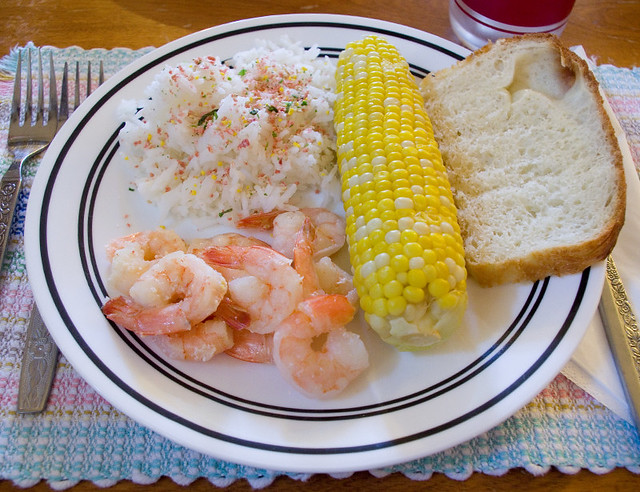
It wasn’t too long before it was time to go back to the cottage to bake the bread, and then to make dinner. I made shrimp with garlic butter, jasmine rice with furikake, corn on the cob, and of course the freshly-baked bread.
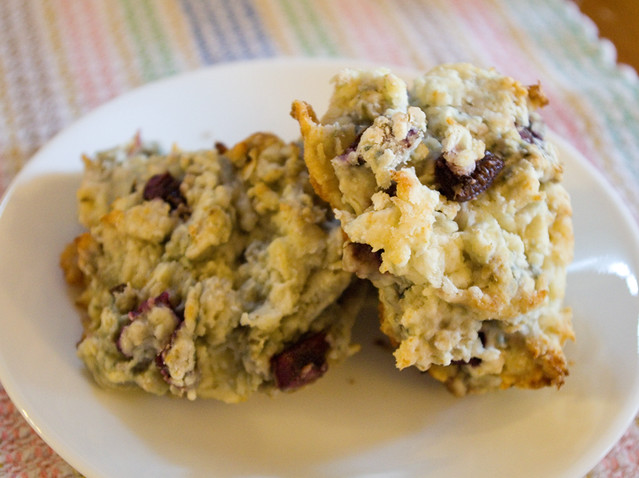
Dessert was cherry drop biscuits baked the day before using the Rolled Biscuits recipe from page 638 of the Joy of Cooking (or the app again). I added a bunch of pitted, quartered cherries stirred into the batter and a sprinkle of sugar on the top of each biscuit before baking. I got lazy and just made them drop biscuits instead of rolled, and they turned out fine that way.

Then it was time for one last dip in the lake, followed swiftly by bedtime for the kiddos, who had had a long, fun day. I took the opportunity to bring my glass of maple Sortilège on the rocks out to the screened-in sun room (the mosquitoes are much too bad in the evening to simply sit outside) so that I could watch the sun set. It wasn’t the most spectacular that I’ve viewed from this spot, seeing as there wasn’t a cloud in sight, but I think I can live with that.
Cool Dinner

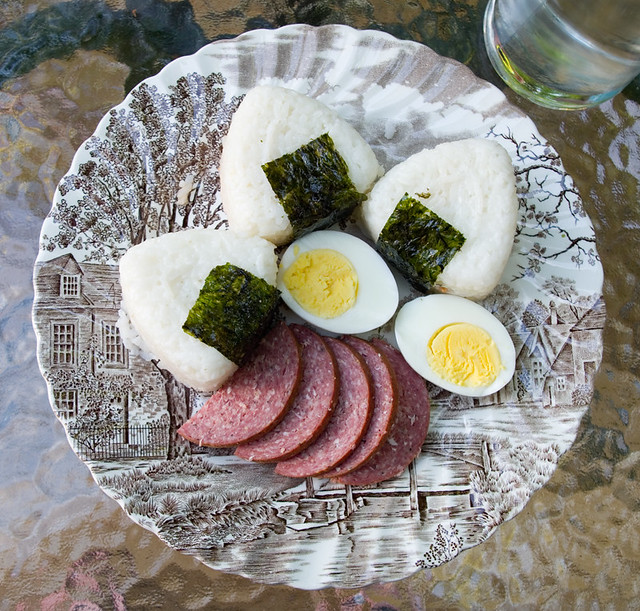
Last night I figured that we needed a cool, refreshing dinner to help combat the heat. To this end, I boiled up what was frankly way too much sushi rice and made some onigiri like I had eaten so regularly in Japan. I wrote a bit about this dish when I tried making pork belly onigiri, and doing so really made me crave the simple version. It’s fresh and clean-tasting, and it’s served cold, so you can whip it up during the cooler part of the day (or the night before), refrigerate, and serve it when it gets warmer.

I used a onigiri press like this one (which I bought at T&T for less than ten dollars, so don’t let the online price tag fool you). Of course, you can totally form rice balls by hand, a press just makes it less messy and keeps each one looking more or less identical. A press also makes it so much easier to put a filling inside the rice ball. I used canned salmon with a dash of mayonnaise (Japanese Kewpie mayo would have been best, but I didn’t have any on hand and substituted regular old Hellmann’s). For a bit more of a pop of flavour, I also added a few drops of liquid hickory smoke. We always have some of that stuff in the pantry because it makes a canned salmon sandwich absolutely divine, so I figured it would do the same to the onigiri.

I served the onigiri with halved hard-boiled eggs (also cold and prepared in advance) and some local summer sausage from the farmers’ market. I know that’s not how it would traditionally be served, but I wasn’t trying for accuracy here, I just wanted a nice, cool dinner that we could eat comfortably with our hands while we sat out on the porch. This would also have made a great picnic.

Grilled Duck Breasts & Strawberry Shortcake

Yesterday I decided to cook something I’d never cooked before: duck. I’d eaten it before, generally in Asian fusion food, but I’d never cooked it. It’s different than most of the poultry I’m used to working with (i.e. chicken and turkey) in that it’s a red meat. It’s honestly more like ostrich. Somehow I’d managed to cook up ostrich long before I’d ever worked with duck, which is a little odd seeing as duck is domestic and ostrich is most definitely not. But I digress.

I found the duck breasts in the frozen section of T&T Supermarket a while back, and I bought them because they looked interesting and they were on special (my favourite combination). I’m not sure if this is usually the case, as I have no baseline, but that day they were significantly cheaper than beef. The breasts weren’t whole; they were already cut up into what I think of as tiny little steaks.

I used the marinade from a Grilled Wild Duck Breast Recipe that I’d Googled, knowing full well that since I liked all of the ingredients separately I’d probably like them together. I only did a quick marinade of about half an hour, since I wanted to taste the meat and not just the sauce. Then I threw the steaks on a preheated gas grill. The real challenge here was not to overcook them. I didn’t want them to be rare in the center, but they were so small that I really worried that I’d accidentally turn them into shoe leather. I settled on about five minutes per side, and that ended up being perfect. There was just a bit of char on the outside, but the middle was tender and soft.

I served the duck breasts on a bed of basmati rice, alongside some green zucchini that I’d sliced and grilled at the same time as the duck breast. Timing is always an issue with this kind of meal, so I cooked the rice first, then put the duck on, and then the zucchini, since it was sliced fairly thinly. It all came to the table piping hot and delicious.

For dessert we piled into the car and drove over to my parents’ house for strawberry shortcake. This time my mother made it, but she basically followed my Nan’s recipe. It was an assemble-it-yourself kind of affair (which the kids love), so if mine ended up being sloppy and leaning, that’s nobody’s fault but my own. Part of the problem with structural integrity is that I had to use a non-dairy whipped topping, which never beats as stiff as true whipping cream. Also, we upped the sweets game by drizzling dark maple syrup over the top, further compromising the tower’s support but definitely enhancing the taste.

Dessert finished and hands (and tables, and place mats) cleaned of sticky syrup residue, we headed back home to put the children to bed and to spend some quiet time digesting.

Pork Belly Onigiri

Boyed up by not having messed up dinner over the long weekend, I decided to try a recipe that has been on my to-do list ever since I saw it on Tasty Japan: Pork Belly Onigiri (English translation in the video comments). The simplest onigiri is just a palm-sized ball of sticky rice, shaped by hand or pressed in a mould, and served cold. Often, they have a filling (such as canned salmon or barbecue eel), and they are served with a sheet of nori (the same seaweed that wraps some kinds of sushi), which makes them easier to grasp. They’re one of the most ubiquitous snacks you can find in Japan. You can buy them at nice restaurants, but they’re also in the cooler of every corner store and even in vending machines.

These pork belly onigiri definitely take it up a notch when it comes to complexity. First of all, there’s a whole soft-boiled egg in the middle, which means that the rice balls are going to be a lot bigger than the standard kind. Also, they’re wrapped in pork belly (the same cut of meat as bacon, but not cured), fried, and then a sauce is added.

My pork belly onigiri were very tasty, even though I couldn’t find any shiso leaves at a store in my area, and hence had to omit that ingredient. However, all but one of my onigiri fell apart in the final stages of cooking. I think it was because the pork belly I had at home had been thick-sliced at the butcher shop. Really, what you want is something as thinly-sliced as cheap bacon, not the thick cuts that are better in tonkotsu ramen. It’s totally possible that I just might not have squeezed the balls firmly enough before frying them.

In addition, despite cooking the soft-boiled eggs for exactly the amount of time recommended, they ended up being hard-boiled instead of soft. Should I try this recipe again, I think I will deliberately undercook the eggs a bit so that when they cook a bit during the frying stage, they’ll end up perfect in the middle.

Each one of these onigiri was a meal in and of itself; my kids couldn’t finish theirs, and my husband and I were very full after eating ours. I think they might make a nice appetizer if they were made using quail eggs instead of chicken. Quail eggs being a pain in the butt to peel, let alone getting the timing right for soft-boiled, I don’t think I’ll be trying that myself any time soon. Overall, this was a fun meal to make and it was very tasty, even if my end result was far from perfect. I would definitely recommend giving it a go.

Shrimp and Asparagus on Steamed Rice

I actually had a moderately successful weekend! First, I got my tomato plants caged before both the exceedingly hot weather and the related thunderstorms rolled in:

That’s eighteen tomato plants, but except for the two that my friend gave me (on the far right, closest to the front), I have no idea what kind they will grow up to be, because they self-seeded. They are coming up nicely, though, and they’re starting to flower, so that hopefully means that they’ll be yielding fruit soon. Now all that’s left to stake or cage is the eggplants, but I’m in no huge rush since they’re not even flowering yet so I don’t have to worry about the weight of their fruit dragging them down.

You might have noticed that there’s a lot more green to the garden than last time I wrote about it. The potato plants have come up nicely, but some other weed has decided that my garden is an absolutely lovely place to try to take over. I’m going to go on a weed-pulling spree as soon as the current heat wave breaks — it hit 48°C (118.4°F) with the humidex yesterday, and I’m just not made for that kind of temperature. The weeds can wait.

And after a string of highly unsatisfying meals, I managed to successfully pull together a lovely light dinner of shrimp skewers with butter and garlic, and asparagus with olive oil and salt. Except for the rice, this supper was all cooked quite quickly on the back yard grill, meaning that I also managed not to heat the house up too badly. Grilled shrimp and veggies is so easy, I’m not entirely sure why I don’t think to do it more often. Perhaps it’s a mental block left over from my childhood? When I was a kid, the barbecue was for hot dogs, hamburgers, and steak, with the occasional foil packet of potatoes thrown in for good measure. I really need to re-think what I can do on the grill to make the best use of it this summer.

Glico Curry

One of the foods that I fell in love with in Japan is Japanese curry. It’s very different than any Indian, Thai, or even British curry I have ever tried. It’s generally a lot of rice, a lot of creamy sauce, and a tiny bit of meat — and it doesn’t have to be very spicy at all. It’s the kind of thing that you can find as cheap street food or sold out of tiny little take-out shops. When you make Japanese curry as a homemade dish, it’s a comfort food, and it’s generally prepared with boxes of pre-made sauce cubes with the spices suspended in a kind of solid roux that melts with the addition of heat. It’s really very easy to prepare. There are a number of companies that make this kind of thing in Japan, but the easiest to come by both there and here in Canada is Glico Curry.

We were having my brother-in-law and his friend that helped with the deck, so I wanted to make something that I hadn’t cooked for them before. I also wanted it to be a hearty meal that would satisfy two men who did physical labour for a living as well as our family of four. Given that we only had one guy over instead of two, I may have gone a bit overboard; I used a whole pan of veggies and meat, and the sauce that I made was supposed to serve ten. We ended up with lots of leftovers. Ah well, it reheats well.

It’s always slightly disappointing to me how unappetizing this kind of dish can be once cooked, because it’s so chock full of delicious, healthy ingredients — and it’s really, really tasty. I used potatoes, carrots, baby bok choy, and steak, but it kind of turned out looking like brown glop. Aesthetics aside, everyone ate their share and some came back for seconds, so the flavor must have made up for the looks.

Mushroom-Free Loco Moco

I’m still trying to get back into cooking proper meals, instead of fast food or whatever I can throw together in a pinch as I was during con crunch. Tonight I made Loco Moco, but my own version which basically uses ground beef instead of hamburger patties, but keeps the rest of the recipe more or less the same. I just find that it’s easier to eat that way — and, more importantly, that my kids make less of a mess if they don’t have to cut up the burger.

My brother-in-law was over for dinner, and he vehemently abhors mushrooms, so I had to make further changes to Guy Fieri’s recipe in order to make it palatable to everyone. Basically, I just skipped the mushrooms, and it was all good (if not as flavourful). I also wanted to make it a bit healthier by adding more veggies in the form of additional tomatoes and stalks of asparagus — it’s much easier to persuade my kids to eat their greens if they’re covered in sauce of some sort.

New Stove!

I have a new stove! Well, okay, new to me. A friend of a friend was replacing her perfectly-functional old stove to get a fancy new one. She found out that I was looking for a stove to replace my old one, which was starting to develop… Issues. It was a really fancy-schmancy stove back when it was new like thirty years ago. It had panels on the top you could switch out so that it became a griddle, or a grill, or a special burner for a wok. But the oven was only large enough for a single cookie sheet to make room for the surface-level fan, and the drawer underneath was sacrificed for that as well. The light socket in the oven had something wrong with it, so the oven light bulb would burn out within days every time. And, most importantly, the oven didn’t keep a consistent temperature, which makes it really difficult to bake.

So here’s my new stove! It doesn’t match the rest of my black appliances, but I don’t care. It’s immaculate and runs reliably. The oven runs about 25 degrees F hot, but since it does so consistently I can compensate. And I actually have an oven light now so I can check for doneness without having to open the door!

One of these days I’ll be able to afford an electric, non-glass-top double oven… Maybe I’ll get one when I finally get my dream kitchen (which will probably be only in my dreams). Until then, this stove is fantastic!

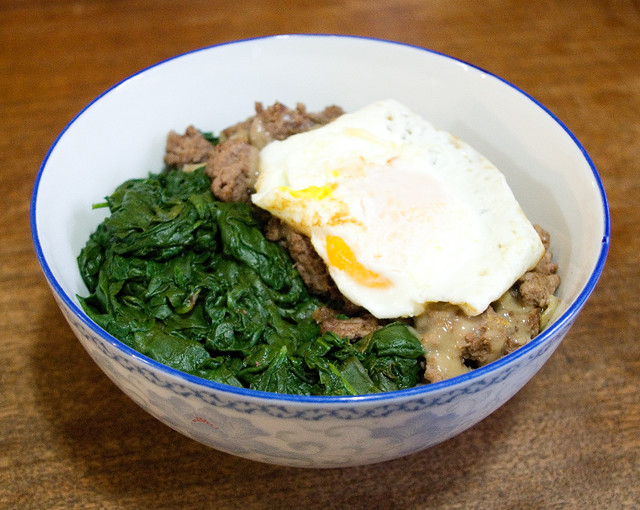
Tonight I tested the stove out with a simple dinner of teriyaki salmon with steamed spinach on rice. I bought the salmon in one of those budget $10 freezer packs, and it was… Okay. Not bad, but a little bit dry. I think if I use this kind of salmon again it will be in something like a casserole that disguises the texture a bit better. But for a dinner for three adults and two kids (my brother-in-law was over) for about $13, it wasn’t half bad. Fresher fish would have been better, but this was definitely acceptable.

Slow Cooker Lemon Garlic Chicken

Keeping on the theme of making easy dinners in the crock pot, friends of mine recommended the Slow Cooker Lemon Garlic Chicken recipe from AllRecipes.com. They said that they loved it, but I was less than satisfied. I followed the recipe exactly, but the chicken turned out dry and not very flavourful. There wasn’t even much sauce to pour over the meat to relieve the dryness.

I went back over the website to try and figure out where I went wrong. Well, it turns out that it’s totally possible that my friends made a completely different dish than I did! (And if so, no wonder they were raving about it, because the other version looks lovely.) If you watch the video of how to prepare the dish (which I did not), it adds a lot more ingredients that aren’t even mentioned as options in the recipe text. First of all, for spices, it adds onion powder, garlic powder, and paprika. Secondly, baby carrots, sliced mushrooms, and frozen peas are added to the crock pot before setting it up to cook. Thirdly, the 1/4 cup water and chicken bouillon is replaced with 1/2 of a cup of white wine and 2 cups of chicken broth. With all of those added flavourings and liquids, of course the dish wouldn’t end up dry and tasteless.

Personally, I think that if you’re going to make a recipe video, you should stick to the recipe that goes along with it. The easy fix to this would be to add the changes to the text of the recipe. When reading a recipe, one shouldn’t have to filter through the comment section or watch a “how to” video in order to get the correct list of ingredients — neither of which are an option in a hard-copy cookbook anyway.

Sadly, I think AllRecipes dropped the ball on this one.

How to Fix Lumpy Gravy

I love gravy and I’ll eat it with just about any meat, steamed vegetable, or starch. It’s to die for on mashed potatoes and it’s fantastic over an open-faced hot turkey sandwich. However, it’s also really easy to get wrong. If it’s too thin, you can always dust in a bit more flour or simmer it for a while to reduce. But if it’s lumpy, it’s absolutely nasty. Those congealed lumps of flour and fat are just… Ew.

I’ve accidentally made lumpy gravy many times over the years — although the stuff pictured above was done on purpose to illustrate the point. I’ve tried pre-mixing the flour with water, I’ve thickened it with a roux instead, I’ve whisked until it feels like my arm is going to fall off. I’ve tried every tip and trick in my cookbooks, but sometimes the gravy still comes up lumpy, and it seems like the only way to salvage it is to strain it (which still can leave some tiny lumps).

When my mother taught me how to make gravy, she insisted that it be perfectly smooth, or it couldn’t be served. Lumps in anything make Mom gag, so potatoes were always mashed or whipped silky smooth, we never ate cream of wheat, and bubble tea was absolutely out. So if I messed up the gravy, we were out of luck even if it was intended to be a part of a major roast meal. Don’t ask me why, but this technique of fixing the problem never came up:

Just run the gravy through the blender. It comes out smooth every time. Not only that, but lumpy gravy tends to get really thick when you finally get it to an even consistency, so this is a great time to thin it out using a bit of the appropriate stock. The one in the photo above was loco moco hamburger gravy, so I thinned it with beef stock. There are probably a bunch of you who were using this technique for years and are agog that I’m thinking it’s revolutionary, but honestly it’s totally new to me. And if my crappy old two-speed General Electric machine from the 70’s with dull blades can do the trick, any blender can.

This works for all kinds of sauces, by the way. White sauce I find is also very prone to lumpiness if you’re not careful, but it does blend nicely. As with blending all hot things, do exert extra care to prevent burns!

The loco moco turned out great, by the way, even if I didn’t have any parsley or tomatoes for garnish. I find that it pairs rather nicely with steamed spinach, since you can combine it with the gravy and meat for a wonderful, rich flavour.