Muffins & Schnitzel & Faux Alfredo

Yesterday was a busy day for cooking. The first thing Thing 2 did when she returned from school was to request that we make muffins together. I used up the leftover pancake mix from the Pancake Mix & Peach Muffins to whip up a second batch; it turns out that the size of box that they sell at the dollar store will make two batches with a little left over. This time we tried the recipe with the spices (which greatly enhanced the flavour), and added apricots instead of peaches as the fruit. No nuts again this time, since the kids want to take them to school. They turned out quite well!


Pancake mix & apricot muffins.

For dinner I decided to try a few things I hadn’t made before, the first of which was chicken schnitzel. Schnitzel is one of my husband’s favourite foods from his childhood (although he insists that it’s not real schnitzel unless it’s pork). I found pre-tenderized and breaded schnitzel on clearance at the grocery store yesterday, so I figured I’d give it a shot. In all honesty, I did overcook it, but my husband still ate his portion and the kids’ leftovers, so it wasn’t that bad. I think I know where I made my mistakes and I know what to change when I try this dish again in the future.


Chicken schnitzel, linguini with cauliflower Alfredo sauce, and steamed spinach.

The second new dish that I made was linguini with Cauliflower Alfredo Sauce from Just A Pinch. I’d seen this recipe referenced on a few cooking blogs and it was touted as being fantastic. I love creamy sauces, but my digestive system can’t handle much milk, so I thought that this was the perfect solution. My sauce turned out a little more brown than the recipe’s, but that’s because my homemade chicken broth turned out more brown than the commercial kind because of the way the chicken was originally prepared. Taste-wise, I don’t think that affected it much, though.

My main problem with the recipe is that after following all of the instructions to the letter, the sauce ended up being really, really watery. I mean, it was more of a soup than a sauce and would never have stuck to the noodles. I suspect that this was because my cauliflower was smaller than the one from the recipe, which affected the solid-to-liquid ratio; I find that accurately recreating a dish can be difficult if the ingredients aren’t given in a weight or volume-based measure. I also had to use almond milk instead of heavy cream, which probably didn’t help, but there’s only 1/4 cup of that in there in any case. In the end I was able to save the sauce. First I whisked about 4 Tbsp of flour with some water to make a smooth paste, which I then whisked into the sauce. I simmered it all together for a while but I found that it wasn’t thickening fast enough, so I chucked it all into a microwave-safe casserole dish and microwaved it in three-minute increments (stirring after every three minutes) until it reached the desired consistency.

So would I make this recipe again? Probably, when my desire for a creamy alfredo-like sauce resurfaces. You definitely could taste the cauliflower in there, but that’s not necessarily a bad thing. I’d say it’s a reasonable replacement for a proper Alfredo, and it’s still a thousand times better than some of the canned versions that are available around here. Next time I’ll just adjust planned cooking times to accommodate having to thicken it.

Pork Belly Ramen

Earlier this week I accidentally bought two packages of pork riblets. I was distracted by the fact that each package was less than $2.00 and didn’t read the label very well; I thought that what was inside the package was solid meat instead of mostly bone. When I went to cook it I was highly disappointed! So I threw the bones into a crock pot and simmered them for two days in order to get a passable broth.

On that same shopping trip I bought some pork belly slices for about 75% off, with which I was much less disappointed. I haven’t had much luck cooking pork belly in the past (one time I over-salted, another I cooked them for much too long and they were tough). I went to the Internet and found that one way to cook them for soup is to simmer them. I used:

– 1 tsp ginger
– 3 Tbsp sugar
– 4 Tbsp soy sauce
– 4 Tbsp sake
– 2 green onions, roughly chopped
– 1 clove garlic, roughly chopped
– 1 1/2 cups water

When the meat was done, I set it aside and added the remaining simmering liquid (with the large particulate strained out), plus 1 tsp instant dashi granules and a drizzle of mirin, to a pot of the pork bone broth I’d made. The broth turned out nice and flavourful, but the pork belly still needs a bit of work; perhaps if I marinaded the pork belly in the liquid first, simmered it, then grilled it briefly to get some browning? I definitely need some more practice before I get it 100% right.

In my ongoing quest for a better noodle, I served the pork and broth over a base of Kumai Japanese Style Handmade Ramen noodles by Chewy International Foods Ltd.. They’re still nothing close to fresh handmade noodles, but they have been the best pre-packaged noodles I’ve tried so far. You only have to cook them for 30 seconds in boiling water, which I think really helped them stay nice and chewy.

I served the ramen with shredded Napa cabbage, soft-boiled eggs, and green onions, in addition to the pork belly and broth I’d made. It wasn’t perfect, but it was quite tasty, and I enjoyed it. Too bad Thing 1 is down with a cold again and couldn’t really enjoy it, since it’s generally the kind of dish she prefers. At least the warm soup felt good on her sore throat.

Herb-Crusted Fish

Today I was lucky enough to find a copy of Essential Cooking Basics: The New Cook by Mary Berry & Marlena Spieler (1997) for $1.25 at a local charity shop. I’ve just started watching Mary Berry on YouTube, which makes it seem like I’m way behind the curve since she has written more than seventy cookbooks, but honestly she’s not as big of a name here as she is in the UK! I mean, only seven of her books are available in hard copy via Chapters, and in brick-and-mortar stores she’s even harder to spot. It’s a tragedy, actually. My introduction to Mary Berry was via old episodes of The Great British Bake Off where she was the judge.


Preparing the ingredients.

So I was thrilled to find a copy of one of her out-of-print books today. A quick perusal of the recipes within while I waited for the kids to get home made me realize that I had almost all of the ingredients for Herb-Crusted Fish (page 134). (My choice of dinner recipe had absolutely nothing to do with having pulled a muscle in my back when I shoveled the ice berm at the bottom of the driveway the day before, and hence wanting nothing to do with lifting heavy bags of flour or potatoes.) I thought that a quick trip to the grocery store would be all that I needed. Ha! Does it ever work that way? First of all, I couldn’t find bread crumbs that didn’t already have cheese or seasoning mixed in, so I had to go with Panko. Then the store was out of non-frozen haddock (what grocery store runs out of haddock?), so I substituted basa fillets. Then I went on to looks for chervil, which apparently is really hard to get around here, so I bought curly parsley instead, which an Internet search suggested as a reasonable substitution. (The other herbs, tarragon and dill, I already had in the fridge.)


Frying the fish.

I mean, none of that was the recipe’s fault. The book is really intended for a British audience, so it’s not unheard of that some of the ingredients can’t be easily found this side of the pond. I’ve run into this problem with international cookbooks before. It is a frustrating, though.


Herb-crusted basa fillet with sliced avocado and romaine lettuce with Greek dressing.

When all was said and done, I was really happy with the final product. The substitutions worked really well. I mean, I have no idea if it tasted anything like what Mary Berry intended, but it did taste good! The whole family ate theirs and asked me to make it again sometime. The recipe’s instructions were clear and easy to follow, which is exactly what I was looking for in a book with “basics” and “new cook” in the title. The step-by-step photos throughout were great as well. I hope that I’m past the “new cook” stage by now, but it never hurts to brush up. It’s also great to have an illustrated guide when the instructions are from another country, because the terminology sometimes changes. All in all, I look forward to preparing recipes from this book again. I also hope to use it to help my kids learn to cook.

Dollar Store Challenge: Tuna Noodle Casserole Recipe

One of the culinary challenges I’ve heard people talking about is to make a meal out of ingredients bought entirely from somewhere that doesn’t specialize in food. Gas stations, convenience stores, discount stores, that kind of thing. Here is the rules that I’ve seen:

1) Ingredients must all come from a single location. Exceptions can be made for water, small amounts of salt, pepper, oil, and commonly-available, inexpensive dried spices.
2) Ingredients purchased must come in under a certain budget (I chose $10.00 before tax).
3) The meal should feed at least four adults.
4) There must be some actual cooking involved. You may combine ingredients from instant meals or canned goods, but they can’t be served as-is with no changes.
5) The meal should be as healthy as possible; it should not be able to be mistaken for a dessert.

There is a lot of food available at the local Dollarama, but most of it is junk food. Chips, candy, chocolate, soft drinks, that kind of thing. There is a small section near the back of regular food, but nothing is perishable. I wanted to include some fruit and/or veggies in the meal, and preferably a bit of meat if possible, so that narrowed my choices even further. I was tempted to make spaghetti with tomato sauce (there was both pre-made spaghetti sauce and canned tomatoes, tomato paste, and Italian spice mix), or canned soup/stew with Bisquick dumplings, or pancakes with canned fruit (there was pancake mix, coconut milk to replace cow’s milk, canola oil and applesauce to replace the eggs, and a couple of kinds of canned fruit as the topping). However, I finally decided on a tuna noodle casserole.

My ingredients were:

2 x Pacific Pride Flaked Light Tuna in Water 130g @ $1.00/ea
1 x Fruitropic Coconut Milk 398mL @ $1.25/ea
2 x Aylmer Vacuum-Packed Whole-Kernel Corn 341mL @ $1.00/ea
2 x Campbell’s Cream of Mushroom Soup 284mL @ $1.00/ea
1 x Buongusto Macaroni 900g @ $1.00/ea
1 x Old Dutch Original Potato Chips 40g @ $0.50/ea

Subtotal: $8.75 + tax
Total with tax: $8.82

(Only the chips were taxable.)

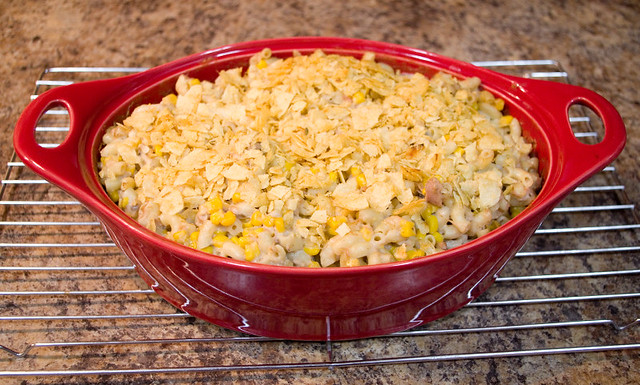
I was very happy with the end result, which I based on the Campbell’s® Tuna Noodle Casserole from Allrecipes.com. Of course, I had to make changes for the available ingredients, but I had to start somewhere. For example, I replaced milk with coconut milk, frozen peas with canned corn, egg noodles with macaroni, and the dry bread crumb and butter topping with plain crushed potato chips. Even so, it worked really well! I think that I will probably make this recipe again, but not in challenge-mode, so that I can use frozen corn instead of canned since I greatly prefer the taste of frozen.

As a bonus, it’s a great meal for camping (cooked in a pot instead of baked), cottaging, or when trying to clean out the pantry, since all of the ingredients are non-perishable. And at $2.21 a head (assuming it serves the minimum four people), it’s pretty darned affordable. Out of challenge mode, with a bit of bargain shopping at the supermarket, it could be made even cheaper. Around here, I know that cans of cream of mushroom soup often go on sale for $0.50 each, coconut milk is about $0.98, a big bag of frozen corn often costs about $2.00, and dried noodles sometimes go on sale for less than $1.00 a bag. This is all assuming you don’t buy the big name-brand version stuff, of course.

So here’s the recipe:

Dollar Store Tuna Noodle Casserole
Serves 4-6 adults

Fill a medium-sized pot three-quarters of the way with water. Add:
a pinch of salt
Bring the water to the boil on the stove on high heat. Add:
2 1/4 cups dried macaroni
Turn the burner down to medium-high. Cook the pasta until it is al dente. Drain the pasta and set aside.
Preheat the oven to 400°F (205°C).
In a casserole dish that holds at least 2 quarts (1.9L), add:
2 cans condensed cream of mushroom soup
1 cup canned coconut milk*
2 x 341mL cans of whole-kernel corn, drained and rinsed OR 2 cups frozen corn
2 x 130g cans of tuna packed in water, drained and broken up with a fork
Mix well. Add the drained pasta to the sauce mixture, stirring well to evenly distribute the ingredients. Put casserole into the oven uncovered. Bake for 30 minutes or until warmed through**.
Remove casserole from the oven. Open and crush in the bag:
1 40g bag of plain potato chips
Stir the casserole. Sprinkle the crushed chips onto the top of the casserole and bake for an additional 5 minutes. Remove from oven and serve.

*Canned coconut milk tends to separate, so stir it well before measuring.
**If you are cooking this on the stove, heat mixture gently in a pot until it is warmed through and sauce is slightly thickened. Skip the next baking step, and instead garnish each individual serving with a sprinkling of crushed potato chips.

Pulled Pork Sandwiches

It was inevitable. At least one of my kids has been sick since Saturday, and I’ve finally come down with whatever they have. Some kind of cold. But everyone needs to eat, so threw some ingredients in a slow-cooker and called it dinner. I’d never made pulled pork before, but a friend of mine taught me the basic technique:

– Cut a cheap cut of pork (in this case, pork loin) into large chunks, removing as much fat as possible.
– Put it in a slow cooker with the entire contents of a 500mL bottle of your barbecue sauce of choice. Stir.
– Cover and cook for four hours on high, until the meat pulls apart easily with a fork.
– Remove the meat from the cooker, pull it apart/shred it with two forks, and then return it to the cooker. Mix the meat back into the sauce.
– Cook for another hour on high.

The end result tastes really good, but it takes very little effort. I served the pulled pork in open-faced sandwiches that I made with homemade dinner rolls. Lest you think that it this took a great deal of effort, I just put the ingredients into the breadmaker and let it do most of the work. I used the Dinner Roll recipe from page 176 of Betty Crocker’s Best Bread Machine Cookbook (1999). Now, once the kneading is done, I did have to form the rolls by hand and bake them in the oven, but it was only about a dozen and a half of rolls, so that didn’t take long. I served the open-faced sandwiches with some of my homemade pickled beets, dilled carrot spears made with some of my monster carrots, and dill pickles. The acidity of the vinegar cut nicely through the sauce of the pulled pork.

We’re not quite at the stage where machines can do all of the cooking for us. However, having the option to just thrown ingredients into a something automated and then leave it ’till it’s done is a saving grace when you’re under the weather.

Bulgogi Beef Bowl

Yesterday Thing 2 was home from school with a cold, and Thing 1 returned from school at the end of the day complaining of a sore throat. Since my day was primarily taken up with caring for the both of them, I needed to make an easy dinner, one that didn’t take a lot of supervision. I also needed to make dinner from what I had in the house, because if taking the kids to the store can be a chore, it’s a thousand times worse when they’re sick. And let’s be honest, nobody else at the store appreciates me bringing my little disease vectors along.

I rooted through my pantry and found a bottle of Sempio Bulgogi Marinade, which to be honest I had completely forgotten about. I’d tried their Kalbi sauce a while back and really liked it, so I had high hopes for this marinade. It was a bit more liquid than I’d expected, but otherwise it was lovely. I half-thawed some beef from the freezer, sliced it thin, then marinaded it (and thawed it the rest of the way) over the course of an hour. Then I boiled up a pot of rice (basmati, which I know is more of an Indian thing than Korean, but it’s what I had on hand), steamed bok choy in the microwave, and then layered them in a bowl with the beef on top. If I’d thought about it I would have topped it with toasted sesame seeds, which I do have in my spice cupboard, but I forgot they were there! I had a little extra marinade at the bottom of the pan, which I poured over the bowl. This drizzled through the beef slices and onto the bok choy and rice, making both very tasty.

Things don’t bode much better for the kids being well tomorrow, so I’ll have to think of another pantry-friendly, healthy, hopefully-tasty meal for tomorrow…

Avocado Pasta Sauce: Second Try

Yesterday was another busy day, followed by a trip to Costco as soon as the girls got home. The trip took over two hours; I can never get out of that place in a reasonable amount of time! Luckily, Thing 1 and Thing 2 were very patient, which couldn’t possibly have anything whatsoever to do with the plethora of food samples that they were able to try. By the time I finished at the store and drove home, I had eaten significantly into the time that I usually use to prepare dinner. Something quick and easy was in order.

I have to say that the Avocado Pasta Sauce that I wrote about earlier this week is definitely a quick and easy dish. In the time that it takes to boil up the pasta (assuming you’re using dried — fresh stuff only takes a couple of minutes), the sauce is done. Since the sauce only requires prepping a few veggies and running them through a blender, it’s also very simple. This time I took my own advice and added a generous handful of fresh basil and cilantro to the mix, along with a bit more pasta water to thin it all out. I was much happier with the flavour this way — it wasn’t so plain! I sliced a few cherry tomatoes and tossed them in with the pasta and sauce as well for a bit of an acid zing. I also discovered that a generous shake of Parmesan cheese tops this dish nicely. (I’d suggest using a bit more salt and pepper if you’re going to forego the dairy.)

I served the avocado sauce on penne basically because it was the only wheat-based pasta that we had in the house (I didn’t think it would go terribly well on vermicelli or soba noodles). For the meat, I just carved up a rotisserie chicken that I’d picked up at Costco while I was there. It was a tasty and satisfying meal that was whipped up in the amount of time that it takes to boil some pasta. Not bad!

Ice Day

Yesterday was what we generally call a “snow day” around here, as in the winter weather was so terrible that school buses were cancelled and the kids stayed home from school. But it was really more of an “ice day”, since it had snowed the day before and then the temperature jumped up so we could have freezing rain coating that layer of snow, and then just plain old rain creating puddles on top of it all. It was a mess. It was definitely an ice storm, if not the ice storm.

With the kids home from school and it being too dangerous to really get out of the house (that being the whole reason for the bus cancellations in the first place), I found myself trying to wrangle two active children with increasingly high levels of cabin fever. The day was taken up with playing, crafting, snacking, NERF target practice, and video games. When the weather cleared up a bit, the girls went outside with their father to clear the driveway while I cooked supper (no mean feat after the plough had been by, leaving a burm of ice and slush between our house and the road).

On days like this, you really have to cook with whatever happens to be in the house. My pantry and freezer are well-stocked, and although it would likely take us weeks to even feel hungry feeding on those items alone, I was craving something a bit fresher. I Googled to find some recipes for pasta sauce that I could make without hitting the grocery store, and I found PureWow’s Spaghetti with Avocado Pasta Sauce. I thought that it would be ideal because it is a sauce with a creamy texture (which I adore), but without any actual dairy products.

I served the sauce over cooked spaghetti squash, with baked chicken legs (sprinkled with my usual garlic powder, sage, rosemary, thyme, summer savoury, and sea salt). I only realized after I took the picture exactly how unappetizing the sauce ended up looking, especially since I couldn’t toss it in the “noodles” without them falling apart. Ignoring the other gross things it could look like, the shine on the sauce makes it look like icing or a glaze, which it did not taste like at all. Flavour-wise, it was like eating guacamole, without the heat of peppers. Honestly, it was a little bit bland. I’d like to try this recipe again, but on actual pasta, with some fresh herbs thrown in (Googling has suggested basil and cilantro), and possibly some sliced cherry tomatoes.

At least dessert was a success! I heated a frozen apple pie from Mom’s birthday dinner (I always make two pies when I bake, one for the event and another to throw in the freezer for future use). When reheated from fully frozen, it usually takes about an hour in an oven at 350°F. I served the pie with a scoop of non-dairy vanilla “ice cream” for me and whipped cream for everyone else. There were no complaints on that score!

Frozen Ramen

I love fresh noodles. I am endlessly fascinated by videos like the ones about making thread-thin suo noodles or precisely-cut Chinese spinach noodles or seemingly-effortless hand-pulled noodles (emphasis on “seemingly”). In Japan, I was lucky enough to be able to try fresh ramen and, I think, udon, but there may have been a bit lost in translation.

Sadly, it’s hard to get fresh noodles of any style around here. There are a couple of specialty restaurants that make them, but for home use the closest I can get is refrigerated ones from the grocery store — and that’s only European styles. So until someone teaches me how to hand-pull noodles, or until I can afford an automatic pasta maker (or at the very least a hand-cranked pasta machine), I’m stuck with frozen or dried noodles.


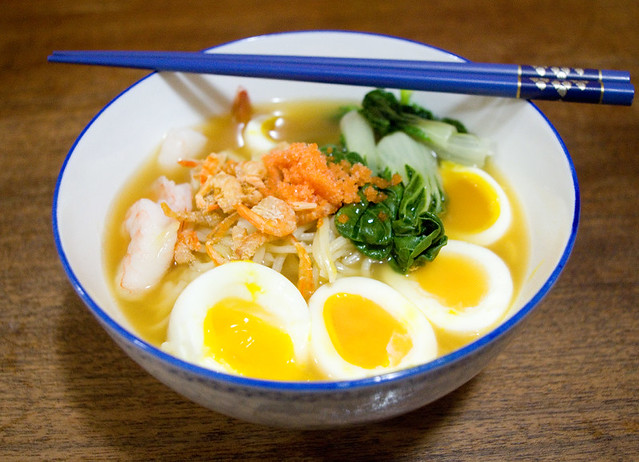
Frozen ramen that my husband prepared, topped with cooked shrimp, dried shrimp, baby bok choy, and soft-boiled eggs.

The consistency of dried noodles doesn’t seem to bother my husband. Sure, he likes freshly-made pasta on the few occasions that we do get it, but he doesn’t crave the chewiness and strength of well-made ramen or udon. When he cooks ramen for dinner (and he always uses either instant broth or my homemade broth from the freezer), the consistency of the noodles doesn’t even cross his mind.


Frozen ramen that my husband prepared, topped with cooked shrimp, sliced avocado, baby bok choy, and soft-boiled eggs.

That being said, he is willing to go along with my conviction that there are much better things out there. To that end, we’ve been trying out the other brands of ramen that are locally available, which admittedly aren’t very many. We started with dried noodles — not the ones in the instant noodle packets, but something very similar. The last two meals my husband made used Nissin Frozen Ramen Roodles in Artificial Pork Flavour. The noodles were a bit better than the dried kind, but not by much. The broth mix that went with the noodles actually had less flavour than the packets that come with instant noodles (and so far as I can tell they had just as much sodium). I think the lack of punch is funny considering that Nissin is the same company that makes our family’s preferred brand of instant noodle packet. If I have to eat a just-add-water soup, I prefer their Tonkotsu Artificial Pork Flavour with Black Garlic Oil.

So I guess this frozen ramen was overall a bit better than the dried kind, but only a bit. I have another variety in my freezer left to try, though, before I head back to T&T to see if they have any others.

As an aside, did anyone else use to eat dried ramen as a kid without cooking it first? It makes me cringe in retrospect, but we used to sprinkle the dried sauce packet over the top and eat it as is. I was reminded of this recently when I noticed that one of the local grocery stores had instant ramen on sale for 27¢ a packet, and I realized how happy this would have made me as a child, or as a broke college student for that matter. How my teeth survived unbroken I’ll never know.

Personal Pizza

I’ve been craving pizza lately, which is pretty much a no-no because of the issues that my digestive tract has with dairy. However, to my everlasting joy, I’ve discovered that I can eat lactose-free cheese so long as I don’t go overboard, since cheese is also quite greasy, especially when melted. Since none of the pizzerias around here carry lactose-free cheese as an option, I thought that a “make your own pizza” evening was in order.

It didn’t look spectacular because I put the toppings under the cheese, but it tasted great! I started with the dough from the Two-Cheese Pizza recipe on page 170 of Betty Crocker’s Best Bread Machine Cookbook (1999). This made enough for one 12″ pizza or four 4″ or so thin-crust-ish pizzas. (Next time I do this, I’m doubling the recipe.) You can’t actually cook pizzas in the bread machine, so I rolled out the dough into individual crusts and everyone topped their own. I used Healthy Veggie Tomato Sauce that I had in the freezer as the sauce, although I did simmer it a little to reduce it a little bit. I topped my pizza with ground beef and crumbled bacon, along with a few cremini mushroom slices. The rest of the family had theirs with more traditional mozzarella, but since cheddar was the only kind I could get lactose-free, I went with that.

I’ve tried Jamie Oliver’s Quick Family Pizza in the past, and although the kids liked it, one of the things I discovered about myself is that I’m not a big fan of the taste of self-rising flour. I think it’s just a little too salty for me. At any rate, I like the yeast dough a great deal more, and it’s just as easy as the quick bread version if I use the bread machine. So I think I’ll stick with this kind of dough for future pizza iterations.