Fire Station 54

I know this isn’t the kind of thing that I usually write about, but as this is a public venue, and I figure that I should take advantage of it as such. I wanted to say a big thank-you to the fire fighters at Fire Station 54 in Blackburn Hamlet.

You see, Thing 1 needed a picture of a fire station for a poster board that she was preparing for a presentation to her Girl Guide group. Instead of photocopying something out of a book or printing something she’d found online, I suggested that we take a drive and visit an Ottawa fire station. She was dubious at first, but then she was persuaded that first-hand reporting would be more impressive for her presentation.

So we drove out to Fire Station 54, where two fire fighters were in the middle of parking a truck on the side lot. I asked if I could take a picture of the truck with my good camera for my daughter’s project, and they were more than happy to comply. Then they suggested that Thing 1 and Thing 2 get a chance to sit inside the driver’s seat, then check out the inside of the cab and ask questions. Then the fire fighters offered to set up the outriggers and extend the ladder so the girls could see how high it goes (about five stories, apparently).

After they put the ladder away, the fire fighters suggested that the girls go on a brief tour of the station. They got to see the garage, the fire fighting suits, the dispatch room, and most importantly to the kids, the fireman’s pole (which is, in the case of this particular station, located in its own closet).

I have lots of reasons to respect fire fighters. I mean, they’re heroes, both to the community and to me personally. On July 16th, 2012, I almost lost my little brother to a house fire caused by an electrical fault in a nearly-new air conditioner. Although he did manage to get out of the house on his own, the fire fighters had to contain the fire and put it out. So I have a lot of personal respect for them as well. But now, after my kids were treated so nicely, our local fire fighters have made a great impression on our family. Honestly, Thing 1 is super pumped about the whole experience and now she wants to be one when she grows up. To this I say: work those muscles, girl, you’re going to need them!

Ice Storm French Toast

Sunday going into Monday we had one heck of an ice storm. It was possibly as bad as the one in 1986, but nothing close to 1998. Even so, 43,000 people in town lost power and the city was turned into a virtual skating rink.


Apple tree branches encased in ice.


More apple tree branches.

Now, freezing rain isn’t a new thing in this city. But this is the latest that I can ever remember it closing everything down — I mean, it’s April, for crying out loud! My kids had a “snow day” (“ice day””?) yesterday. It’s nuts.


Roofing shingles under ice.

It got even more dangerous to be outside as the day went on and the temperatures rose, causing the ice to start falling off the trees and the roofs. Some people had flying ice shatter the windshield of their car. Everyone avoided the areas around buildings and trees to reduce the likelihood of being brained. At least here in Ottawa we don’t have any super-tall buildings like the CN Tower dropping big chunks of ice onto other buildings and damaging them.

As the sun set, the ground was covered in a few centimeters of slick ice from the freezing rain, and then another layer of broken ice from the branches and buildings dumping their loads. Many of the ice chunks were bigger than my hand, and almost two centimeters thick.


Pain perdu served with sliced apples.

Right before a big storm like this, around here the things that people tend to stock up on are milk, eggs, and bread. I think this is because, with a typically Canadian mentality, we tend to have lots of food put by in the freezer or the pantry to get us through bad weather, but we tend to run out of perishables. A common joke based on this trend is that everyone wants to make French toast when the weather is stormy (a dish which is comprised primarily of these three ingredients). Now, I don’t think I’ve ever made French toast during a storm before, but I was looking for a quick and easy meal for last night, so I figured why not? I had the supplies, after all.

I’d made Egg-Enriched White Loaf (page 67, Bread Machine: How to Prepare and Bake the Perfect Loaf (Jennie Shapter (2002)) earlier in the day (although I’d had issues with the amount of liquid and had to add more than the recipe recommended). I sliced that bread thickly and used the recipe for Pain Perdu on the Restigouche from page 19 of Anita Stewart’s Canada (2008) for the coating. (Yes, the book I had on reserve finally came in at the library.) I do know how to make French toast the way my parents taught me, which has rather more eggs and less milk (I used almond milk in any case), but I rather liked this new way of doing it.

Hopefully the weather will clear a little Tuesday so that my house-bound children can get to school, and this stir-crazy mom can get out of the house, if only for a coffee!

Teacup Pin Cushion Tutorial

My kids are learning to sew, so I thought that it was time that they had pincushions of their own. I’ve seen teacup pin cushions around at flea markets and craft fairs, so I thought we’d make a go of whipping up some of our own. They’re really easy and right up the kids’ alwy, patience-wise.

Teacup Pin Cushion

Materials:
– 1 teacup (saucer optional)
– 1 square of cotton or cotton-blend fabric, about 3X as wide as the teacup’s top
– polyester fiberfill
– thread

Supplies Needed:
– fabric scissors
– needle
– hot glue gun & glue
– pins

1. It all starts with a teacup — but none of Grandma’s fine china! We bought ours for about $2.00 at a local charity thrift shoppe. If you’re not into tea, a coffee or espresso cup works well, or an egg cup, or even a sake glass. We even made one using a miniature terracotta pot (picked up for about $0.75 at a gardening supply store). Basically, it has to be an opaque container that you like the looks of that’s about the size of an old teacup, or smaller. You will also need to pick out a piece of coordinating fabric that’s about three times as wide as the mouth of your vessel.

1.B. OPTIONAL STEP: If you’re very crafty, you can embroider a design on your fabric at this stage.

2. Using a pair of fabric scissors, cut your fabric into a circle about three times as wide as the opening of your teacup. It doesn’t have to be perfect, since this end will be hidden inside the bottom of the cup where nobody will ever see it.

3. Using a running stitch, stitch around the outside edge of the circle, about 1cm from the edge. Use a sturdy thread, but don’t worry about the colour, since this will be hidden as well. Tie a knot at each end of the thread, but do not stitch that knot into the fabric.

4. Making sure that the fabric is inside-right, pull the thread taut to gather the fabric, but do not tie a knot. This will make a little pouch.

5. Stuff the pouch firmly with fiberfill.

6. Draw the thread as taut as possible and tie it off securely. This will create a small cushion.

7. Stuff the cushion into the teacup, making sure that the end with the stitching and the gathering is at the bottom of the cup.

8. Affix the cushion inside the cup using hot glue. I found that I got the neatest results by pushing the fabric down below the edge of the cup, and then running a bead of hot glue quickly about 0.5cm lower than the edge of the cup. Then I carefully released pressure on the cushion until it sat at the height I wanted, holding it in place while the glue dried. Otherwise, the cushion kept trying to puff much too far out of the cup.

9.B. OPTIONAL STEP: Using hot glue or by sewing, decorate the pin cushion. You can add a border of ribbon or trim around the edge of the cup to conceal the glue. Buttons, lace, small pompoms, googly eyes, felt cutouts, silk flowers… If you’re so inclined, this is a great time to be creative.

And that’s really all there is to it!

As for our last March Break craft, Thing 2 went with a more contemporary look.

Whereas I made mine in a little flower pot. I created the floral element by sticking sewing pins through little fabric flowers bought in a confetti-like pack from the dollar store.

And Thing 1 used the fabric flowers slightly differently, pinning them into place with her pincushion’s pins.

String Art Tutorial

I’ve been wanting to try this craft with my girls for a while; it is a great way to learn how to use a hammer and nails! I never did this as a child, but my little brother did, and his string art masterpiece hung in his room for years. The nice thing about this craft is that you can make it simple or complicated, depending on the skill level of the people doing it. We went with really simple, perfect for a busy day’s work!

String Art

Materials:
– 1 piece of 1/2″to 3/4″ thick wood, approx 12″ by 12″ (pine preferred)
– 1 colour of acrylic paint
– 20 (or so) 1″ long common framing nails
– scraps of thin yarn or string
– sawtooth picture hanger & screws

Supplies Needed:
– fine-grain sandpaper
– paintbrush
– hammer
– wooden clothes pin
– screwdriver

1. We started with a 12″ by 12″ piece of 1/2″ pine shelving left over from an old project. Pine is inexpensive and easy to hammer nails into. Such a small piece can be often be found inexpensively (or free) off-cut from a home improvement store. If you’re not handy with a saw, most reno stores will cut wood to size if you ask.

2. Using fine-grain sandpaper, give the piece of wood a quick once-over to remove any splinters.

3. You can leave the wood unfinished (in fact, a lot of string art is done on gorgeous, rustic barn board), but my girls opted to paint theirs. Two coats of crafting acrylic turned Thing 2’s board an eye-searing pink, while Thing 1 chose a more muted lavender. Don’t forget to cover your work surfaces with paper or plastic if you care at all if it gets stained! (Graffito from the kids is optional.)

4. Nail in the nails in the pattern of your choice. My kids went for an abstract creation of their own design. However, any number of designs and shapes can be downloaded off of the Internet, printed out, and then taped onto the top of the wood. You can then nail along the edges of the design, and rip the paper away when you’re done. Alternately, you can freehand a design in pencil and then paint over the marks before you add the string.

Since the kids hadn’t done much hammering with full-sized hammers before, we used wooden clothes pins to hold the nails upright while they got them started. This keeps their fingers away from the hammer, at least until they have a little bit more precision! (It stunned Thing 1 that I could hold a nail while hammering without smashing my fingers.)

Thing 1 went with a free-form design.

Thing 2 went with a more geometric plan.

5. Tie a few knots around one of the nails, and then go to town wrapping the string around the nails!

6. If you’re planning on hanging the string art on the wall, using a screwdriver, attach a sawtooth picture hanger with screws to the top back of the piece. Alternately, it can be propped on shelf, or held up by a mini easel.

Salt Dough Creations

A friend of mine bought me a copy of the Better Homes and Gardens Treasury of Christmas Crafts & Foods for Christmas, and leafing through the project ideas therein brought back many memories of the kinds of crafts that I did when I was growing up. One of the ones that stood out the most was the salt dough Christmas ornaments. Although I never made any in the patterns suggested by this book, I did make some simple ones through Brownies and Guides, and I had a lovely little girl in a red dress as part of my ornament collection until she eventually fell apart. I thought that my kids might enjoy playing with dough that becomes a permanent creation for a change. (If your kids would basically like to do the same exercise but come away with something that they can eat, I would highly recommend Cookie Monster’s Famous Cookie Dough instead.)


Rolling out the dough and cutting it out with cookie cutters and Play Doh cutters.

I did my due Googling, and I discovered that although the style of ornament that people make has changed a bit over the years (especially when it comes to the choice of colours used), the actual technique remains the same. Multiple books and many sources on the Net stick to the basic recipe of:

– 2 cups flour
– 1 cup salt
– 1 cup water

Which you then knead together to create a stiff dough. You then cut out/shape your designs and lay them on parchment paper on a cooking tray. Advanced creations can take a long time, a lot of skill, and a great attention to detail. However, when you’re making crafts with younger children, quick and easy cookie cut-outs are the name of the game! As a bonus, since the dough is so cheap to make and is 100% biodegradable, if the kids proclaim themselves done after having made very few cutouts, it’s not too big of a deal.

Salt Dough 2//embedr.flickr.com/assets/client-code.js

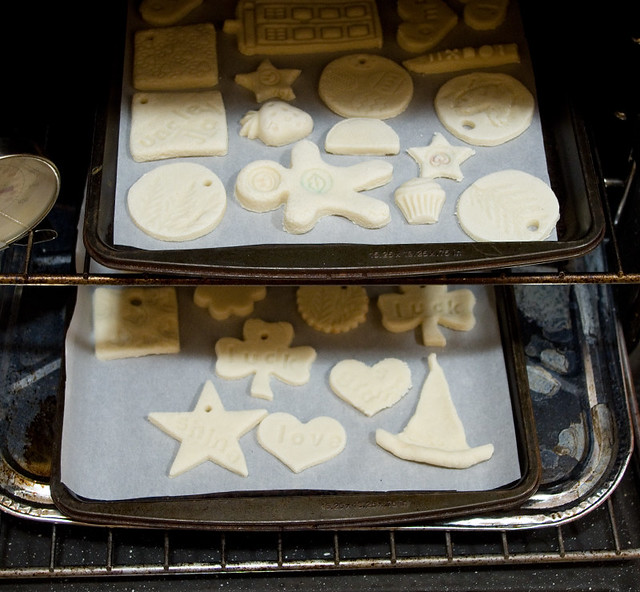
After shaping, you put the salt dough creations in the oven at 200°F (93°C) for… Well, that’s where directions vary. I think it all really depends on the thickness of the final pieces. I’ve seen it anywhere from two to eight hours, so I kind of guessed at three, which worked out okay. I think that what everyone agrees on is that you don’t want to bake or brown the dough, you just want to remove all the moisture.

Then the cut-outs need to be cooled on a cooling rack, which doesn’t take all that long, really, since they weren’t terribly hot in the first place. We left them overnight to hopefully remove the last of the moisture. It’s not like you have to worry about them going stale, after all.

Then it was time for paint! I have what seems like a million colours of acrylic and many different paint brushes, all from the dollar store. If you don’t have a stash of paint and want to keep costs low, stick with red, yellow, blue, black, and white. The kids can mix any colours they want with the primary ones, and it’s a good lesson in colour theory.

To be honest, my girls ran out of patience with the fiddly details, so the painting will have to be completed another day. Since I had to make dinner, I didn’t get a chance to finish painting the ones that I made either, so we’ll have to sit down and do them all together tomorrow. I really liked how the ones with the impressions turned out, though. The girls used rubber stamps, carved rolling pins, and even leaves of plants to create textures.

Of the ones that I painted, I am particularly happy some of the simplest: the Easter bunnies, made using a cookie cutter and a little ball of dough for the tails.

The next step is to seal salt dough, which I’d prefer to do with spray-on acrylic, so that will probably have to be done out in the garage once it warms up a bit. I’m told it can also be done with Mod Podge or PVA glue, both of which I own, but I’d like to test them first to see how badly they smudge. Then the ones with holes will become ornaments, and the ones without holes will have a magnet (also from the dollar store) glued on the back to become fridge magnets.

Tie Dyed Pillow Cases

Tie dyeing with the kids is really something that I prefer to do in the summer when I can throw the kids outside in their bathing suits (which are synthetic and don’t absorb dye) to minimize the mess indoors. This time of year, with temperatures hovering around freezing and snow still covering the ground, that’s not exactly an option. Instead, the girls worked in their bathing suits and socks (warm feet are important) in the kitchen, over the metal sink, and we hoped for the best.

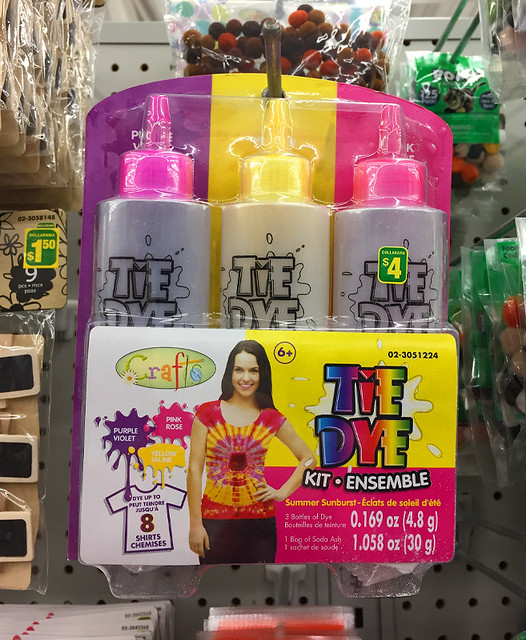
In the spirit of keeping things as cheap as possible, we used fabric we already had — four old, plain cotton pillow cases. We also bought the dye at the dollar store. So far, this are the cheapest kits I’ve found locally, with even Walmart’s selection starting at about $11.00 for a two-colour Tulip-brand kit that only makes three items. For six colours, you’re looking at upwards of $25.00. At Dollarama, they sell their own Crafts brand three-colour kits for $4.00 apiece, and we bought two in different colours. But would these kits work as well as the more expensive ones we’d tried?

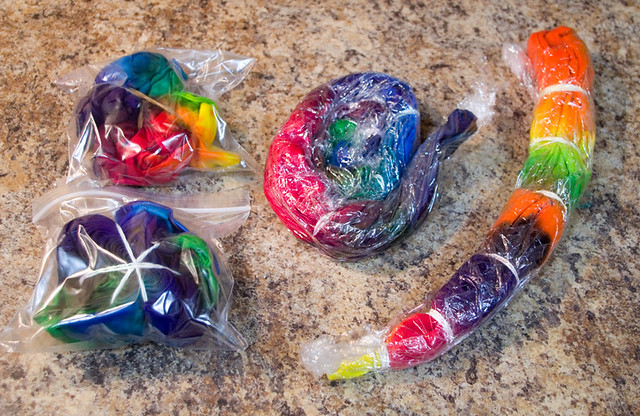
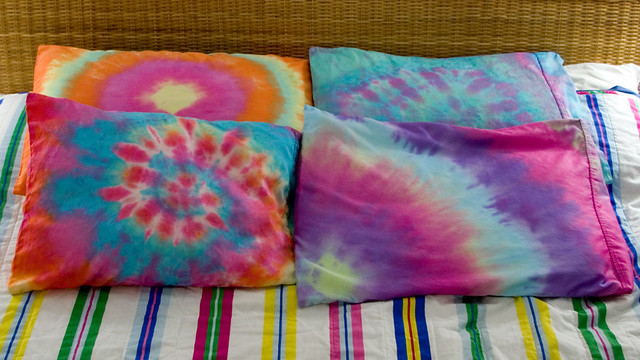
When it comes to the supplies included in the kit, I found that they were more or less the same as other brands. They contained everything we needed except the water and the plastic to wrap the fabric as it sat, which is standard. Slightly higher quality gloves would have been appreciated, since they did leak and now the kids have splotches on their hands in places, but that seems to be standard too (just like the ones that come with hair dye). The instructions were clear and concise, and even had a brief photo tutorial for how to make different kinds of designs. We used the spiral (left) and bullseye (center and right) techniques on the kids’ pillowcases. (If you need more information about how to tie dye there are a million sites out there, but the Tulip site has some great tutorials that will work with any brand of dye.)

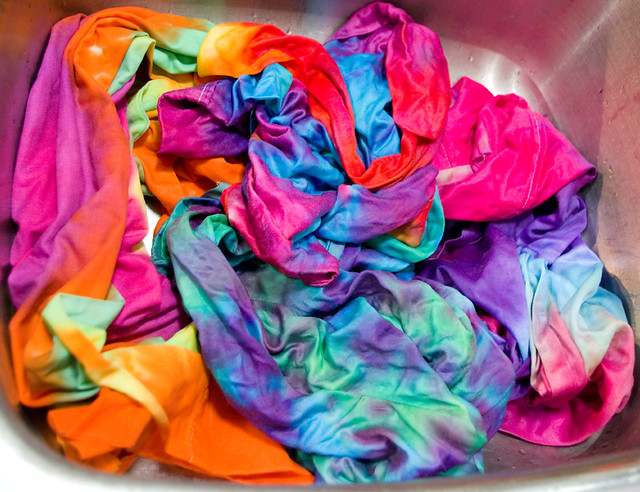
The kit did contain soda ash, which is necessary to pre-treat the fabric to retain vibrant colours. However, the directions did say that the dyes could be used without pre-treatment, but they would come out more pastel. I let the kids choose between waiting a bit longer to dye so they could have bright colours, or to do it right away and have lighter colours, and not surprisingly they chose to go with the route that required the least amount of patience. Despite the dire warnings of the packaging and articles online, after the first rinse the colours remained vibrant (above).

After a run through the washer and dryer, the colours did fade a bit, and I expect that they will continue to do so throughout their lifetime, but I remain happy with the final product. The kids are thrilled (according to Thing 1, the pillow cases are “Awesome!”), and since the project was for them, I say it was a success. (Bottom left and top right were done in the spiral techniques, top left and bottom right were done using bullseye — more techniques here.)

I will say one thing, though: each package of three colours claims that it contains enough dye for up to eight T-shirts. I guess that could technically be true, if you were to use very small shirts, and if you didn’t want a lot of colour saturation or variation in your design. Two packs, for us, did four very saturated single-bed-sized pillow cases (which I would say are about the same size as a small adult T-shirt), with enough left over to do maybe one more. That’s five items out of two packs of dye, when it claims we could make sixteen items. So keep that in mind when you decide how many items to prep. Even so, that’s five items in six colours for $8.00, compared to Walmart’s three items in two colours for $11.00, so Dollarama remains the cheapest place in town to buy supplies for tie dye crafts.

Grilled Cheese

Our household is currently in the grip of a nasty gastro bug; Thing 1’s illness started promptly at 6:00am on Friday morning, and Thing 2 woke up at 4:30am Monday morning to begin her turn. I’ll spare you all the nasty details, but nobody in our house is really thinking about cooking or thrifting or crafting at the moment. Right now we’re all just trying to take care of each other and/or minimize the effects of the bug. So here’s a picture of a meal we made up last week:

That’s a grilled cheese (lactose-free for me) and avocado sandwich, served with a salad of romaine lettuce and baby spinach and a choice of dressings. The bread is a Farmhouse Loaf that Thing 1 made in the bread machine; the recipe is on page 72 of Bread Machine: How to Prepare and Bake the Perfect Loaf (Jennie Shapter (2002)).

Hopefully we’ll be able to return to your regularly scheduled programming quickly.

Cleaning Enameled Cast Iron

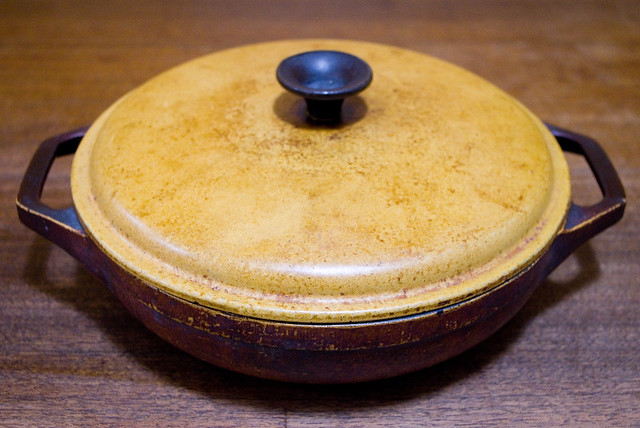
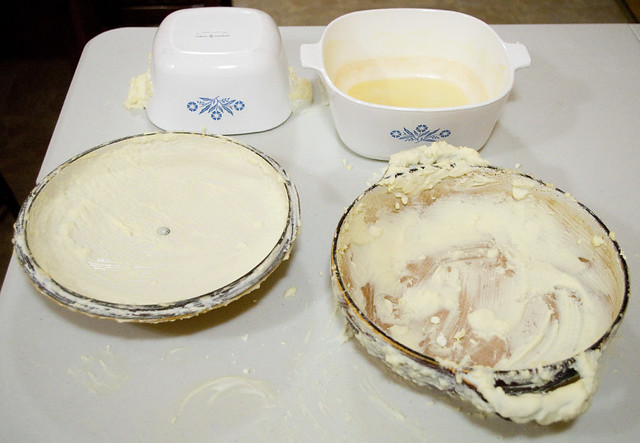
I picked up a box of old, used kitchenware a while back, and buried down deep at the bottom was what looked like an enameled cast iron casserole dish. It was in pretty rough shape.

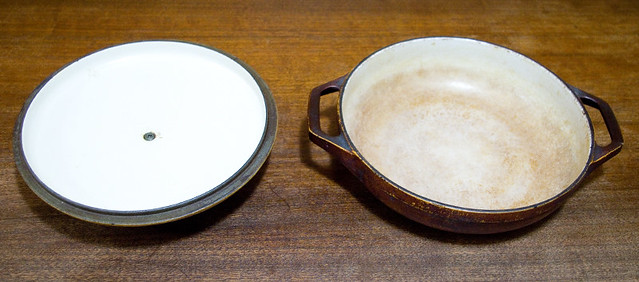
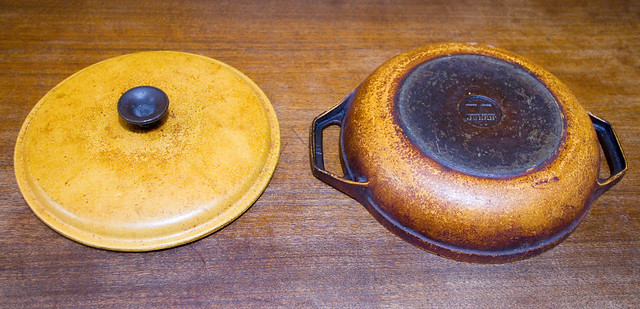
The inside wasn’t too badly off; there seemed to be some staining, but no chips or pits in the coating. The outside, however, was a mess:

My best guess is that the previous owner(s) had regularly cleaned the inside where food would actually touch, but were lackadaisical at best about cleaning the exterior. There was a brand name on the bottom, but it was so covered in gunk that I couldn’t quite make it out. But it seemed like a solid piece, so I decided to give cleaning it up a shot.

(I was also going to write about two vintage Pyrex dishes from the same box that had cleaned up really nicely with a lot of elbow grease, but yesterday I managed to bump into them and send them crashing to the floor. They hit each other on the way down and shattered into teeny tiny little pieces. They were only Cornflower Blue dishes, probably about 30 to 40 years old and not terribly rare, but after all that work I was — and still am — rather pissed off that I made such a stupid mistake. Anyway, that’s why there are Pyrex casseroles in that photo as well.)

One of the suggestions that I found online was to coat the piece in a paste of baking soda and lemon or lime juice, so I tried that first. If nothing else, it smelled nicer than any other cleaner I tried!

It actually made a pretty good dent in polishing up the interior.

However, it didn’t have the penetrating power to get a the worst of the exterior’s years of caked-on grease. I’m going to keep this technique in my arsenal for future reference, though, since it did do wonders for the areas where the damage wasn’t so bad, like on the outside of the lid.

The next tip I tried was to soak the pot overnight in a solution of two parts water to one part vinegar. This made so little difference that I didn’t even bother taking a picture. It was just a waste of time.

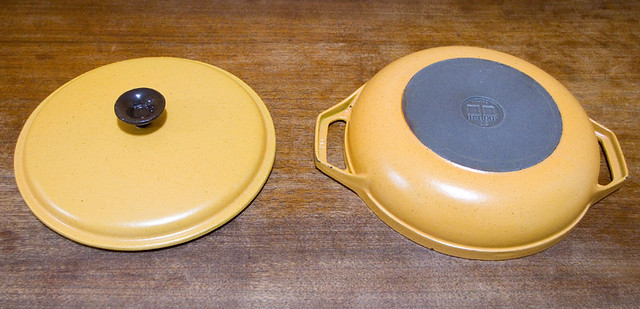
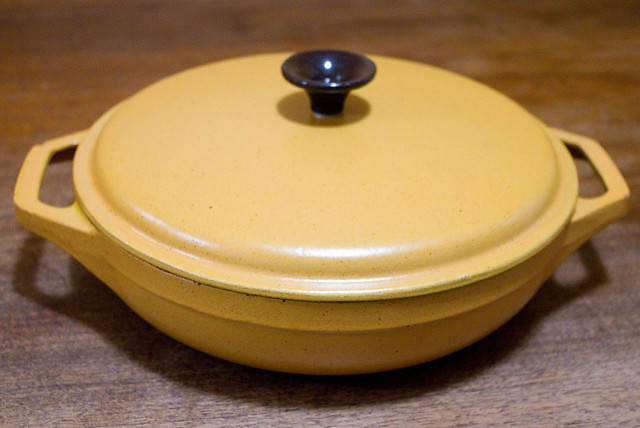
My friend suggested that I fill the sink with water and add two dishwasher pods, which did end up being the technique I was looking for. Even so, I had to soak for 12 hours, give it a scrub, change the water, and then return it to soak. This technique took three days, but just look how it turned out!

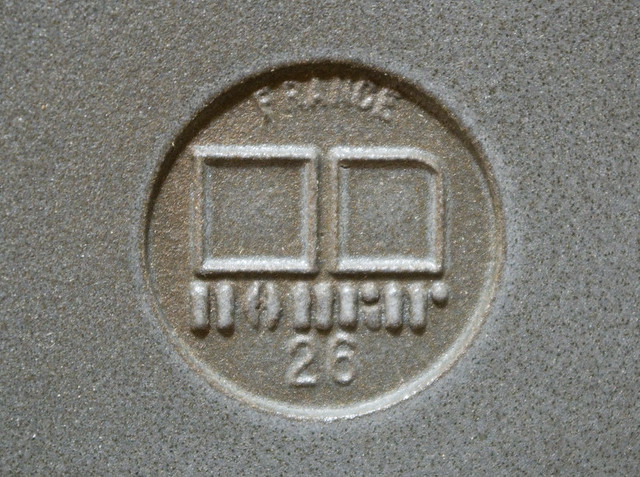
While it was soaking, I was finally able to get a good look at the logo. It’s a Nomar braiser, and my research dates it from the late 1960’s to early 1970’s:

At some point Nomar was bought out by Staub, which is a competitor of Le Creuset. Apparently, back when they went by the Nomar name, the brand was an even stronger competitor. And Le Creuset is the be-all and end-all of cast iron ware these days!

My roaster holds about 2.5L, which puts it between Le Creuset’s 1.5L and 3.5L braisers… Which retail for $200 and $340 CAD, respectively. So my piece old Nomar was definitely worth the work I put into it!

And I have to say, it’s awfully pretty.

But What Is It? The Sequel

Over this past summer I found a tool at the cottage my parents were renting and I couldn’t for the life of me figure out what it was. After posting But What Is It? and But What Is It? Part 2, the general consensus was that it was some kind of homemade chopping tool, probably to aid someone who had limited hand strength.

Today I have a new quandary. I picked up a piece of Tupperware when I bought a big box of second-hand plastic containers, and I have no idea what it is. Here are some photos for your reference:

As you can see, it’s actual Tupperware brand (around here we often call any plastic container “Tupperware”, no matter the brand, so I had to specify). However, it doesn’t have a mold number, so it can’t easily be looked up online. Because of this, I suspect that it may be part of a larger item. Because of the colour/texture, I suspect that it’s of relatively recent manufacture, not vintage. It’s solid plastic, and one end tapers sharply, scraper-like. It measures 19.8cm (7 3/4″) at its widest point and is about 13cm (5″) tall at the highest point at the center of the arch.

I’ve asked my friend who is into collecting Tupperware in a big way, and she has no idea. My Googling has yielded nothing. Anyone? Anyone? Bueller?

EDITED TO ADD:

Karen and Peter over on my Facebook page pointed me in the right direction: it’s a food scoop! Its meant to scoop up food after you chop it so it’s easily transferred from food to pan. This makes sense, because the scoop was originally packaged with a five-slot knife block that had an attached recipe card holder. There’s a good example over on eBay. Mystery solved!

New Toy

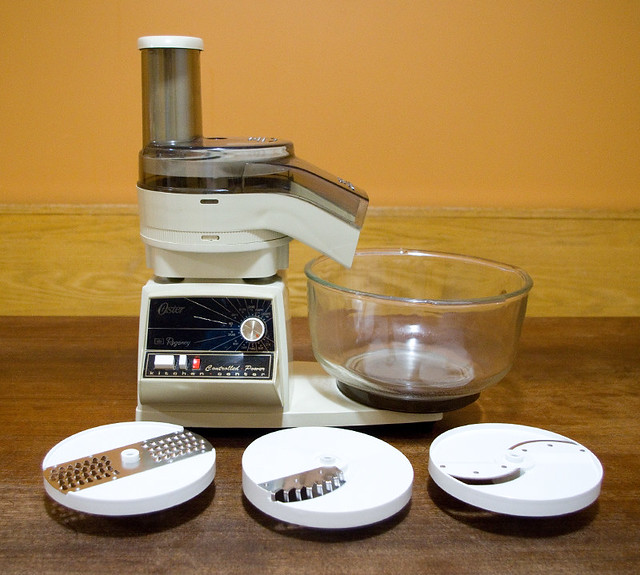
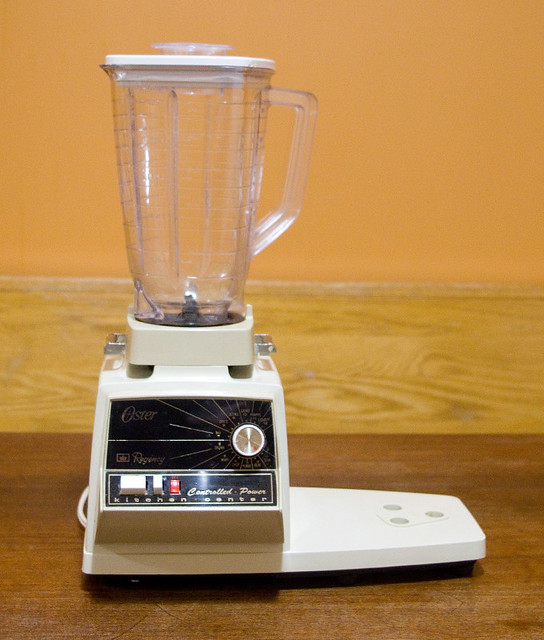
So I have a bit of thing for hunting for interesting vintage kitchen gear. Part of this is the love of the hunt, part of it is because I love the look of older pieces, and part of it is because I actually use a lot of these things and I just can’t afford to buy them new. And, let’s face it, the phrase “Reduce, Reuse, Recycle!” was beaten so thoroughly into my head as a child that I just can’t shake it free. My new toy is a case in point: a Oster Regency Kitchen Center, circa 1983.

Oster Kitchen Center Slicer Shredder Salad Maker
Kitchen Center with slicer/shredder/salad maker/French fry cutter attachment and four cutting discs (shredder, French fry cutter, thick slicer, and thin slicer).

I adore the styling of the KitchenAid and Smeg stand mixers, but heaven knows that I can’t afford one. I do have a beautiful Dormeyer Princess mixer, but so far I only have the mixer attachment for it. My new-to-me Kitchen Center has slicer/shredder/salad maker/French fry cutter, mixer/doughmaker, and blender attachments. Actually, it originally came with a grinder as well, but that part went missing sometime in the last 35 years.


Kitchen Center with blender attachment.

Also missing: the mixing bowls! Well, two bowls that looked about right came with it, but it turns out that they weren’t the correct ones. I shopped around at my local thrift stores and found a total of four that work for about $20, which is reasonable when you consider they’d be about $70 on Amazon.

I was a little worried when I took the machine apart to clean it and realized that some of the gears are plastic. I have a bad habit of putting too much strain on my machines and stripping plastic gears. I’ve ruined a couple of blenders that way. Luckily, the gears for the blender attachment are all metal. We’ll see if the other attachments’ gears are durable enough to withstand my not-so-tender ministrations.


Kitchen Center with mixer/dough maker attachment.

I have to admit that the part I am most enthused about is the stand mixer/dough maker. So many recipes and instructional videos just call for you to use one. I mean sure, it’s possible to do it all by hand, but sometimes I just don’t want to put in all that effort. Also, it can sometimes be a bit tricky to translate directions (especially timing/consistency) from machine mixing to hand mixing.

Apparently there were a whole lot of other attachments that were additional, optional purchases. The one that interests me the most was the pasta accessory, which included five processing discs for thin or thic spaghetti, lasagne, rigatoni, and fettuccine. Unfortunately, it looks like it attached to the (missing) grinder. So I’ll be keeping an eye out for these pieces during my future thrifting expeditions. There may be homemade ramen in my future yet!