Breakfast for Supper

Last night I was running errands with the girls until just before dinner time, so I needed a quick, easy, and nutritious meal to feed the family. I chose bacon (cooked in the microwave — it’s much less messy that way), eggs (over easy or scrambled, depending on preference), enormous everything bagels from Costco, and a homemade fruit salad.

It’s a good thing that I chose such a simple dinner, actually, because my brother-in-law popped by around dinner time. I don’t think he was originally planning to join us for a meal! However, it’s quite easy to throw on a couple of extra eggs and pieces of toast. My door is always open, but for some meals it’s definitely easier to “throw an extra potato in the pot”, as my mother would say.

Seasonal School Snacks

I mentioned in my last post that since it’s in season, I wanted to do more cooking with maple syrup over the next little while. Well, after reading a book about kids learning to cook, Thing 1 has been bugging me to make fruit leather with her. Since fruit leather is just pureed fruit that has been dried, I figured why not? Also, it’s a great way to use up an overabundance of fresh fruit (not really a problem here in the spring) or the fruit that you’d forgotten about in the freezer (more of an issue of mine right now).

My parents actually used to make fruit leather and dried fruit for my brother and I when we were kids. This was the era of the Fruit Roll-Up, but my brother’s sensitivity to corn (and hence corn syrup) made most versions of this store-bought snack inadvisable. Actually, the dehydrator that I’m using now is exactly the same one we used when I was a kid; my parents let me have it when they realized they hadn’t used it since my brother and I moved out.

The instructions for the dehydrator recommend that if you’re going to use a sweetener when making fruit leather, you should “use corn syrup, honey or fruit juice instead of granulated sugar which tends to crystallize”. We’ve discovered that maple syrup actually makes a great, all-natural sweetener for fruit leather that does not crystallize — and it adds a lovely flavour as well.

As an aside, if you don’t have a dehydrator, you can make fruit leather in the oven by drying it out at 200°F (93°C) for eight hours or so… But a dehydrator is a much smaller machine and uses a lot less electricity, so if you’re going to make fruit leather often, I’d recommend buying a purpose-built machine.

This is also the week leading up to Easter, which in our family means at the very minimum it’s time to dye some eggs! The kids like to take hard-boiled eggs to school in their lunches, so I made up a dozen for the week.

I used food colouring to dye the eggs vibrant, food-safe colours. There are all kinds of kits out there for dyeing and decorating Easter eggs, but a lot of them aren’t intended for consumption afterwards, so I like to stick with food colouring. The kids may decorate more eggs over the long weekend, though, and those will probably be with paint and glitter. They might be old enough to blow out the eggs to create permanent ornaments this year. Well, I know that Thing 1 is, but Thing 2 is not always as gentle as her big sister… And empty eggshells are mighty easy to smash.

The nice thing about blowing out eggs for decorating is that you can save the yolks and whites and make lovely scrambled eggs, or breakfast burritos, or tamagoyaki (either by itself or in sushi), or egg drop soup. This way, no part of the egg would be wasted. I have to admit, wasting food is a pet peeve of mine. Sometimes it can’t be avoided, but all efforts should be made not to, you know?

Weekend Recap

Manning my first stall at Russell Flea was a lot of fun, and it was definitely a learning experience! I learned that the lights that I bought (from Dollarama, since a lot of people have asked) don’t fit through the bottom slats of all of the display crates, so I’ll have to widen a spot for them. I learned that it takes a really long time to pack and unpack a table’s worth of glass and stoneware when you have to unwrap and wrap every single item to prevent damage in transit. I learned that paper is great for wrapping delicate items if you only need to do so once or twice, but it disintegrates really fast (you’re better off using old fabric — blankets and towels are best — if you’re going to do it repeatedly). I learned that an apron with a lot of change in the pockets which ties around your neck can make your neck really sore if you wear it all day. I learned that people have really fond memories of old Tupperware and Pyrex.

Oh yeah, and I learned that I should be careful not to cram all of my tablecloths as tightly as possible into one bag, so that they effectively have the wrinkles pressed into them by the time I arrive at the venue. Whoops.

But I did have a good time. I got to chat with some friends who stopped by, and meet the vendors around me with a great deal more experience than I. I may even have met someone who can teach me how to spin if I ever manage to get my spinning wheel repaired.

One of the nice things about working for myself is that I can knit and mind a stall at the same time, once it’s all set up. That’s not something you’re generally allowed to do in a traditional retail setup. I find that it’s a great conversation starter. I managed to get about a third of a sock done that day.

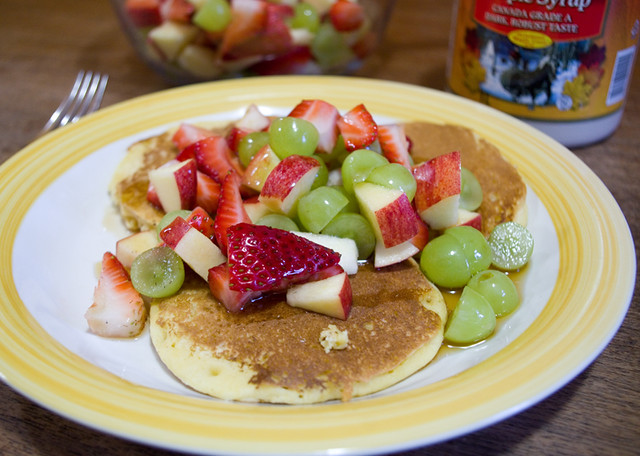
Since I was away all day working, my husband did have to make dinner which was, at the request of the kiddos, pancakes! Hubby had never actually made pancakes before, although I was sure that that was a basic thing that everyone around here knows how to make if they cook at all. My husband is an unenthusiastic cook at best, but he has learned the necessary skills. His pancakes turned out really lovely! Fluffy and delicious, and smothered with fruit and maple syrup.

Speaking of syrup, apparently the sap has been running since that weird warm spell back in February, so the local tree farms should be getting a great harvest this year. Note to self: I need to pick up some more local maple syrup when I’m at Russell Flea again two weeks from now. I’m pretty sure it’s McCannell Craftwork was the farm that brought the syrup on Saturday, and I hope they’ll be back again.

A Piece of Pie

Recently, my husband and I were playing Borderlands 2 online with another couple who are good friends of ours. At one point I had to take a brief AFK break to take a pie out of the oven, causing our friends to jokingly lament that they didn’t have pie too. At that time, their birthdays were swiftly approaching, so I promised them that I’d make them pies for their birthday. Well, their joint birthday celebration (their birthdays are only a couple of days apart) was this past Friday, so on Thursday night I had to make their pies.

I decided to make two totally different kinds of pies, and I started with a lemon meringue. I used the crust recipe from page 73 of The All-New Purity Cook Book (Elizabeth Driver, 2001), the filling from page 687 of the Joy of Cooking (Rombauer & Becker, 2006 edition), and Soft Meringue Topping #1 on page 798 of the Joy of Cooking. I’ll confess right now that I had never made lemon meringue pie before, even though I quite like it. I’d only tried a meringue once before and that failed spectacularly. I don’t know what I did, but no matter how hard I whipped it, the meringue never formed peaks at all, it just stayed runny. I was really worried that it wouldn’t turn out right.


Photo by Karen Turnbull.

In the end, I’m quite proud of my first lemon meringue pie, even though I singed the topping a bit. I have got to remember that my oven heats unevenly and that I need to check on my baked goods more often. I mean, I set a timer for the minimum time recommended and then checked it with five minutes to go, and it was still a rather dark brown (I was aiming for a toasted gold). If I’d left it in five minutes longer, it would have been burnt. Luckily, the colour was only on the surface, and my friends said it tasted just fine. They served it up to their gaming group when playing D&D on Sunday night, and everyone liked it, even one person who generally doesn’t like lemon meringue. I’m wondering if that’s because I used fresh lemons and lemon zest when I made the filling from scratch, instead of using canned filling.

For the second pie I went with a fruit-filled pie, which something I’ve done successfully a million times before, just in case. I mean, given the disaster with the bitter pumpkin pie at Christmas, experience doesn’t always mean mistake-free. But I’m fairly confident that it will taste fine (especially since you can honestly completely omit sugar in most fruit pies and it’ll still be palatable). For kicks, I rolled the top crust using a laser-engraved rolling pin that I received as a gift a while back. It features the hazard symbols for poison, ionizing radiation, high voltage, and biological hazards. Something tickles me about using this on food.

What with a fruit pie crust never baking flat, it’s hard to see the design, but it is there. I also vented the crust using a 8-Piece Pie Divider for the first time, which was a gift from another friend. It is honestly the weirdest-looking gadget in my kitchen, but it works quite well. The recipe for apple-strawberry pie that I used can actually be found on the back of its packaging box — although I did use the same Purity Pastry crust for both pies, since it’s just easier to whip up one big batch instead of multiple small ones. I used leftovers of that crust, along with some extra fruit from the fridge, to make the fruit tarts that night as well.

Honestly, I’m kind of hoping that this baking-as-a-birthday-gift idea becomes a regular thing. As my friends and I get older, I find it harder to shop for presents, since I know the things that they really want is way out of my budget, and we all have more clutter than we really need. But food is a necessity of life. And just maybe on our birthdays we deserve to be able to elevate a basic need to something a little more special.

Pancake Tuesday

Mardi Gras isn’t really a thing around here, although I’d love to head down to New Orleans some day to celebrate it. However, my family does have British history, and hence strong cultural ties to the Anglican church. As such, when I was growing up we honoured Shrove Tuesday, which immediately precedes Ash Wednesday (the first day of Lent) — although perhaps “honoured” is stretching things a bit. We never sought out the church in order to obtain absolution for our sins on Shrove Tuesday, and we didn’t give up certain foods for Lent. What we did do was make a point of serving pancakes on Pancake Tuesday. As you can see, the celebration for us, such as it is, was much more secular than religious. It’s kind of like how many people celebrate Christmas without ever going to church.

I’ve decided to keep the tradition alive with my children by cooking pancakes for dinner every year on this day (when I remember). It’s not like this is the only time we have pancakes, after all. This year I served it covered in a mound of freshly-prepared fruit salad that included green grapes, blueberries, honeycrisp apples, oranges, bananas, and strawberries. As winter drags on, these pops of colour and flavour are welcome additions to our diet. That being said, every single one of these items is an import (except maybe the apples, which store well), so the fruit commands a premium price.

I used my Spiced Pancake Recipe for the pancakes themselves, since they’ve become quite a hit in my household of late. There were all kinds of sweet toppings available: whipped cream and non-dairy whipped cream substitute, black currant syrup, elderberry syrup, maple syrup, caramel syrup, and icing sugar. I had mine with elderberry syrup and non-dairy whipped cream substitute. It was delicious! I made a bit extra for the kids to reheat in the morning for breakfast, too, which makes our morning that much easier — and tastier.

Christmas Breakfast

Christmas breakfast was a big thing at my house when I was a kid. Mom and Dad pulled out all of the stops and bought all kinds of awesome food that we pretty much never had any other time of the year. I associated these foods so strongly with the holidays that it came as a great revelation to me when I moved out that I could buy Havarti cheese with dill or caraway seeds, or Babybel miniature cheeses, or Stoned Wheat Thins all year long.

We’ve been hosting Christmas breakfast at our house since the year that Thing 1 was born. Given that she would have needed to be fed and then probably put down for a nap sometime during the festivities, it just made sense for us to stay home and have the rest of my family come to us. Breakfast is generally served buffet-style, so that everyone can have a little bit of everything and then head over to the Christmas tree to open gifts, often while still munching.

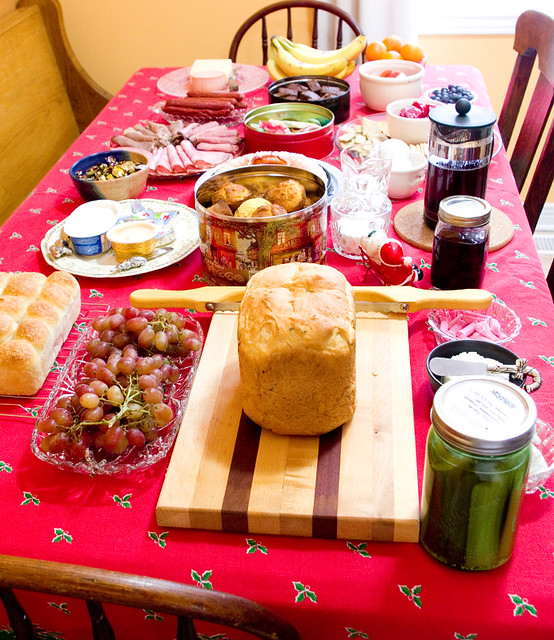
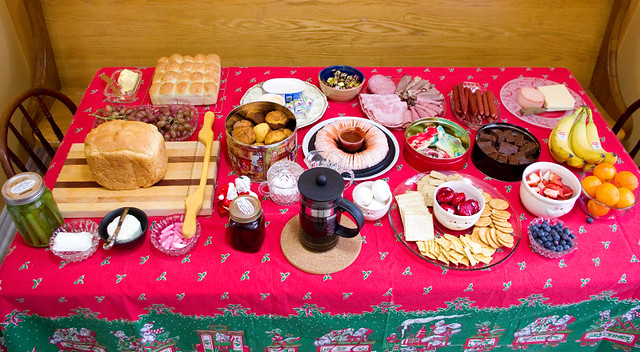
This year I served (working roughly from left to right):

Nan’s pan rolls* with butter
– red grapes
– rosemary bread from the bread machine**
– homemade dill pickles
– Chevrai Original Goat Cheese
– Garlic & Fine Herbs Boursin cheese
Chicken Bones
– Daiya Plain Cream Cheeze Style Spread
– Crème Oka cheese
– Laughing Cow cheese
– my husband’s homemade cornmeal muffins
– homemade pickled beets
– coffee & tea with sugar & milk
– chocolate toffees
– meat platter with Hungarian salami, Montreal smoked meat, roast beef, and Black Forest ham
– shrimp ring with cocktail sauce
– Christmas Cookie Monster’s Shape Cookies (made, for the most part, by Thing 1 and Thing 2)
– cold hard-boiled eggs
– Babybel miniature cheeses
– cracker plate with Stoned Wheat Thins, Ritz, Vegetable Thins, and Rosemary & Olive Oil Triscuits
– pepperettes (all-beef by my hubby’s preference and European style for mine)
– Oka and Havarti cheeses
Fudgy Pumpkin Brownies (this time with no coffee)
– bananas
– strawberries
– clementines
– blueberries

In case you’re worried, no, the seven of us did not eat this all in one sitting. This much could have easily fed twice that amount of people, with food to spare! The point of this kind of meal (which only happens once a year) is that everyone can have as much as they like, and then it all gets packed away to become lunches and dinners for the next week or so. There were still a few leftovers as of New Year’s Day, but that was of the kind of thing that takes forever to go bad, like crackers. Some of it will probably even make its way into the kids’ lunches in the new year.

*I discovered that these rolls can be left to do their second rise overnight in the refrigerator, and then just popped into the oven to serve fresh-baked for breakfast. If you’re going to do so, make sure that the pan you use is metal and not glass, as it takes the glass longer to heat up and can make the bottom of the rolls take a little too long to cook. Also, if the top is browning but the bottom isn’t quite done yet, cover the top of the rolls with aluminum foil to prevent them going from “browned” to “burnt”.

**Classic White Bread, found on page 24 of Betty Crocker’s Best Bread Machine Cookbook (1999) — but with half the sugar, olive oil instead of margarine, and about 1/4 cup fresh chopped rosemary added.

Pear & Honey Jam Recipe

As I wrote about before, I had a lot of cooking pears that needed to be used up recently. All of this excess meant that I had a chance to experiment with making a jam of my own devising. Pears are a naturally acidic fruit, which makes them perfect for hot-water-bath canning with a bit of sugar. It took me a couple of tries to get this recipe right, since since I didn’t want to use like ten cups of sugar (with would generally produce and easily firm set), since I wanted to taste the fruit and the spices more than the sweetness. In the end, I had something that I am quite proud of. Next year, when pears come into season, I think that I will make this the main pear jam (although I did really like the Spiced Pear Jam with Pineapple found on page 935 of the Joy of Cooking (2006 edition, Rombauer & Becker), or on the app). Maybe next year I’ll have a yield of more than four pears off of my baby pear tree, and I’ll be able to make more things from fruit I’ve grown myself!

Pear & Honey Jam
Yields six 250mL (1 cup) jars

Prepare and sterilize six 250mL (1 cup) jars (or twelve 125mL (1/2 cup) jars) and matching lids as per manufacturer instructions. Keep jars and lids warm until it is time to fill them.
In a Maslin pan or other non-reactive, heavy-bottomed pot, combine:
1.5 Kg (3.3 lbs) ripe/slightly overripe pears, peeled, cored, and roughly chopped
350 mL (1.5 cups) honey*
700 mL (3 cups) sugar
60 mL (1/4 cup) lemon juice
2.5mL (1/2 tsp) ground allspice
5 mL (1 tsp) ground cinnamon
2.5mL (1/2 tsp) ground cloves
2.5mL (1/2 tsp) ground nutmeg
2.5mL (1/2 tsp) ground ginger
Bring to a boil over medium-high heat, stirring constantly to prevent burning. Boil for 10 minutes. Remove from the heat. Run the mixture through a blender or food processor until it reaches a smooth consistency, being extremely careful as the ingredients will be very, very hot. Return the mixture to the pot and bring it back to a boil.
Add:
one 85 mL (2.9 oz) package of liquid pectin
Bring mixture back to a boil. Stir constantly as mixture boil hard for an additional minute.
Ladle the jam into the prepared jars, leaving a 5mm head space. Wipe jar rims with a clean, damp cloth or paper towel. Top jars with lids and screw metal rings into place until fingertip tight. Place jars on top of a canning rack inside a boiling water canner, being sure that none of them touch the sides of the pot or each other. Jars should be covered by at least 2.5cm (1″) of water, so add hot water if necessary. Bring to a rolling boil and process for 15 minutes, starting your timer once the water is boiling.
Remove jars from canner and place them on a cooling rack, not touching each other. Let them rest for 24 hours before touching. Label if desired. Jams may take up to 48 hours to set, so do not open them until this time has passed.
This jam may be kept in a cool, dark area for up to one year.

*It’s really not worth it to use unpasteurized honey here, since all the additional benefits are lost when the honey is cooked.

Low-Prep Suppers

I kind of have my kitchen back again… Okay, not the whole thing, but the counters and table are clear again, so I can cook properly. I made shepherd’s pie for dinner (but without the cheese topping, to reduce the amount of dairy and make it better for my gut). However, the meal was running late and we dug into it much too fast for me to take pictures. Instead, I have photos of the bread that was cooking while we were eating dinner:

That’s Beer Bacon Bread found on page 44 of Betty Crocker’s Best Bread Machine Cookbook (Betty Crocker, 1999). I used a flat Guinness beer, a package of crumbled circular bacon, and chives from my window garden instead of green onion because that’s what I had on hand. It’s only the second time that I tried out any recipes for this book, and so far so good! There’s a Cottage Dill Loaf on page 152 and Brandied Pumpkin Bread on page 104 that I can’t wait to try.

Earlier in the week I had to make a few easy and quick meals that required little in the way of prep space, so I whipped up a loaf of Sally Lunn bread (page 25, also from Betty Crocker’s Best Bread Machine Cookbook), which I think called for an unreasonable amount of butter in the dough (6 Tbsp!), but I have to admit tasted quite nice. I used it to make grilled cheese sandwiches for the girls, with sides of sliced apples.

Of course I have issues with dairy (and at any rate I’d run out of cheddar), so I fried up a couple of eggs each for my hubby and I, and served it with the Sally Lunn, sliced apples, and mandarin oranges.

Earlier this week I went with a less bread-based meal and baked up some trout with in teriyaki sauce, which I served over rice with a side of asparagus.

I’m really looking forward to having this mini-reno complete so that I can try some new recipes! This hasn’t been nearly as time-consuming an affair as a full gutting of the kitchen (much as I’d love to be able to afford a 100% fresh new kitchen), but it’s still rather disruptive. At least it’s cheap!

Canning Pears

A while back, a friend of mine brought me a box of cooking pears from his neighbour’s tree, which was producing an overabundance. Not too long after that, he brought me a second box full. I’m told that these boxes of fruit kept appearing in front of his house under not-so-mysterious circumstances; apparently that neighbour was getting really tired of being beaned in the head by falling fruit. This week I finally had the chance to tackle this mass of pears. I’ve been cooking with them for over a month, but my rate of attrition was much too slow, and some of the fruit was starting to turn.

First I made a double batch of Cinnamon-Scented Parsnip Pear Jam, from page 407 of Preserving: The Canning and Freezing Guide for All Seasons by Pat Crocker (2011). As interesting as this combination appeared at first glance, I found the final result much too sweet; it uses twice as much sugar as fruit by volume, which is a very high ratio even by jam standards. It would still be nice on Dad’s Biscuits, fresh bread, or toast, but I guess I was hoping for more of a flavour punch given my success with this book’s carrot jam. However, I do agree with the book’s assessment that this jam, when mixed with a bit of orange juice, would probably make a lovely glaze in which roasted root veggies could be tossed.
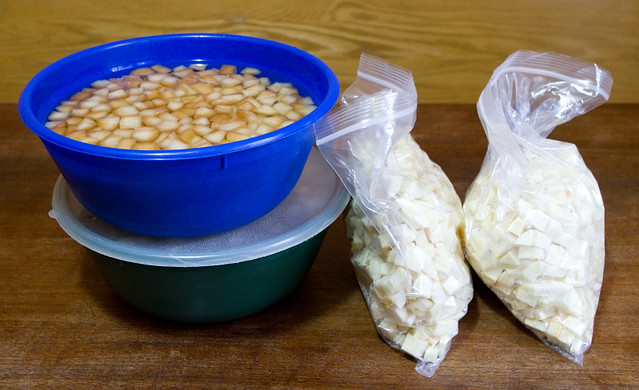
I well and truly overestimated how much fruit & veg to prepare to make this recipe, even doubled; I honestly thought I’d be able to get at least a quadruple batch in, but with all of that sugar, my pots just weren’t big enough. So I had a whole bunch of peeled, cut up pears (left) and parsnips (right) after this attempt.

The parsnips became part of our dinner last night, roasted in the oven with a sprinkle of salt, pepper, rosemary, and olive oil. I served them with baked pork chops coated in dried onion soup mix, which is a dish from my childhood that I’ve been making a lot lately once I was reminded of it. It’s just so easy! I probably have enough parsnips left for another three dinners like this one, but I think that would get old fast. I’ll need to research another recipe.

For my next recipe, I took a chance and tried peeling my ginger with a spoon, which is a kitchen hack I’ve seen floating around the Web for a while. I was quite satisfied with how this worked, actually. Not all cooking hacks are worth your time, but I found that this was honestly easier than a veggie peeler or a knife, and it wasted much less of the root.

The next step was to break out the candy/deep fry thermometer and bring the next jam up to the jelling point. (As an aside, am I the only one who feels like they need a shield as their jam/jelly gets thicker and it starts spitting huge globs of boiling-hot sugar and juice out of the pot?) This time I made Spiced Pear Jam with Pineapple found on page 935 of the Joy of Cooking (2006 edition, Rombauer & Becker), or on the app.
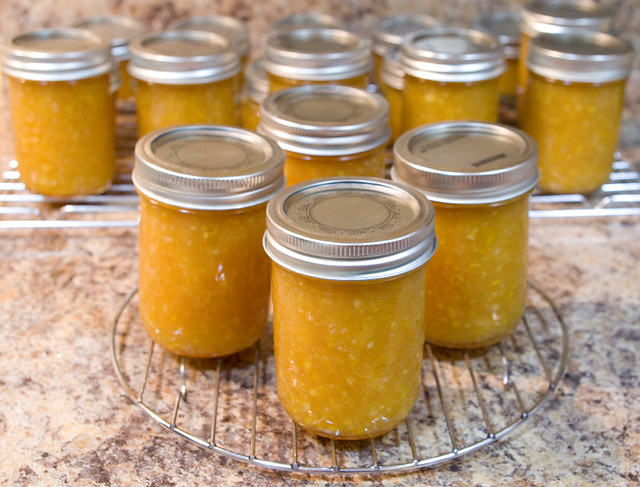
I was much happier with this jam than the previous one. I could definitely taste the fruit, and it wasn’t too sweet (it has a much lower sugar-to-fruit ratio). I have to admit that I couldn’t really taste the pineapple; the citrus note is definitely the strongest part of this jam, which isn’t necessarily a bad thing, although it does end up tasting more like a marmalade.

I probably still have enough chopped pears to make one more batch of jam. What kind should I make? I still haven’t decided. I have a lovely old recipe for pears poached in red wine and then canned, but that’s really intended for whole pears. These cooking pears needed to be chopped up to remove imperfections, so they’re sadly not really suitable to such a dish.

Circular Bacon?

I’m trying my darndest to get the costume photos from this weekend edited, but it’s taking much longer than I had hoped, although I do acknowledge that this is mostly because I’m really picky. It would have been much too easy to just crop the photos to size. So it may be another day or two before I have it all done.

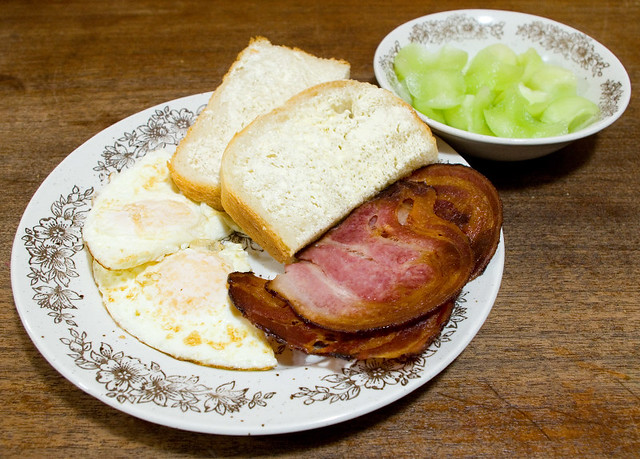
In the meantime, I did have to cook dinner last night, which had to be quick because I had to get the kids to extracurricular activities. Thing 2 requested bacon and eggs, which I thought was a perfectly acceptable solution. Earlier in the day I’d put some Milk Loaf (page 65, Bread Machine: How to Prepare and Bake the Perfect Loaf (Jennie Shapter (2002)) on to cook in my bread machine. I just microwaved some bacon (my preferred low-mess way to cook it), scooped out some honeydew melon, fried up some eggs, and buttered some fresh bread for a quick dinner.

You might note that the bacon in the above photo are shaped unusually. It’s not an illusion, the slices are actually more or less circular! They’re actually Presiden’t Choice Naturally Smoked Bacon Rounds, which are described as follows:

A real game changer when it comes to whipping up burgers, breakfast sandwiches and BLTs, bacon rounds make things so much easier. Cut from the pork belly, they’re everything you love about traditional bacon – only rolled prior to smoking and slicing. Not only are they the perfect fit for buns and English muffins, the edges curl up a little while cooking, creating a “cup” for toppings.

Well, my slices didn’t curl up on the edges, but maybe they do so when fried. I have to admit, I’ve never had any problem whatsoever fitting traditionally-sliced bacon into a sandwich or burger, so I think that these bacon rounds have been created to fix a problem that doesn’t really exist. I mean, if your bacon is too big for your bread, it can be broken if crispy or cut if soft. The rounds are more expensive than the same brand’s regularly-sliced bacon, too ($1.60/100g vs. $1.20/100g). I have a feeling that other shoppers agree, since I found my supply in the clearance section at the local grocery store and I haven’t seen them there since. I paid only $0.99 per package (so $0.26/100g if I did my math right), and at that price it was definitely worth it since the rounds taste exactly the same as regular bacon. Without another comparable sale, I can’t see myself buying these again though.